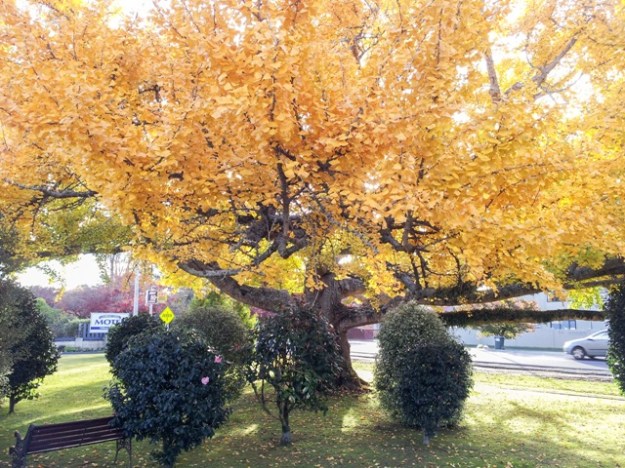
At the front of the Cambrian Lodge Motel in Cambridge on the main road to Hamilton, this ginkgo has been a remarkable sight for many years. Its wide spreading habit of growth belies the usual pyramidal form and may possibly be a result of having been topped and trimmed over several years earlier in its life.
Ginkgos are remarkable trees – botanically, in the landscape and in traditional medicine. They are spectacular at this time of year with their pure golden colour and must be one of the showiest stars of autumn. I am assuming the common name of “maidenhair tree” has come about because of the resemblance of leaf shape to the common maidenhair ferns. The leaves are flat, neat little fans
I say they are remarkable botanically because they are a living fossil and in a family of one. In the kingdom of plants, tracing down from the highest order – the division of Ginkophyta – all the separate classifications descend to one solitary species, Ginkgo biloba. Mind you, it is dioecious which means that specimens are gender specific and both male and female are needed to get viable seed. It is called a living fossil, because it has been around for a length of time variously estimated between 160 and 270 million years. That is such a huge time span that it is a bit irrelevant whether the lower or upper figure is more accurate. Suffice to say, the dinosaurs may have browsed on ginkgo trees and they have outlived all their botanical relatives, surviving not only the dinosaurs but also climate changes and all diseases. That is pretty remarkable.
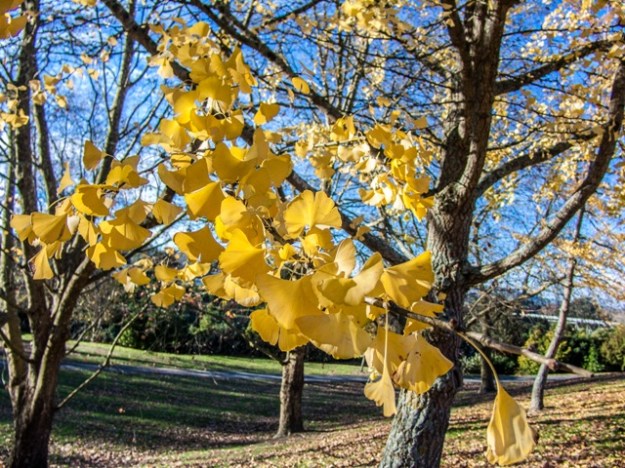
Ginkgo leaves have a distinctive fan shape. These are on a tree in the Gil Lumb Park in Leamington. The foliage has long been used in traditional Asian medicine, particularly for its alleged memory enhancing benefits.
If I hadn’t looked up the tree bible, The Hillier Manual of Trees and Shrubs, I would not have realised they are classified with conifers even though they produce seed, not cones. They are at the primitive end of the evolution of conifers.
Ginkgos originated in China and have long been regarded as sacred trees. This is just as well because they are pretty much extinct in the wild so if they hadn’t been cultivated for thousands of years in Asia and hundreds of years in Europe and North America, they may have been lost to the modern world. They are long-lived and can last well past 1000 years, though not so much in this country where any tree is lucky to last past a few decades at most. In other parts of the world, the populace are not quite so chainsaw-mad and even venerate old trees. The only tree accorded that status in NZ is Tane Mahuta.
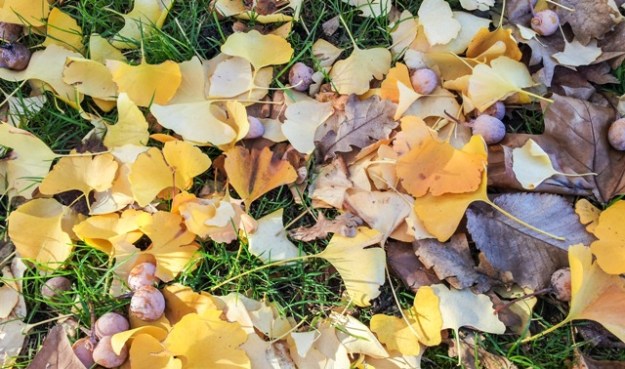
With so many ginkgos planted in the area, there are sufficient specimens of both male and female trees to get consistent crops of the nuts. While the outer casing emits a deeply unpleasant odour, the inner kernel is prized in traditional Chinese cuisine.
Despite the unmistakeable aroma of the fallen seed (variously described as ‘malodorous’ or smelling like vomit), once the soft casing has been removed, the seed inside is a traditional food in China and other parts of Asia. The smell is apparently in the fleshy casing, not the seed.
More interestingly, ginkgo leaves have long played a part in Chinese herbalism. The science on their effectiveness in slowing memory loss has yielded mixed results but research continues. At this stage, it is not looking as if ginkgo offers a magic bullet to reverse or even slow Alzheimers. Even now, most of our modern medications still orginate from plants. It is one reason why maintaining global bio-diversity is so important.
What started me on ginkgos was the sight of some leaves Mark had harvested and left on the back doorstep. I laughed because I knew instantly that he was curious about their memory enhancing reputation. But he forgot to bring them indoors and the wind blew them away.
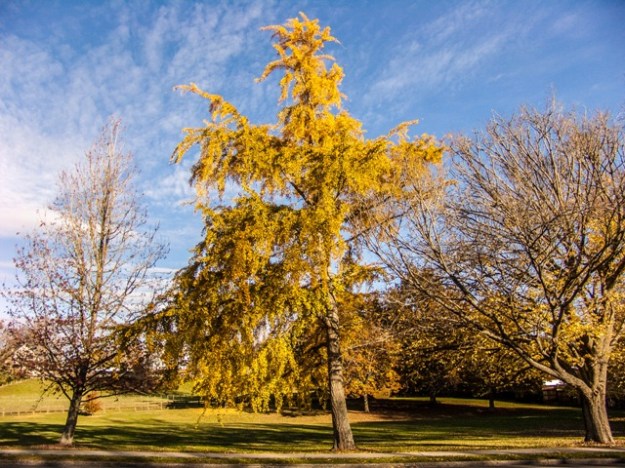
Trees take a while to mature and take on their final form but the usual conical shape can be seen developing in this tree which is in Lindsay Park in Leamington
First published in the Waikato Times and reprinted here with their permission.
All photographs courtesy of my friend Michael Jeans, Photographer, Cambridge.

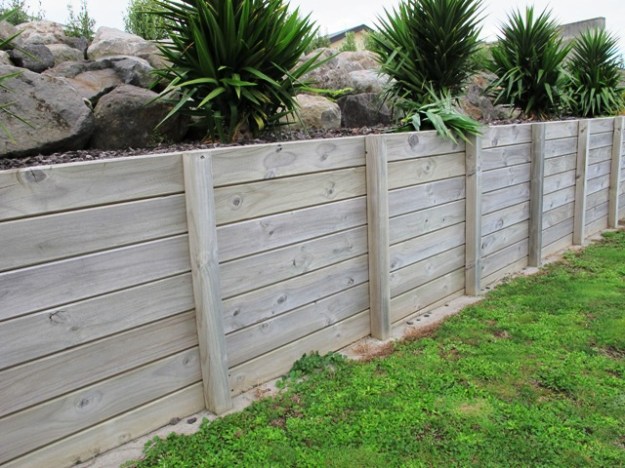 1) Timber remains the most common choice, probably based on price and the DIY ethos. It is holding back a considerable weight of soil that will be wet and exerting outward pressure, so strong construction is critical. Walk around established suburbs and you are sure to find older timber retaining walls bulging outwards. You need to get the supports right, both horizontally and vertically, to keep it all in place. Milled timber must be tanalised to ground retention grade or it will rot quickly.
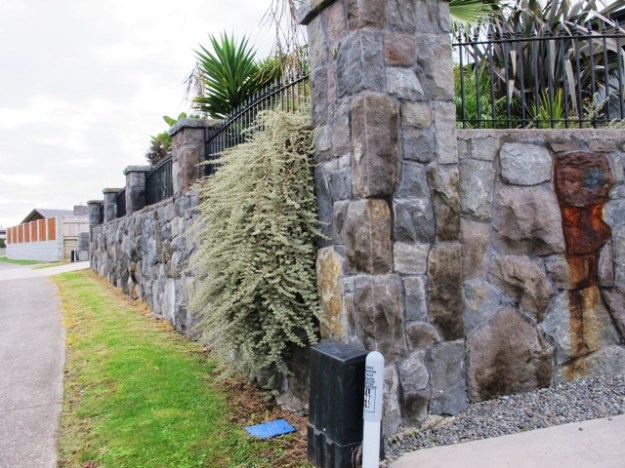 2) A cut stone wall is permanent, aesthetically pleasing and probably the most expensive option. The part-time stonemason here critiques my photos of modern stonework, pointing out that the stones should be keyed in to each other (as brickwork is). You should not be able to pick out vertical lines running down the wall because these are a point of weakness which indicate that it is the mortar holding the stones together. I mention this in case you decide to commission a stone wall of your own.
 3) Immediately next door to the attractive stone wall is the DIY option – although probably involving some lifting machinery to get the rocks in place. These have cement laid between them, which is unlikely to be structural but merely to keep out weed growth. Keen gardeners might prefer to plant between the rocks. Interestingly, some gradient has been left here rather than the vertical cut seen on the adjacent stone wall. Allowing a gradient reduces the outward pressure the retained ground will exert.
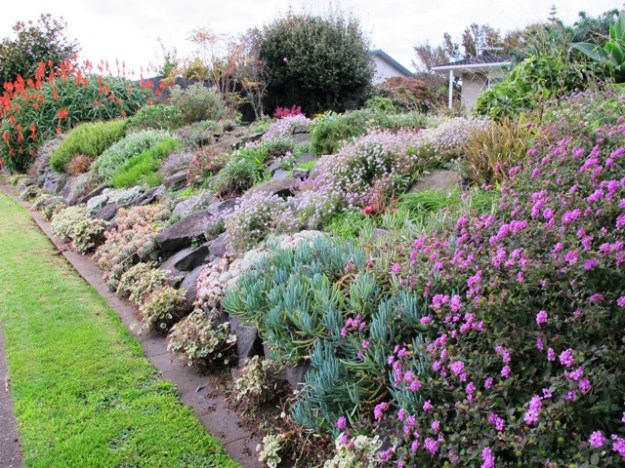 4) Further down the same street, I found the true DIY option. Smaller stones, able to be lifted by one or two people, have been placed and the area has been turned into a rockery on a sloped gradient again. Once established, plant roots will hold a certain amount of soil in place. The owner of this frontage is clearly a keen gardener.
 5) Ugly functionalism at its worst – and I can say that because this is on a property we bought. Concrete blocks have been used to retain the straight sections, poured concrete on the curves. It does the job. That is all there is to say. If I still lived in that house, I would be contemplating plastering and painting the retaining walls to try and make them a little less brutal.
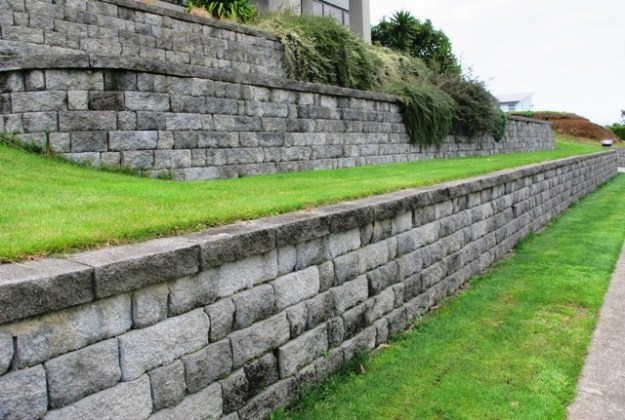 6) Faced with a similar situation to the preceding photo, this example shows what a little more thought, imagination and money can achieve. These are blocks – though whether a soft stone or aggregate, I am not sure – but a much superior look in aesthetic terms with the softer edges and random sizes. What also makes a big difference here is the flat capping on the top of the retained sections. It is a stylish finishing touch.
 7) The same bottom layer of retaining wall has been used throughout this modern subdivision. This house shows a mix of materials used in the quest for privacy, ground retention and street appeal. It was so well executed that I suspect a professional was employed to achieve this effect. The usual advice is not to mix materials but you can see the use of cobblestone bricks, timber, hedging and a relatively wide palette of plants. Prostrate plants are being used to retain the sloping bank.
 Tikorangi The Jury Garden