Maples. They are acers, botanically speaking and there are plenty of them. They are often seen in gardens too, though the majority are probably what is commonly referred to as the Japanese maple – A. palmatum usually dissectum. There are multitudes of selected forms of this around, many of them carrying Japanese names. One of the reasons I have not written much about Japanese maples is because we don’t have names on many of the ones in our garden here and I have not gone to the trouble of working out which varieties they are. This failure is irrelevant when it comes to their role in the garden but it matters rather more when I write about them.
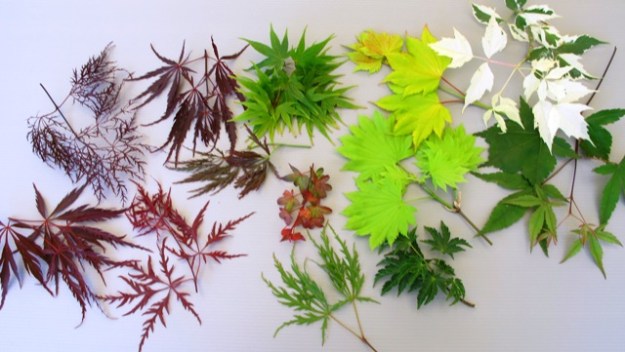
A random collection of maple leaves from around the garden
The world of maples goes well beyond those feathery Japanese ones. Maple syrup, dear readers does indeed come from maple trees, unless it is a synthetic version. Acer saccharum – the sugar maple – and that is the inspiration for the Canadian maple leaf emblem. It is also a major contributor to the autumn colours we associate with North America, along with Acer negundo. These are large landscape trees, not dainty little garden specimens though Acer negundo ‘Flamingo’, a pretty variegated form, is widely sold here and stays small enough to be a good option.
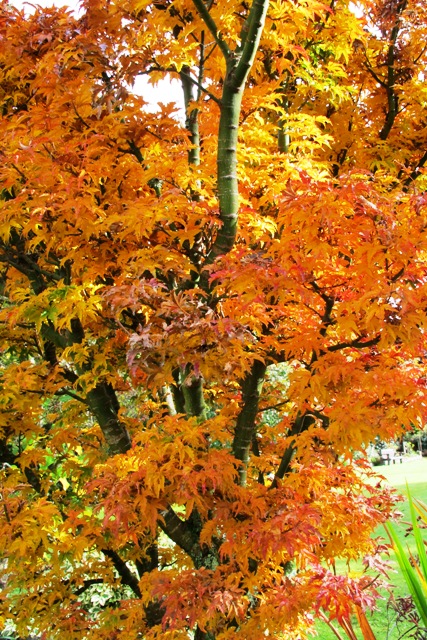
Autumn colour supreme
Maples are classified botanically and share certain characteristics including curious winged seeds which are designed to be dispersed by wind. In a gardening or landscape context, they have some common ground too. The foliage is soft so almost all of them are unsuitable for windy locations. They need adequate moisture levels in summer so are never going to like baking in hot, dry conditions. Many of them are happy in semi shade though some will lose their colour and become dull green in low light levels. Many colour up beautifully in autumn, even in milder climates.
Beyond that, rather than looking at pictures and deciding that you want a particular variety, this is one plant family where I suggest you go to your garden centre and read the plant labels. If you are really lucky, you may even strike someone there who knows about maples. You need to make decisions about whether you want a tree (and if so, what sized tree) or a little dwarf – often called patio maples. Also whether you want weeping or arching growth, or a more upright habit. Then there is the colour and whether you want one that keeps the same colour through spring and summer because some of them change colour as the leaves age.
I would counsel caution against buying too many red or burgundy foliaged maples. These are very dominant colours in the garden landscape and best used sparingly as feature plants. And if you feel compelled to plant a collection of maples, bear in mind that there may not be a huge difference in style between the dreaded conifer garden of the 1970s and the maple garden of more modern times. Enough said on that issue.
 Besides feature trees which add to the skyline, we find the smaller growing maples combine well in a variety of situations. I really like the little weeping one we have planted with roses growing through it. It is a very pretty combination, especially with perennials also in flower. Pretty too are the ones in a semi- shaded bed with clematis scrambling around them and seasonal bulbs at their base. We have more upright forms in the rockery where we can keep their bases clear and they give good year-round form.
 But one of the unsung delights of the smaller growing maples is that as they grow older, they can be gently encouraged into natural bonsai forms which give shape and interest in winter when they are fully naked. We do a bit of thinning and shaping but not much is required to make a feature of a maple with a good skeleton.
Plants which delight with distinctive, fresh spring foliage, last all summer, colour up in autumn and then have a really interesting shape in winter justify their garden position all year round. Add in their adaptability to a range of situations and their happy characteristic of combining with all sorts of other plants. It all comes down to making the right decisions on the variety and the garden position from the start. These are good staple plants to incorporate into any sheltered garden.
First published in the Waikato Times and reprinted here with their permission.
-39.042098
174.300314

 Summer pruning