
In my flu ridden state last week, I was so grateful to Lynda Hallinan. Her new book, Back to the Land – a Year of Country Gardening – made me laugh out loud on several occasions. She fair sparkles in this book.
Many readers will know Lynda Hallinan as former editor of the NZ Gardener magazine, now editor at large. In that role, she entirely repositioned the magazine to appeal to a younger demographic. She read the mood well and was at the vanguard of the renewed interest in growing food at home to the extent that I uncharitably took to referring to said mag as The Girls’ Vegetable Monthly. But readership figures showed that was where the interest lay and the very personal, anecdotal take on growing food was highly successful. Having met the author on a couple of occasions having had a few dealings with her, we have always known here that she is genuinely interested in a whole range of plants well beyond carrots. That is not always true of garden writers or editors, by any manner of means.
Her book is in diary form, covering from June 1, 2011 to mid May this year – a year in which she adjusted to life back in the country with baby and husband after years of inner city living as a single career woman. To coin a phrase of respect from my late father in law: “she’s a worker, I’ll give you that”. With a new baby, regular writing commissions plus some TV and radio work as well as personal appearances, she is out there gardening on a grand scale. There is a strong emphasis on edible crops but she is also developing a significant ornamental garden. She has a regular stall at Clevedon Farmers’ Market. And she cooks, preserves, pickles and makes various fresh beverages (many alcoholic). All this is managed with family support but without the whole machine of paid staff backing up behind which the likes of Hugh Fearnley-Whittingstall of River Cottage needs to keep his show on track.
As I was reading “Back to the Land”, I started making jokes to Mark about having found New Zealand’s potential answer to Martha Stewart. She is the doyenne of lifestyle, including gardening, in USA – aside from her unfortunate brush with insider trading which resulted in a short period behind bars. Her TV gardening programmes had Mark riveted for a brief time. He was in awe of her compost mountains. Martha, of course, is an expert on everything and does everything properly. “She had better hope,” I said, “that Our Lynda never takes up dog breeding or crafts”. That was before I came to the diary entry: “When I first became interested in gardening, the crafty cottage craze was in full swing. I embroidered pillows with pictures of herbs, made my own natural hand creams and grew swags of English lavender and statice to hang from the rafters to dry.” Right. I am now wondering if I should warn Lynda to stay away from the share market which was so nearly the undoing of her older American counterpart.
So what else did I like about this book? Of course the author can write. She has been a journalist and editor for years. But it was a pleasant surprise to find that, away from the limitations of magazine writing (word count, prescriptive structure and similar external requirements), she can write even better.
There is no commercial sponsorship or intrusive product placement. When the author recommends a product or a source, (which she does freely), the reader can reasonably assume that this is genuine and independent advice. A return to old fashioned credibility, one might say. All sources are acknowledged. In a book packed with practical information but in diary format, there are indexes at the back. Two indexes even – one for recipes and one for gardening. The recipes are wide-ranging and eclectic and it is the most seamless integration of recipes and gardening text that I have seen in any publication. The gardening practices are focussed on sustainability, not quick-fix modern consumerism. Don’t expect to find raised beds filled with endless heavy grade plastic bags of potting mix here.
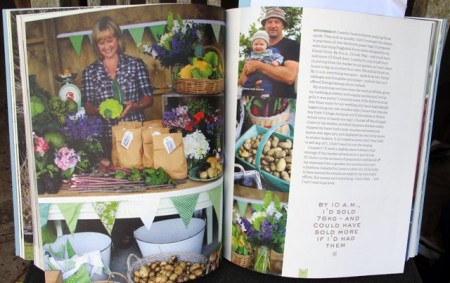
I haven’t even touched on the lovely photography by Sally Tagg. Some are illustrative, many are mood photos. Plant photos are captioned with names. The photos capture the spirit of what is a lifestyle book. The publisher is Penguin which means that the production values are high quality – at last they have the content to match (which can’t be said of all their recent gardening publications). The book evokes a slightly soft focus nostalgia although the content is a thoroughly modern take on old practices.
It is primarily aimed at women. My advice is that, if it appeals, go and buy a copy for yourself now (especially if you need cheering up) and then you will know if you want to buy copies as Christmas presents for others. The growing conditions described in the book are Hunua and will be very similar to much of Waikato.
Move over Martha Stewart. The new generation has come of age in the world of gardening and lifestyle.
Back to the Land. A Year of Country Gardening by Lynda Hallinan. Photography by Sally Tagg. (Penguin; ISBN: 978 0 143 56708 0)

First published in the Waikato Times and reprinted here with their permission.
-39.042098
174.300314




 Tikorangi The Jury Garden