Tag Archives: Abbie Jury

Repetition – unifying a garden or downright dull?

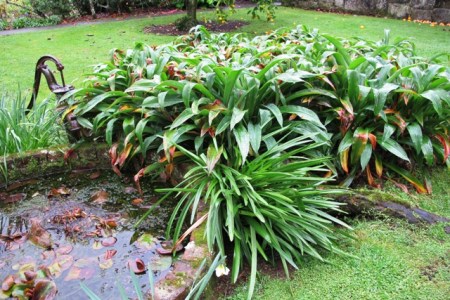
A surfeit of renga renga lilies repeated throughout your garden is highly unlikely to unify it

A surfeit of renga renga lilies repeated throughout your garden is highly unlikely to unify it

How often have you heard the advice to repeat the same plant in your garden to achieve continuity? It has almost achieved truism status though I would argue that this is one piece of so-called garden wisdom that too few people ever question. In fact I would go so far as to suggest that you are better to cast that piece of clichéd advice out to the wilderness and ignore it.

I don’t know where it originated, though I would hazard a guess it was from within the landscape sector. Now it is just repeated mindlessly as a golden rule.

The first time I was aware of a plant being repeated through a garden was with Dahlia Bonne Esperance. It is a baby dahlia with pink daisy flowers and increases readily (lights should be flashing here for you, dear Reader) and it featured throughout this person’s garden. Far from giving continuity, in fact it looked like a cheap, gaudy dot plant (as in dotted around everywhere). Therein lies the problem. When the advice is dispensed so glibly that you should repeat a plant to give continuity, there never seems to be any corresponding advice as to what types of plant are most effective. And in the absence of such advice, too many gardeners fall upon an option that is cheap to start with and easy to increase.
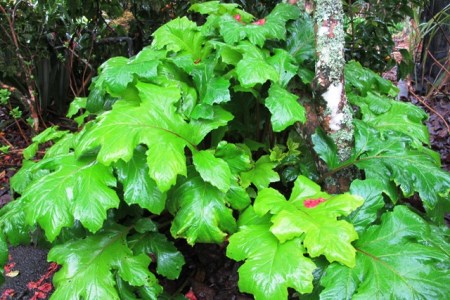
Acanthus mollis or bears' breeches - too close to weed status to be a desirable repeat planting

Acanthus mollis or bears’ breeches – too close to weed status to be a desirable repeat planting

I am sorry to say that many plantings of renga renga lilies are not going to enhance and unify your garden. The same goes for mondo grass, liriope, catmint (nepeta), the dreaded aluminium plant (lamium), common hostas which bulk up readily, Acanthus mollis, or Ligularia ‘Britt-Marie Crawford’. They are just going to look boring and repetitive when used again and again throughout.

Truly, you can have too much, even of a good thing. I have seen gardens which suffer from the ABC syndrome (another bloody clivia), or the oh no, TMBBH trait (too many big blue hostas). You need a deft hand and very good eye to make it work well.

There may be a difference between large and small gardens here. It is a long time since I have had a small garden but I can see that restricting the plant palette and using a repeating motif could help mitigate the bitsy effect so many gardens suffer from. But if you are determined to repeat a plant, try and make it a choice one. Trilliums are good. Paris, too. Though there is a possibility that the originator of the recommendation was thinking more in terms of pencil cypress or topiary yew – a woody plant rather than a perennial. I am fairly sure he or she was not thinking of Dahlia Bonne Esperance or renga rengas.

In a large garden, hmmm. As far as I am concerned, a large garden succeeds better when it has distinct changes of mood and style. To repeat a plant or plants throughout renders it too much the same and that is when large gardens become rambling, indistinct, and not very memorable. Unless you want to be remembered as, “Oh, that was the garden with all the orange clivias/acanthus mollis/buxus hedging/catmint/day lilies.” (Strike out those which do not apply.) We prefer to aim for different groups of plants in different areas, rather than mixing and matching throughout or streaming one particular plant through the lot.

That said, there are exceptions. We are steadily drifting English snowdrops throughout (on the grounds that you can’t have too many fleeting seasonal wonders and they are satisfyingly compatible with most situations – and transient, not year round). Mark has observed before that it is rhododendrons that form a backbone of continuity to our garden. But it is not just the one rhododendron that we have repeated. While we favour the nuttalliis (the rhodo equivalent of trilliums, one could say), we have multiple different varieties used in different combinations throughout. I don’t think that is what is meant by repeating a plant for continuity.

If I have failed to convince you that the interest in a garden lies in different plant combinations, interesting plants and variety, then I would at least make a plea for considering seedling variation. Mark and I looked at a planting in a garden – a hillside of red rhododendrons all the same. They will be showy in flower and look unified in conformity when not in bloom. They are also, to our eyes, dull, utility and public sector amenity planting (and it was a public garden too). What sets a private garden apart is the opportunity and scope to detail such a planting. Had it been done in seedling raised rhododendrons (collected from the same parent plant), there would have been the overall unity but subtle variation to add interest. The same goes for a range of plants – from pohutukawa to hostas. Raising them from seed takes time but gives interest and detail which is lacking when you order in a mass of one plant only.

But then we never have been fans of mass planting and massed display. The devil may be in the detail but so is the gardening interest.
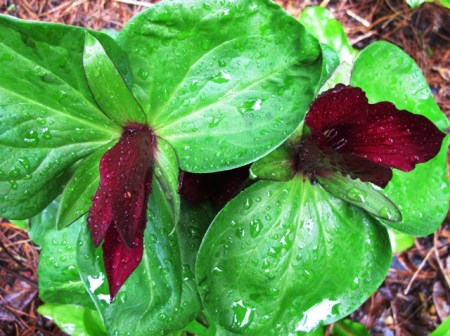
If you are determined to unify through repeat planting, at least pick something with bragging rights - desirable dark red trilliums, perhaps

If you are determined to unify through repeat planting, at least pick something with bragging rights – desirable dark red trilliums, perhaps

First published in the Waikato Times and reproduced here with their permission.
Tikorangi Notes: Friday 7 September, 2012

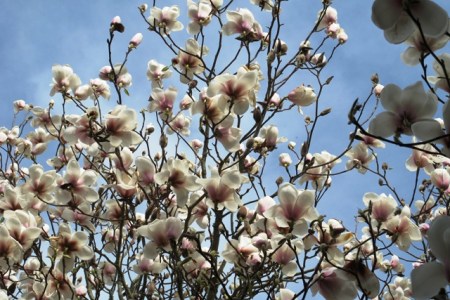
Just another unnamed seedling, as we say here

Just another unnamed seedling, as we say here

Latest posts:
1) Repeating plants throughout the garden – does this unify the garden? Maybe not….
2) Magnolia Burgundy Star – a useful fastigiate form and great red flowers.
3) Garden lore – a quote on colour from Edward Augustus Bowles, possibly even more relevant now than in 1914 when he wrote it. And this week’s handy hint on boiling water instead of weedkiller.

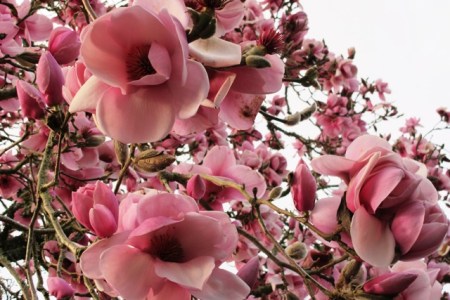
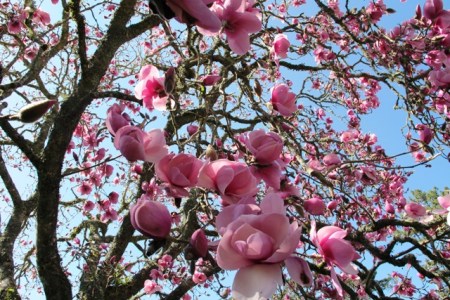
The mid season magnolias are simply magnificent. While there is an abundance of other seasonal colour in the garden – flowering cherries, spring bulbs left, right and centre, camellias, Kurume azaleas, hellebores, early rhododendrons, even humble little polys and prims – the magnolias hold centre stage. The early varieties have all been, done and gone now. The mids are at their peak, the late varieties are opening. If you have been planning a visit to see the magnolias, you might be wise not to leave it much longer past this weekend.

More Iolanthe

More Iolanthe

Tikorangi Diary Friday August 31, 2012

There is rather a lot of Iolanthe looking glorious

There is rather a lot of Iolanthe looking glorious

It is magnolia time here. All the mid season varieties are opening now, including the original Iolanthe beside our driveway. As this tree now measures over 15 metres across, there is a whole lot of Iolanthe on display. If you are planning a garden visit to see the magnolias, do not delay. Our garden is open every day. If we are not around, there is an honesty box.

LATEST POSTS
1) Plant Collector this week is Corylopsis pauciflora – a dainty primrose yellow witch hazel which is but a fleeting seasonal wonder here, though delightful while it lasts.
2) Move over Martha Stewart. The new generation has come of age in the world of gardening and lifestyle. Lynda Hallinan’s book on a year of country living is a cracker.
3) Garden lore this week – a quote from Anne Raven on the frustrating nature of a day’s gardening and some advice on using wood ash as fertiliser.
4) More feeding tui, this time in Prunus Te Mara. Another brief YouTube clip.

A NOTE TO SUBSCRIBERS
For historic reasons, I have two websites, closely linked. We are moving to integrate them into one site (www.jury.co.nz) which is where new posts now go. At this stage I am linking through from this site but in due course http://www.abbiejury.co.nz will disappear. What I can’t do is to transfer subscriptions over from one site to the other. If you wish to continue receiving new posts via email, you will need to subscribe at the jury site. Please do. Alternatively, if you are a Facebook user, if you go to www.facebook.com/thejurygarden and “like” the page (as Facebook lingo goes), you will get the links posted to your Facebook page on Fridays.

Plant Collector: Corylopsis pauciflora

Corylopsis pauciflora - short flowering season in our climate, but charming

Corylopsis pauciflora – short flowering season in our climate, but charming

This dainty delight is in full bloom now and a good reminder of why I like having a large garden. It is so pretty in flower for a maximum of two weeks in late winter or early spring. For the remaining fifty weeks of the year, it is an anonymous looking shrub. If you only have a small garden, you need plants that work a bit harder than that to justify their space. But for those two weeks when its light, arching branches are clothed in pale lemon witch hazel flowers (it is a member of the witch hazel family, Hamamelidaceae), it has an understated grace and charm. It is also pleasantly scented. When the flowering finishes, saw toothed leaves in dull greeny bronze will take over.

C. pauciflora is one of the more compact species, making maybe 1.5m high by 2m wide. These are hardy, deciduous shrubs from cooler parts of Asia and Japan and are best suited to open woodland areas (in other words, humus rich and semi shaded). We also have C. willmottiae ‘Spring Purple’ which has similar delicate primrose blossom but with purple new growth. It has yet to come into bloom here but it grows to twice the size so it needs a fair bit of space for its 14 days of glory. The flowering period appears to be extended in colder climates.

First published in the Waikato Times and reprinted here with their permission.

Lynda Hallinan’s year in her country garden

In my flu ridden state last week, I was so grateful to Lynda Hallinan. Her new book, Back to the Land – a Year of Country Gardening – made me laugh out loud on several occasions. She fair sparkles in this book.

Many readers will know Lynda Hallinan as former editor of the NZ Gardener magazine, now editor at large. In that role, she entirely repositioned the magazine to appeal to a younger demographic. She read the mood well and was at the vanguard of the renewed interest in growing food at home to the extent that I uncharitably took to referring to said mag as The Girls’ Vegetable Monthly. But readership figures showed that was where the interest lay and the very personal, anecdotal take on growing food was highly successful. Having met the author on a couple of occasions having had a few dealings with her, we have always known here that she is genuinely interested in a whole range of plants well beyond carrots. That is not always true of garden writers or editors, by any manner of means.

Her book is in diary form, covering from June 1, 2011 to mid May this year – a year in which she adjusted to life back in the country with baby and husband after years of inner city living as a single career woman. To coin a phrase of respect from my late father in law: “she’s a worker, I’ll give you that”. With a new baby, regular writing commissions plus some TV and radio work as well as personal appearances, she is out there gardening on a grand scale. There is a strong emphasis on edible crops but she is also developing a significant ornamental garden. She has a regular stall at Clevedon Farmers’ Market. And she cooks, preserves, pickles and makes various fresh beverages (many alcoholic). All this is managed with family support but without the whole machine of paid staff backing up behind which the likes of Hugh Fearnley-Whittingstall of River Cottage needs to keep his show on track.

As I was reading “Back to the Land”, I started making jokes to Mark about having found New Zealand’s potential answer to Martha Stewart. She is the doyenne of lifestyle, including gardening, in USA – aside from her unfortunate brush with insider trading which resulted in a short period behind bars. Her TV gardening programmes had Mark riveted for a brief time. He was in awe of her compost mountains. Martha, of course, is an expert on everything and does everything properly. “She had better hope,” I said, “that Our Lynda never takes up dog breeding or crafts”. That was before I came to the diary entry: “When I first became interested in gardening, the crafty cottage craze was in full swing. I embroidered pillows with pictures of herbs, made my own natural hand creams and grew swags of English lavender and statice to hang from the rafters to dry.” Right. I am now wondering if I should warn Lynda to stay away from the share market which was so nearly the undoing of her older American counterpart.

So what else did I like about this book? Of course the author can write. She has been a journalist and editor for years. But it was a pleasant surprise to find that, away from the limitations of magazine writing (word count, prescriptive structure and similar external requirements), she can write even better.

There is no commercial sponsorship or intrusive product placement. When the author recommends a product or a source, (which she does freely), the reader can reasonably assume that this is genuine and independent advice. A return to old fashioned credibility, one might say. All sources are acknowledged. In a book packed with practical information but in diary format, there are indexes at the back. Two indexes even – one for recipes and one for gardening. The recipes are wide-ranging and eclectic and it is the most seamless integration of recipes and gardening text that I have seen in any publication. The gardening practices are focussed on sustainability, not quick-fix modern consumerism. Don’t expect to find raised beds filled with endless heavy grade plastic bags of potting mix here.

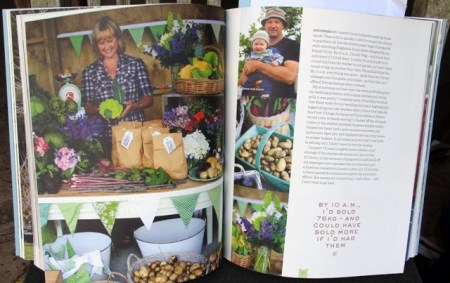
I haven’t even touched on the lovely photography by Sally Tagg. Some are illustrative, many are mood photos. Plant photos are captioned with names. The photos capture the spirit of what is a lifestyle book. The publisher is Penguin which means that the production values are high quality – at last they have the content to match (which can’t be said of all their recent gardening publications). The book evokes a slightly soft focus nostalgia although the content is a thoroughly modern take on old practices.

It is primarily aimed at women. My advice is that, if it appeals, go and buy a copy for yourself now (especially if you need cheering up) and then you will know if you want to buy copies as Christmas presents for others. The growing conditions described in the book are Hunua and will be very similar to much of Waikato.

Move over Martha Stewart. The new generation has come of age in the world of gardening and lifestyle.

Back to the Land. A Year of Country Gardening by Lynda Hallinan. Photography by Sally Tagg. (Penguin; ISBN: 978 0 143 56708 0)


First published in the Waikato Times and reprinted here with their permission.