

Our Rimu Avenue with its informal raised beds which are essentially a stumpery
Stumperies are a thing, overseas if not so much in New Zealand. After all, Prince Charles has one at Highgrove. So has Wisley, the Royal Horticulture Society’s flagship gardens. Indeed, many of the best gardens have a stumpery. The first deliberate construction of old tree roots and stumps is attributed to Biddulph Grange in Britain, where the keen owner wanted to display his fern collection but other shade gardens through history must have had incidental stumperies. They are hailed these days as ecological havens.
When you think about it, the stumpery is basically a naturalistic alternative to trendy insect hotels. But instead of being a confined hotel, it is more like an entire estate.
Our stumperies have rather more pragmatic origins than caring for the under-appreciated critters of the garden. In the area we call the rimu avenue, it has evolved over decades. The rimus are so grand and large now that they suck all the goodness and moisture from the ground around them. Our stump and log constructions are a means of getting informal raised beds so we can establish underplantings, including epiphytic plants like vireya rhododendron species and zygocactus, the so-called chain cactus. It adds a lot more interest and gardening potential to have these elevated areas and pockets for planting amongst the tree stumps and trunks.
When we have dug out the stumps of larger plants, these are re-sited to shade areas, sometimes placed upside down so the roots give more visual interest. There they can gently decay, but in the process they add some structure and height to otherwise flat areas dominated by very tall trees.
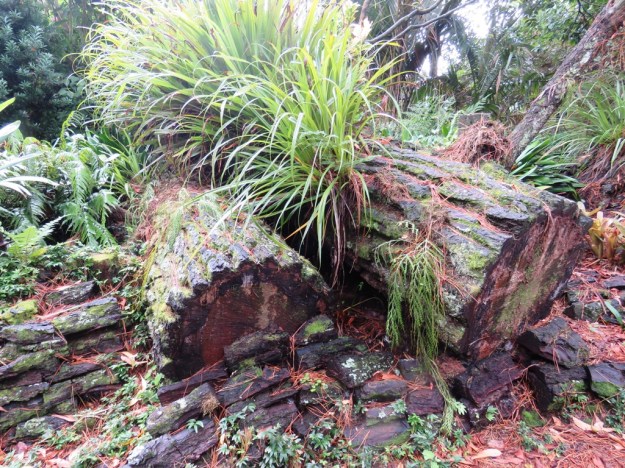
Allowing nature to create a stumpery – two pine logs left where they fell
The more substantial stumpery efforts come on the other side of the garden where we have venerable old pine trees. As with the rimus, they are up to 140 years old. Unlike the rimus, they lack a good grip below ground and from time to time, one falls. Four plus a gum tree of the same age have done so in recent years. They cause surprisingly little damage when they fall but were we to try and extract the enormous trunks, it would create a swathe of destruction. We do a cleanup of the foliage, the side branches and the prodigious quantities of pine cones but leave the main trunk where it fell and simply work around it, chainsawing back to clear paths where we need to.
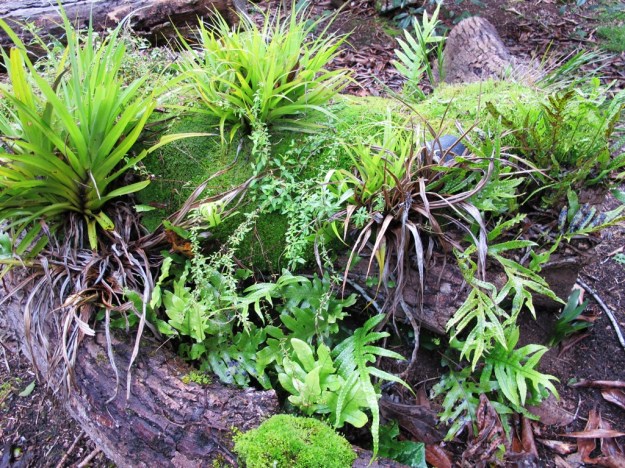
A naturally developing ecological haven on fallen poplar logs
When our instant stumpery installations arrive, they are invariably covered in epiphytes – native astelias and collospermums in particular. We thin these if required but basically leave it to nature to colonise these new areas, adding in special plants to add interest. The ferns just arrive. Dendrobium and cymbidium orchids add seasonal colour and settle in readily. Clivias are often happy at the base. Hostas tend to need more soil than is offered in these situations, but rogersias and farfugiums have settled in well. Hippeastrums and scadoxus are bulbs that we find are happy in this environment and common old impatiens seeds down and adds some summer blooms.
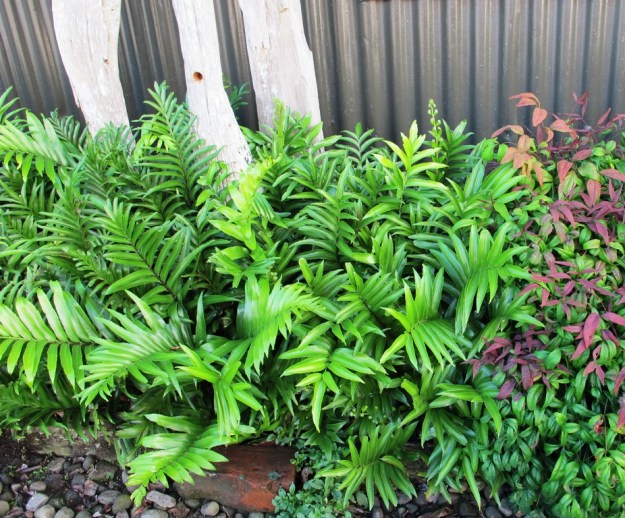
A small stumpery (or stumpette) in a narrow, shaded border in Pat and Brian Woods garden in Waitara
You don’t need a large area to establish a stumpery. Many suburban homes will have a dark and narrow back border (usually the home of the wheelie and recycling bins and the garden hose). As long as you have half or metre or more in width and are not scared of wetas, you can bring in a smaller stump or length of tree trunk and start establishing shade loving plants around it. A little shade garden will contribute far more to a healthy eco-system than gravelling or paving and can be genuinely low maintenance. Fewer weeds grow in shade and once plants are established, it becomes a self maintaining system with the falling leaf litter and gently decaying wood feeding the soil. I did pause to wonder if a very small stumpery became stumperesque in style, or maybe a stumpette?
Amusingly, according to the information board on Wisley’s stumpery, “Not everyone appreciates an artistic garden feature. When the Duke of Edinburgh first laid eyes on the Highgrove stumpery, he allegedly turned to Prince Charles and said, ‘When are you going to set fire to this lot?’”
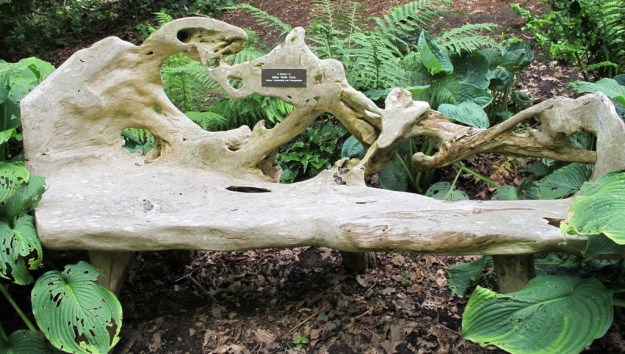
A natural-formed seat in the stumpery at Wisley, though it would look better without the dedication plaque
First published in the May issue of NZ Gardener and reprinted here with their permission.

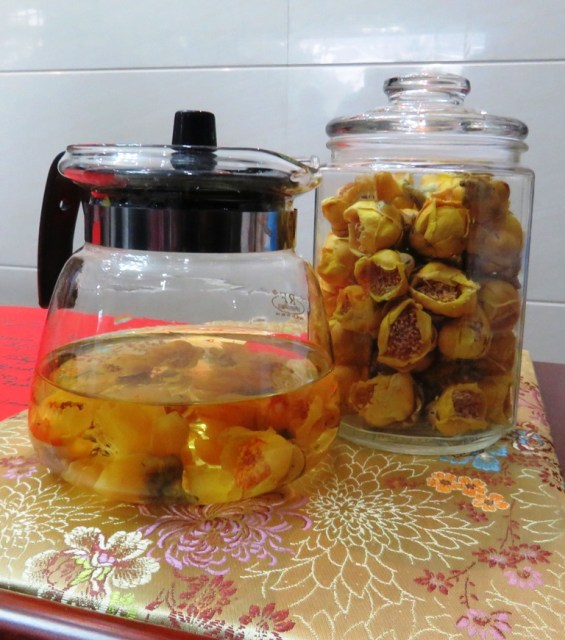
 Finally a few snippets: If there is one thing I absolutely loathe on purchased fruit, it is the sticky little labels which do not even break down in the compost. I often peel them off in the shop and leave them behind. These apples solved the problems of labels but we have no idea how imprinting the branding on the skins is achieved.
 I do not know if children’s Saturday sports matches continue to serve up segments of orange as half time refreshments (this may be a tradition that has died out at Saturday netball, rugby and hockey), but if they do, I feel that we could practice more class in the presentation….
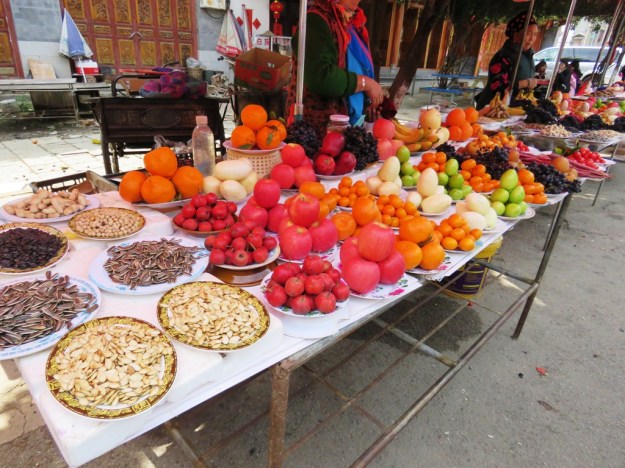 Similarly, the displays of fresh produce in New Zealand can leave a lot to be desired when compared to the care taken with the street stalls that lined a road near Dali.
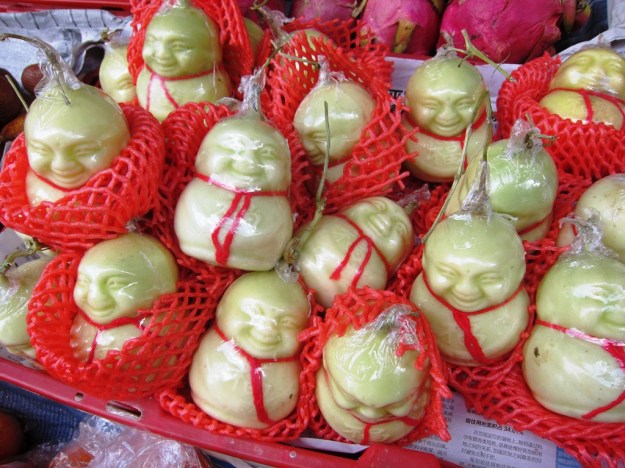 Buddha fruit! Not carved. Grown in plastic moulds, the ever-useful internet tells me. There is a labour intensive way of growing a novelty crop. These may be pears. If your curiosity is whetted, there are many
 Some things are not what they appear. This is not a dead leaf. It is in fact a butterfly – quite possibly Kallima inachus, also referred to as the orange oakleaf or dead leaf butterfly. We saw butterfly houses at both the Butterfly Spring in Dali and again in Xishuangbanna, though it was a cool spring so we didn’t see any in the wild.
 I had thought that the advertisement on NZ television that features what appear to be blue as blue monarch butterflies might have undergone some computer intervention to change the colour, but no – they do exist. Though my perfunctory net search does not suggest they belong to the monarch family.
 As we flew into Xishuangbanna (on Lucky Air – not entirely sure of that branding), I wondered about the huge plantations visible from the air. Something twiggy. Rubber trees! I had not realised they were deciduous. I have always associated commercial rubber production with Malaya but maybe modern Malaysia has found palm oil more lucrative, leaving a substantial gap in the market for entrepreneurial Chinese. In fact the most common tree used for rubber, Hevea brasiliensis, originates from South America around the Amazon.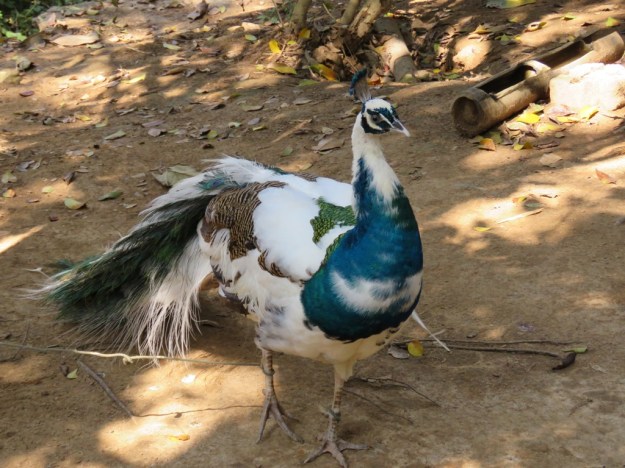
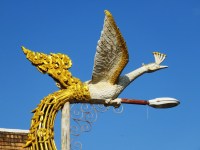 Jinghong is branded as the peacock city – even to light fittings in one area. In the tour of “primitive forest” (I was not entirely sure how primitive it was now that it has been adapted to accommodate tens, nay hundreds of thousands of visitors) there were tethered peacocks. What happens when you cross a pure white with a traditional blue? Why, this interesting combination.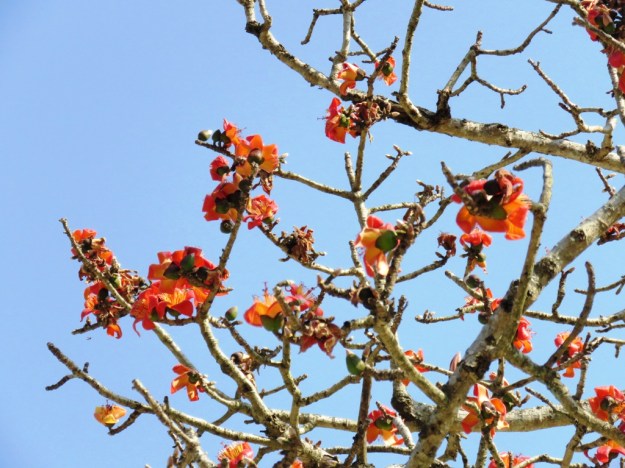
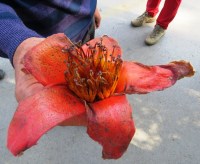 Kapok flowers. Some of us are old enough to remember the days of kapok mattresses and pillows but I doubt that many of us knew that they were stuffed with the fluff from the seed pods of the kapok tree, Ceiba pentandra. However that species has flowers that are considerably less spectacular than the ornamental kapoks. We had seen kapoks used as street plantings in Hue in Vietnam some years ago but they were not in flower.
 First published in the NZ Gardener April edition and reprinted here with their permission.
 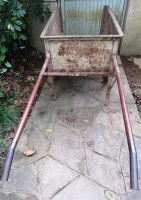 “The invention of the wheelbarrow is usually traced to China’s Chuko Liang, and adviser to the Shu-Han Dynasty from AD 197 to 234, who had it developed as a means of transport for military supplies. The first evidence of wheelbarrows being used in Europe is found in illustrations in the thirteenth century.”
 Remembering that odd piece of information from earlier use, I had to photograph a garden barrow when I came across it in Kunming Botanic Gardens in China last month. In fact these Chinese barrows are more like carts and they must be pulled, not pushed. If your definition of a wheelbarrow is that it be a single-wheeled cart, then these would not qualify, even though they are to be found in the original habitat.
 Double wheeled barrows are, however, clearly more stable than our garden barrows, capable of holding a greater volume and decidedly versatile. We came across this building site in a small village in the south of China where it is a receptacle for winching bricks up to the second storey. There did not appear to be a New Zealand Workplace Safety Officer on site.
 And then winched down again to be refilled.
 Tikorangi The Jury Garden