

A touch of whimsy to welcome at the entrance – yes or no?
We first visited Cloudehill Gardens about 20 years ago when it was still very much one man’s garden. Jeremy Francis took over the property in 1992 so it would still have been very new when we saw it. While there were plants and established trees from its earlier time as a nursery, there was no garden when he started. In the time since, it has matured to one of the flagship gardens of the Dandenong area, about an hour out of Melbourne. It is a large garden, created in the Arts and Crafts style with, the publicity tells me, twenty different garden rooms.
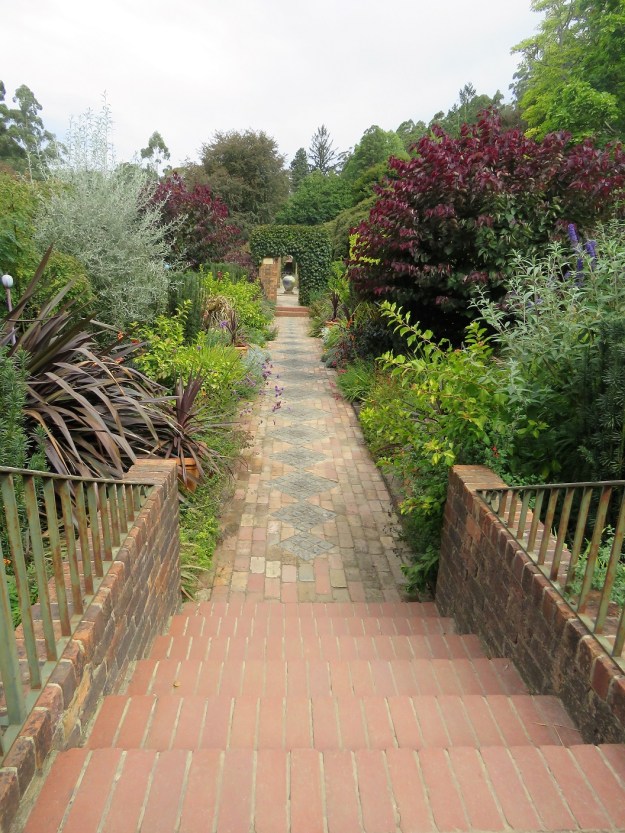
Very arts and craftsy in style
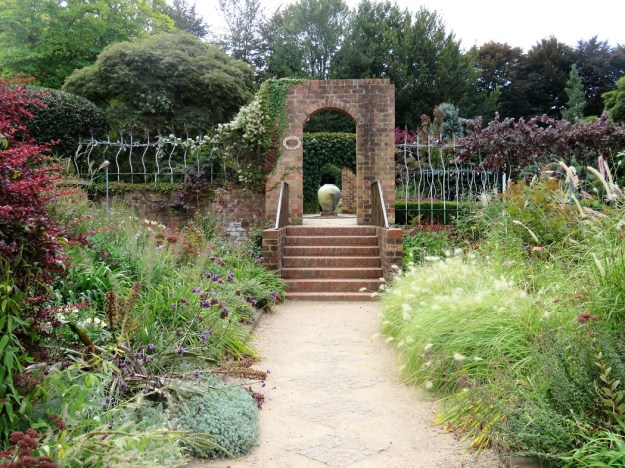
The design may be very Hidcote/Sissinghurst, but the perennial plantings reflect the fashions of the new millenium
While it appears that the originator, Jeremy Francis, is still on the scene, day to day management has transferred to The Diggers’ Club, which is a membership organisation unique to Australia. The upshot of this is that there is a now a retail outlet and a good café/restaurant (though the wasp infestation drove us indoors to eat), a focus on events and attractions and ‘adding interest’ to the garden. This means it has facilities and infrastructure but the trade-off is that the deeply personal touch of a single owner is no longer as evident. I found some of the novelty sculptures and touches were a little jarring in a garden where the underpinning hard landscaping is of exceptional quality. But a garden being run as a commercial entity has to strive to be all things to all people. It is now branded with the ubiquitous but rarely accurate strap-line of “a garden for all seasons’.

Not, I think, Cloudehill’s finest moment but it is hard for a garden to be all things to all people
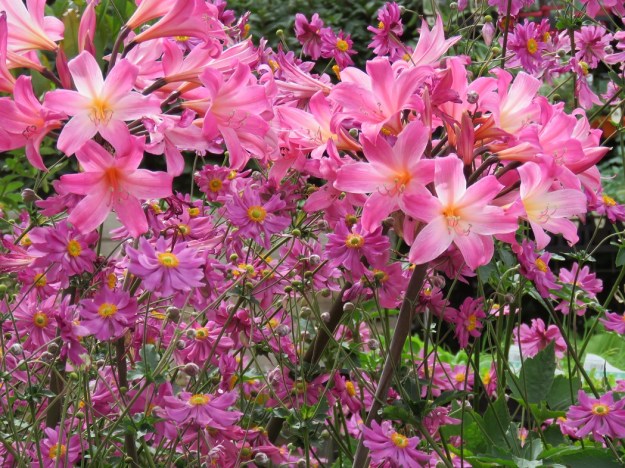
Colour-toned belladonnas and Japanese anemones for an early autumn welcome
I have never seen a garden that can peak for twelve months of the year and at the end of a long, hot, dry Australian summer, it was not at its peak but there was still plenty of interest along the way. When I review my photographs, I see that I kept focusing on the high quality of most of the garden structures. Attention to detail, again and again. I really appreciate that. There is a timelessness to good structure that carries a garden well through the years, even though the plantings may change with the times.
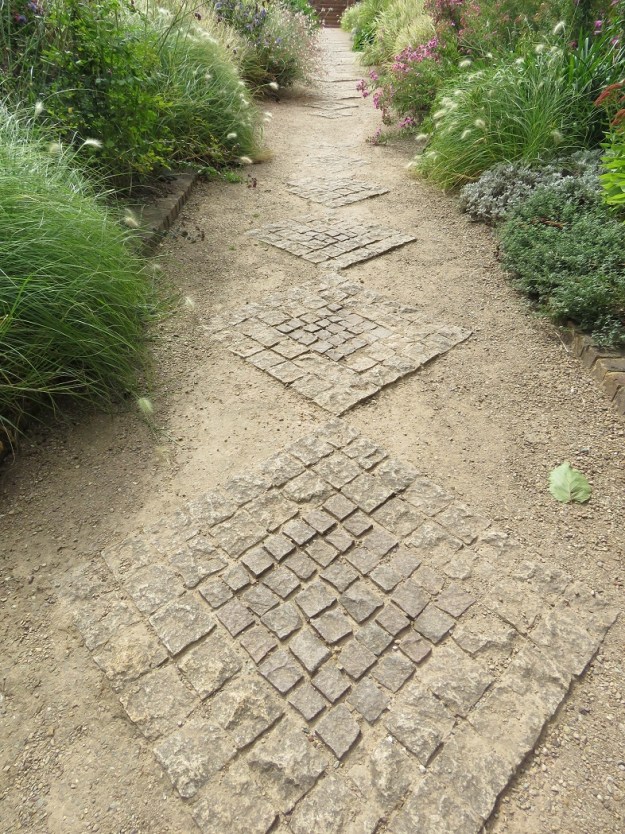
I liked the cobbles set in the path, as an example of understated detail, though I am guessing the fill has washed away, leaving them as something of a trip hazard. It was the only maintenance flaw that I recall in a garden where the overall management was of a very high calibre.

Attention to detail – look at the staging of this feature pot
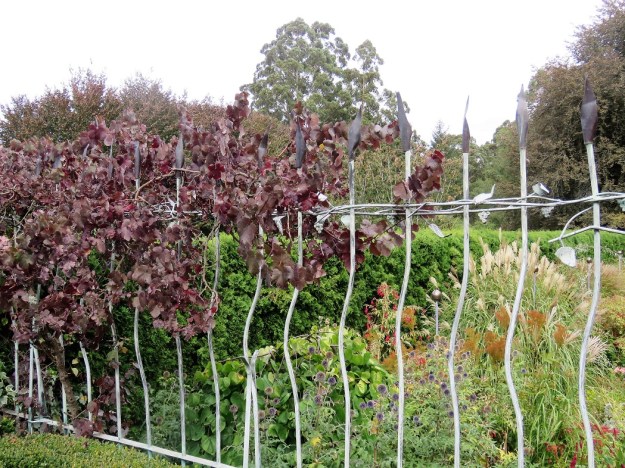
The hand-crafted wrought iron fence that separated gardens took my fancy as a personalised, modern take on an old craft. 
Detail again – look at the beautiful end to this balustrade. And unless I am mistaken, that is a Marlborough rock daisy from New Zealand, Pachystegia insignis, nestled into an Australian garden that is modelled on English design.
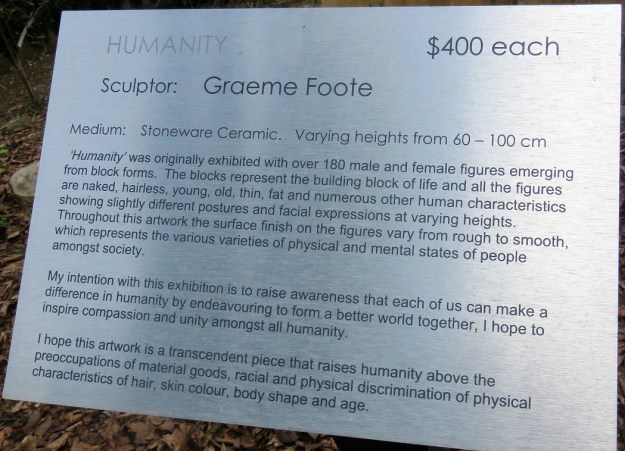
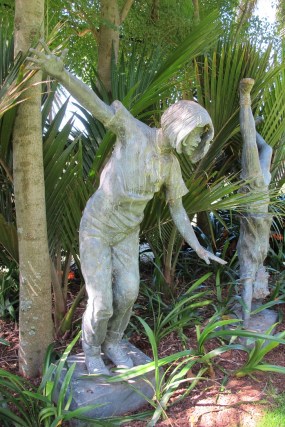
I blog. I do not instagram. This may be the reason why I forgot to photograph my lunch but as far as I recall, it was very pleasant. What I did photograph was an installation of figures created by sculptor, Graeme Foote. These I really did like, especially in their setting here. I could find a home for some of these figures. While the individual price seems very reasonable at a mere $400 each, the trouble is that we would need at least 10 to make a statement. Plus packing and freight across the Tasman. Sometimes we have to be content with memories and photographs.
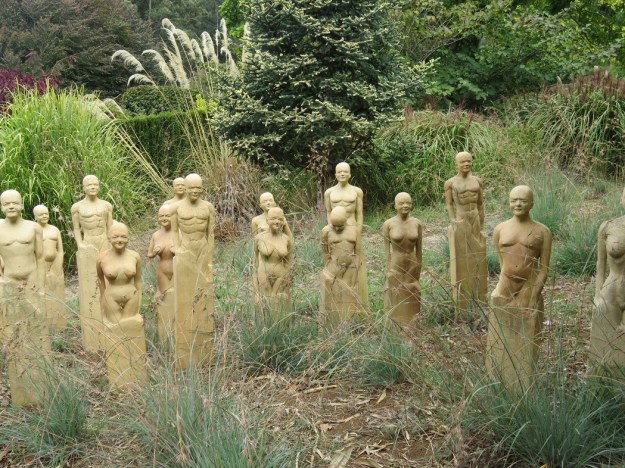
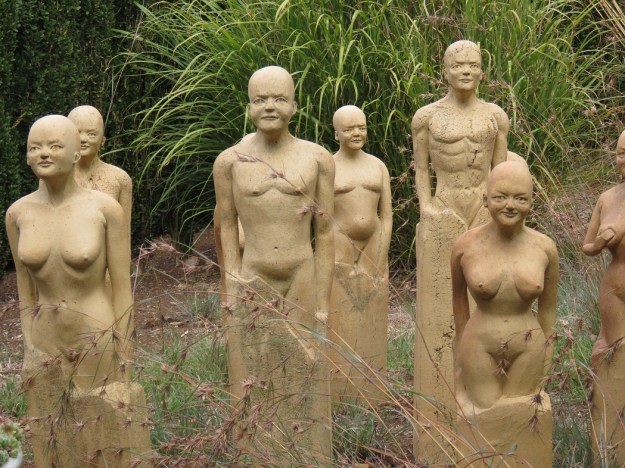
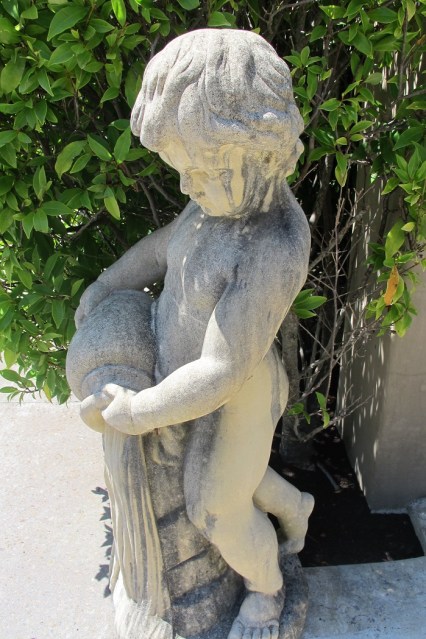
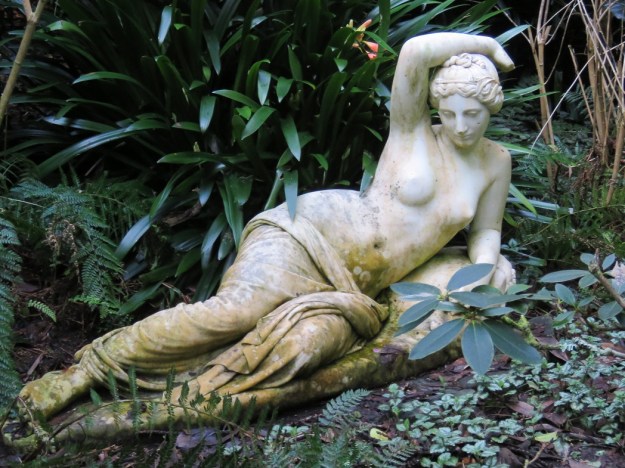

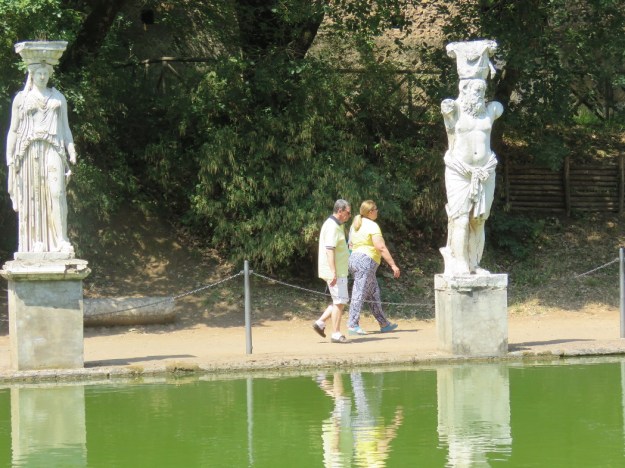
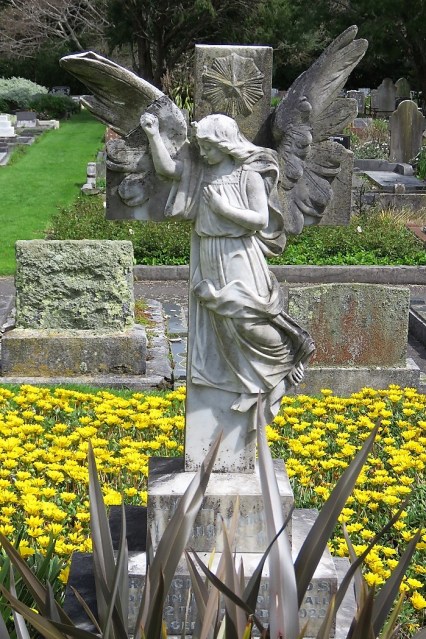
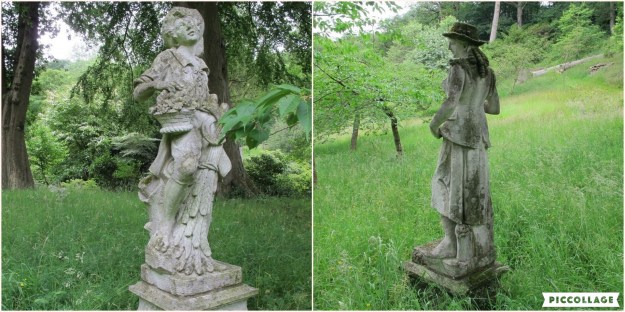 The pieces I have admired, I realise now, are more likely to date from the pre-Raphaelites. I would like to own the female figure from Gresgarth garden (above right). At least, I think I would. That garden is in the north of England and I remain uncertain how this style would transfer across the world.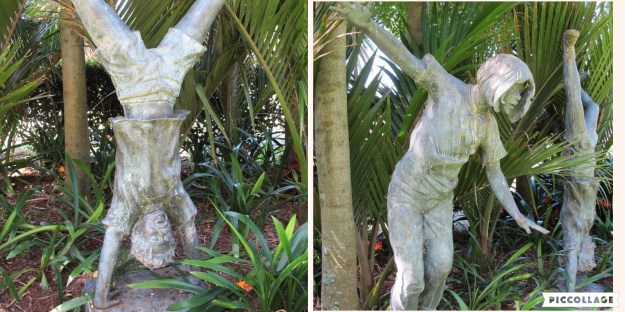


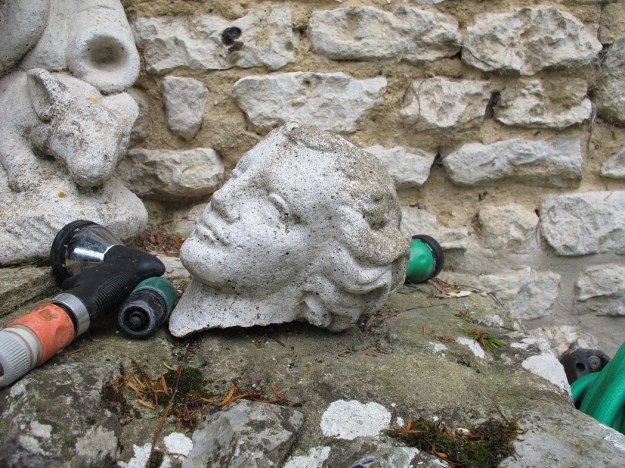
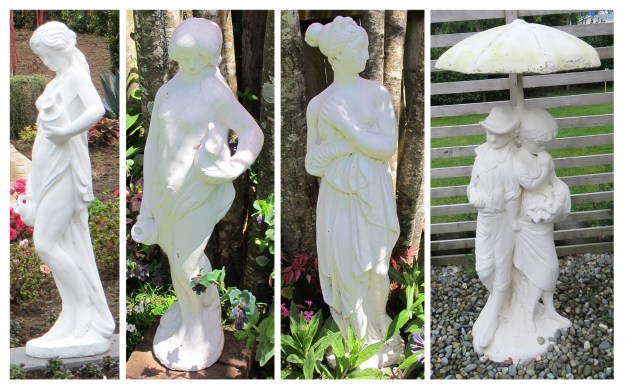 Much of the white domestic garden figurine decoration here probably has a closer debt to the pre Raphaelites and Victorian sentimentality, but personally, I remain unconvinced as to what it adds to home gardens. Especially as so many garden owners appear to feel the need to repaint their figures every year or two, to maintain that pristine whiteness. Each to their own, is all I can say.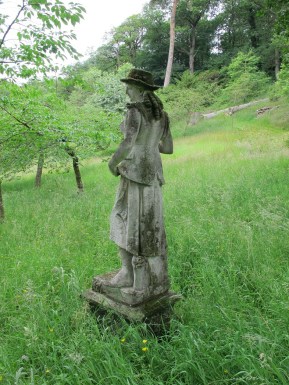

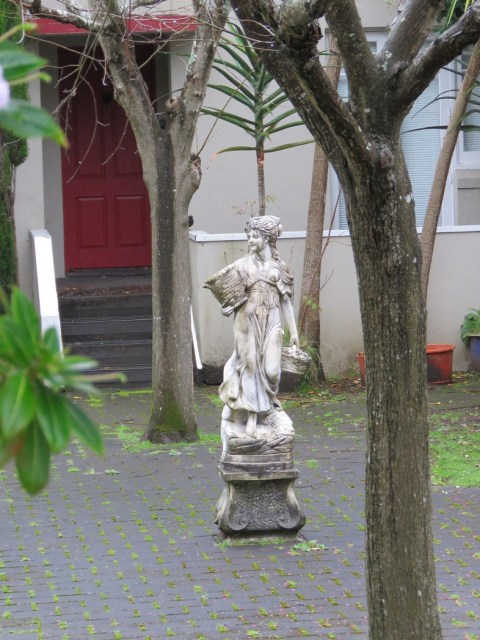 In a similar mould, I think I could even find the right spot for this unloved figure of the harvest maid that is marooned in the area serving some equally unloved apartments in Auckland. By the Countdown Supermarket on the corner of Dominion Road in Mt Eden, if my memory serves me right. But Mark may disagree. “Why,” he says, “must we import the art and history of other countries? Can we not evolve our own?”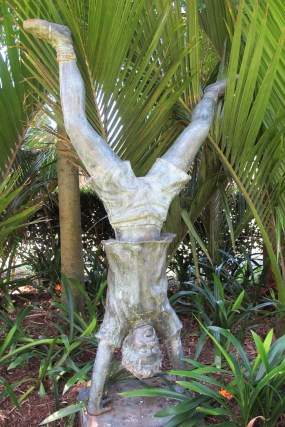
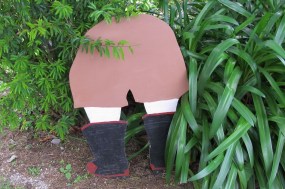
 Similarly, the Holyoakes in New Plymouth are strongly family oriented and told me that their large Lego man makes them smile and acts as a constant reminder of the delights of child rearing. While uncompromising as a piece of garden sculpture, they have placed it in a small courtyard visible only from their living room, surrounded by the grandeur of the very large bird of paradise plant – Strelitzia nicolai.
 By no means can all garden statuary be called sculpture. Some is more akin to craft than art although at its best, crafty efforts can cross over to folk art (more on this another time). Figures made from terracotta pots are found relatively frequently, usually created by the garden owner. This is affordable garden decoration, not sculpture or art.








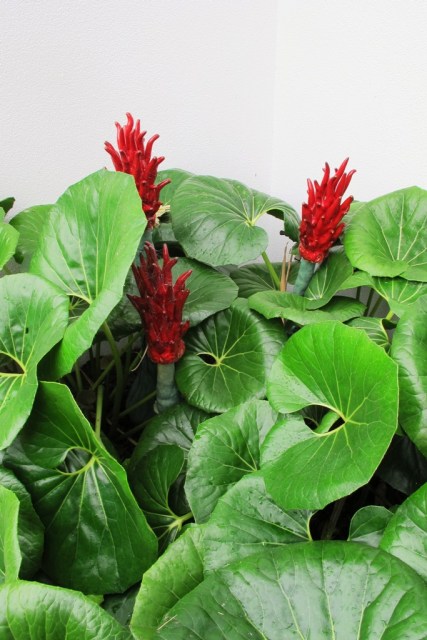 The ceramic detail amongst the simple planting of Ligularia reniformis, set against a stark white wall, added an understated detail that enhanced an otherwise predictable scene.
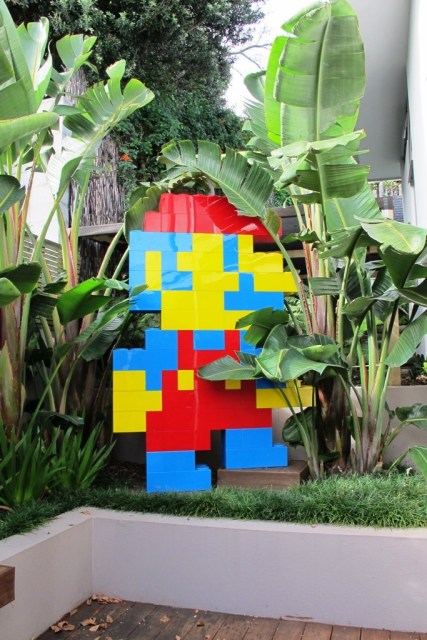 The large lego man was a pretty strong statement and not, I admit, one I could ever imagine in my own garden. But the owners love it. As parents of five children – all now adults – lego featured very large in their lives and this sculpture is placed in an intimate and enclosed section of garden which opens up from the family living area. Its placement was superb and it brought great delight to the owners.
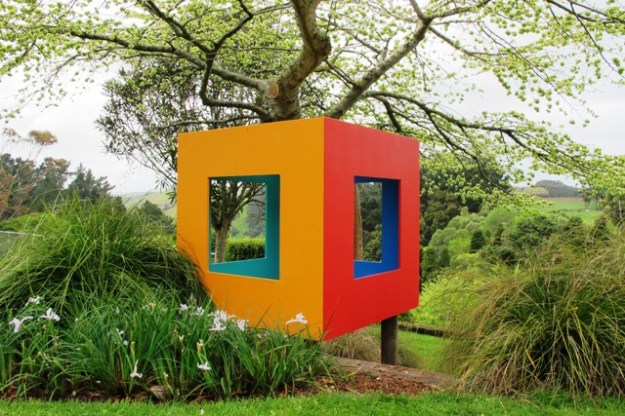 1) The box with its flat planes of colour is by Coromandel-resident artist Michael Smither and has found its permanent home at Puketarata Garden near Hawera. It has echoes of a child’s play house but the simplicity is deceptive. So too is the placement. It becomes the absolute centre of attention in the middle ground but is also successful in drawing the eye to the large landscape beyond.
 2) In a similar vein, the whimsical pavilion created by garden owner, Clive Higgie at Paloma Garden near Whanganui makes an undeniable statement as a focal point in an otherwise natural environment. The reflection is an integral part of the picture. As with the Smither box, it is the combination of a vibrant creation with thoughtful placement which makes this a successful installation. What appears to be a blue ceramic ball topping the roof is arguably the best use I have seen of one of these mass produced decorative items.
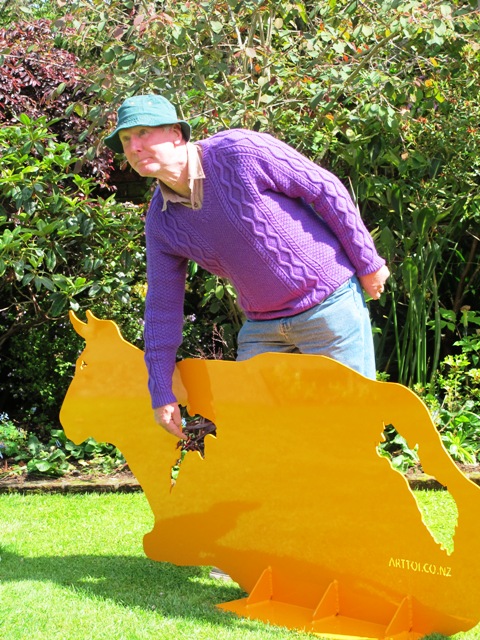 3) The freestanding, two dimensional yellow cow was on temporary display in our garden, the work of Joep from Arttoi (www.arttoi.co.nz) so we won’t mention the placement. The gentleman in the very purple jersey posed so willingly, adding a certain ambience, I felt. The cow may or may not be to your personal taste (I would have preferred it without the map of New Zealand). The purple jersey, the man’s wife told me, had been found in a skip and became an instant favourite for the wearer. Each to their own.
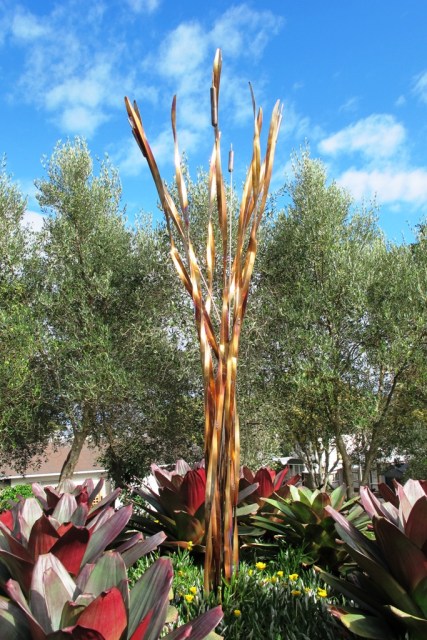
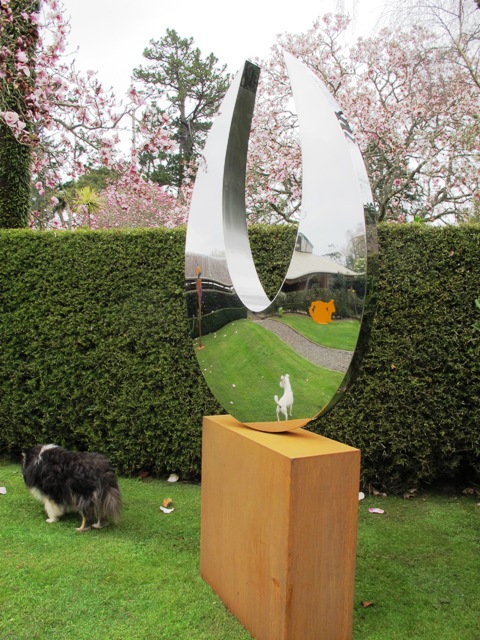 4) At the same temporary installation of Joep’s work, the stainless steel sculptures were beautifully executed and caught my fancy. The reflective qualities of the highly polished stainless steel were a great deal more subtle than a garden mirror. While there is a tendency to put this type of work in a hard-edged, minimalist, modern garden, I admit I was surprised by how well they fitted in to our own setting which is anything but that. We placed them in positions with relatively plain backgrounds where they could star and the reflections made it a two way interaction with their surroundings.
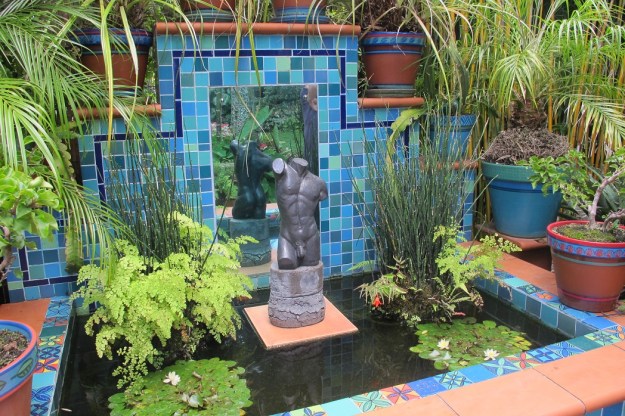
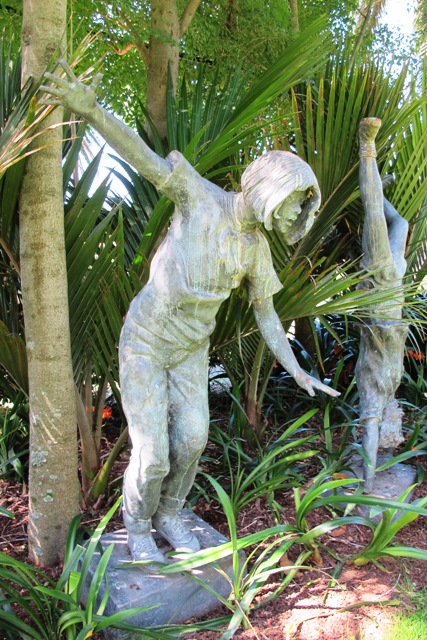 5) While not keen on reproduction classical statuary in a New Zealand garden context, these modern interpretations made me smile. In a very family-oriented garden, they fitted thematically. The frozen moment in time captured with the balance of their poses gave the contrast of tension with the subtle placement against the nikau palms. I could see these ageing gracefully down the decades.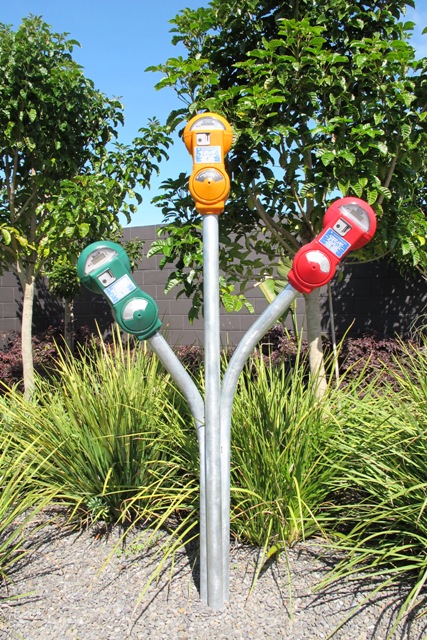
 6) When out and about garden visiting in spring and I could not help but notice a plethora of parking meters as garden ornaments. I am sure this was a result of the market being flooded with old meters in this particular area, which had moved to an electronic sensor parking system. The customised triple meter installation was perhaps more witty and striking than those single ones which had simply been placed as a relic of the past decade.
  Tikorangi The Jury Garden