Tag Archives: gardening

From big picture gardening to small picture detail

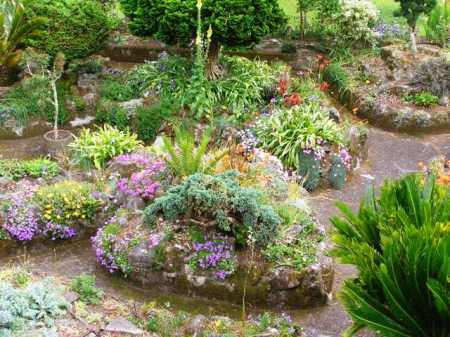
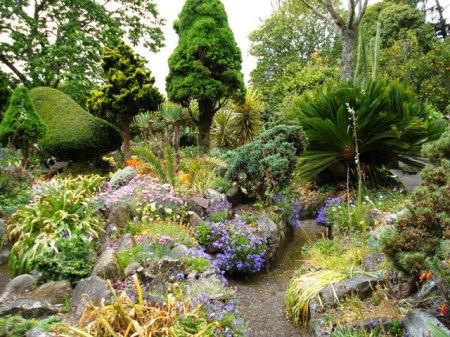
Ours is not a rockery for growing alpines

Ours is not a rockery for growing alpines

My mission to weed our stream and ponds, about which I wrote last week, has been subsumed. That is to say it has largely been taken over by the menfolk in my life and turned into something much larger but I am not complaining. I was trying to clear the water weed. They are now building an additional weir, flushing the stream and hiring a sludge pump to clear the ponds. I know my limits. I have moved up from the park and into the rockery.

Moving from the open areas to the intimacy of the rockery is going from one extreme to another. The former is big picture gardening and much concerned with giving large trees space to grow and anchoring the whole picture well into the surrounding environs. This used to be called borrowed views and vistas before those terms became so pretentious they fell into naffdom. The rockery is all about little pictures, highly detailed gardening. I wouldn’t be without either, but I really enjoy the attention the rockery requires.

Traditionally, rockeries were about creating an environment that resembled scree slopes of mountains in order to grow alpines. We cannot grow alpines. We’ve tried but it doesn’t work. Our high humidity, high rainfall and mild year-round temperatures conspire against alpines. For us the rockery has become the place to keep track of treasures and to confine dangerous but attractive bulbs. Most gardeners know how easy it is to lose bulbs in garden borders. Some get swamped out by neighbouring plants, some are so anonymous when dormant that they get pulled out with other plants, some just seem to go, we know not where. If they have their own pocket in the rockery, it is possible to label their location and restrict competition.

Rockery conditions are surprisingly harsh. All that stone and other hard material heats up in summer so the soil dries out quickly. The gentle, steady rain we had last week didn’t penetrate very far. This means you have to be pretty selective about small shrubs, perennials and other plants but the bulbs don’t usually mind. In the wild, most are used to marginal conditions.
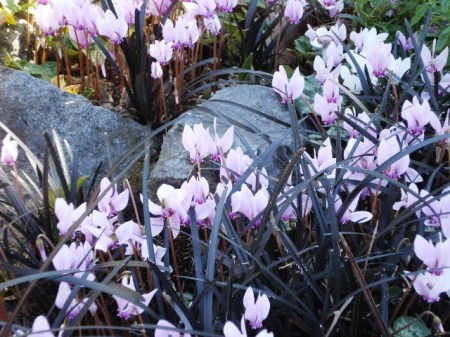
Too much of a good thing - Cyclamen hederafolium with black mondo grass

Too much of a good thing - Cyclamen hederafolium with black mondo grass

Two summers ago, I took the rockery apart pocket by pocket. At the time, I estimated there were about 500 separate compartments and it took me a full month’s work. At least I got to know it and all its inhabitants. This time I am only concentrating on the messy bits and the areas where plants responded a little too enthusiastically to the earlier renovation. The combination of black mondo grass and pink Cyclamen hederafolium is very pretty, especially as snowdrops come through the marbled foliage of the cyclamen in the depths of winter. But you can have too much of a good thing and all three inhabitants were trying to outcompete each other. I am thinning them drastically.

To garden in this style, you have to be willing to tolerate the messy season bulbs have, when their foliage is looking past its best. Most bulbs use the time after flowering to build strength below ground so they can flower again next year. When they have done that, their foliage dies down naturally. With some, this is a quick turnaround. Others, like nerines and colchicums, take many months. We just try and ensure that other areas of the rockery have more attractive displays to distract the viewer and leave the plants to their natural cycle.

I used to think that every pocket of the rockery should have something of interest in it all the time. This is actually a lot harder than it sounds because you then need to use a succession of maybe four different plants which can co-exist quite happily – and each compartment should have different combinations. In other words, for me this would be getting on for 500 miniature gardens. Rockeries are no place for mass planting. I flagged that idea – too hard and not necessary. Some compartments will have periods of the year when they appear empty and that is fine as long as there are no weeds. There is no place for any weeds at all in this intensive style of gardening.

Ours is an aged example – sixty years to be precise. We have some fine, gnarly, old, characterful dwarf conifers to give year round structure along with some smaller growing cycads (though somebody forgot to tell the handsome Cycas revoluta to stop growing). We have a few easy care, small perennials to soften the edges. A compact little blue campanula is one of the best of these along with a well behaved little scutellaria. We like the tall punctuation marks of some plants drifted through the rockery. The upright orange-toned orchid, Satyrium coriifolium, is the choicest one. The large flowered yellow Verbascum creticum seeds down gently to give the statement in late spring and the amaranthus (Love Lies Bleeding), similarly self seeded, is growing before our very eyes to fill the vertical accent role in autumn. These plants just provide a framework for the real stars – a succession of any and all interesting bulbs we can grow.

It means there is always something of interest to look at. I enjoy that sort of detailed gardening.

First published in the Waikato Times and reproduced here with their permission.
Grow it yourself: spinach

Silver beet and spinach are close relatives. Indeed, somebody very close to me claims they taste the same when cooked, which I can’t argue against because it is so long since I have eaten the former. Texturally, I much prefer the finer, softer leaves of spinach and will happily eat those. Spinach is a winter vegetable. It will continue growing in colder temperatures but as soon as the weather warms in spring, it will bolt to seed. It is not quite as amenable as silver beet to grow and while you can leave plants in the ground and just pick as much as you need, it does not have the same cut and come again characteristics.

Well cultivated, well drained soil rich in nitrogenous fertiliser and full sun are the keys. Spinach is usually direct sown from seed and most of us now know to pick the thinnings and eat them as micro greens in salads or stir fries. The final spacing is in the 10cm range. In the right conditions, it is a quick crop because it will mature within a couple of months and you may have been eating immature leaves all that time. Some gardeners like to sow successive crops every few weeks to ensure continued supply.

There are a number of different spinach varieties, including New Zealand spinach or kokihi which is a different plant altogether (though similar taste and texture) and is our one great contribution to the global world of vegetables. While most spinach are spinacia, it is Tetragonia expansa. We recommend shunning the heirloom strawberry spinach (Chenopodium foliosum), being of the opinion that the reason it has been around for over 400 years is because it seeds so freely it is nigh on impossible to eradicate once you have it. The leaves are pleasant enough but the so-called strawberry seed heads are not.

First published in the Waikato Times and reproduced here with their permission.
In the garden this fortnight: Thursday February 9, 2012

A fortnightly series first published in the Weekend Gardener and reproduced here with their permission.
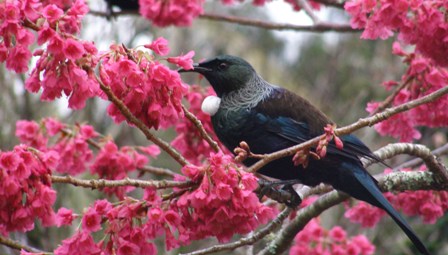
The only justification for growing seeding campanulata cherries - feeding the scores of tui in late winter

The only justification for growing seeding campanulata cherries - feeding the scores of tui in late winter


A rash of germinating campanulata cherries

A rash of germinating campanulata cherries

We are very cautious about invasive plants here. I know there is an old cliché that says a weed is just a plant in the wrong place but in a large garden, we can’t afford to have out of control triffids. If a plant starts to look dangerous, it probably is. If it is a prolific seeder and the seed is dispersed by birds, it is even more problematic. The campanulata cherries fall into this category and if it weren’t for the scores of tui they attract to the garden each spring, we would do away with them. The seeding bangalow palm (Archontophoenix cunninghamiana) is also a source of angst. The same goes for the Himalayan Daphne bholua which doesn’t just seed. It also suckers below ground. If we lived near a national park or adjacent to a native reserve, we would feel morally obliged to review our hospitality to these ornamental plants.

We are nowhere near as tolerant of wayward perennials and annuals. Forget-me-not may be pretty but it is aptly named. We have been weeding it out for years here and still it stages a comeback. The orangeberry (Rubus pentalobus) had to go when it formed an impenetrable mat after just one year then started climbing and leaping to extend its territory – but never fruited. Some of the ornamental tradescantias (wandering willies) are also invasive. We have a very pretty blue flowered form but it sets prodigious quantities of seed and is popping up in thickets many metres away. The remains of the arum lily Green Goddess still require regular attention to get rid of the last remnants of tiny rhizomes out of the ground.

Where we have plants which set miles too much seed, like the granny bonnets (aquilegias) and the sweet williams (dianthus), we try and deadhead straight into a bucket. From there, they either go to the bottom of a hot compost heap, out with the rubbish or on the burning heap. Composting alone does not kill seeds unless you manage your compost in a way that generates considerable heat. While we don’t mind a certain amount of seeding down of pretty plants, we like to keep them confined to particular areas and don’t want to spread them everywhere when we use the compost as mulch.

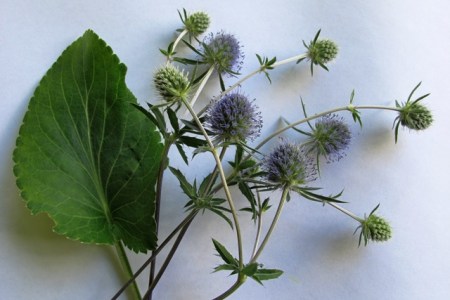
I am very fond of eryngiums

I am very fond of eryngiums

Top tasks:
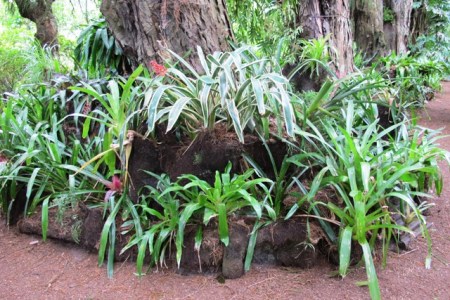
1) Persuade Mark to head out with the chainsaw and cut down some of the self seeded pongas. We don’t regard these as weeds because they are native, but we end up with too many of them. We have them as raised beds in the rimu avenue, where some are now 50 years old. I want to extend the constructions along further and feature more bromeliads. I have never learned to use a chainsaw and am terrified of them. Mark is equally worried by what I could do with one if I became confident so has never encouraged me to learn.
2) Mark has been raising perennials from seed in the nursery and I need to get onto planting these out. I was particularly pleased to see a tray of eryngiums – blue sea holly. It is a little bit prickly but so very pretty. Blue flowers are my absolute favourite. It would have been better had we got onto planting these out earlier but they are perennial so should grow on to star next summer.

Ponga (tree fern) trunks, used to make raised beds andwhich have lasted for five decades already

Ponga (tree fern) trunks, used to make raised beds andwhich have lasted for five decades already


The battle with the water weeds

We have dropped the water level for me to hand scoop the stream

We have dropped the water level for me to hand scoop the stream

I have been getting really down and dirty this week, hand pulling the weed from our main stream. As this involves wading in mud up to my knees, I emerge looking decidedly worse for the wear and no, you are not going to see a photo of me in this state.

Our main issues are with dreaded oxygen weed, Cape Pond weed and blanket weed. If we didn’t stay on top of them, the entire water surface would disappear below vegetation, which rather defeats the purpose of having a stream in the garden. I asked Mark if he thought our problems were related to farm run-off and excessive nitrogen but he is of the opinion that it has more to do with slow water flow rates, though he felt the build up of mud and silt in our streambed would be extremely fertile. When we get sudden bright green algal bloom, it is an indication of nitrogen being applied on farms upstream.

The worst offenders: Cape pond weed and oxygen weed

The worst offenders: Cape pond weed and oxygen weed

There is something very appealing about a natural stream but they are not without their problems. Offhand, I thought of three gardening colleagues with natural streams. One has problems with flooding in torrential rain. The water cannot get away fast enough so it builds up on his property. One has no problem at all with flooding because their stream is in a deep ravine, maybe 20 metres below the level of their land, but this means it isn’t really a significant garden feature. The third has a picturesque mountain brook to die for, bar two factors. Their land has sufficient natural fall to clear flood waters quickly but the bubbling brook can turn into a torrent that scours everything alongside. This means that they can’t have streamside plantings of any quality. They tried two or three times before giving up, having seen the plants ripped out and carried away. Their second issue is that the water is of high purity so a number of neighbours have water rights granted. Each neighbour has installed their own alkathene pipe at the top of our friends’ garden where the stream enters, running the pipes along the streambed until they exit at their adjoining properties down the bottom. There must be at least five alkathene pipes, both black and garish white, visible in that stream. It is not a good look.

So be careful what you wish for. None of these people, however, have to do what we do and clear the waterway of vegetation every year or two. We eliminated problems with flooding and scouring but our water flow is not sufficient to stop the growth of water weed. Our wonderfully natural looking stream is actually the result of outside expertise and in-house experience coming up with a low tech solution. We control the water where it enters our property by means of a simple weir. In normal conditions, this allows the water to flow equally down two streambeds. One meanders pleasantly through our park while the other is a deeper flood channel girded by stop banks. The two stream beds join up again on the other side of our property so the flow downstream is completely unaffected. When heavy rains cause flooding, a mechanism is triggered which directs all the water down the flood channel. By these simple means, we eliminated flooding, boggy patches and scouring from the park though we do have to manually reset the weir in order to get the water flowing again.

The pond weed is the direct result of having a relatively low flow through the park area, though our stream is such that it never dries up. Oxygen weed is a curse. We had a bad infestation which Mark finally eliminated entirely for some years. He blames the reinfestation on people emptying unwanted goldfish bowls into the stream at the corner by the road. Do not ever do this. The goldfish are most likely to die but the oxygen weed is an invasive menace in slow moving water.

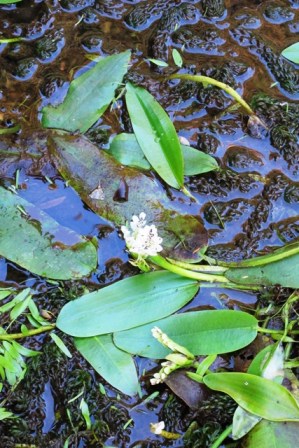
Our other great burden comes from a former neighbour who, as far as Mark is concerned, should be lined up and shot for liberating such an invasive weed. African Cape Pondweed, also known as water hawthorn, (botanically Aponogeton distachyum) is undeniably pretty, with a very long flowering season. Presumably this is why the former neighbour planted it on the margins of his ponds. Because he had no control over the water flow, the inevitable floods scoured it all out of his place but it found a lovely home in our slow moving sections. I don’t know how many hundreds of hours we have spent rooting it out. It is quite good friends with the oxygen weed because it can grow through it and spread its lily pad-like leaves. Between them they have the potential to turn our stream to bog. Native weeds are nowhere near as aggressive.

It is only yours truly who has shed most clothes to get in and hand pull the water weeds this year. Generally this is done by the two men in my gardening life (Mark and Lloyd) who take it in turns to wield the long handled rake and manually haul it all out on to the bank. It is a slow process and pretty hard on their backs. I thought it would be faster and easier to do it by getting in and so it is proving to be. The water is pleasantly warm, the mud even more so on sunny days. I just have to time my mud wrestling because I can’t exactly stop for lunch or a cuppa. Wisecracks about eels are not welcome.

Lloyd at least stays cleaner on the end of the rake but it is harder on the back

Lloyd at least stays cleaner on the end of the rake but it is harder on the back

First published in the Waikato Times and reproduced here with their permission.
Plant Collector – Pinus montezumae

Pinus montezumae - just one of the more special pines

Pinus montezumae - just one of the more special pines

The pine tree family is a great deal more extensive than the common radiata pine we know so well in this country. Perhaps it is because the timber tree is such a widespread and drearily predictable planting that we tend to take little note of the other 100 or so species in the group. The beautiful Pinus montezumae is a case in point. It comes from Mexico and into Central America (think Guatemala) though usually growing in areas with some altitude which cools temperatures. Despite this origin, the Montezuma is hardy for our New Zealand conditions.

What sets the Montezuma Pine apart as a specimen tree is its very long needles which give the appearance of a pendulous or spreading habit of growth. The needles can be 25cm or even more, whereas most pine needles are in the 10 to 15cm range. Because they are so long, they appear to curve and drape themselves in a most elegant manner. They are also of what is called glaucous hue. This simply means they are toned to a bluish-grey in colour, not the forest green we associate with common pines.

You do need space. It will make a large tree, over 30 metres or more so it is not one for the back yard. As with all the pine family, it likes open, sunny conditions. It is not a forest or woodland tree. What about the pine plantations, you may ask. They are planted at the same time and at prescribed spacings which allows equal sun to all the plants. A plantation is different to a forest. With hindsight, I would plant the Montezuma in splendid glory all on its own. We have a few lower, evergreen shrubs beneath ours and they tend to look a bit scruffy when the falling needles catch in their foliage. At least keep underplanting deciduous for easier grooming.

First published in the Waikato Times and reprinted here with their permission.