Tag Archives: gardening

The battle with the water weeds

We have dropped the water level for me to hand scoop the stream

We have dropped the water level for me to hand scoop the stream

I have been getting really down and dirty this week, hand pulling the weed from our main stream. As this involves wading in mud up to my knees, I emerge looking decidedly worse for the wear and no, you are not going to see a photo of me in this state.

Our main issues are with dreaded oxygen weed, Cape Pond weed and blanket weed. If we didn’t stay on top of them, the entire water surface would disappear below vegetation, which rather defeats the purpose of having a stream in the garden. I asked Mark if he thought our problems were related to farm run-off and excessive nitrogen but he is of the opinion that it has more to do with slow water flow rates, though he felt the build up of mud and silt in our streambed would be extremely fertile. When we get sudden bright green algal bloom, it is an indication of nitrogen being applied on farms upstream.
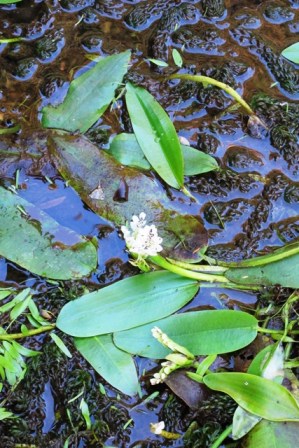
The worst offenders: Cape pond weed and oxygen weed

The worst offenders: Cape pond weed and oxygen weed

There is something very appealing about a natural stream but they are not without their problems. Offhand, I thought of three gardening colleagues with natural streams. One has problems with flooding in torrential rain. The water cannot get away fast enough so it builds up on his property. One has no problem at all with flooding because their stream is in a deep ravine, maybe 20 metres below the level of their land, but this means it isn’t really a significant garden feature. The third has a picturesque mountain brook to die for, bar two factors. Their land has sufficient natural fall to clear flood waters quickly but the bubbling brook can turn into a torrent that scours everything alongside. This means that they can’t have streamside plantings of any quality. They tried two or three times before giving up, having seen the plants ripped out and carried away. Their second issue is that the water is of high purity so a number of neighbours have water rights granted. Each neighbour has installed their own alkathene pipe at the top of our friends’ garden where the stream enters, running the pipes along the streambed until they exit at their adjoining properties down the bottom. There must be at least five alkathene pipes, both black and garish white, visible in that stream. It is not a good look.

So be careful what you wish for. None of these people, however, have to do what we do and clear the waterway of vegetation every year or two. We eliminated problems with flooding and scouring but our water flow is not sufficient to stop the growth of water weed. Our wonderfully natural looking stream is actually the result of outside expertise and in-house experience coming up with a low tech solution. We control the water where it enters our property by means of a simple weir. In normal conditions, this allows the water to flow equally down two streambeds. One meanders pleasantly through our park while the other is a deeper flood channel girded by stop banks. The two stream beds join up again on the other side of our property so the flow downstream is completely unaffected. When heavy rains cause flooding, a mechanism is triggered which directs all the water down the flood channel. By these simple means, we eliminated flooding, boggy patches and scouring from the park though we do have to manually reset the weir in order to get the water flowing again.

The pond weed is the direct result of having a relatively low flow through the park area, though our stream is such that it never dries up. Oxygen weed is a curse. We had a bad infestation which Mark finally eliminated entirely for some years. He blames the reinfestation on people emptying unwanted goldfish bowls into the stream at the corner by the road. Do not ever do this. The goldfish are most likely to die but the oxygen weed is an invasive menace in slow moving water.

Our other great burden comes from a former neighbour who, as far as Mark is concerned, should be lined up and shot for liberating such an invasive weed. African Cape Pondweed, also known as water hawthorn, (botanically Aponogeton distachyum) is undeniably pretty, with a very long flowering season. Presumably this is why the former neighbour planted it on the margins of his ponds. Because he had no control over the water flow, the inevitable floods scoured it all out of his place but it found a lovely home in our slow moving sections. I don’t know how many hundreds of hours we have spent rooting it out. It is quite good friends with the oxygen weed because it can grow through it and spread its lily pad-like leaves. Between them they have the potential to turn our stream to bog. Native weeds are nowhere near as aggressive.

It is only yours truly who has shed most clothes to get in and hand pull the water weeds this year. Generally this is done by the two men in my gardening life (Mark and Lloyd) who take it in turns to wield the long handled rake and manually haul it all out on to the bank. It is a slow process and pretty hard on their backs. I thought it would be faster and easier to do it by getting in and so it is proving to be. The water is pleasantly warm, the mud even more so on sunny days. I just have to time my mud wrestling because I can’t exactly stop for lunch or a cuppa. Wisecracks about eels are not welcome.

Lloyd at least stays cleaner on the end of the rake but it is harder on the back

Lloyd at least stays cleaner on the end of the rake but it is harder on the back

First published in the Waikato Times and reproduced here with their permission.

Plant Collector – Pinus montezumae

Pinus montezumae - just one of the more special pines

Pinus montezumae - just one of the more special pines

The pine tree family is a great deal more extensive than the common radiata pine we know so well in this country. Perhaps it is because the timber tree is such a widespread and drearily predictable planting that we tend to take little note of the other 100 or so species in the group. The beautiful Pinus montezumae is a case in point. It comes from Mexico and into Central America (think Guatemala) though usually growing in areas with some altitude which cools temperatures. Despite this origin, the Montezuma is hardy for our New Zealand conditions.

What sets the Montezuma Pine apart as a specimen tree is its very long needles which give the appearance of a pendulous or spreading habit of growth. The needles can be 25cm or even more, whereas most pine needles are in the 10 to 15cm range. Because they are so long, they appear to curve and drape themselves in a most elegant manner. They are also of what is called glaucous hue. This simply means they are toned to a bluish-grey in colour, not the forest green we associate with common pines.

You do need space. It will make a large tree, over 30 metres or more so it is not one for the back yard. As with all the pine family, it likes open, sunny conditions. It is not a forest or woodland tree. What about the pine plantations, you may ask. They are planted at the same time and at prescribed spacings which allows equal sun to all the plants. A plantation is different to a forest. With hindsight, I would plant the Montezuma in splendid glory all on its own. We have a few lower, evergreen shrubs beneath ours and they tend to look a bit scruffy when the falling needles catch in their foliage. At least keep underplanting deciduous for easier grooming.

First published in the Waikato Times and reprinted here with their permission.

Grow it yourself: silver beet

Call it silver beet, chard or Swiss chard. It is what you start planting as space becomes available from now on to offer a reprieve from frozen peas in winter. In fact you can grow it pretty much any time of the year but there are more delicious crops to eat in summer. Some of us think there are more delicious crops to eat in autumn, winter and spring as well but it is the proven ease and reliability which has made silver beet such a longstanding vegetable garden staple. Some people even claim to like it.

Being a leafy green, silver beet likes lots of organic matter, nitrogen and water. This is a crop where you can dig in animal manures, preferably composted first (and definitely composted if it is poultry manure). Sow the seed and cover lightly to a depth of a couple of centimetres. You can eat the thinnings as fresh salad greens when young, achieving a final spacing of around 30 to 40cm per plant. Silver beet can be a handy plant for tucking into odd spaces instead of a uniform row. It will sit there for a long time until it bolts to seed in spring because usual practice is to harvest a few leaves as you need them, rather than picking the whole plant at once. It is that cut and come again ability in cool conditions that makes it so handy. Just don’t cut too much at once or you will weaken the plant.

The rainbow coloured chards with red, yellow and pink stems and leaf ribs may add a decorative element in the garden and to raw salads when young, but they taste no different to the usual white stemmed version and the colour disappears entirely if you do more than the lightest blanching. However, they may encourage children to take a more kindly attitude to what is essentially an obliging but utility vegetable which is dead easy to grow and high in iron.

First published in the Waikato Times and reprinted here with their permission.

Tikorangi Notes; Friday 27 January, 2012

Crocosmia hybrids

Crocosmia hybrids

Latest posts: Friday 27 January, 2012
1) No amount of wishful thinking can alter the fact that we do not in fact have a Mediterranean climate here and romantic recreations of the glam of Med holidays are likely doomed to disaster. Abbie’s column.
2) A big, beautiful, fragrant rhododendron flowering in mid to late January? R. diaprepes in Plant Collector this week (but don’t expect to find this one offered for sale at your local plant store).
3) Grow it Yourself – broccoli. Personally I prefer not to. I have tried repeatedly over many years to learn to love broccoli and have met with dismal failure but others are more enthusiastic and it is fearfully good for you.
4) The latest instalment of our fortnightly garden diary as published first in the Weekend Gardener – dealing with prickly onehunga weed without resorting to lawn sprays and other garden matters.

The sad state of Camellia chyrsantha

The sad state of Camellia chyrsantha

Tikorangi Notes; Friday 27 January, 2012

It was only last year that I featured one of the best flowerings we have had on Camellia chyrsantha (it of the butter yellow flowers – bright New Zealand butter at that). It only took a decade or two to start performing well. Alas, it came off second best to the rapid descent of a massive old pear tree last week. The trouble is that it is a grafted plant and the trunk has been split. We are hoping it may still recover and live to bloom again. We can take the long view and wait another decade, if need be.

I have been photographing the different bulbs flowering this month. We were worried we had lost the yellow-orange form of crocosmia but it has leapt into flower and is remarkably showy with very large blooms. The red form (the one above is a hybrid called Lucifer) is such a strong grower that the chances of losing it are negligible, which means we take it completely for granted. Indeed, red crocosmia is a widespread roadside flower regarded as an invasive weed and known as montbretia in our area. The pink vallota is also looking particularly fetching. I would describe it more as peach than pink. There appears to be some debate about whether it is a vallota or a cyrtanthus so the pink vallota may in fact be the peach cyrtanthus. The auratum lilies are still fattening buds and not yet in full stride – just some tasters open so far.

The pink vallota. Or should that be the peach cyrtanthus?

The pink vallota. Or should that be the peach cyrtanthus?

No. We do not have a Mediterranean climate here

The romance of lavender - though it can be shortlived in our climate

The romance of lavender - though it can be shortlived in our climate

We were watching an interview with the head gardener at Tresco Abbey on the Scilly Islands just off the coast of Cornwall. The garden is notable for growing a whole range of plant material which is too tender for the mainland and the gardener claimed they had a Mediterranean climate. He then proceeded to elaborate and it could have been me describing our climate here.

“We never get very hot and we never get very cold,” I say. “In fact we are almost frost free and we get regular rains twelve months of the year along with high sunshine hours.” Is that a Mediterranean climate? I don’t think so. It is what we call a temperate, maritime climate. Wikipedia agrees with me. A Mediterranean climate is that which is experienced by all those countries ringing the Med – places like the south of France, Portugal, coastal Spain, Italy, Greece and down to the coastal areas of North Africa. It is also found in California, south and west Australia and parts of South Africa. These are places where they grow wonderful pistachios, luscious olives and grapes, where lavender, bourgainvillea and red geraniums flourish. Hot, dry summers and cool, damp winters are what characterise the Mediterranean climate.

Almost a signature plant for Mediterranean gardening

Almost a signature plant for Mediterranean gardening

Head inland from these coastal areas and you get to the classic continental climate – hotter, drier summers and much colder, dry winters. The closest thing we have to a Mediterranean climate in NZ is probably Hawkes Bay while only Central Otago could be said to have a continental climate. There are reasons why they are the cherry and apricot bowls of New Zealand. The rest of us fall pretty much into the aforementioned temperate, maritime class with the upper reaches of Northland leaning to the subtropical end of the spectrum.

No amount of wishful thinking and attempting to redefine our climatic definitions (we have seen wild claims that the North Island is subtropical) is going to alter the actual temperatures and rainfall distribution we have. Most of us would like to be a degree or two warmer all year round and a little drier – or at least have the rain fall at night and please make it warm rain. But we are not a sub tropical Pacific island and we have to understand what we have in terms of climate and garden within that.

This is not to say that we can’t grow some of those Med plants. We can and we do but they are not always long lived. Many of those plants are the grey foliaged ones – whether the aforementioned lavender, cistus (rock rose), oleander, even artemisia (the wormwoods), rosemary and succulent sempervivums. In areas of higher rainfall, the one critical issue to growing these types of plants is superb drainage. Most of them also need full sun. In New Zealand, they are often recommended for coastal conditions where sandy soils give sharp drainage and dry out quickly in summer.

The same is true of many of the Australian native plants which have adapted to drier conditions. Some put on terrific floral displays – the grevilleas, some of the wattles, anigozanthus, even the fragrant boronias which many of us have tried and lost. It is usually the wetter climate and fertile soils that are the death knell of these plants, as indeed with most of the showy proteas from South Africa.

It is not all bad. We do have quite a bit of success with some of the Australian plants from their subtropical forest areas. These plants are used to higher humidity and heavy rainfall while tolerating the cooler conditions we have. Plants like the doryanthes (spear lily), the subtropical cordylines, the aromatic myrtles such as Backhousia anisata and citriodora will all thrive in our climate if given reasonably protected conditions.

Gardening styles and plants  have evolved for very different conditions in the Med - this is Portugal

Gardening styles and plants have evolved for very different conditions in the Med - this is Portugal

The problems often come with the desire to recreate the romance of a holiday. For many New Zealanders, the Mediterranean areas with their long history, their breathtakingly quaint villages contrasting with the grandest architecture imaginable, crowned by a blue as blue sky (most of us visit in summer) are the pinnacle of sophisticated style. If it is sophisticated there, it must be sophisticated at home, right? Wrong. Mediterranean gardens and plants have evolved for Mediterranean conditions. They are more likely to look contrived, verging even on the pretentious, when set in this green and verdant environment of ours.

Experienced gardeners often like to push the boundaries of what can be grown in their conditions. It is enormously satisfying to look at a thriving plant which would generally turn up its toes and die in such an alien location. But experienced gardeners rarely try and create an entire garden using a genre from a foreign land and an incompatible climate. Nothing shouts novice louder.

If you want that Med look, it may be easier to move. What we do have in the centre and north of the North Island is one of most benign climates imaginable and the result is lots of lush growth which is the envy of those from harsher climes. We are better to start with what we have rather than to try and recreate an inappropriate fantasy from foreign shores.

There is a certain folly in trying to recreate the romance of a Greek island holiday back home

There is a certain folly in trying to recreate the romance of a Greek island holiday back home

First published in the Waikato Times and reprinted here with their permission.