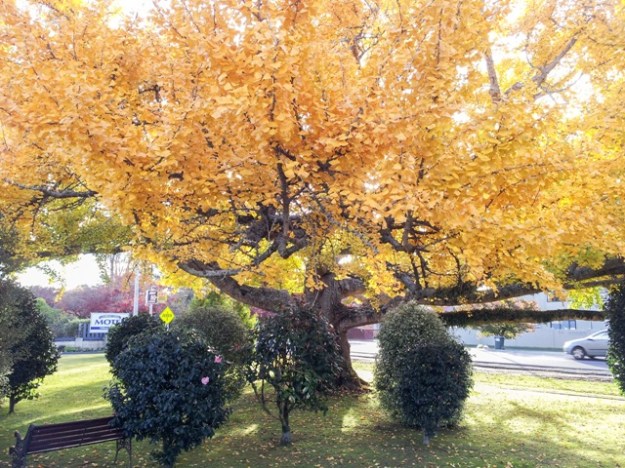
At the front of the Cambrian Lodge Motel in Cambridge on the main road to Hamilton, this ginkgo has been a remarkable sight for many years. Its wide spreading habit of growth belies the usual pyramidal form and may possibly be a result of having been topped and trimmed over several years earlier in its life.
Ginkgos are remarkable trees – botanically, in the landscape and in traditional medicine. They are spectacular at this time of year with their pure golden colour and must be one of the showiest stars of autumn. I am assuming the common name of “maidenhair tree” has come about because of the resemblance of leaf shape to the common maidenhair ferns. The leaves are flat, neat little fans
I say they are remarkable botanically because they are a living fossil and in a family of one. In the kingdom of plants, tracing down from the highest order – the division of Ginkophyta – all the separate classifications descend to one solitary species, Ginkgo biloba. Mind you, it is dioecious which means that specimens are gender specific and both male and female are needed to get viable seed. It is called a living fossil, because it has been around for a length of time variously estimated between 160 and 270 million years. That is such a huge time span that it is a bit irrelevant whether the lower or upper figure is more accurate. Suffice to say, the dinosaurs may have browsed on ginkgo trees and they have outlived all their botanical relatives, surviving not only the dinosaurs but also climate changes and all diseases. That is pretty remarkable.
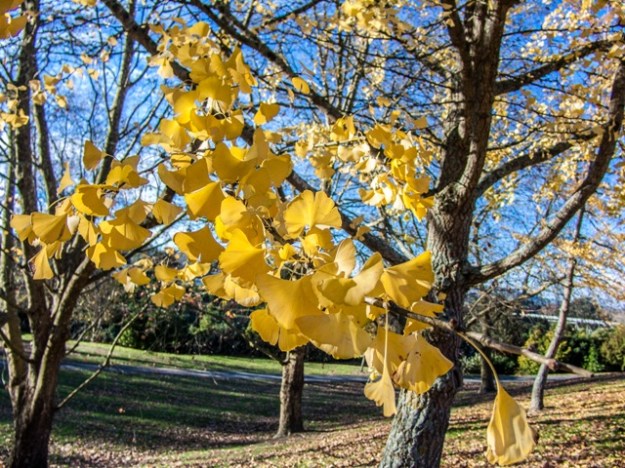
Ginkgo leaves have a distinctive fan shape. These are on a tree in the Gil Lumb Park in Leamington. The foliage has long been used in traditional Asian medicine, particularly for its alleged memory enhancing benefits.
If I hadn’t looked up the tree bible, The Hillier Manual of Trees and Shrubs, I would not have realised they are classified with conifers even though they produce seed, not cones. They are at the primitive end of the evolution of conifers.
Ginkgos originated in China and have long been regarded as sacred trees. This is just as well because they are pretty much extinct in the wild so if they hadn’t been cultivated for thousands of years in Asia and hundreds of years in Europe and North America, they may have been lost to the modern world. They are long-lived and can last well past 1000 years, though not so much in this country where any tree is lucky to last past a few decades at most. In other parts of the world, the populace are not quite so chainsaw-mad and even venerate old trees. The only tree accorded that status in NZ is Tane Mahuta.
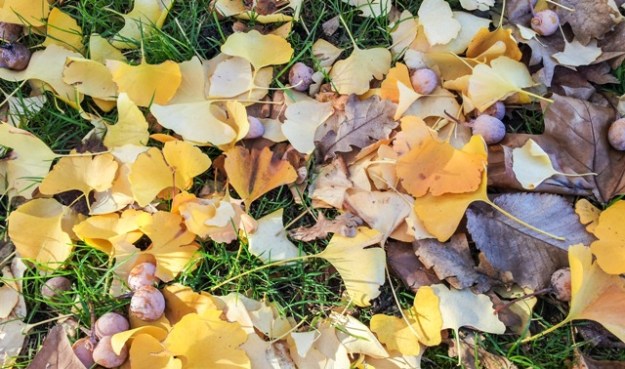
With so many ginkgos planted in the area, there are sufficient specimens of both male and female trees to get consistent crops of the nuts. While the outer casing emits a deeply unpleasant odour, the inner kernel is prized in traditional Chinese cuisine.
Despite the unmistakeable aroma of the fallen seed (variously described as ‘malodorous’ or smelling like vomit), once the soft casing has been removed, the seed inside is a traditional food in China and other parts of Asia. The smell is apparently in the fleshy casing, not the seed.
More interestingly, ginkgo leaves have long played a part in Chinese herbalism. The science on their effectiveness in slowing memory loss has yielded mixed results but research continues. At this stage, it is not looking as if ginkgo offers a magic bullet to reverse or even slow Alzheimers. Even now, most of our modern medications still orginate from plants. It is one reason why maintaining global bio-diversity is so important.
What started me on ginkgos was the sight of some leaves Mark had harvested and left on the back doorstep. I laughed because I knew instantly that he was curious about their memory enhancing reputation. But he forgot to bring them indoors and the wind blew them away.
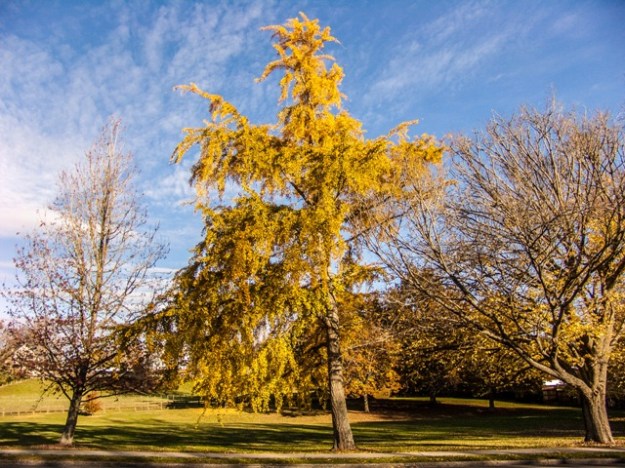
Trees take a while to mature and take on their final form but the usual conical shape can be seen developing in this tree which is in Lindsay Park in Leamington
First published in the Waikato Times and reprinted here with their permission.
All photographs courtesy of my friend Michael Jeans, Photographer, Cambridge.

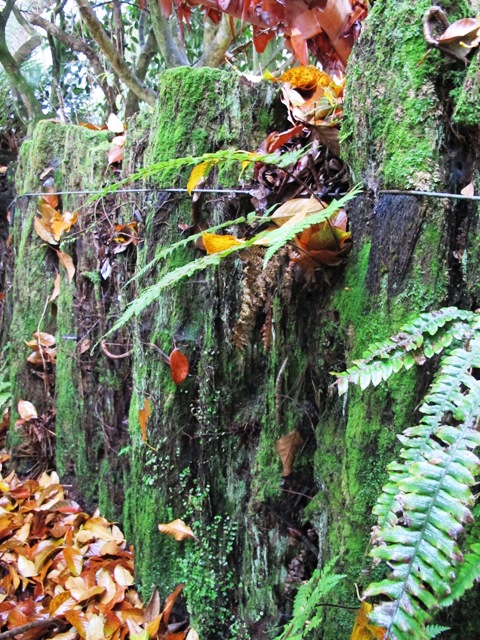

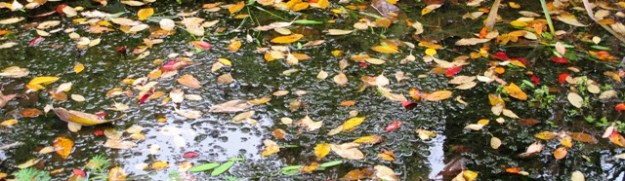 Autumn colour occurs when deciduous trees shut down the chlorophyll which is what makes most leaves green. It is chlorophyll which enables the plant to combine sunshine, water and carbon dioxide, making the simple sugars that sustain the plant (a process called photosynthesis). Once the green colouring disappears from the leaves, the other colours already in the leaf become obvious.
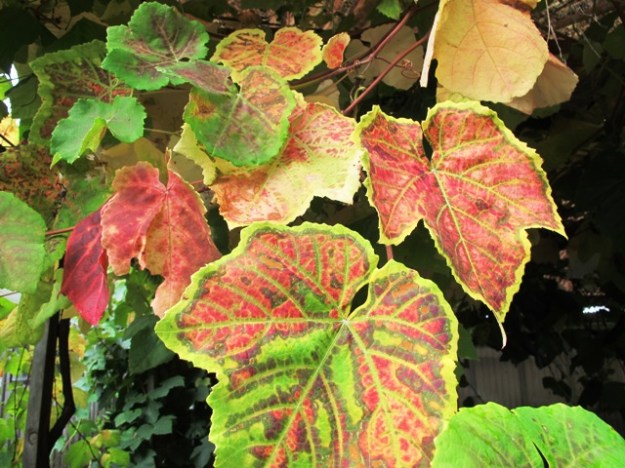 You can see in this grape leaf that the chlorophyll is still alive in parts, particularly the veins but other colours dominate in the body of the leaf. Not all grapes colour the same way. Our Albany Surprise grape becomes brilliant yellow, making it appear as if the sun is shining, even on a grey day.
 Some of our flowering cherries (prunus) turn yellow but this one is notable for its red colouring, caused apparently by anthocyanins which are what give the red and purple tones. Bright light in autumn helps the anthocyanins and bright sunlight is one thing we do well in most of this country.
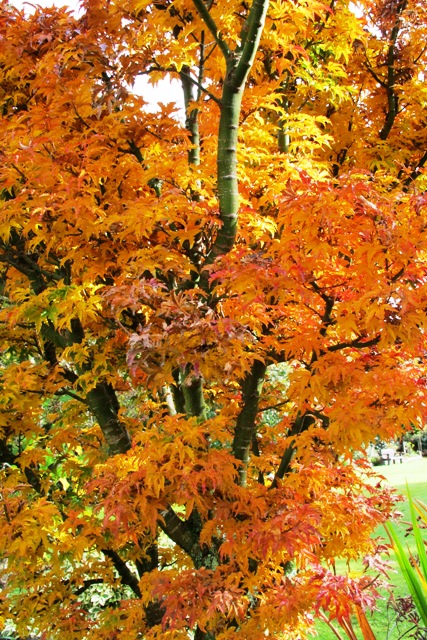 Maples, particularly the Japanese varieties, are one of the most reliable plants for autumn colour and the brilliant hues occur even in milder areas where some other plants will just skip the colouring step and turn brown. What is more, there are many petite maples (often sold as patio varieties) which will fit in even the smallest garden.
 We find the deciduous conifers colour well for us. This is a taxodium but the metasequoia and glyptostrobus are also good. However these are large trees, unsuitable for small urban sections. There are many smaller growing options like the koelreuteria or parrotia.
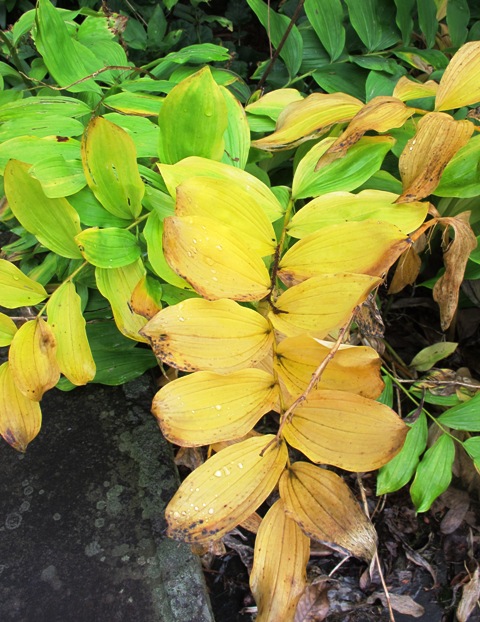 Just to prove it is not only the woody trees and shrubs that can flaunt their autumn raiment, Soloman Seal (Polygonatum multiflorum) grows from rhizomes below ground. A common enough plant which fills a role in semi shade conditions, it can startle with its golden foliage as it prepares to hibernate for winter.
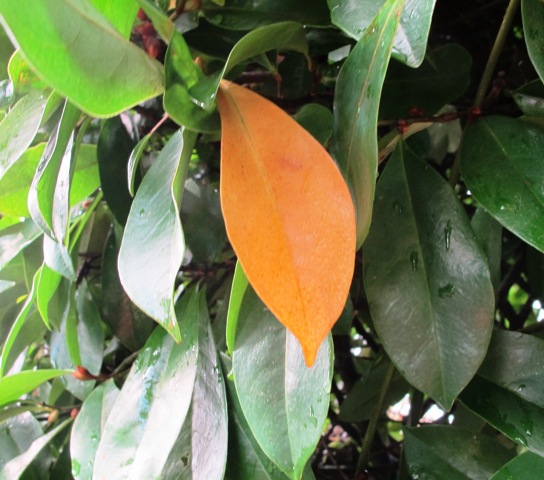 Many folk never consider that evergreen plants also drop leaves (do they think that foliage is permanently attached for the life of the plant?). All evergreens drop a full set of foliage every year. It is just that they don’t drop them all at once. However some plants, like this Fairy Magnolia Blush, have a tendency for some leaves to colour and then drop in autumn. It is not a bad sign, it is just part of the plant’s cycle.
 Tikorangi The Jury Garden