Tag Archives: gardening

A fossil, but very much alive – Ginkgo biloba

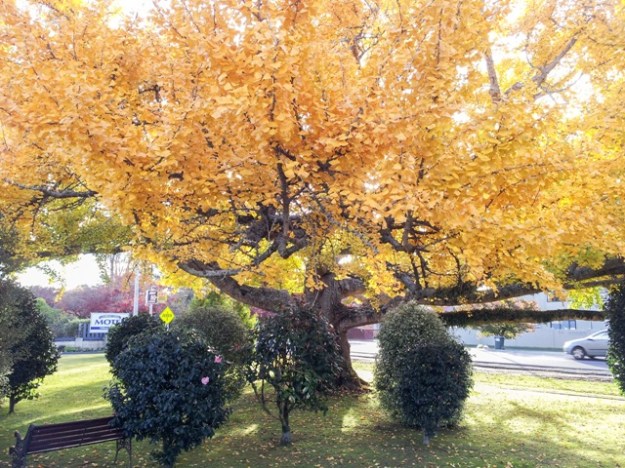
At the front of the Cambrian Lodge Motel in Cambridge on the main road to Hamilton, this ginkgo has been a remarkable sight for many years. Its wide spreading habit of growth belies the usual pyramidal form and may possibly be a result of having been topped and trimmed over several years earlier in its life.

At the front of the Cambrian Lodge Motel in Cambridge on the main road to Hamilton, this ginkgo has been a remarkable sight for many years. Its wide spreading habit of growth belies the usual pyramidal form and may possibly be a result of having been topped and trimmed over several years earlier in its life.

Ginkgos are remarkable trees – botanically, in the landscape and in traditional medicine. They are spectacular at this time of year with their pure golden colour and must be one of the showiest stars of autumn. I am assuming the common name of “maidenhair tree” has come about because of the resemblance of leaf shape to the common maidenhair ferns. The leaves are flat, neat little fans

I say they are remarkable botanically because they are a living fossil and in a family of one. In the kingdom of plants, tracing down from the highest order – the division of Ginkophyta – all the separate classifications descend to one solitary species, Ginkgo biloba. Mind you, it is dioecious which means that specimens are gender specific and both male and female are needed to get viable seed. It is called a living fossil, because it has been around for a length of time variously estimated between 160 and 270 million years. That is such a huge time span that it is a bit irrelevant whether the lower or upper figure is more accurate. Suffice to say, the dinosaurs may have browsed on ginkgo trees and they have outlived all their botanical relatives, surviving not only the dinosaurs but also climate changes and all diseases. That is pretty remarkable.
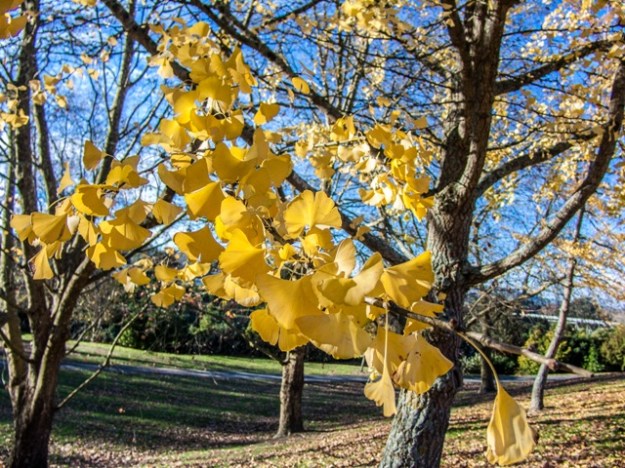
Ginkgo leaves have a distinctive fan shape. These are on a tree in the Gil Lumb Park in Leamington. The foliage has long been used in traditional Asian medicine, particularly for its alleged memory enhancing benefits.

Ginkgo leaves have a distinctive fan shape. These are on a tree in the Gil Lumb Park in Leamington. The foliage has long been used in traditional Asian medicine, particularly for its alleged memory enhancing benefits.

If I hadn’t looked up the tree bible, The Hillier Manual of Trees and Shrubs, I would not have realised they are classified with conifers even though they produce seed, not cones. They are at the primitive end of the evolution of conifers.

Ginkgos originated in China and have long been regarded as sacred trees. This is just as well because they are pretty much extinct in the wild so if they hadn’t been cultivated for thousands of years in Asia and hundreds of years in Europe and North America, they may have been lost to the modern world. They are long-lived and can last well past 1000 years, though not so much in this country where any tree is lucky to last past a few decades at most. In other parts of the world, the populace are not quite so chainsaw-mad and even venerate old trees. The only tree accorded that status in NZ is Tane Mahuta.
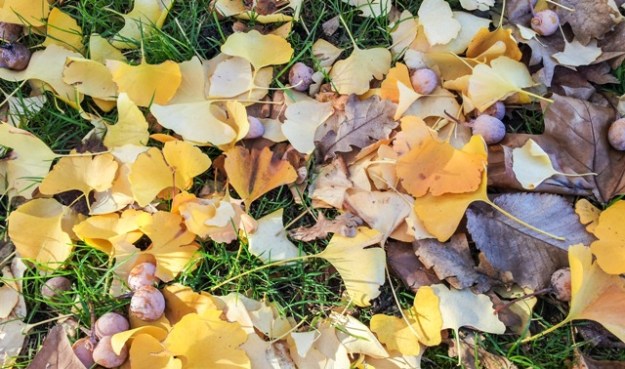
With so many ginkgos planted in the area, there are sufficient specimens of both male and female trees to get consistent crops of the nuts. While the outer casing emits a deeply unpleasant odour, the inner kernel is prized in traditional Chinese cuisine.

With so many ginkgos planted in the area, there are sufficient specimens of both male and female trees to get consistent crops of the nuts. While the outer casing emits a deeply unpleasant odour, the inner kernel is prized in traditional Chinese cuisine.

Despite the unmistakeable aroma of the fallen seed (variously described as ‘malodorous’ or smelling like vomit), once the soft casing has been removed, the seed inside is a traditional food in China and other parts of Asia. The smell is apparently in the fleshy casing, not the seed.

More interestingly, ginkgo leaves have long played a part in Chinese herbalism. The science on their effectiveness in slowing memory loss has yielded mixed results but research continues. At this stage, it is not looking as if ginkgo offers a magic bullet to reverse or even slow Alzheimers. Even now, most of our modern medications still orginate from plants. It is one reason why maintaining global bio-diversity is so important.

What started me on ginkgos was the sight of some leaves Mark had harvested and left on the back doorstep. I laughed because I knew instantly that he was curious about their memory enhancing reputation. But he forgot to bring them indoors and the wind blew them away.
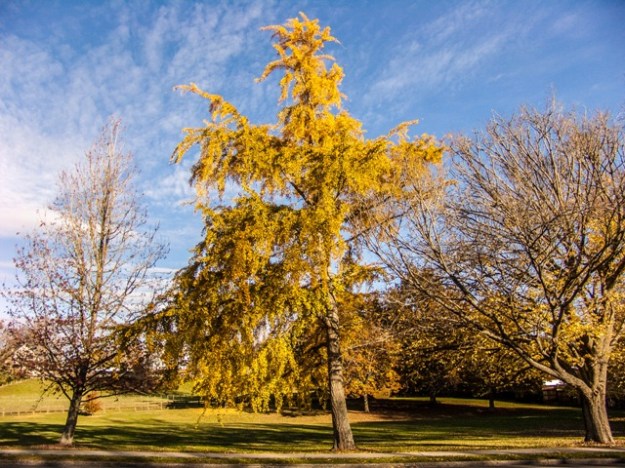
Trees take a while to mature and take on their final form but the usual conical shape can be seen developing in this tree which is in Lindsay Park in Leamington

Trees take a while to mature and take on their final form but the usual conical shape can be seen developing in this tree which is in Lindsay Park in Leamington

First published in the Waikato Times and reprinted here with their permission.
All photographs courtesy of my friend Michael Jeans, Photographer, Cambridge.

Plant Collector: Narcissus bulbocodium var. citrinus ‘Pandora’

Narcissus bulbocodium var. citrinus ‘Pandora’

Narcissus bulbocodium var. citrinus ‘Pandora’

Look! The first narcissi of the season – commonly known as daffodils, although the hooped petticoat varieties look somewhat different. These have just the cup with 6 very narrow, spiky petals forming the skirt. It is the pale lemon ones that flower so early. The more common, bright yellow N. bulbocodium come considerably later in the season.

The foliage is narrow, described as grassy. While sometimes recommended as a good option for naturalising in grassy meadows or on banks, we would beg to differ. It is too hard to pick the foliage and emerging flower stems, which makes it difficult to do a late autumn trim on the grass. Without that trim, the narcissi can get swamped by competing growth. We use them in the rockery and along the edges of paths or walls. They are quite happy on the side of the stony drive. Good drainage is the key – they hail from south western France, Portugal and Spain.

These dainty narcissi are like slug magnets, as you may be able to see in the photo. After being somewhat relaxed about the munching varmints in the off-season, it is a call to action before the bulk of the winter and early spring bulbs come into bloom, offering a veritable smorgasbord.

First published in the Waikato Times and reprinted here with their permission.

Autumn hues

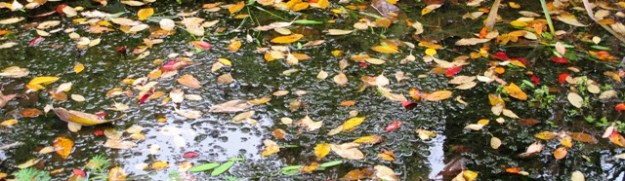
012Autumn colour occurs when deciduous trees shut down the chlorophyll which is what makes most leaves green. It is chlorophyll which enables the plant to combine sunshine, water and carbon dioxide, making the simple sugars that sustain the plant (a process called photosynthesis). Once the green colouring disappears from the leaves, the other colours already in the leaf become obvious.
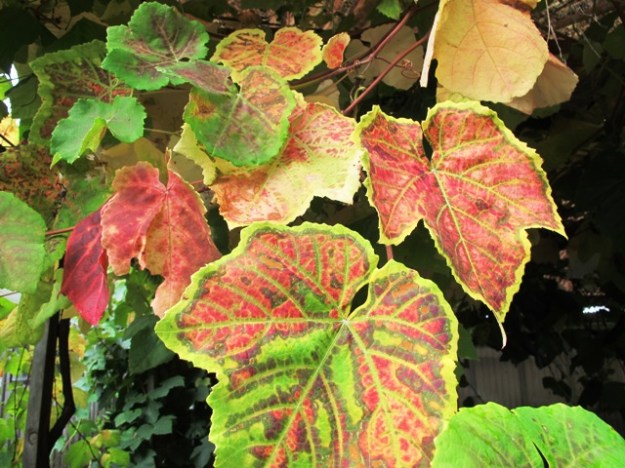
001 grapeYou can see in this grape leaf that the chlorophyll is still alive in parts, particularly the veins but other colours dominate in the body of the leaf. Not all grapes colour the same way. Our Albany Surprise grape becomes brilliant yellow, making it appear as if the sun is shining, even on a grey day.
002 prunusSome of our flowering cherries (prunus) turn yellow but this one is notable for its red colouring, caused apparently by anthocyanins which are what give the red and purple tones. Bright light in autumn helps the anthocyanins and bright sunlight is one thing we do well in most of this country.
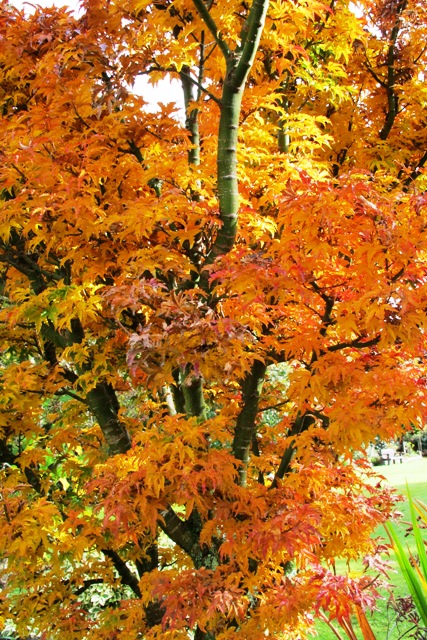
005 patio mapleMaples, particularly the Japanese varieties, are one of the most reliable plants for autumn colour and the brilliant hues occur even in milder areas where some other plants will just skip the colouring step and turn brown. What is more, there are many petite maples (often sold as patio varieties) which will fit in even the smallest garden.
004 taxodiumWe find the deciduous conifers colour well for us. This is a taxodium but the metasequoia and glyptostrobus are also good. However these are large trees, unsuitable for small urban sections. There are many smaller growing options like the koelreuteria or parrotia.
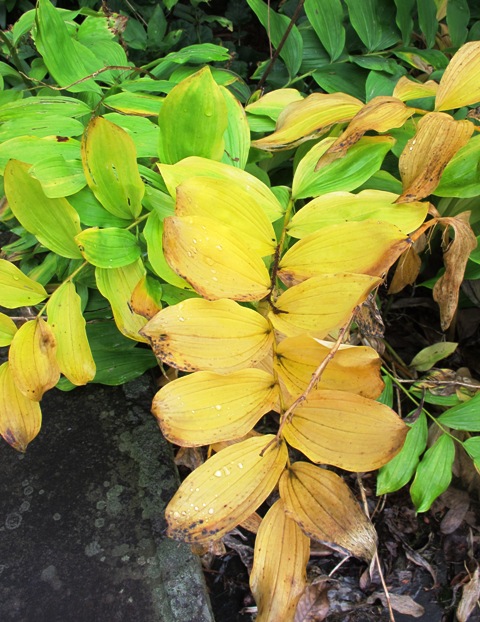
005 Soloman SealJust to prove it is not only the woody trees and shrubs that can flaunt their autumn raiment, Soloman Seal (Polygonatum multiflorum) grows from rhizomes below ground. A common enough plant which fills a role in semi shade conditions, it can startle with its golden foliage as it prepares to hibernate for winter.
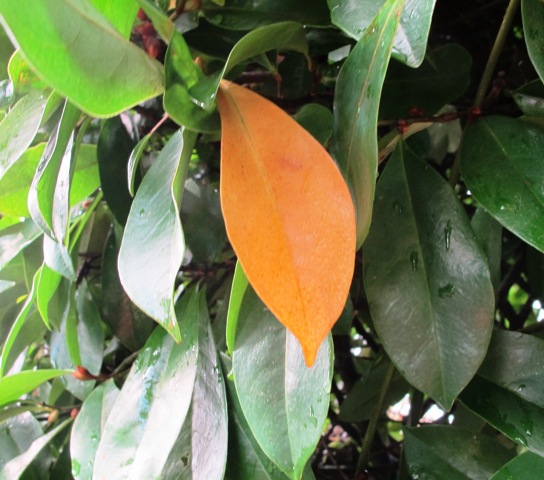
006 Fairy Magnolia BlushMany folk never consider that evergreen plants also drop leaves (do they think that foliage is permanently attached for the life of the plant?). All evergreens drop a full set of foliage every year. It is just that they don’t drop them all at once. However some plants, like this Fairy Magnolia Blush, have a tendency for some leaves to colour and then drop in autumn. It is not a bad sign, it is just part of the plant’s cycle.

First published in the Waikato Times and reprinted here with their permission.

An Easter legend – the Glastonbury thorn

I went looking for the Glastonbury thorn but it was not to be found at St Mary's cathedral after all

I went looking for the Glastonbury thorn but it was not to be found at St Mary’s cathedral after all

The legend of the Glastonbury thorn seems timely as an Easter story. I started by setting out to find the local specimen at St Mary’s Cathedral in New Plymouth that is reputed to be the Glastonbury thorn, only to find it isn’t. We have our own legends too.

Glastonbury is in the Somerset area of the United Kingdom. The abbey site has had a Christian church on it since the seventh century, but legend takes it back further. One version has Joseph of Arimathea bringing his young nephew, Jesus Christ to Glastonbury where they built the first Christian church at that location. But the Glastonbury thorn tree is attributed to the second visit by Joseph of Arimathea soon after the death of Christ. Reportedly landing in a state of exhaustion, he thrust his staff into the ground on the slope now known as Wearyall Hill. The staff took root overnight and grew into the Glastonbury thorn tree, revered as sacred through the ages since.

Interwoven through the Glastonbury thorn legend, is the more powerful myth of the Holy Grail that Joseph was believed to have brought and buried just beneath the Glastonbury Tor. The Holy Grail of course is the cup used by Christ at the Last Supper and subsequently used by Joseph to catch his blood at the crucifixion. And with the Holy Grail come the legends of King Arthur and the Knights of the Round Table. Glastonbury Abbey is reputedly the final resting place of both Arthur and Guinevere. Sadly, after about 1000 years, they got a bit careless with the remains and when the abbey was sacked and largely destroyed in the 1500s, Arthur and Guinevere’s remains were no more.

But the Glastonbury thorn endured. Not the original tree. It had a bit of a rough history and still has as replacement plants either die, are vandalised or maybe attacked in spiritual fervour. But as the plant does not strike from cutting or grow true from seed, it has to be grafted. And it does appear that the plant has remained true and been distributed for many hundreds of years.

It seems a little mean-spirited to disturb such a wonderful legend with botany. But whatever the truth is about the Holy Grail, it is a fact that that the Glastonbury thorn is simply a variation on Crataegus monogyna that is the common hawthorn of the UK – the fragrant Mayflower. It seems unlikely that Joseph of Arimathea’s wooden staff at the time of his alleged arrival in Britain was fashioned from a plant native to that country. What makes C. monogyna “Biflora” different is that it has two flowerings a year. Its main flowering is in spring but it also puts up a minor second blooming in winter. The tradition of sending a spray of Glastonbury thorn to the monarch at Christmas started back in the time of James 1 at the turn of the sixteenth century and apparently continues today.

These days Glastonbury is probably associated as much with the annual music festival which, despite being timed for the end of June, seems to be a particularly muddy affair. Despite its very early Christian history and even earlier pagan history, or maybe as a result of it, modern Glastonbury apparently now resembles something more akin to Diagon Alley from the Harry Potter stories.

I noticed the wry comments on a BBC New Magazine site from 2012. “The former mayor John Coles tends to the remnants of the thorn. In recent years, people have tied ribbons to it bearing messages, prayers and maybe even spells. Coles removes them. “It takes daylight away from the trunk,” he explains. He also prises out the coins that people have jammed into the bark.”This never used to happen even eight or nine years ago,” he says sadly.The apparent takeover of the town by new age believers disturbs him. “There’s nothing wrong with paganism but there is a certain taste of Satanism as well and I have always regarded Glastonbury as a Christian town.”

Many St Mary’s parishioners in New Plymouth were proud of their Glastonbury thorn until it was revealed that it is Crataegus crus-galli from the eastern states of North America. Apparently it was planted back around 1860 by Archdeacon Govett. This makes it one of the oldest known introduced trees in the province but the Glastonbury thorn it ain’t. This is a bit of a shame as the Cathedral of St Mary is the oldest stone church in New Zealand with its foundation stone having been laid in 1845. It would have been a charming connection back to the Glastonbury Abbey history and legend where the lady chapel is still referred to as ‘Our Lady St. Mary of Glastonbury’. Instead they just have a scrubby but venerable North American species.

First published in the Waikato Times and reprinted here with their permission.

Windflower romance

Wind flowers are a personal marker of our wedding anniversary

Wind flowers are a personal marker of our wedding anniversary

On the evening before we married, Mark turned up with an armful of Japanese anemones that he had gathered from the Taihape roadside. Don’t even ask why we got married in Taihape when we neither lived there nor came from there. It’s a complicated story. Wind flowers, he called the anemones and believe me, although back in the mists of time, it was a romantic gesture I have never forgotten.

Every year the wind flowers bloom on our wedding anniversary and he often brings some indoors. Last week he followed the old cut flower wisdom – re-cut the stems and burned the ends and they have lasted a full week in water.

We have three different Japanese anemones, in light pink, white and a semi double dark pink which is more compact in growth. It seems that the first two are the straight species, A. hupehensis. Although known throughout the world as Japanese anemones, they are originally Chinese – from the eastern province of Hupeh, in fact. They have been grown so widely in Japan for so long that common parlance attributes them to that country. It is no surprise that the Japanese, with their cultural penchant for simplicity and natural form, took a liking to them.

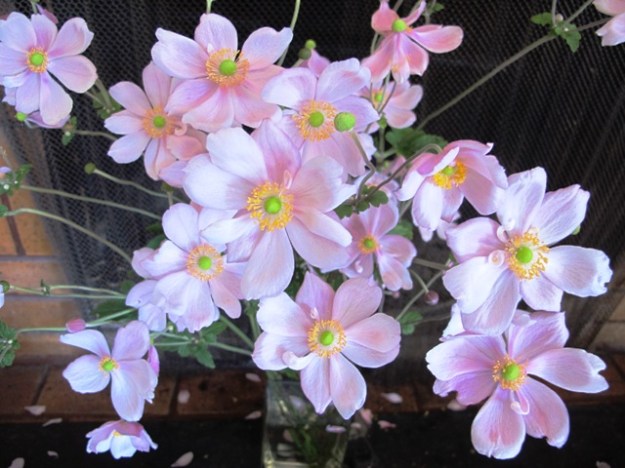
Japanese anemones are commonly found in pinks and white although selections are being made to extend the colour range into lilac blues

Japanese anemones are commonly found in pinks and white although selections are being made to extend the colour range into lilac blues

The semi-double darker one will be a hybrid and a named form that was purchased. Mark commented vaguely that he thought it may carry a woman’s name but I see that this plant family is more highly prized overseas than in New Zealand and there are a fair number of named forms, several of them named after women. For the botanically inclined, the Japanese anemones classified as A. hybrida are likely to be mixes of A. hupehenis with A. elegans and A. vitifolia. This is a plant family that crosses readily – though to get a cross you generally need plants that flower around the same time.

Weeds, I hear some readers saying. Weeds. Yes they can be overly vigorous, given the right conditions and become rampant, bordering on invasive because they spread below ground. You probably don’t want to unleash them in areas with plant treasures which they may out-compete. Lovely though they are in flower, you can have too many of them.

That said, I see that there is general agreement that they are not always easy to establish which made me feel better about our meagre showing of white ones in the woodland garden. I had spotted a pretty patch down the road, growing as a roadside wild flower and it is those I photographed. I love the combination of the single, white flowers dancing above the dried grasses.

 The white Japanese anemone down the road looks better than the patch we have in our garden

The white Japanese anemone down the road looks better than the patch we have in our garden

Our pink ones are planted on our roadside and come into flower after the summer colour has largely faded. We have designated our rural road verges no-spray zones with the local council so we carry out our own maintenance. We mow a grassy strip immediately beside the road, get rid of noxious weeds like the dreaded bristle grass and we can do what we like with the rest. And what we like are roadside wild flowers – agapanthus, hydrangeas, robust begonia species, oenothera (evening primrose), belladonnas, crocosmia and the like. It is not just for passing motorists. It is also to feed the bees and to keep some roadside cover in an intensive dairying area which can otherwise resemble a green grass desert.

There are actually somewhere over 120 different anemone species. By far the most common in gardens are A. coronaria. These are the spring flowering corms that you buy as de Caen (the singles, mainly in blue and red but also in pinks and whites) and St Brigid (the doubles). They are very cheerful and cheap to buy. If you get a bulk pack, split it into four and soak one batch at a time overnight before planting. Done at weekly intervals, you can extend the flowering for the first season.

A. blanda is a little Greek species with predominantly blue flowers, more like a carpet if mass planted. A. nemerosa is the European wood anemone. We would like both of these dainty species to naturalise far more widely in our garden than we have achieved so far. They are transient early spring delights.

But in autumn it is time for the wind flowers to star.

First published in the Waikato Times and reprinted here with this permission.