Tag Archives: Jury magnolias

Plant Collector: Magnolia Athene

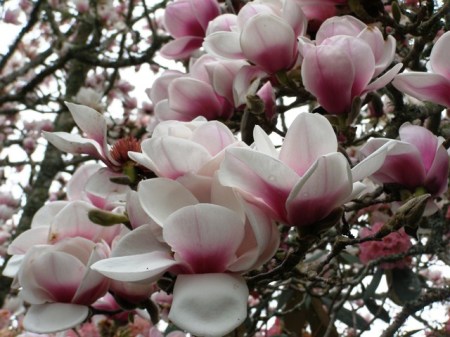
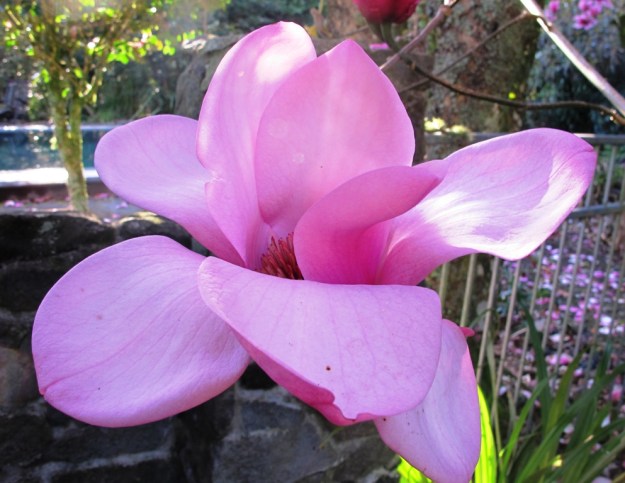
Magnolia Athene in her glory

Magnolia Athene in her glory


Thank goodness for the mid season magnolias this year. There we were, as usual, admiring the early season ones in flower when a once in a hundred year event hit here – snow followed by a killer frost in late August. The early bloomers did not like it one bit. But the next flush rose to the challenge and their flowering was unaffected. This one is Magnolia Athene, a particularly lovely variety with big ivory white flowers sporting a violet pink base. It is what is called a cup and saucer form. When open, the outer layer of petals drops a little to form the saucer, while the inner petals keep a tight cup form. Botanically, magnolias don’t actually have much in the way of petals, they have tepals which look like petals but that tends to confuse all but the most enthusiastic gardener.

Bred in the early 1960s, Athene is one of a small series from the late Felix Jury in his quest for new plants which would carry the good aspects of the classic campbellii magnolias but flower on young plants and not grow as large. It should flower within a year of planting out. The parents are magnolias lennei alba (which is a very tidy, smaller tree with pure cream flowers) and Mark Jury (which is a large growing tree with very large, heavy textured flowers in lilac tones). Athene was a significant advance on the parents and puts on a magnificent display with its bi-coloured blooms. It will eventually reach about 5 metres with an upright habit and the flowers are pleasantly scented.

Tikorangi Notes: Friday 23 September, 2011

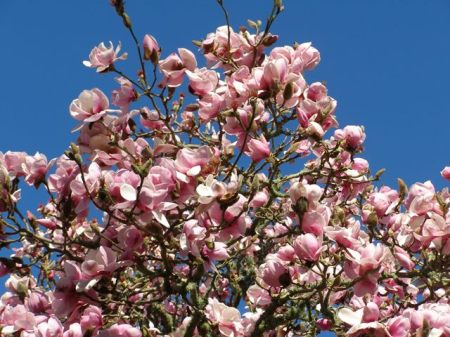
Looking a little like a froth of pink candy floss this week - our magnificent Iolanthe (again)

Looking a little like a froth of pink candy floss this week - our magnificent Iolanthe (again)

Latest posts: Friday 23 September, 2011

1) Tropaeolum tricolorum, a distinctly refined member of the nasturtium family in Plant Collector this week.
2) Yates Vegetable Garden – yet another NZ gardening book in that folksy-wolksy vein that NZ publishers think is all we can cope with these days.
3) Managing bulb meadows and drifts – Abbie’s column
4) GIY Peas A little introduction to growing peas in warmer climates.
5) Even we can lower our sights – the first of our clearance specials. First up a splendid hedging line of Camellia Jury’s Yellow.

No apologies for continuing to lead with Magnolia Iolanthe this week. In a season which will not rank as memorable for magnolias, Iolanthe has not wavered or faltered and is simply beautiful. The first flowers on Serene are just opening – she is always the last of the season to flower for us. The magnolias will be drawing to a close in a matter of weeks, but the rhododendrons are coming into their own. The camellias battle on, badly affected by petal blight but doing their best. Mark uses the blower vac on them to blast away the blighted blooms which otherwise refuse to fall. It is such a disappointment, is camellia petal blight, but there is no point in railing against something we can not alter.

Plant Collector: Magnolia Serene

The very pink Magnolia Serene in full bloom

The very pink Magnolia Serene in full bloom

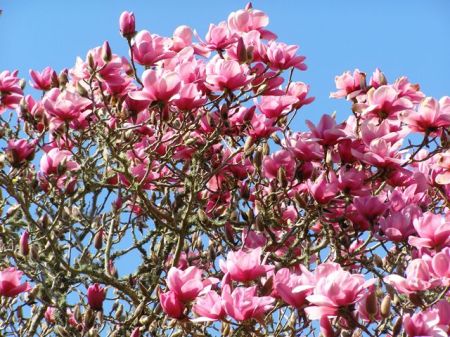
For us, Serene in full flower heralds the last chapter of the magnolia season each year. It is the latest and the last of the Jury magnolias to flower. It is also the pinkest. This is another of the series named by Felix Jury back in the early 1970s and the original tree now stands around six metres tall and is pyramidal in shape rather than spreading. In full flower, it is just a mass of large rosy pink bowl-shaped blooms.

001Being so late to flower, Serene is an excellent choice for people in colder areas or prone to late frosts. It also tends to miss the worst of the equinoctial winds. Cold conditions will make the plant adjust to blooming even later but Serene does get its flowers through before its foliage. We are picky here – we want deciduous magnolias to mass flower on bare stems before the new season’s leaves unfurl. When the leaves do come, they are a particularly good deep green and tidy in form so Serene stands out as a good summer foliage plant in a way in which few deciduous magnolias do. It will also set a flush of summer flowers which is bonus territory.
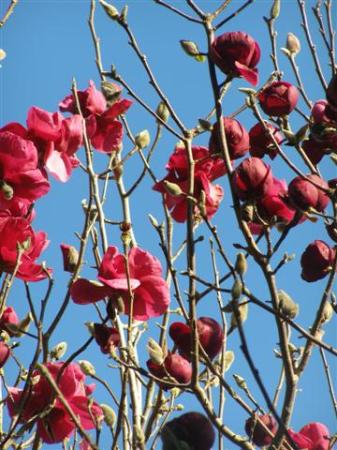
Serene was another of the series Felix bred using his wonder breeder parent, slightly embarrassingly named Magnolia Mark Jury. Its other parent is liliiflora.

Tikorangi Notes – a blue sky day in Taranaki

Magnolias Black Tulip and Felix Jury on a blue sky spring morning in Taranaki, Monday August 23, 2010

Magnolias Black Tulip and Felix Jury on a blue sky spring morning in Taranaki, Monday August 23, 2010

We tend to take our blue as blue skies for granted here, especially in mid winter or early spring as it is now. New Zealanders also tend to take red magnolias for granted, not realising that the sheer intensity of colour we can get here is unsurpassed elsewhere and that most of the breeding of red magnolias has taken place in this country – in fact much of the work was done in this very garden here – Jury Magnolias charts the journey.

Magnolia Diary 14, February 19, 2010

Click to see all Magnolia diary entries

Click on the Magnolia diary logo above to see all diary entries

Magnolia alba - hardly spectacular flowers but an intoxicating fragance

In our southern hemisphere summer, Michelia alba is in flower. One could never describe alba as being in full flower – it just gently flowers over a long period without ever putting on a mass display. We planted it near our swimming pool so it could perfume the air in the summer months but as it grows ever larger, we are wondering if we have made a mistake. After about eight years, it is already around eight metres tall and showing no sign of slowing down. It has splendid foliage for those in warm enough climates to grow it and the flowers make up for their rather understated (almost insignificant) appearance with their heady fragrance. We have never seen any evidence that alba is fertile, either as seed parent or pollen donor and lean to the belief that it is likely that there is only one clone in existence and that is sterile. We have champaca (believed to be the seed parent of alba on the premise that alba is most likely a natural hybrid) which has attractive colour in the flowers but the forms we have seen are scruffy as garden plants.

Michelia alba, in the centre rear of the photo, has lush foliage but is growing at an alarming rate in our garden

Michelia alba, in the centre rear of the photo, has lush foliage but is growing at an alarming rate in our garden

Mark’s Fairy Magnolia Blush (the first of his michelias to be released) is also summer flowering but these are random blooms which lack the colour of the main spring season. We have decided that the move to lump all magnolia relations, including michelia and mangletia, into the magnolia group is not helpful so we are going to remain with the former nomenclature at this stage. Mark is of the view that michelias are a distinct group which warrants being kept separate. As far as he knows, nobody has yet proven that they can successfully cross michelias with magnolias, or indeed mangletias although some have claimed hybrids. We will wait for proof because we doubt that it is possible to achieve crosses between distinctly different groups without scientific intervention.

Many of the deciduous magnolias are summer flowering at this time but we never get particularly excited about these. They are bonus flowers, tucked in amongst the foliage, and they lack the impact of the spring flowering on bare wood though it should be said that Black Tulip has put up some fine dark flowers this year. Iolanthe, Apollo and Serene all have summer flowers – in fact most soulangeana hybrids will do so. With our very strong sunlight (blame the depletion of the ozone layer along with our clear atmosphere) summer flowers tend to burn.

Summer flowers on Iolanthe

Magnolia Serene has stand out dark foliage. Generally speaking, the foliage on deciduous magnolias does not excite much interest and in summer, most of them are just green trees with relatively large leaves. But when we cast our eyes around a number of trees in our garden landscape, Serene stood out as having deeper colour and appearing glossier than the others nearby. We think it has considerable merit as a specimen tree for its summer foliage as well as its form and spring flowering. Some magnolias stand the test of time and this is one of Felix’s where we are surprised that it has not been picked up more widely in the marketplace. With its later flowering (ref Magnolia Diaries 11 and 12 to see the flowers) it should perform well in cooler climates.