Tag Archives: Mark and Abbie Jury

A love-hate affair with rose bushes continues

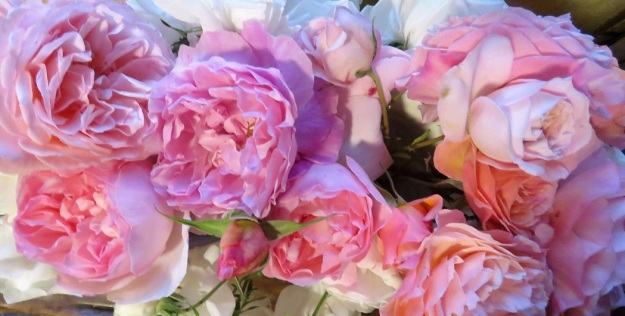
Is there anything lovelier than beautiful, soft, fragrant rose blooms? Not for me the stiff, hybrid tea types. I will leave those for others. But the David Austins are so deliciously voluptuous that I just want to bury my nose in all those scented petals. In a vase. And therein lies the rub.
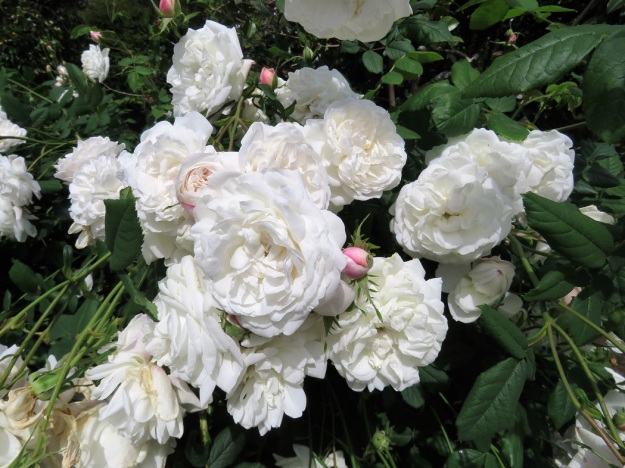
The rose garden here is on borrowed time. It dates back to Mark’s mother who had a love affair with old fashioned roses and it has undergone several makeovers in the decades since. But it just doesn’t work aesthetically. We are not a good rose climate here – humid and high  rainfall without enough winter chill to kill off the greeblies, fungi and diseases that afflict roses. Our rose garden is too sheltered which restricts air movement. One of the beds is now too dry and the competition from the roots of our massive rimu trees nearby are an issue. Mark has always refused point blank to spray roses, being of the opinion that they must thrive on their own merits.

I have tried. Oh I have tried. I was recommended varieties by experienced rose producers and growers and I have crowd sourced others. Alas I have pulled out and burned more roses for poor performance than any other plant I have had to buy. After 20 years, I am going to cut my losses this winter and pull out the central beds that surround our sunken garden.

Not all will be burned. Fortunately we have large vegetable gardens, but not a picking garden as such. A couple of years ago when I was getting discouraged at  the underperforming, defoliated, ugly rose bushes, I dug some out and Mark planted them in a row in one of his veg gardens. He has several. Veg gardens, that is. The rose bushes with the most gorgeous blooms can be added to that row. It does not matter there if they have black spot and are defoliated and ugly. I can go and pick the blooms when I wish. But only those with gorgeous blooms will be relocated to this position.

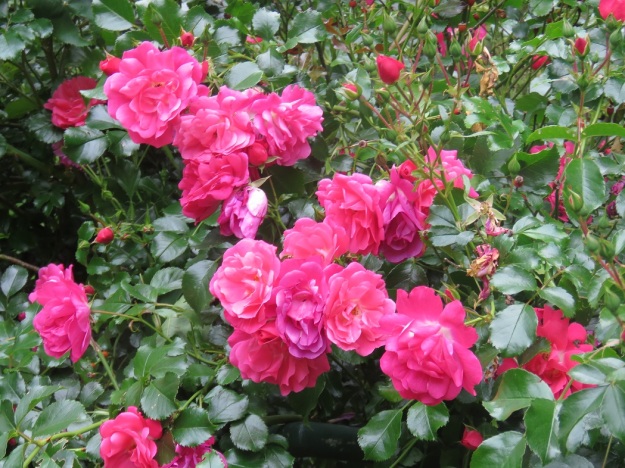
It is very, very pink is Rose Flower Carpet Pink but just look at that foliage. Superb.

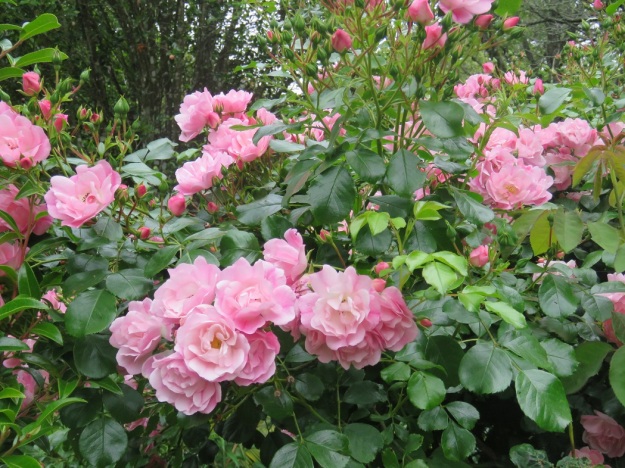
Rose Flower Carpet Appleblossom – a prettier pink, still with good foliage though it does not flower as long through for us. The white version flowers all year round, however.

Not all the roses are a dead loss. What the Rose Flower Carpet series lacks in individual flower form and scent is more than made up for in fantastic performance throughout the season and brilliantly healthy foliage. They are what we call *good garden plants*. Not blooms for cutting, but all-round garden performers.

Mme Plantier, I believe?

Madame Plantier is only once flowering but I can forgive that for her month or so of glory, her gorgeous scent and healthy foliage. There is one super healthy rose that I think is a David Austen but I have lost its name – again lush, strong growth and very good blooms in apricot pink. That one is to be relocated and trained as a climber up a pergola pole. Though as the pergola is not yet built, it may have to go to temporary quarters. The white rugosa, Rosa Blanc Double de Coubert, stays a healthy bush for us though there are more prolific bloomers in the rose world.

The central borders in the grass are to go. This may take a year or so.

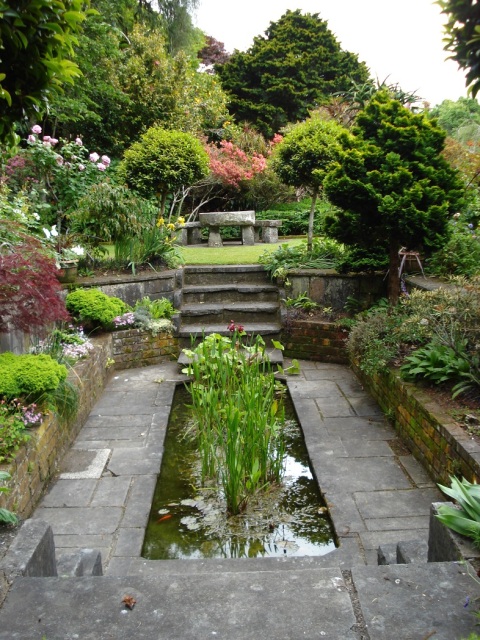
The sunken garden, seen here at its tidiest, is to be the feature without the distraction of the borders

The so-called rose garden here is the area of the garden where I have put in the greatest effort  over the last 20 years. And while it has times when it looks pretty enough, I have come to realise that it is also the one area of the garden that I really do not enjoy maintaining at all. In fact, I avoid it as much as I can which is an indicator that all is not well. A landscaper friend looked at it recently and immediately suggested that we pull out all of the central borders that edge the deep, marble and granite sunken garden. “Feature the sunken garden,” he said. “The borders just detract.” I had to think about it for a while. But he is right. It was just a bit of a shock after all my efforts down the years. More on that in the future. We can’t do much going into summer but mentally I am relocating the plants that are worth saving and discarding the rest.

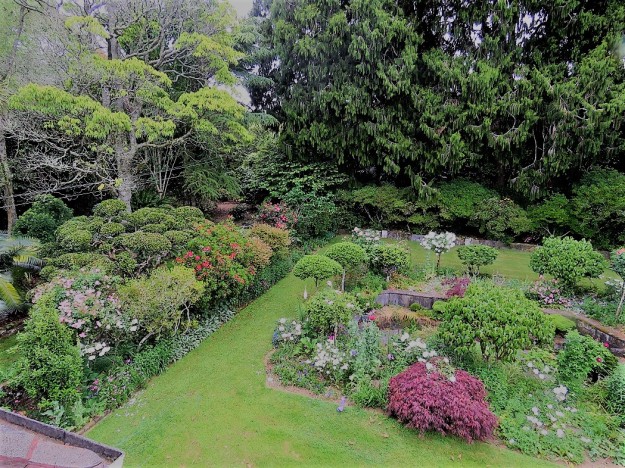
And I am mentally remaking the one border that we will save but renovate which runs along to the left. It is the garden we look out to from a favoured late afternoon seating position. Not a lot has changed in the nine years since the photo above was taken. We are still often to be found in the same seats in the same location. But it is a good reminder of why we want that one border looking good with a high level of plant interest, because we see it often.
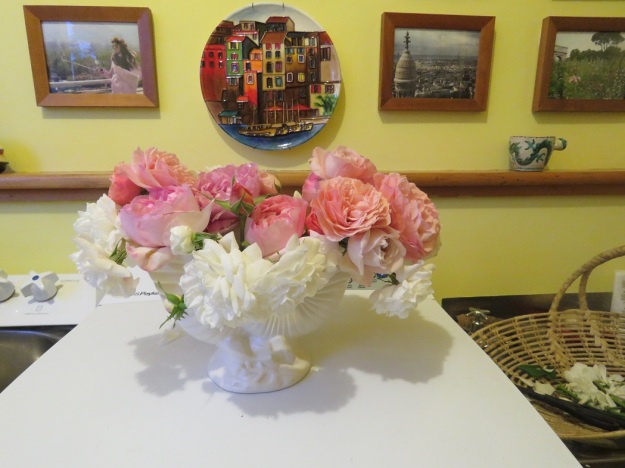
“Doing the flowers” in the laundry. I only show this for overseas readers because I love my laundry room, a space much favoured in NZ and Australian houses that does not seem to be adopted as widely in other parts of the world. I can’t imagine living without a separate laundry room.

My new weeding friend

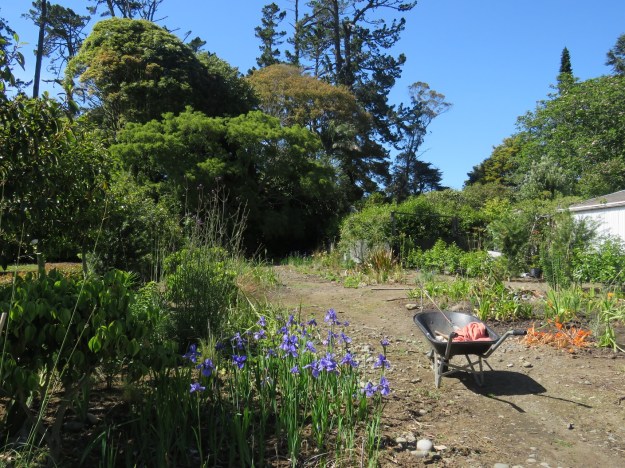
The weed growth in this new area under development was scary after a few weeks of spring

I have a new weeding implement and a very good one it is too. Meet my little Wolf-Garten Multi-Star Cultivator Weeder LBM (I wrote the full name down from an internet search). It is my new best friend.

Having been away to Australia, then coming home somewhat unwell followed by other demands on my time, the weeds in my newly planted borders were threatening to get away on me. With my trusty weeding armoury, I made short work of quite large areas. It was the little cultivator on the long handle that covered the area quickly and efficiently. Unlike a hoe, it does not cut the plant off and being very narrow, it can get in close to plants without damage. It is only 7cm at its widest point.

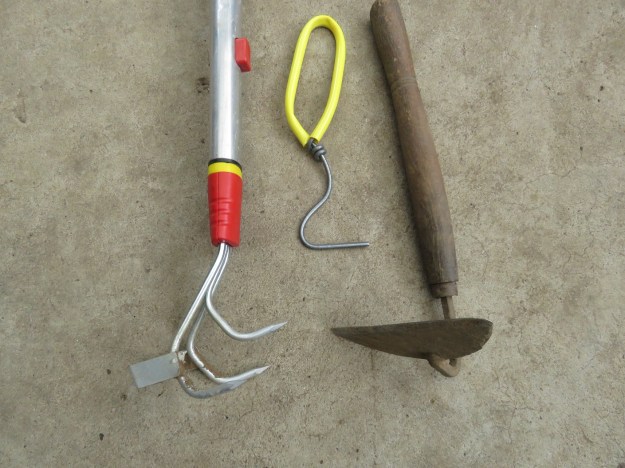
My new Wolf-Garten cultivator, the modest Wonder Weeder and my short handled hoeing implement deal to most weeding situations

One weeding tool does not suit all situations. This cultivator makes short work of scuffing up the surface and dislodging the weeds where soil is friable or there is mulch. It is no good on compacted soil. It also needs to be used before the weeds have set seed and is best on a sunny day so the dislodged weeds shrivel and dry in the sun. As long as they haven’t reached the seeding stage, the weeds do not need to be removed. It is so easy to use, saving bending and stretching, that weeding is not something to dread. A quick follow-up the next day despatched the few weeds that had escaped the first round. If you have similar conditions, buy one is my advice.

Where the plants are closer together (these were newly planted areas that I was speeding around with my cultivator), I resort to the hooked wires known in this country as Wonder Weeders (cheap as chips at under $5 when I bought another three at the garden centre last week). In the case of compacted ground with club moss, liverwort or clover, I use the short-handled implement that looks like a small Dutch hoe. You can get long handled versions of the Dutch hoe to avoid having to bend or kneel, but I am fine with the precision of my short version.


The new baby cultivator and its full-sized companion on the left and the trusty old Planet Junior to the right

Mark is a push hoe man (the Dutch hoe is pulled towards the user whereas the push hoe is pushed away from the user) but it takes some skill to be a reliable operator and it is all too easy to accidentally sever desirable plants from their roots.  Where there is more space to move, such as in his vegetable patches (known here as Mark’s allotment), he will reach for his trusty old Planet Junior that makes quick work of surface cultivation or the big granddaddy cultivator relative of my new, small version.

What about weed sprays? Mark follows the international debate and research on glyphosate (the active ingredient of Round Up) with reasonably keen interest. When Round Up hit the outdoor maintenance world in 1974, it was seen as saving the equivalent of a labour unit and it changed attitudes to weeds in the garden. Being seen to be weed-free became mandatory for “good” gardening. Mark has used a fair amount of it over the years to maintain our gardens and wider property. With the huge volume of glyphosate that has been used throughout the world over 43 years, if it was the worst thing since Paraquat, DDT and the likes, we would expect there to be more compelling evidence but it is not an open and shut case. That said, caution is always advisable and I worry about its use as a desiccant on commercial food crops.  Certainly, Mark has hugely reduced how much he uses it, which has seen us returning to some older, tried and true methods of cultivation.

I would comment that with the amount of conflicting evidence on the safety of glyphosate, we are a little concerned about what is mixed with it to give the near instant knockdown capabilities of the over the counter, ready to use spray dispensers that are widely sold. Glyphosate used to take up to three weeks in cooler weather to kill weeds and there are various plants that are resistant to it. Those ready-mixed spray cans can kill within hours. When I used to write for the newspapers, I was sent samples of two different such sprays called “Weed Weapon” with ‘breakthrough technology’. I rarely use them but they are both scarily easy to use and efficient at killing plants, even ones that I would not expect them to knock out. The combined effects of glyphosate and saflufenacil are much greater than glyphosate alone.

Compacted soil, the result of years of no surface cultivation and likely use of weed spraying for maintenance – not our garden.

In terms of garden maintenance, repeated use of weed sprays as routine control leads to soil compaction and the growth of liverwort which we find unsightly. We are guilty of judging open gardens on their visible use of weed sprays for maintenance. But then we are subscribers to the school of soil cultivation and mulching when it comes to gardening.

With the growing antipathy to chemical controls for weeds, we may need to revise the aesthetic value placed on weed-free gardens. Even my new-found cultivator friend has its limitations. But weeding a little often is probably the best way to go for most keen gardeners.


Clipping the michelias

Starting on the left – the annual clip

This is what it will like when done – freezing the size of the plants in time with an annual clip

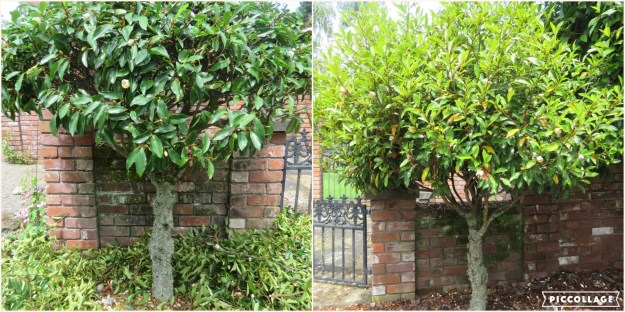
We have a row of lollipop michelias at our entranceway and it is time for their annual clip. Yes, one annual clip is all they get and we are maybe three weeks late on doing them this year. I did not intend to start yesterday, having other things planned. Besides, clipping the michelias feels like a Big Job. Well, it does involve a ladder for the taller ones.

I timed myself yesterday. It takes me 30 minutes a plant to clip with secateurs and to rake up the clippings. That is not long for annual maintenance on what are significant feature plants. You could do it faster with a powered hedge trimmer or even hand clippers but you lose the precision. Besides, I don’t like using the hand clippers because each time they snap shut it jars my wrists and the residual carpel tunnel syndrome I nurse in those joints.

Aesthetically speaking, cutting with secateurs means there is no leaf damage whereas the speedier clippers or hedge trimmer will cut almost every external leaf which will then discolour on the damaged edges. It is also easy to reach in at the time and remove dead wood and do a clean-up of the interior of the ball using secateurs and the finished result is less… brutally shorn, shall I say?

Most michelias can be clipped hard, especially these hybrids of Mark’s. The two smaller ones here are an unnamed hybrid from his breeding programme while the taller ones are Fairy Magnolia Blush. I have planted two Fairy Magnolia Cream in the vehicle entranceway to the left which will, over the next few years, be trained to lollipop standards.

Michelias are magnolias, just a grouping within that wider family. That is why Michelia yunnanensis has been renamed Magnolia laevifolia by the experts. Our position of continuing to refer to them as michelias is on shaky ground botanically but we find it a useful differentiation in common parlance. It is a handy point of difference to the big leather-leafed Magnolia grandiflora types which are what most people think of when evergreen magnolias are mentioned. Our agents chose to brand Mark’s hybrids as “fairy magnolias” to mark out that difference.

Magnolia laevifolia  (aka Michelia yunnanensis) defoliating in wet, cold climate

The aforementioned species, Magnolia laevifolia, is a lovely plant in bloom but not always the best garden plant. It has a tendency to defoliate in a wet spring and we have certainly had that this year. This plant is not in our garden. I photographed it at Pukeiti. It is neither dead nor dying. Nor is it deciduous. It has defoliated in the wet and that is a characteristic of this particular species that is not to its credit. Not far along the same track is a fine specimen of Mark’s Fairy Magnolia ‘Blush’ which, we were pleased to see, shows no tendency whatever to defoliate, even in the hard growing conditions of Pukeiti Gardens.

This is what Magnolia laevifolia looks like at its best, seen here in my friend Lorri’s garden 

As a piece of advice for local gardeners, if you into clipping camellias – and we clip a few now as feature plants as well as camellia hedging – the time to do it is right now. If you leave it much longer, you will be cutting off all next year’s flower buds.

We have renamed the area of our garden we used to refer to as “the park’. It is now The Meadow

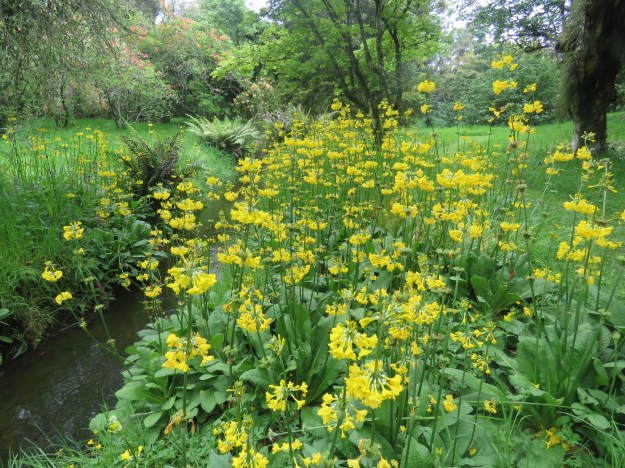
Finally, for a spot of colour, may I give you a host of golden primulas (not daffodils) in our meadow garden by the stream. It is just common old Primula helodoxa but so very pretty in its season.

But where are the panda bears?

Our stands of giant bamboo are a never-ending source of disappointment to us. That is because they are enduring proof that the cargo cult does not work. The cargo cult is that school of thought that says “build it and they will come”. We often see it espoused in this tourist backwater where we live. Build a café/gondola/light rail/cruise ship terminal/tourist hub (strike out any which do not apply) and visitors will arrive. Well no panda bears have arrived here, is all I can say. I even checked that they eat Phyllostachys edulis – it is not their favourite bamboo but they will eat it.
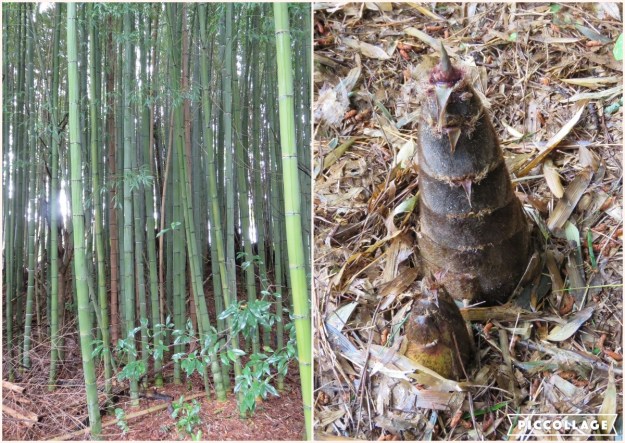
We have one stand of giant bamboo confined on a small island in the stream where it cannot leap for freedom. The other is on a boundary and each spring we have to dig out the new shoots which pop up across the boundary fence. They grow extremely rapidly and would colonise the neighbour’s paddock if left to their own devices. This is Phyllostachys edulis and the second word is a clue – it is edible for humans as well as panda bears. There are many edible bamboo varieties – 110 out of 1575 known species. Apparently.

I tried blanching and freezing a few shoots last spring time and they stored well. Bamboo shoots are not exactly full of rich flavours and are more of a subtle and textural addition to stir-fries. My home prepared version is easily equal to tinned bamboo shoots, maybe superior because I keep them slightly crisper. This spring I am preparing more because I can see they would be a pleasant addition to salads and platters as well.

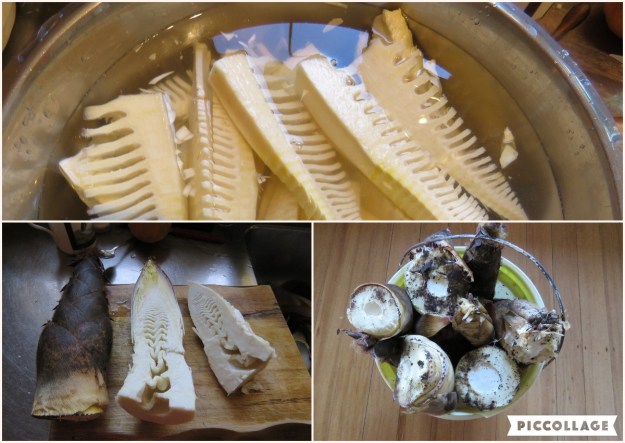
Top photo – prepared shoots waiting to be blanched. Bottom right, a bucket load of fresh shoots only yielded enough for 14 meals. Bottom left – the shoot is sliced lengthwise and then peeled.

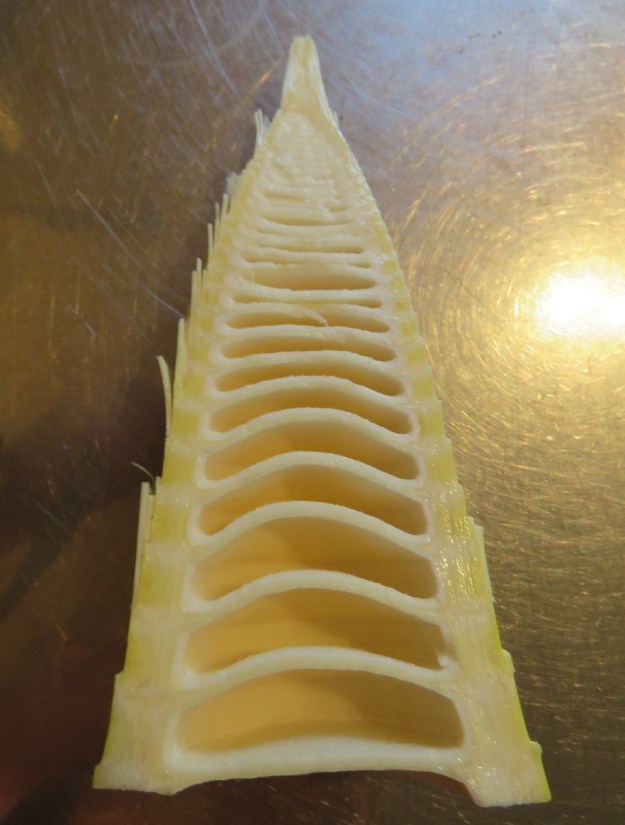
Mark brought in bucket of young shoots and it yielded 14 packages for freezing – each being more or less equivalent to a standard sized can. They are easy to prepare. I slice vertically and then peel off the outer layers until just the lattice centre remains. At this stage, as Mark said, they rather resemble a pagoda in form. I slice them into centimetre thick lengths.

The pagoda look of a fresh bamboo shoot

I checked the internet for recipes. Bamboo shoots can be bitter and are not palatable fresh and raw. But I covered them with cold water and added a tablespoon of sugar, bringing them to the boil and simmering them for about eight minutes. I then discarded that water and covered them with fresh, cold water and a couple of teaspoons of salt. They were then brought back to the boil for another couple of minutes, then cooled and packed in meal-sized quantities, adding a little of the cooking brine. They are in the freezer. That is all it took. The bamboo season is but brief and we are eating freshly freshly blanched baby shoots this evening with dinner.

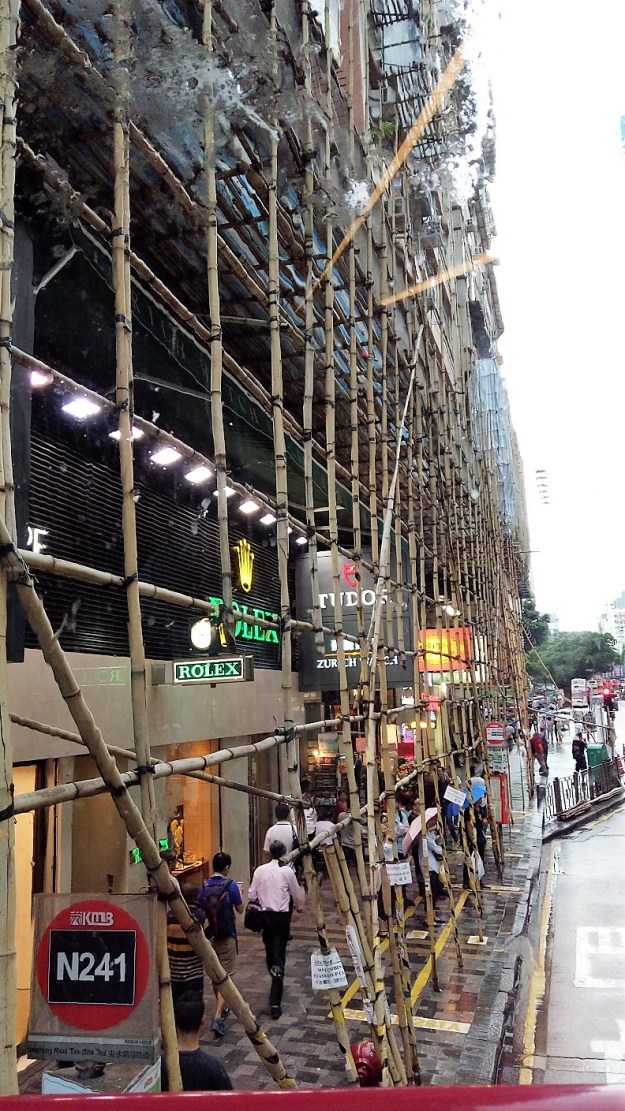
Bamboo scaffolding on a Hong Kong street

Each time we transit Hong Kong, we pause in awe to admire the bamboo scaffolding that often encases high rise buildings. It seems unlikely that Health and Safety inspectors in the western world would ever accept the use of bamboo scaffolding but it has a proven track record and would be a great deal lighter and easy to assemble and move than the heavy pipe scaffolding used in this country.

Vegeconomy

This scene reflects experience and resources

Vegeconomists are people who suggest that the poor should be growing their own food at home. I had not heard the word until it came up on social media this week but boy, I have heard the sentiment. Often. Usually in the context of, “What is wrong with these people? Why don’t they just get off their chuffs and plant potatoes and cabbages in the garden to feed themselves?” (Can you tell it is election time in this country and one of the big issues is the rising incidence of poverty and the growing gulf between the rich and the poor?)

There are many, many good reasons to grow your own vegetables but saving money is not usually one of them. And I would bet that the judgemental vegeconomists I have heard on this matter have not actually done it themselves. Or if they have, it was when the world was a very different place forty years ago and they are now speaking with a rosy glow of smug nostalgia.

Just one section of Mark’s various vegetable patches

It is not impossible to save money growing your own veg but it takes experience, timing, the right conditions, planning and a fair amount of good fortune. And good land. I dispute that you can save money on a square metre of garden and a few pots. Mark is of the view that it is possible to save money on winter salads. We eat salad every day, fresh from his garden, and the daily fresh greens and other raw ingredients would indeed command a premium in the off season at the supermarket or greengrocer. Mark has been vegetable gardening since we moved out to a country cottage the first year we got married so he brings over four decades of experience to the edible garden. These days, with more time and a lifetime of resources, – including things like moveable cloche frames, a propagation house, bird netting and plenty of posts and poles to hold the netting up, a fully functioning compost heap plus a small tractor to cart the compost if more than a few barrow loads are needed, along with plenty of good land with good shelter – yes, these days his vegetable gardening is very productive.

Sorting the apples for winter storage (in the second fridge)

We have also learned which vegetables and fruit store well and how to eat with the seasons. And that involves a deep freeze and a second fridge. We ate the last apple from autumn this week, the last frozen asparagus from November 2016 and I think there is only one packet of frozen broad beans left though there is still plenty of frozen corn. We are eating soy beans instead of borlottis this year because the borlotti bean crop failed but the soy bean crop was remarkably good. There is still an open verdict on the success or otherwise of the surplus brussel sprout crop which is fermenting into sauerkraut at this very moment.

So, please spare me from glib pronouncements that people can solve their poverty related issues by planting silver beet and taties. I have a great deal more respect for those experienced growers who get out there and work with community gardens to foster a love for growing your own, or with schools to encourage children to appreciate that fresh is indeed much nicer. But the economies of mass production mean that in dollar terms, it will almost certainly be cheaper for most people to buy vegetables than to grow their own.

All this was eclipsed, I must say, by the gentleman from down south somewhere who took it one step further on social media. There was, he asserted, no reason for hunger in New Zealand when people could grow their own food and head out to the country to kill a wild goat for meat. I do not think he meant a tethered goat like this handsome fellow from up the road. I also suspect he did not get out much and maybe thought it was still 1950 when jolly practical young fellows could head out with the gun and shoot a rabbit or goat for the pot, all the while speaking with a fridge and freezer full of meat already paid for, packaged and ready for his wife to cook for dinner that night. Bah humbug.

Just for clarity’s sake – growing your own fruit and vegetables can be enormously pleasurable, tasty, convenient and healthy along with bringing better flavour and often a higher nutrition level. Just don’t expect it to save you a whole lot of money as well. And maybe stop judging the poor as lazy because vegetable gardening is just too difficult for them and planting fruit trees is not practical in an unstable housing situation.