Tag Archives: Mark and Abbie Jury

Colour themes for gardens – the single colour choice

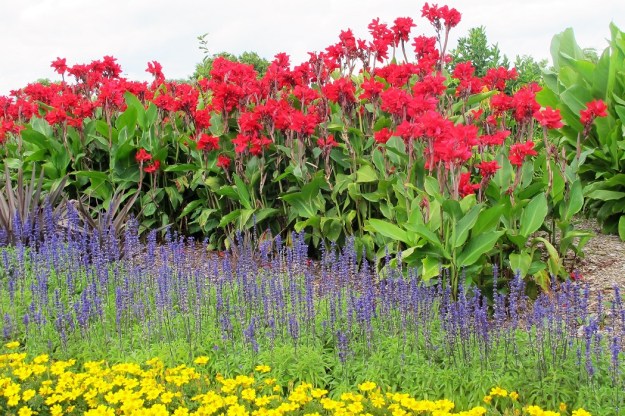
The primary colours, planted in stripes at Auckland Botanic Gardens

We are still talking colour theory at great length here. In great detail. In part this is driven by the start of the new year of gardening conversation with Tony Murrell on Radio Live’s Home and Garden Show. Tune in around 7.45am on Sunday if you want to listen live. Both Tony and I like to clarify our thoughts before we go on air and for me, that often means extended conversations with Mark, whom I have been known to call my in-house advisor or expert. This week’s conversations have been around the relatively modern idea of gardens themed on a single colour.

If you think of colours, basically a monochromatic garden is either reds, yellows or blues, whites or maybe green or black. What they all have in common is that green is regarded as colour neutral in a tightly colour-controlled garden. So whichever colour you choose, it is plus green. White, however, is not colour neutral in a colour-themed garden.

I have nothing more to say about white gardens that I have not said already. Except to reiterate that the most effective white gardens that I have seen are comprised of heavy flowering white perennials, sometimes mixed with annuals or biennials – so summer gardens at their peak. For a list of previous posts on white gardens, skip to the end.

The ‘black’ garden in the village of Giverny. Need I say more?

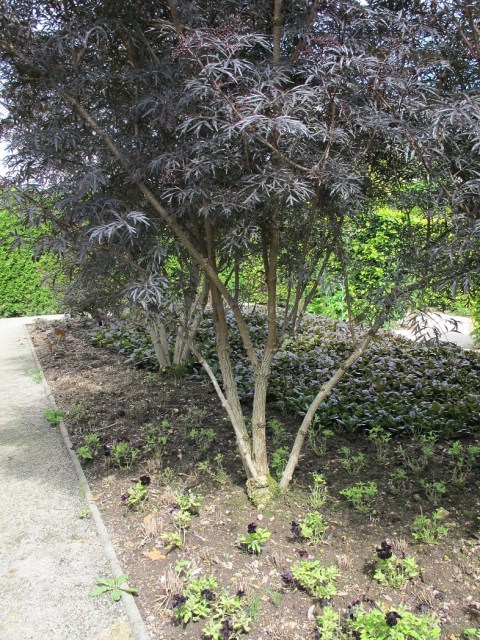
Black gardens? Way better in theory than in practice and even then it will still be a novelty garden (you should be able to hear the disdain in my voice). I have only ever seen one and that was a public planting in the village of Giverny. It was underwhelming. I wonder if they just didn’t have the black ophiopogon (mondo grass) because it was all black pansies, dark ajuga and dark foliaged shrubs. Besides the fact that it seems extremely unlikely that black ever lifted anybody’s spirits or brought joy to their day, most plants that are described as black are in fact very deep burgundy. Leave it at the theory stage, is my advice.

I recently read an opinion that it is easier to manage a red garden than either blue or yellow. I beg to differ. And I think that comes back to the colour wheel and the role of white.

If you do a blue garden, the blues on the yellow side of the spectrum will be green-toned and therefore fit into the blue and green colour range. Those closer to red will throw to purple which sits perfectly happily alongside the blue and green tones. Add some white and you get pastel shades – pale blues, lilacs and lavenders and they all sit harmoniously in that blue colour palette.

The blue border at Sissingurst some years ago

I have seen two blue borders. The first was at Sissinghurst where we liked it much more than the famous white garden. The second was at Parham House in Sussex and it had been freshly renovated and was lovely. I am of the view that you can never have too much blue in a garden but that is personal taste.

The blue and yellow borders at Parham House

A similar scenario sits with a yellow garden. Head to the blue side and it is in the green shades. Head to the red side and it introduces orange. Add white and it is simply a paler hue of the same colour. I have only seen one example of an all yellow garden which may be a reflection on the unfashionable status of yellow and orange at this time in history. It was okay. Not stunning but fine and done well at Parham House again.

A random sampling of red foliage and blooms

Red is different. Pure reds are rare. Most lean either to the blue side which gives the purple and burgundy hues or to yellow which gives orange. Add white and you get a totally different colour – pink. There is no way I can see pinks as ‘pale red’. Then there are the many reds that are really closer to brown. I am not a fan of brown flowers, personally.

The red borders at Hidcote Manor Garden

I have seen two red borders – the classic red border at Hidcote and Alan Trott’s red border at his garden near Ashburton. Both were mixed borders and red foliaged shrubs mostly lean to the burgundy shades. That dominance of burgundy, even with splashes of scarlet, can seem quite sombre to my eyes. It comes down to taste.

Similarly, all green gardens can seem a bit gloomy to me, but I am writing this on a grey, rainy day. I can’t complain because we need the rain. Our rain deficit this summer is such that we are still an official drought area, but when I look out the window, the green does not look restful so much as sombre. To me, it is bold colour that lifts such scenes.

I am not convinced that it is as easy as some folks think to plant a monochromatic garden. At least not one of a high standard horticulturally and visually. I think it is easier to go to a two-colour garden (+ green, of course) but more of that next time. However, should you still hanker for a single coloured garden, I have one bit advice gleaned from looking at gardens created by some excellent horticulturists and skilled gardeners. Don’t be too slavish in your dedication to a single colour. Sometimes a flash of another colour can lift the whole scene. A splash of bright pink in a blue border maybe. Or a spire of blue blooms in a yellow garden. How  about the bright orange bloom of a canna lily with burgundy foliage in a red border?

Earlier posts on white gardens:

White gardens for the new age

Shades of white in the world of flower gardens 

White frou frou

The perils of the monochromatic colour scheme in gardening 


We be diggers here.

Rain after the drought

It is raining here which is a relief, for once. North Taranaki, where we live, is not known for droughts so over two months without significant rain was heading to critical territory. Mark was worrying about fire potential because we have chosen to leave grazing pasture long and also in the meadow with all its very dry material. Taranaki is better known for flooding than fire.

We have been lucky to have fairly gentle rain to soften the ground first. The problem with drought-hardened ground is that torrential rain just flows across it like a sheet of water, without being absorbed. It has been interesting looking at the absorption of the rain so far. Where the ground is compacted, yesterday’s rain had only soaked the top centimetre or so. But the areas of garden that are extremely well cultivated and friable have absorbed the water right down.

We are diggers here and still like to work the soil. I have always been a bit suspicious that the current craze for no-dig gardening might have more to do with people not wanting to exert themselves on the end of a spade or shovel. I am particularly dubious about those who use the death toll of worms cut by the spade as an excuse not to dig when all the while, they will sit down to a dinner of tasty steak. Chances are that it was more traumatic for the beef beast, lamb, pig or even chicken to be brought to the dining table than for the occasional worm that had its tail cut off or met its end for the digging of the garden.

The other reason I often read is that digging should be avoided because it ‘destroys the structure of the soil’. Certainly you don’t want to be bringing the substrata and clay layers to the top, but you can dig without doing that.

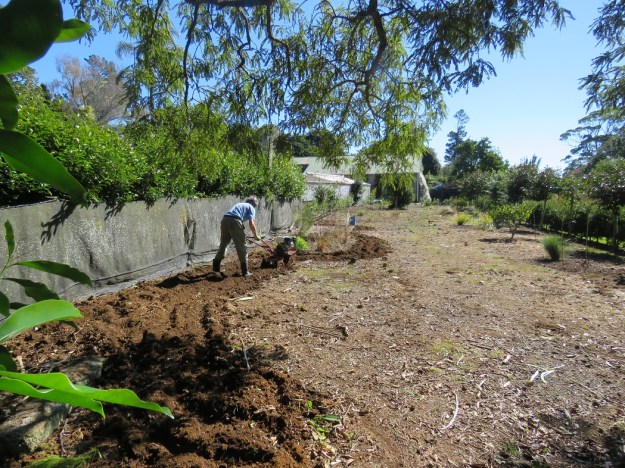
Rotary hoeing one of the new borders to break up heavily compacted ground

Mark has always dug his vegetable gardens, on the principle that vegetables need to be able to get their roots out as easily and quickly as possible in order to grow well. We have applied the same principle to the new gardens we are making. They are on ground that had been heavily compacted over the years, covered by weed mat and nursery plants for about three decades with every centimetre tramped over repeatedly by heavy-footed humans. Mark rotary hoed it for me first. I then raked and contoured the beds, digging yet again when it came to planting. We mulched some of it after planting but ran out of both compost and wood mulch so some areas missed out.

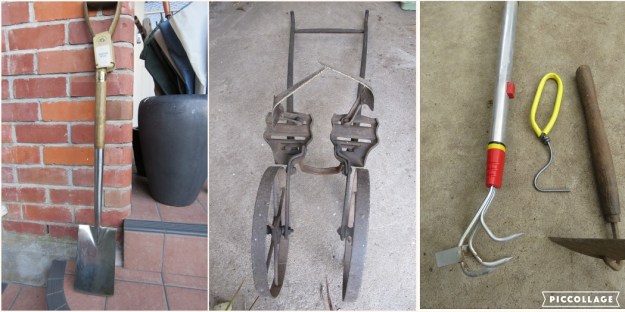
In the time since, I have gone over and over the bare surfaces with my little Wolf-Garten cultivator, scuffing off the germinating weeds. The thing about thick layers of mulch is that they suppress germination but do nothing to kill the dormant seeds that can last a very long time in the ground. I like to think that every round I do that dislodges germinating weeds is another rash of unwanted seeds dealt to. It should save time and effort in the long term. Mark has been saying in encouraging terms that the layer of loose soil on top that I am constantly cultivating acts as something of a mulch layer, protecting the deeper layers from drying out so quickly.

Left to right: my excellent Joseph Bentley border spade with its oak handle, Mark’s prized Planet Junior that he uses to cultivate the soils in his vegetable patches and the smart Wolf-Garten cultivator

The rains have also demonstrated clearly that the very well cultivated and friable areas have benefited the most with their capacity to absorb far more moisture. We will remain diggers here in areas where we are growing perennials, biennials and vegetables and some of the areas with bulbs. Established trees and shrubs do not benefit from having the ground beneath cultivated, but many other plants will reward you with increased vigour and improved performance.

Treat yourself to a decent spade, is my advice.

Earlier related posts include ‘The answer, as they say, lies in the soil’ on the importance of getting your soils right for healthy gardens and ‘Raised beds and to dig or not to dig, that is the question’ which I wrote before it even occurred to me that digging has the added benefit of enabling the ground to absorb a great deal more precipitation.

As a postscript, I googled ‘diggers’ and came up with this Wikipedia entry. “The Diggers were a group of Protestant in England, sometimes seen as forerunners of modern anarchism and also associated with agrarian socialism and Georgism.” Not that we are Protestant. Nor do we see ourselves as radicals, let alone anarchists but we have some sympathy for those early socialist principles and a belief in a more egalitarian society. Diggers we will remain.

A gardening year in retrospect. 2017

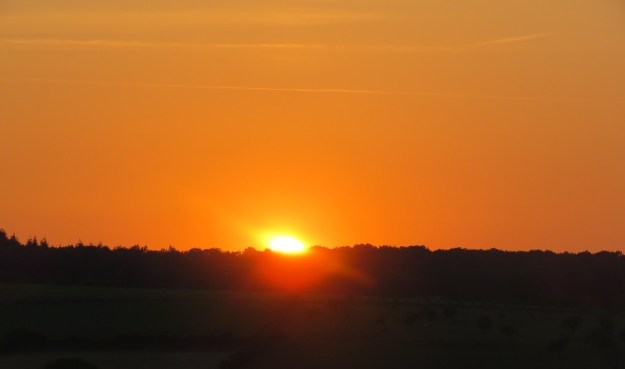
Sunset in Camembert. I am not joking . There is a village of that name in Normandy and I took this photo on a day in late June when the temperature hit 40 celsius. We nearly melted. The cheese did melt.

In all my years of garden writing, I am not sure I have ever looked back on a year just past. Looked forward, yes. Often. But reflecting back – not in the written word until now. Has 2017 been particularly distinctive in gardening terms? Not in extreme terms, but it has certainly been a very full gardening year.

The best gardening book of my year, without a doubt, was the collected columns of contemporary English garden writer, Tim Richardson. Titled You Should Have Been Here Last Week, it was full of thoughtful and opinionated gems and is a book that is worth going back to read again. For me, it eclipsed the gentle collection of Dan Pearson’s gardening columns, ‘Natural Selection’ which had its own charm but became a little heavy going after a while. I have not seen any New Zealand gardening books to recommend. But I can whisper that I have at least started work on my own, after a year or two’s procrastination.

New Zealand is left high and dry when it comes to TV gardening too and we keep going back to Monty Don and BBC Gardeners’ World. We were not instant Monty fans but have grown to really enjoy his delight in his own garden and his measured approach. I say that even after discovering he has two paid gardeners to assist behind the scenes. Gardeners’ World has been around since the beginning of time (or 1968, so coming up to 50 years) and still delivers quality gardening advice and insights in a low-key style that we appreciate.

While on media matters, a personal highlight has been getting to know Auckland garden designer and current garden media celeb, Tony Murrell. We have a weekly conversation on his Home and Garden Show on Radio Live but even more extended conversations off air. It is a rare privilege to work with someone who is a complete professional in his public life, full of enthusiasm, ideas and delight which carries over into his life off the airwaves too.

Breakfast in Tivoli. Bought in the local market and taken back to our AirBnB

We live in the country so I like to travel and to seek experiences and ideas beyond our self contained little patch of this world. Mark, not so much. In fact, he only participates in my advance planning in the most desultory of ways. But when I crank him out of the country, he is a marvellous companion who focuses 110% on the experience. Our trip to Italy, Normandy and England this year was a real highlight for us. It was my third trip to Italy, Mark’s second and we both fell in love with the place in a way we have not before. Mark credits AirBnB which put us right in the heart of the old town of Tivoli and gave us a far more personal connection to the locals than staying in a hotel can ever do. And while getting to Sermoneta was a traumatic experience that might have driven less staunch couples to divorce , staying there was a delight. Seeing the incidental wildflowers at Villa Adriana, the wonderful old olive grove and experiencing the classic architectural lines of the golden mean visible there were truly memorable, even in the heat.

Garden highlights were Le Jardin Plume in Normandy, the pond and the simplicity of the plantings in front of the villa at La Torrecchia (which, despite being in Italy, is early Dan Pearson work) and the privilege of being able to explore and experience the famed Ninfa Garden all alone and at our own pace. All confirmed for us that our gardening hearts lie with the gentle naturalism of more contemporary styles that is so evident in the approaches taken by many modern European and British garden designers. We have a long way to go in New Zealand in learning to garden so that we walk more lightly upon this fragile environment of ours and see beauty in Nature and her serendipitous ways.
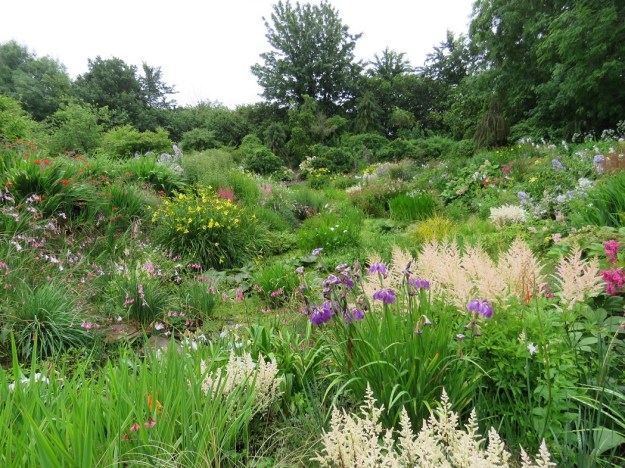
Wildside Garden – still a major highlight for us second time round

When we reached England, we felt we were on more familiar ground. Because we travel so far and pack a great deal in to what are generally just three week excursions, we don’t often go back to see gardens that we have visited before. But on this occasion, we chose to go back to both Bury Court and Wildside and neither disappointed. These are two of the most exciting private gardens we have visited – gardens which delight at the time, stay in the memory and are a rich source of inspiration for how we garden at home. On this trip, we were also privileged to see a private garden that is the work of Dan Pearson and, on the day we visited, as close to a perfect domestic garden as we have ever seen. We can learn from every garden but sometimes it is a revelation to learn from the work of somebody who is at the top of their field right now.

The unexpected highlight of the English section was looking at the work coming out from Sheffield University landscape department and Nigel Dunnett in particular which we saw at the Barbican, at Olympic Park and at Trentham Court. Do a net search on Pictorial Meadows if you want to see more of the commercial work coming out of Sheffield. It is glorious.

The Sheffield style is at the extreme end of naturalistic gardening with lower inputs, low intervention, working in cooperation with the environment and ensuring that plantings enhance eco systems rather than imposing them upon the natural environment. But they generally lack strong design elements which are what give definition and longevity in a gardening environment.
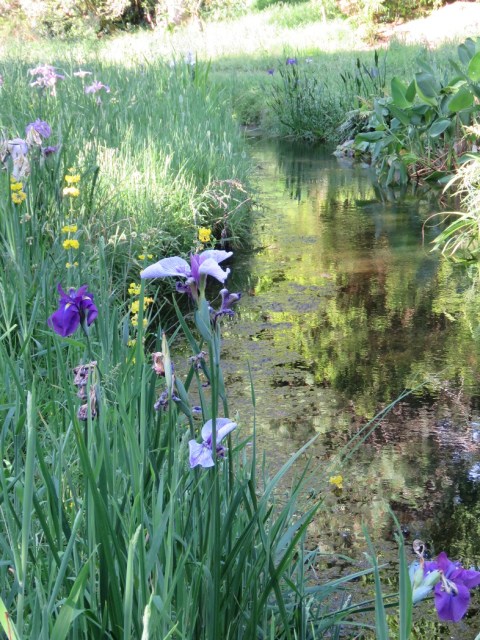
Our meadow where we have reached some level of sustainability and consistency

At home, we have been focused on bringing together elements of the new naturalism style, meadows, sustainable practice and soft-edged romanticism that appeal to us but within a stronger design framework and working in an established garden with a fair swag of notable, long-term trees. Our meadow is progressing beyond the experimental stage as we have refined the low-input techniques we use to manage it and it is a real joy to us. The next step is to look for plants that will enrich the diversity and add visual interest beyond the spring peak. Mark finds the addition of larger flowered, dominant perennials or annuals out of step with the natural look so we are assessing resilient small-flowered options that we can naturalise without creating an environmental disaster of weed potential.

Not our garden. I have this filed under ‘meadow mistakes’ – using an overbred hybrid in a natural setting

Mark’s gardening efforts this year have been dominated by food production and seeing to what point he can keep us self-sufficient in a vegetable-rich diet. It takes a lot of time, effort, skill and space to be this productive and even then the grains and tropical fruits remain on the shopping list. We could, I guess, go without the tropical fruits but we are not that purist.

I have never grown a vegetable in my life and have no plans to start. But I have had a great deal of active pleasure, starting the plantings in our newest garden area which we currently call the Court Garden – on account of the large green space in the middle of the design which currently looks like a somewhat unkempt tennis court but is destined to become a meadow through the seasons in the style of Nigel Dunnett’s Sheffield School plantings. This is former nursery, maybe an acre or more in area.

Mark recently described this new garden area to a neighbour as our last lunge – a major development that we need to do before we get any older and the hard physical labour gets beyond us. In a mature garden, even a very large one such as we have, it is a different experience to be faced with bare space, full sun and open conditions. Years have gone into its planning and it will still take more for it reach the glory we plan. We have also factored in how we integrate this new and different area into the established garden we already have.
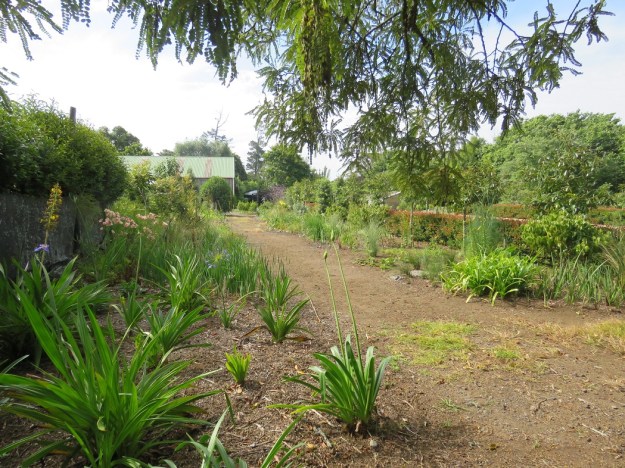
One of the double borders in our new area in its first spring

The court garden, started from a blank canvas

It is a development that we simply could not have done without the accumulated experience we have gained through our gardening lives. It also draws heavily on the inspiration and observations from our gardening travels. And it is possible because of the expertise gained in years of nursery work and Mark’s foresight in setting aside plants and growing them on in field conditions so that we could bring in the framework trees and shrubs as an advanced grade without having to spend money on buying them. We could not have afforded to do it if we had to buy the plants because it takes a lot to furnish a space as large as this.

I have loved developing parts of this area this year and seeing it start to come together as it grows. Mark, too, has been delighted by my efforts because he had not found the time or motivation to start the detailed filling in of spaces himself. I am delighted that he is delighted with my efforts because, in gardening terms, I will always defer to him as the senior partner here.  Will there be an end result? There will come a point when we feel ready to show this new garden to other people but gardening to us is always an active process with no plans for an end result. If we found no pleasure in the process, we would lose interest very quickly.

Finally, on a practical level, I recently raved about my new mini cultivator. It is terrific and I use it often. We have never gone in for all the whistles and bells of garden implements so we are VERY late to the scene with the Niwashi weeder which was a Christmas gift to me. And now, all I can say is, how did I manage so long without one?

An antipodean Christmas greeting

It took a pocket full of dog biscuits to persuade our pair to pose for a festive snap down in the meadow. From left to right, Sharon, Kevin, elderly and deaf Spike and food-focused Dudley at the front. The story of how and why the reindeer are known as Kevin and Sharon is a family joke that may well be lost in the retelling.

I had always regarded our Christmases as a traditional affair – our own traditions adapted for an antipodean summer season – the preparation, the food, the protocols of how the day must proceed. We are lucky in that our children continued to place a high priority on coming home for Christmas well into adulthood, even when it meant exorbitantly expensive, festive season, international airfares. I figured that they came home for those very family traditions.

But times change, and this year only one could get back. And it made me realise how our family traditions gently evolve, particularly with regards to food. Mark and I are about 90% vegetarian nowadays but returning daughter made it very clear that the Christmas ham was non-negotiable. When I realised this, it created a problem. Of all the meats, the industrial production of pork distresses me so it had to be a free-farmed ham. It was a mission, I tell you, to find a free-farmed ham that was not so large that it would feed 40 people. I think I may have found the last small sized one in town. I was triumphant.

It was doing the final Christmas shop that made me realise how much we had changed the way we eat. We are determinedly reducing the amount of packaging and plastic that comes into our house. And apparently our taste buds change. So that final shop was heavily focused on tropical fruits and good cheeses. And a better class of wine than we used to drink when we were younger and poorer. While we produce the greater part of the food we eat these days (and at least the raspberries are our own), the likes of mangoes, pomegranate and tropical pineapples are beyond us unless we build a tropical house. Nor do we have the right climate to produce peaches and apricots that are shipped here from drier parts of the country with hotter summers. This is now a household that is light on chocolate and junk food, very light on meat but we can offer plenty of good cheese and fruit and wine! And ethical ham….
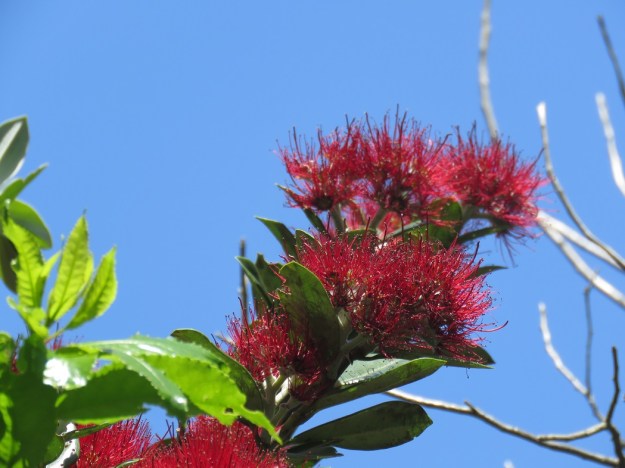
Seasons greetings and may your festive season be full of laughs, love, companionship and good cheer.

A New Zealand Christmas post would not be complete without a photo of what we call the New Zealand Christmas tree that grows all round the area where we live and flowers at this time – our pohutukawa or Metrosideros excelsa. We prefer it to the prickly holly.

Reflections on dyed water and dead water.

Dyed water at the Barbican in London

On my computer, I have a small file labelled ‘dyed water’. I take these photos because each time I see dyed water, it makes me pause to raise my eyebrows. So I was interested to read a blog by a British colleague strongly advocating black dye, based on her personal experience. Black dye appears to be the choice of those people who want sharp reflections, blue dye appears to be the choice for those who believe water looks best when it is blue – albeit synthetic blue.

Every experienced gardener knows that water can be problematic although it is highly desirable in a garden. Lucky are those with natural springs which do not dry out but are strong enough to feed a small lake with a constant supply of fresh water. A flowing stream or river can also be a huge asset though brings a raft of issues with variable flows and flooding. Failing these, you end up having static water. This can be set up as a small ecosystem which is relatively self-sustaining with plants and aquatic life but there will be times of the year when algae grow and the water is likely to be green some of the time. I note that most of my blue dyed water photos are ponds with plant life. Clearly the two are not incompatible so it must have been the colour of the water that worried the gardeners in charge based on a curious perception that all bodies of clean water are blue.

The black water reflecting pool at Veddw in Wales would not work in our climate. Mosquitoes!

Bury Court with black water in 2014 on the left and in 2017 when the owner had stopped dying it and most of the colour had gone. I failed to ask how deep the pool was which would affect the reflective qualities but there was little difference to pick except a slightly more natural look in 2017.

Or you have what Mark calls dead water.

I have always raised my eyebrows at expensive water features that require a full filtration system to keep them pristine clean. If you are going to all that trouble and expense, you might as well have a swimming pool in my view. Mark describes it as the corporate building look. Or, apparently, you dye your water to hide the natural colour and any debris. This is never going to work in our climate where we have to have either moving water, treated water or ecosystem ponds with fish. Any still water simply offers a breeding ground for mosquitoes to make summer wretched.

Is the term ‘dead water’ an exaggeration? Not according to Mark who speaks with passion on this topic. “You might as well have a bare area of tramped earth that you spray regularly with Paraquat,” he declared to me over our afternoon cup of tea. “Environmentally, a dyed water pond with nothing living within it is the same.” He was thinking of feature black ponds that exist for the purpose of reflections only, where any interruption by living plants or pond life will disturb the clarity of those reflections.

I have only ever seen one incidence of dyed water in a New Zealand garden where there was a natural pond full of life with artificially blue water which I really did not think added anything to the scene.

Reflections in our swimming pool. We are rarely dead calm here so they have a shimmer.

We have a swimming pool so we have 65000 litres of treated water (though we swapped to a salt filter some years ago). Because I have a particular dislike for the bright blue pools that may have been California’s gift to the world, we decided to make our pool black. In the event, the plasterer was too mean to add sufficient black colouring to the mix, though I did not realise that was the issue until long after he had gone. We ended up with a pool that is on the dark side of mid grey. Visually it is interesting. We get reflections in it and we get considerable colour variation in the water – many hues of blue through to grey as it reflects the sky. All natural colours.

Dyed water at Tintinhull in Somerset

Whether blue dye or black dye is used is a matter of aesthetics. The issue of colouring outdoor water with a chemical mix is the same. I had a look at the supplier’s website and they are a little sparse on technical detail so I couldn’t work out whether it is simply the dark water that stops plants being able to photosynthesize or whether there is an algicide added. Were I to contemplate dying any bodies of water here, I would be wanting to know that detail rather than just accepting generalised assurances of safety.  I admit I did not do an exhaustive analysis of their entire site but the technical sheets were not helpful.

To Mark, it represents dead water because the purpose is to create a mirror effect and the solid colour of the water appears inert. To me, it seems like a statement of man or womankind’s dominance over nature. It says, “You got the colour wrong, Nature. But I am going to fix that.” It is that philosophical divide between those who see gardening as controlling nature and those who see gardening as working with nature. We prefer the softer-edged focus of a cooperative relationship. I am pretty sure it should be possible to create a reflective water feature without having to dye the water but it comes down to matters like the depth of the water, the materials and colour used for the construction, the location and maintenance.

Perhaps the final comment on reflecting pools belongs to the garden we visited where the owners  had gone to huge expense to install a long reflecting pool with a full filtration system (the sound of the filter humming away was distracting) – only to then install a lavish fountain in it thereby disturbing the surface of the water and breaking up the reflection. There seemed to be something lost in the implementation of an idea.

This water was green, very green, at Butterfly Springs in China. Would it have looked better dyed an unnatural blue?