Tag Archives: Mark and Abbie Jury

Garden thoughts

Just another heavy transporter passing along one of our road boundaries. A particularly noisy one this Sunday morn.

I garden. A lot. So I have a lot of solitary thinking time. Never more so than this week when it has taken every ounce of my inner strength to maintain some equilibrium in the face of relentless heavy traffic from the gas well site on the farm across our bottom road. The company is ‘demobilising’ the workover rig that has been on site and that has generated as much, maybe even more, heavy transporters along our two road boundaries than at the peak of the bad days from 2011 to 2013. Once the rest of the rig gear has been moved out, the ‘well stimulation’ equipment will all be trucked in for four weeks of intensive fracking and flaring. Super! Yes we still carry out open air flaring and extensive fracking in this country. Worries about climate change apparently lie with somebody else, anybody else – a concern divorced from current, high-level activity.

This is why our garden is still closed to the public. Fortunately my coping mechanisms are better than they were during the bad old days, but it does take a lot of mental energy to keep some positivity and inner serenity, I tell you. Especially for one who is not naturally of a serene disposition.

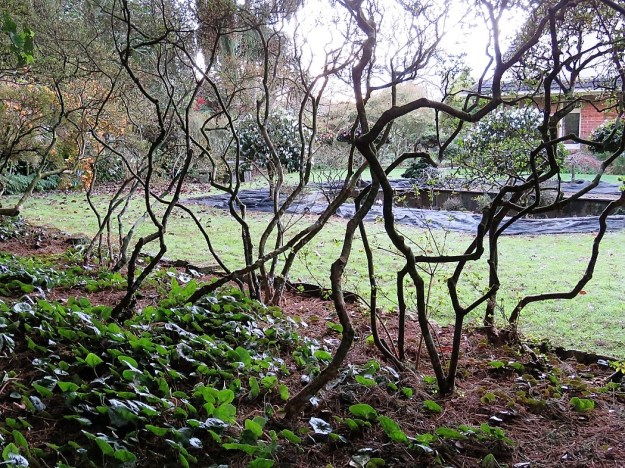
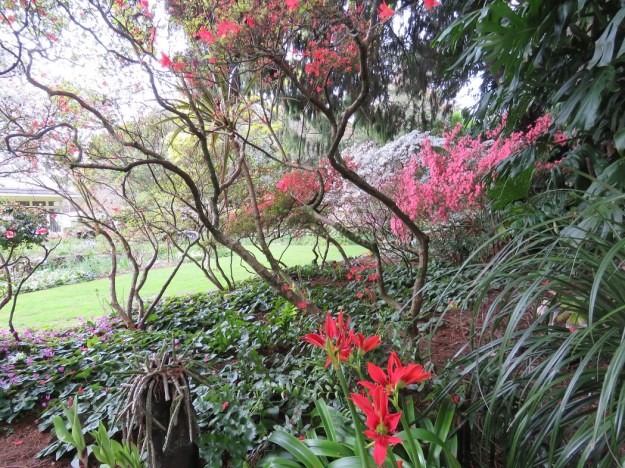
The gnarly trunks of the aged Kurume azaleas. In the background, Mark has draped old shade cloth over the newly sown areas of grass to discourage the pesky rabbits and sparrows.

Back to gardening. I mentioned last week that I was doing a clean-out of the Rimu Avenue. I still am, though I have broken the back of it and am now working more on the margins, including the bed of venerable Kurume azaleas which are underplanted with cyclamen. This is another area that can be left pretty much to its own devices for extended periods of time but it looks better when I get in and clear out the regenerating growth from the base of the azaleas, take out dead wood and shake out the accumulation of leaf litter from the trees above that builds up in the canopy.

It is not really self-sustaining gardening. More like lower-input gardening. For those who like a bit of substance to your gardening reading, you may enjoy Noel Kingsbury’s latest post on the subject of so-called ‘natural gardening’. He is an English writer and a specialist in that new wave style of perennial gardening led by Piet Oudolf.

We have never talked about ‘natural gardens’. Naturalistic, yes, and we have played around with various other descriptors. Enhanced nature, romantic gardening, gardening WITH nature rather than trying to control it but maybe the one we use most is sustainable gardening. We try hard to reduce the negative inputs (spraying, chemical fertilisers, really high input labour practices, use of internal combustion engines for routine maintenance and suchlike). For us, sustainable gardening is also about being able to manage this place as we get older in the next couple of decades. We have no plans to leave in our old age. I anticipate that, like his father before him, Mark will be carried out in a wooden box and hopefully that will not be for another 20 years. So we have to be mindful of how we manage our acreage and what expectations we have of the garden.

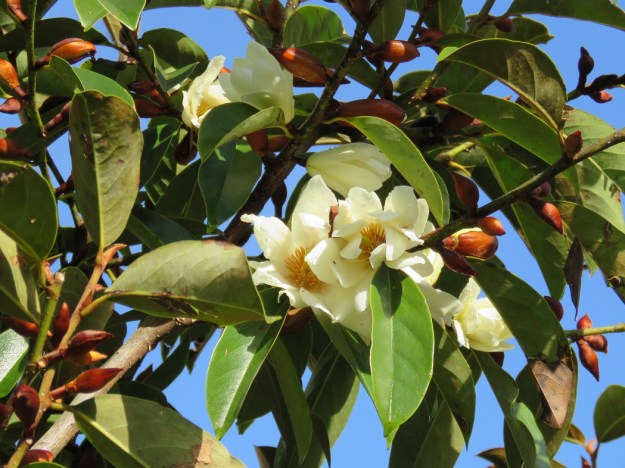
Fairy Magnolia White has opened her first, fragrant blooms this week.

Mark sees it in simple terms. He thinks that we all like to be surrounded by pretty things and that is why he loves flowers and always has done. It is the prettiness – sometimes even astounding beauty – combined with nature that feeds his soul, and indeed mine.

It is perhaps the dearth of homegrown gardening TV programmes and Monty Don and BBC Gardeners’ World taking a break from our screens that drove him to start recording ‘Best Gardens Australia’. This is not gardening as we see it. In fact it has very little indeed to do with gardening. The plants are mostly added in the manner in which scatter cushions and a stylish throw might be added to complete the picture of a stylish sofa. It has a heavy infomercial component and big budget outdoor spaces, mostly dominated by the mandatory swimming pool, additional water features, hard landscaping on a grand and permanent scale (no matter how small the site) and… pavilions. Garden sheds, washing lines, wheelie bins and storage for bikes are not in evidence, but pavilions rule supreme. Along with ‘resort-style living’. In New Zealand, resort-style gardens tend to mean the intimacy and tropical look of small, Balinese hotels. In Australia, it means something very different – the Miami look of lots of stark, hard-edged white plaster and concrete.

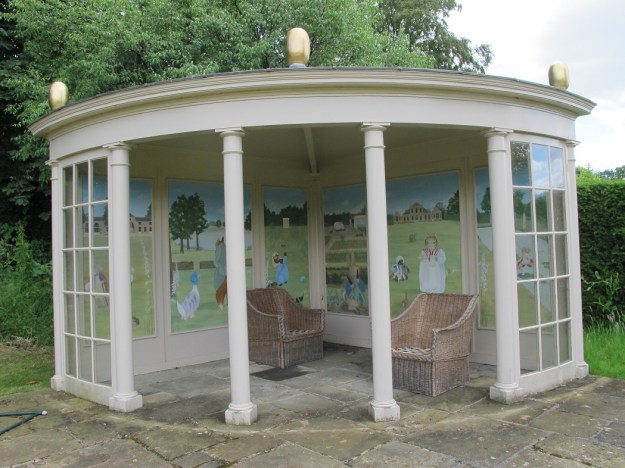
The children’s summer house in a handsome Yorkshire garden

England has its summer houses and garden rooms and very charming many of them are, too. In New Zealand, we are generally more modest and less permanent and the gazebo is most common. I am not a fan of the gazebo as a general rule, with its tanalised pine construction and trellis decoration. We call them gazzybows. They are usually bought in kitset form and too often used as a ‘garden feature’, rather than to enhance the outdoor living experience.

The typical off-the-shelf gazebo

I am not sure at what point a gazzybow crosses over to a pavilion. I suspect you need a budget at least 10 times larger (maybe 20), space in similarly inflated proportions and block or concrete construction (plastered, of course). By the pool. With a full second kitchen, a dining set that can accommodate a minimum of 12 people to a sit-down meal and a barbecue that can roast all the cuts of meat from a beef beast to feed the many (many) friends that the pavilion owners have assembled. Mark was a bit stunned by the pavilion shown with a drinks fridge that would rival most upmarket hotels.

Never have we felt more like the poor relatives across the Tasman than when faced by the ostentatious wealth of ‘Best Gardens Australia’. We are more in synch with the gardening philosophies of the aforementioned Noel Kingsbury.

French style. My photo library is entirely lacking in images of contemporary Australian pavilions.

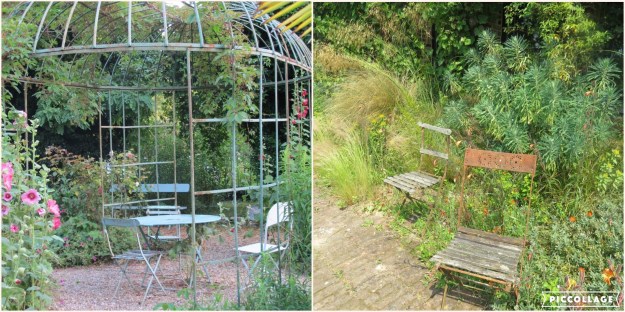
So in the spirit of sweeping generalisations, I tell you that if you are a modest New Zealander, you have a gazebo. If you are nouveau riche Australian, you have a pavilion. If you are British establishment, you have a summerhouse or garden room. If you are French, you have a little, aged, shabby chic café table and chairs.

Finally, the late afternoon light falls upon our maunga or mountain on the winter solstice – a sight which keeps us anchored firmly to this place where we live and garden.

The times, they are a-demandin’ change

Currently a bit forlorn, but give it a few months and it will look very different

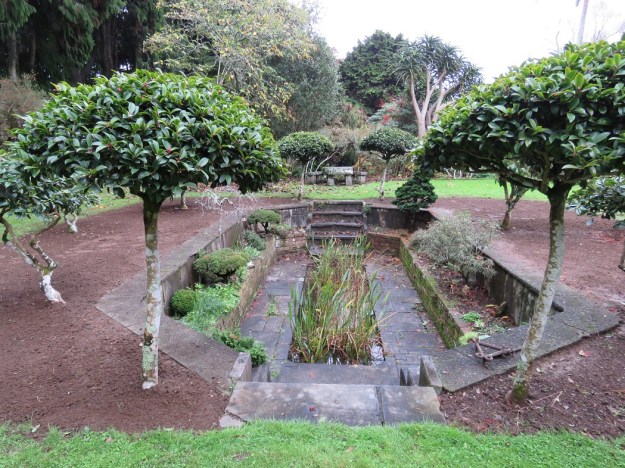
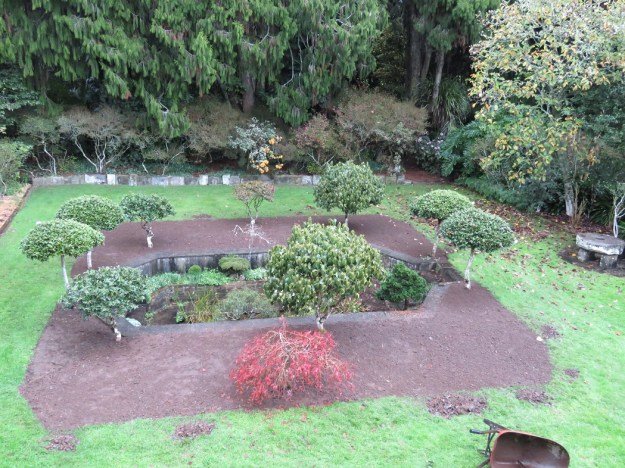
The rose garden has gone. Gorn forever. Henceforth this area will be known as the sunken garden. Because the centrepiece is the sunken garden area – Felix and Mimosa’s DIY colonial Lutyens effort, as I have described it. It is all fashioned from granite, marble and brick. Mark once water blasted it and it came up an alarming shade of white.

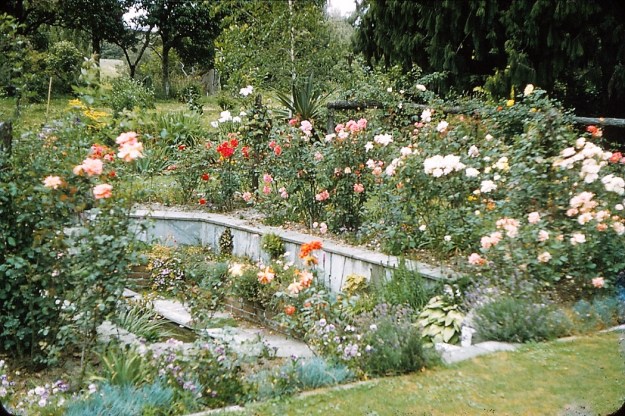
An undated photo but best guess is around the mid 1950s. The marble lining is still white

I, too, could get it looking pretty but it took a lot of work and it didn’t stay looking pretty for long enough to warrant the effort

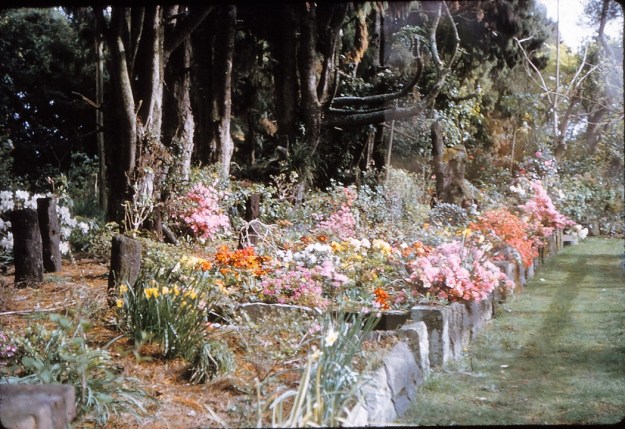
It was the rose garden because it used to house Mimosa’s old rose collection. I think I can recall it as being fantastically opulent, voluptuous and romantic with the air hanging heavy with scent – but only for a couple of weeks in spring. The rest of the time, it could look pretty scruffy. By the time I came onto the scene here in the eighties, it was already past its peak.  This particular garden has probably had more attention lavished upon it in the last 30 years than any other area. Major makeovers, not just regular maintenance. At least four major makeovers that I can recall doing myself. And no matter how hard I tried, it looked okay in winter, really pretty for a few weeks in spring but scruffy in summer and autumn. I could not keep it looking good all year and it finally reached the point where I avoided looking closely, preferring to skirt around the outside rather than walking through it.

We have a date on this photo – 1961

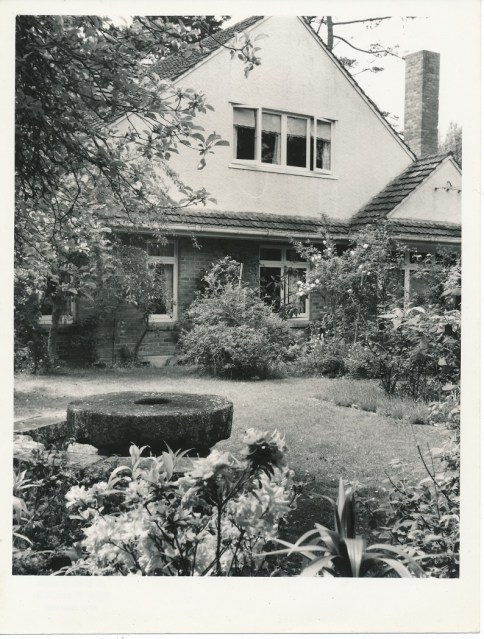
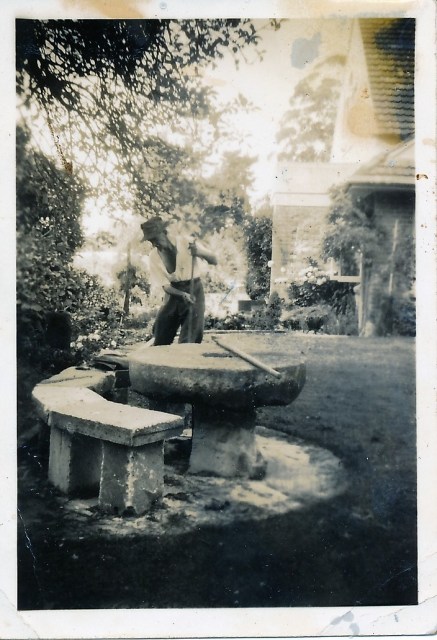
Felix, down  to his woollen singlet but still wearing his tweed hat putting in the stone millwheel table and benches. The wheel is the inner, turning centre of the mill, used for grinding papa to make a low quality brick on a neighbouring  farm. Felix traded two sacks of potatoes for the wheel. The date of this photo must be mid to late 1950s

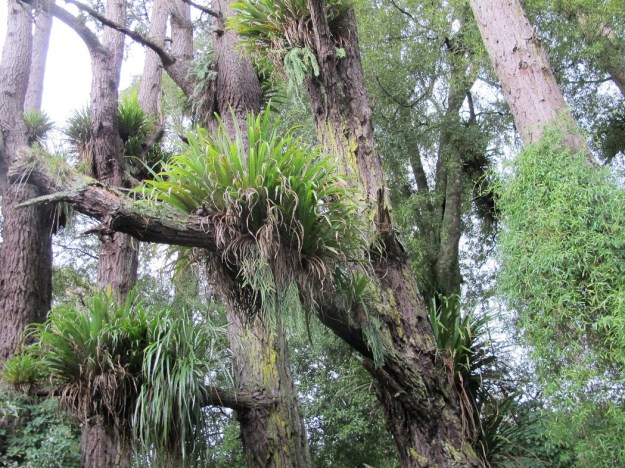
It is obvious what the problem is when I look at the old photos. When Mimosa started and had the area at its peak in the late 1950s and 1960s, conditions were very different. It was open and sunny and the plants grew without competition. In the 70 years since she started, the backbone rimu trees have doubled in size and their root systems have grown to match. Half the area is now always bone dry, sucked out of nutrients and plants have to compete with the rimu roots. The area has also become enclosed, very sheltered and the sunshine hours have been reduced by a whole range of perimeter plants.

I wrote about this area back in March  when I was into full-on stripping out. It would have been easier had I been composting the plants but I recycled most of them. It would also have been easier had I not planted quite so many bulbs through it over the years. Clearing the area was a major operation and has generated many, many more square metres of ground cover than I started with to use elsewhere. There is much to be said for digging and dividing. The good picking roses have been relocated to the vegetable garden where it does not matter that they get black spot and suffer from defoliation. I can at least pick the flowers. We do not have a good climate for roses.

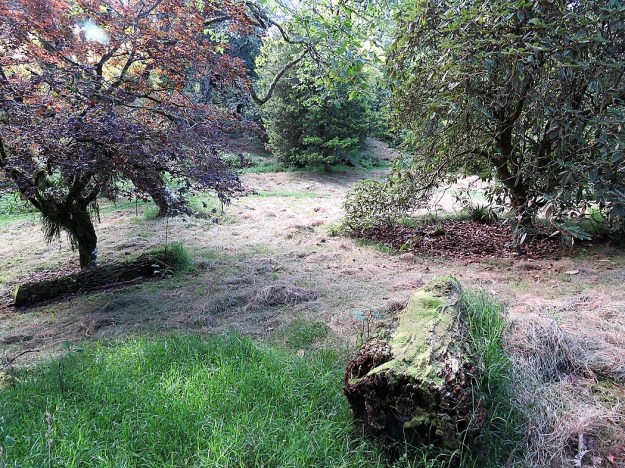
Finally, the last plants were gone at the weekend and the area was bare. Lloyd, our extraordinarily handy and obliging man about the garden, has moved in extra topsoil and raked and levelled to get it ready for sowing in grass. The eight camellias and two maples will stay and be shaped into gnarly, character, feature plants. We normally avoid growing plants in mown lawn areas and I know I will have to hand-trim the grass around the trunks but I am willing to do that. We do not like the weed-sprayed brown look of lank grass around trunks and I have no desire for the tidy, suburban look of encasing each trunk in a tidy round concrete circle planted with pansies. For those of you who want to know what the camellias are, two are the gorgeous species C. yuhsienensis, two are Mark’s ‘Pearly Cascade’ (C. pitardii hybrid) and the four standards are one of Mark’s hybrids that we never released but we refer to as ‘Pink Poppet’.
I am anticipating that once the grass grows we will have something far more sculptural to look at. And that seems a more appropriate look for the next era of this garden. Gardeners must look forward, not try forever to recapture the recalled magic moments of the past.

Again, this must be 1950s – the planting of the azalea bed that provides the far boundary to this garden, butting up to the rimu trees

Match the two horizontal branches in the preceding image to how they look this very morn. After 60 years, the trees have more or less doubled in size

The same Kurume azaleas as they look today, this time viewed looking from the other direction, underplanted with cyclamen. 

The autumn camellias

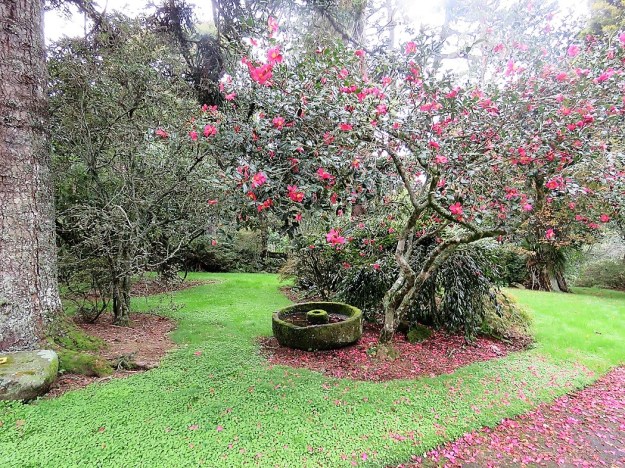
Camellia sasanqua Crimson King in prime position

When Mark returned home to Tikorangi in 1980 bringing me and our first baby bump, the name Jury was synonymous with camellias. These days Jury = magnolias, but not back then. There is a whole chapter in the family history that is headed ‘Camellias’ but it is largely in the past now. Changing fashion, changing focus and the dreaded camellia petal blight has seen to that.

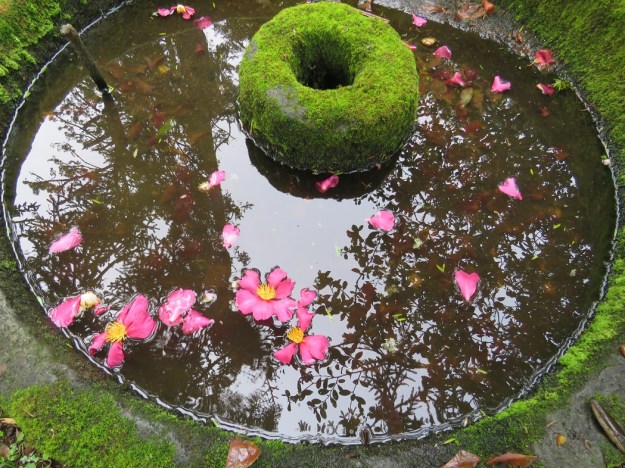
But every autumn, as the sasanquas come into flower we both derive huge delight, particularly from the Camellia Crimson King by the old mill wheel, which is just out from our back door beside the driveway. It is a picture of grace and charm.
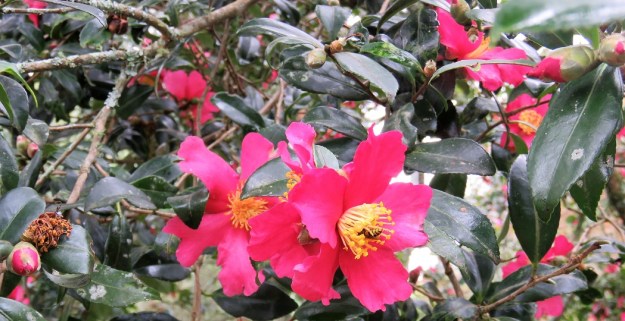
Crimson King rests more on its merits of form and position than the beauty of individual blooms

Sasanquas are the unsung heroes of the camellia family, seen mostly as hedging plants, so utility rather than glorious. But if they are allowed to mature as specimens and gently shaped down the years, they stand on their own merits. Mark declared yesterday that it is the autumn flowering camellias that interest him now, not the late winter and spring varieties. For these autumn ones do not get petal blight whereas the later varieties are now a mere shadow of their former selves, faced by the extreme ravages wrought upon their blooms by blight. Our camellia trip to China in 2016 had us concluding that our mild, humid climate with high rainfall means that we suffer worse from petal blight in Taranaki than pretty much anywhere else, really. It is nowhere near as bad in dry climates.

The history of camellias from the middle of last century onwards has some parallels to the history of tulips – all about show and showy blooms. So it was predicated on the quest for the new – extending the boundaries of flower form, size and colour, prizing breakthroughs even when the results were more novelty than meritorious. Camellia societies had enormous flower shows where the staging of individual show blooms was the focus. It didn’t have much, if anything, to do with garden performance let alone longevity as garden plants. Sasanquas didn’t fit this show bench mould. They flowered too early in the season, individual blooms are often quite small, lacking rigid, defined form and falling apart when picked.

But fashions and conditions change and these days it is the softer look of the Japanese camellia family member, the sasanquas, that makes us stop and take notice more than the later flowering japonicas and hybrids on which the earlier family reputation was forged. The light airiness and grace of the sasanquas fits our style of gardening far better than the solid, chunkiness of many of the later varieties and the autumn flowers serve as another marker of the change of season.

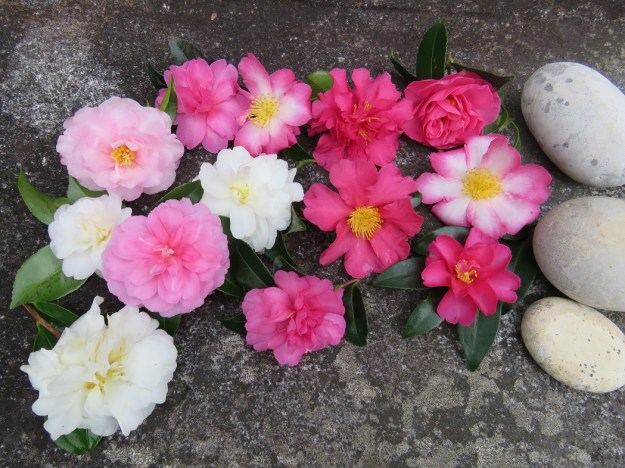
The earliest of the sasanquas here – all named varieties

I did a walk around to see how many different blooms I could pick but it is still a little early in the season and some have yet to open. Some plants we leave entirely to their own devices, some we will clean up the canopy from time to time -to take out dead wood and create an umbrella effect, two we clip tightly once a year to a cloud pruned form. With their small leaves, the sasanquas clip well. It just pays to do it soon after they have made their new growth after flowering. Leave it until late spring and you will be clipping off all the flower buds set for next autumn.

Camellia Mine No Yuki

It takes a few decades of growth to get sufficient size to shape as we shape ‘Elfin Rose’ and ‘Mine No Yuki’ but these specimens now function as distinctive shapes within the garden all year round, rather than melding into the background as most camellias do when not in bloom.

The end of the long, hot summer is nigh

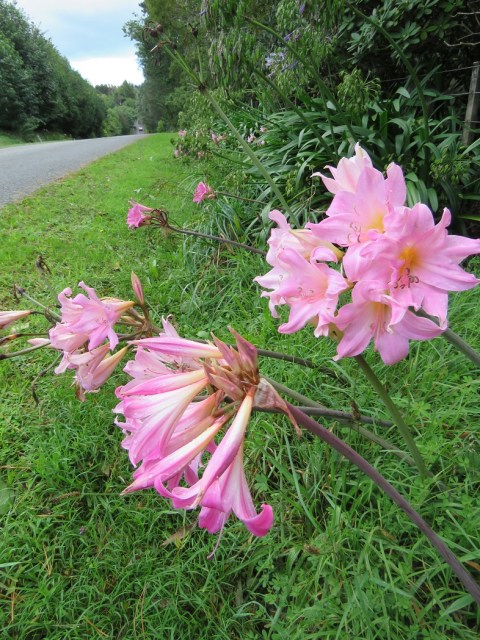
Belladonnas – a roadside flower for us

Summer continues here with temperatures in the mid to late mid twenties during the day, and often not dropping much below 17 at night. That is celsius, of course. With our near-constant high humidity, it feels hotter. Dry heat is easier to live in. But we are not complaining. Last summer never really arrived and we would have been lucky to have a single day where temperatures reached 25 or 26, rather than the three months so far this year.

Our belladonnas range from pure white through pretty pastel pink to sugar candy pinks and all shades between

What is interesting is that while the temperatures haven’t really dropped, the garden is starting to tell us that autumn is coming. The belladonnas are already past their peak, Cyclamen hederifolium is in full bloom  as is the tiny, dainty autumn snowflake, Leucojum autumnalis. Moraea polystachya has started its blooming marathon.Even the first nerine has opened and I spotted a flower on an autumn flowering camellia – C. microphylla. Haemanthus coccineus is out and the exquisite Rhodophiala bifida have already been and almost gone, their lovely trumpet blooms touched with gold dust now withering away for another year.

Cyclamen hederafolium seed down happily for us now

Some plants are triggered into growth or blooming by temperature, some by seasonal rain (we can do the South African autumn bulbs so well because we get summer rain, even in a drought year such as this has been) and some are triggered by day length. While our weather conditions are still indubitably summer, the day length is shortening and these plants are programmed to respond.

We don’t get sharp seasonal changes because our temperature has quite a small range from both summer to winter and day to night. It will be another three months before the trees start to colour. But the garden is coming out of its summer hiatus and entering autumn, whether we are ready or not.

Stachys Bella Grigio is giving up the ghost. Whiffing off, as we say.

Some plants just like to confound you. I wrote earlier about Stachys ‘Bella Grigio’, the startling white, felted variety that was so happily ensconced in a new garden. Booming away, even. It was setting so many offshoots that I thought I would be able to carpet many square metres by the end of the season. Well, it was an ‘upanddieonyou’ after all. It has been upping and dying like mad in the last weeks. Otherwise known as ‘whiffing off’ here.

I dug up a couple of wilting plants to see what was going on. They are dying from the top down. Their roots are fine. As an aside, if you are puzzled by why a plant is clearly dying, basically they die either bottom up or top down so it is always interesting to carry out an autopsy. Each of these plants was carrying 30 or more offshoots. I took off the ones with roots and have tried replanting them and I thinned out the offsets which had not yet established their own roots because it looked a bit as if the plants were smothering themselves to death in their desire to reproduce. There was no sign of insect infestation.

“It’s probably climatic,” Mark said. His thinking is that we are too humid and it has been particularly so this summer, whereas that felted white foliage is usually indicative of alpine plants. I think it is varietal. I have heard too many stories from others who have experienced specimens of this plant thriving, established and growing well before suddenly keeling over and dying. I cleaned up two plants and replanted the offsets out of curiosity. If I have to do this every year to keep these plants alive, then I am afraid I will decide very soon that it simply is not worth the effort.

We have mown the meadow for the season. Well, Lloyd has. With our special sickle bar mower, imported from Germany. We are still learning how to best manage the meadow in our conditions and Mark thinks that we are leaving the mowing too late and that it would be best done soon after Christmas for the first mow with a follow up in autumn. Maybe next year.
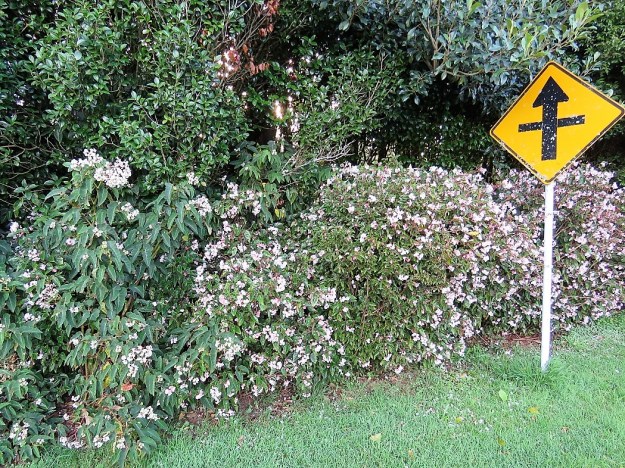
Mark has just declared that the sickle bar mower is otherwise known as the primary herbivore here. He has been reading about eco-systems and wondering what we could be introducing to NZ, given that our primary herbivore, the moa, is now extinct.

You can tell our climate is mild. We have begonias as a roadside hedge.

Requiem for a tree

Mark and Dudley inspect

I may have been a little premature in my post this morning that expressed relief that we had escaped so lightly from ex-tropical Cyclone Gita. We are still discovering damage but nothing to eclipse the mighty fallen gum tree on the neighbour’s farm.

Mark climbed down into the hole to give some sense of scale to the uprooted root ball

We know some of the history of these trees because they were planted by Mark’s great grandfather back in the 1870s. It seems likely that they were part of government-supplied seed or plants to trial alternative timber options for this recently settled colony. The early pioneers had already felled most of the accessible mighty kauri trees. We have a few gum trees, Pinus muricata and radiata dating from the same time, along with our remarkable rimu trees. He was a tree planter, was Thomas Jury, and this land had already been cleared of its native tawa when he took ownership.

Still standing

It isn’t clear why this tree fell. It was of a similar size and stature to the left hand tree and in a sheltered position. The winds were very strong but it is not as if these eucalypts have dense canopies of foliage which act as a sail in the wind. But there is a sense of sadness to see a mighty tree lying on the ground.

It must be said that the sadness to see a bit of family history gone is tinged with relief that this one is not our problem to clean up. It will be no mean feat chainsawing up this monster of twisted hard wood, even if the yield will be a mountain of good firewood.

Beautiful bark on many of the eucalyptus species