
The iconic bridge at Giverny is recognisable from many Monet paintings.
In the world of gardening pilgrimages, Monet’s garden at Giverny rules supreme. His water lily paintings, the evocative scenes of irises, beds of summer flowers in the French countryside – could there be anything more romantic? Many were inspired, we know, from his personal garden. Surely in visiting, we will be able to absorb some of this magic? Maybe.
To get maximum enjoyment from the experience, it helps to be A Believer. But be humble. You will be but one believer amongst the half million who visit over the seven months of the year that the garden is open. That is over 2300 a day.
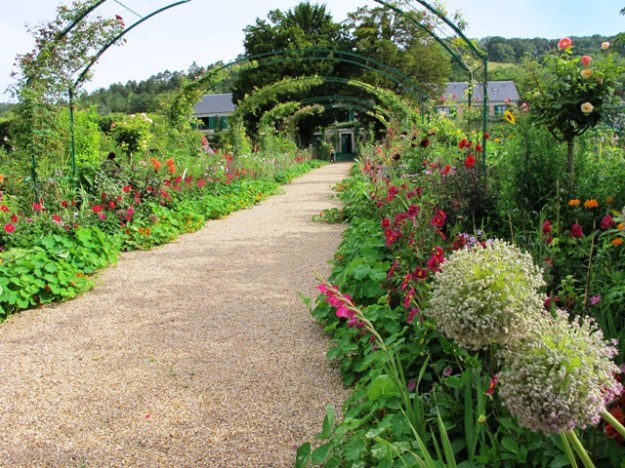
A rare sight – the garden not full of people
As we lined up for opening with our tickets pre-purchased on line, a phalanx of 95 Swiss bore down upon us in the tiny lane. We resolutely held our pole position and were directed left upon entry whereas they were headed right. This sent them to the water lily garden and us to the house gardens where we had the unusual experience of having the place entirely to ourselves for a few precious minutes. I even managed some photos without people in them but this state of affairs was not to last and soon equal numbers were pouring in from the top entrance too.
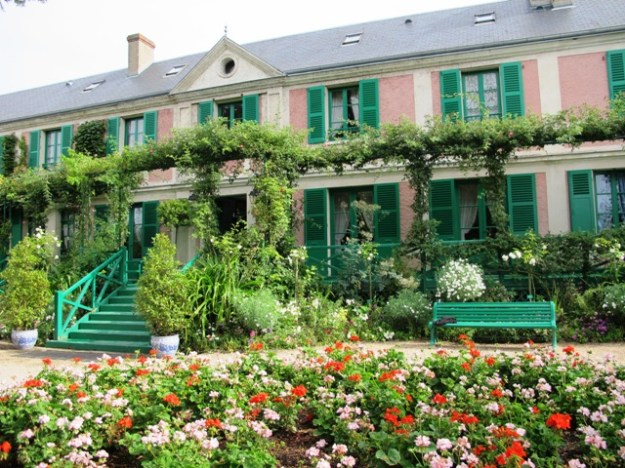
Entry to the garden includes entry to Monet’s house which is presented as it was in his day
We had worked out that it may be wise to traverse the house interior early and so proved to be the case. Goodness knows how that poor house stands up to the beat-beat-beat of a million feet but it is an interesting place in terms of its interior decor and the art. The yellow dining room was pretty astonishing.
There is a very good collection of Japanese prints which were a source of inspiration to Monet, though the print count was exceeded by the number of Japanese visitors on the day we were there. Some fine examples of Impressionist art are on display but don’t expect originals. This is a re-creation of Monet’s house as it was in his day and so too are the paintings reproductions, albeit some good ones.
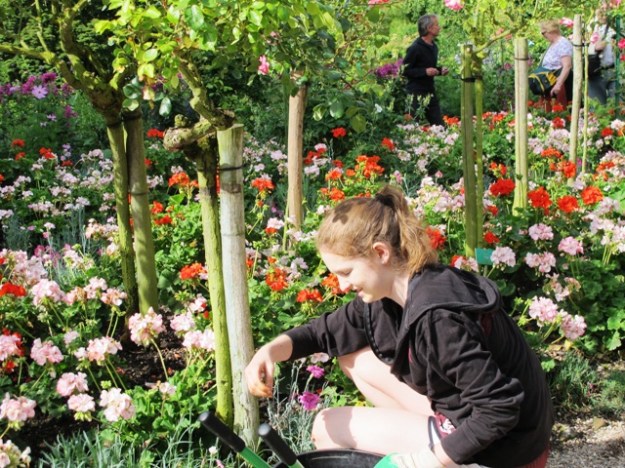
Almost Madonna-like in the garden, one of a small tribe of young women grooming the pelargoniums petal by petal
The garden? I probably have to whisper this, but if you are a keen and knowledgeable gardener, you may find it a little underwhelming. Monet is said to have taken inspiration for many of his paintings from the garden and to have played with colour to make it zing. Private gardens are private visions. Once they pass into public ownership, that dissipates over time and it has had 88 years to do so. In midsummer, there is a heavy emphasis on annuals and some “interesting” plant choices. We rather doubted that Monet would ever have gone for enormous, overblown modern dahlia hybrids. The flower gardens were reminiscent of English cottage garden style but with strong colours. And immaculately maintained. Hordes of gardeners were picking over the pelargonium florets to remove individual spoiled petals.
The water lily gardens were somewhat wilder and charming for that. There are two Monet bridges there but smaller in scale than they appear in his paintings. The mistake is to expect the gardens to reproduce the paintings in real life. They were an inspiration for an Impressionist artist, never a detailed representation of what he saw before him.

About the coaches… just a few and yes, some of these are parked two deep
It is the whole Giverny package that makes it a special experience. If you simply arrive on a coach tour, shuffle around the garden, then the house followed by the gift shop before boarding your coach for the next attraction, you may secretly wonder what the fuss is all about. It is different if you make the time to stay.
We spent two nights in Giverny, staying in a rustic mill house B&B. This gave us time to walk the streets, to bike the countryside and to soak up the romance which still lies below the tourist machine. The first night we dined at the historic Restaurant Baudy which is reputedly largely unchanged from the days when Monet and his friends used to patronise it. The garden out the back was dishevelled and had no plant interest but was utterly romantic in the way we associate with the French.
On the second day we pedalled the 5km to nearby Vernon, along a flat cycle way. “Bonjour,” all the oncoming cyclists and pedestrians called and we replied in kind. We found that it is possible to buy a perfectly acceptable bottle of plonk at the supermarket for €2.50. That evening we had the table d’hote offered at our B&B – freshly cooked local fare eaten al fresco where we talked broken French and some English with our hosts and their friend.
There is still huge charm to be found in Giverny but Monet’s garden, despite all the history and the hype, is only one part of that.
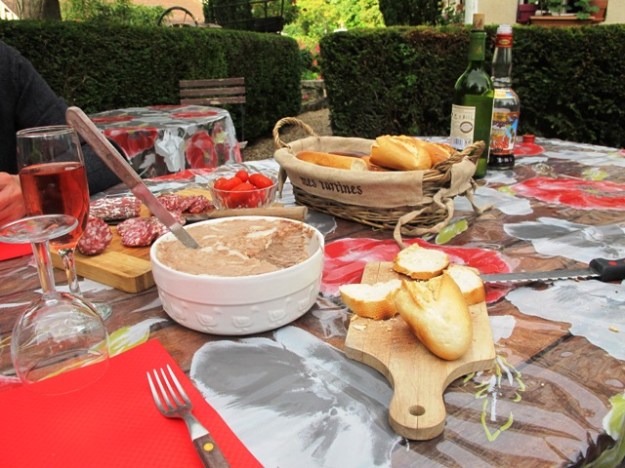
The table d’hote dinner at our bed and breakfast was home-cooked rustic fare and particularly delicious
Monet’s Garden is open daily from 9.30am to 6.00pm from April 1 to November 1. Further details on all matters related to visiting the garden, transport, accommodation, the village and surrounding areas can be found on http://giverny.org/ Tickets to Monet’s garden cost €10.20 and can be purchased on line through this site.
Giverny is reached easily from either Paris or Rouen. The train journey from Gare St Lazare in Paris to the nearest station at Vernon takes 50 minutes and costs €14.30 each way.
We stayed in an impossibly romantic converted mill house, Moulin des Chennevieres in the village of Giverny paying €90 per night double for bed and breakfast.
First published in the Sunday Star Times.

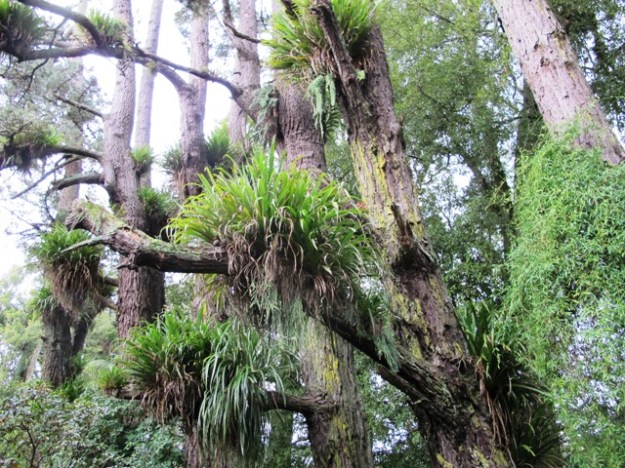 It is both a blessing and a curse to have a garden with very large trees. The pines (mostly Pinus radiata), native rimu trees (Dacrydium cupressinum) and Australian eucalypts all date back to 1870 to early 1880s when Mark’s great grandfather planted them. The rimus are rock solid with a life expectancy of many hundreds of years but from time to time we lose a pine or gum.
 While we can manage most of our tree work ourselves, this one posed a major problem. It broke about 6 metres up where Mark’s grandfather had topped the row in the early 1900s, creating a weak point. But it didn’t break cleanly and the top formed a major swinger. We did the initial cleanup but dealing to the body of the tree required specialist attention.
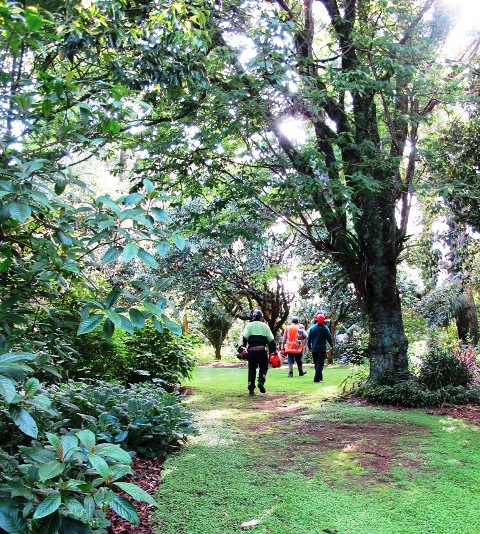 Enter the arborist crew this morning.
 There was a lot of consultation for this was a tricky operation.
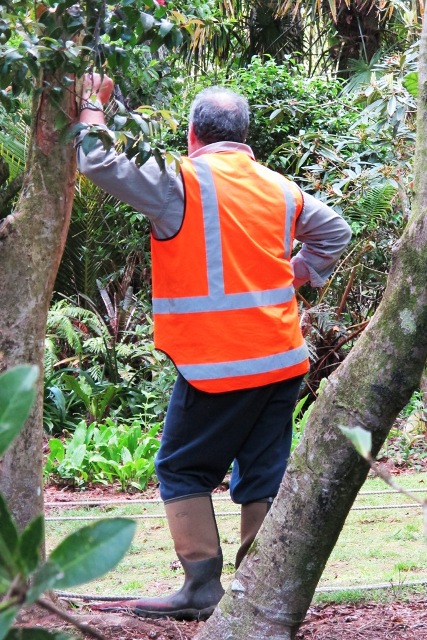 And a lot of supervision.
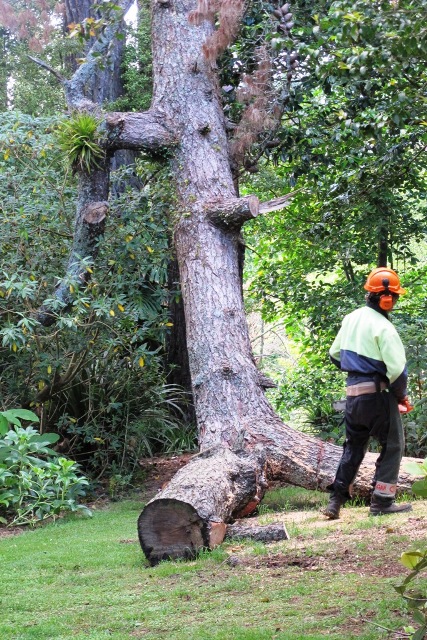 Cuts were made but things did not quite go to plan.
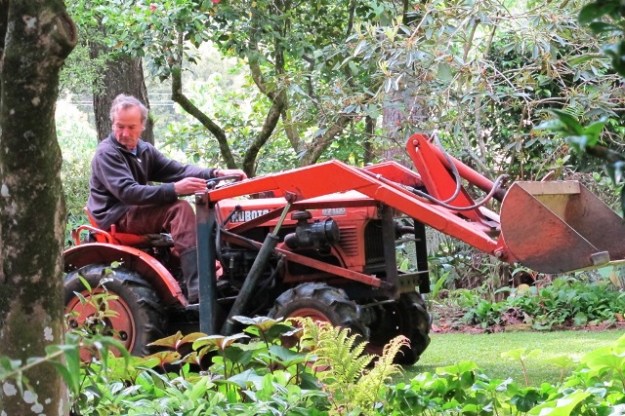 Soon, more equipment was needed. Do not laugh at our baby tractor. It is enormously useful, though not quite equal to this task.
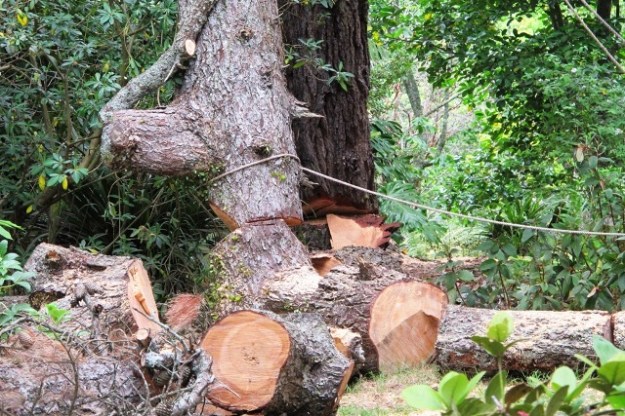 Both ends of the tree were cut through but it remained determinedly in position, defying all attempts to unbalance it.
 There was much manly consultation.
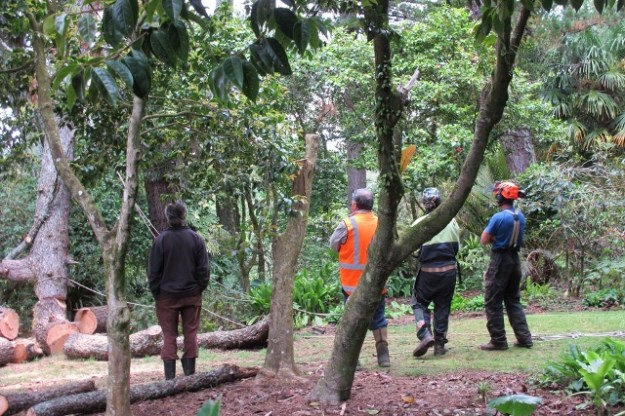 And even more consultation. Lots of consultation. A winch was needed, they decided. The crew departed for more gear.
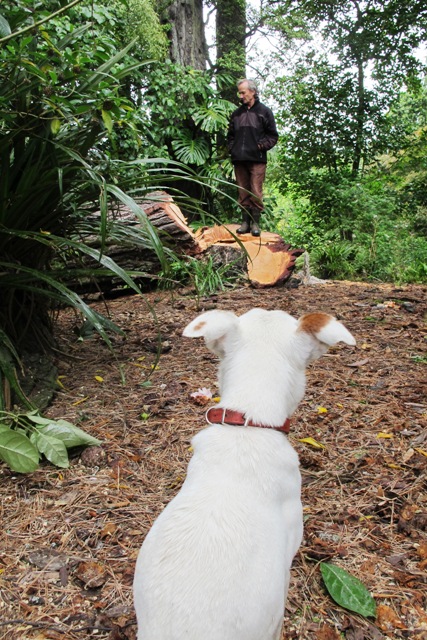 In the end, the crew returned with us not even noticing and both Mark and I missed the final rites when the tree was winched down. We were a little disappointed. It all seemed a bit of an anticlimax but is at least a major problem solved. It is remarkable how a tree some 40 metres high can eventually come down with minimal damage.
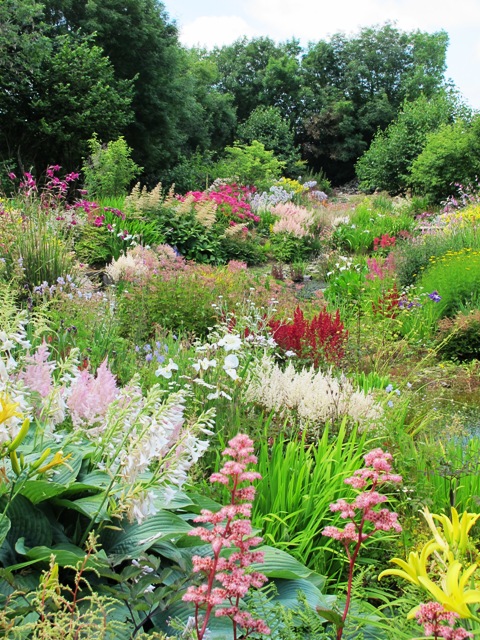 1) I want to try and capture the magic of a particular garden in a few words and photos. This is Wildside in North Devon and was quite simply one of the most exciting modern gardens we have seen. It is not that we will try and re-create it at home, but we found it interesting, stimulating and inspirational in many ways. It has been about 10 years in the making to this point.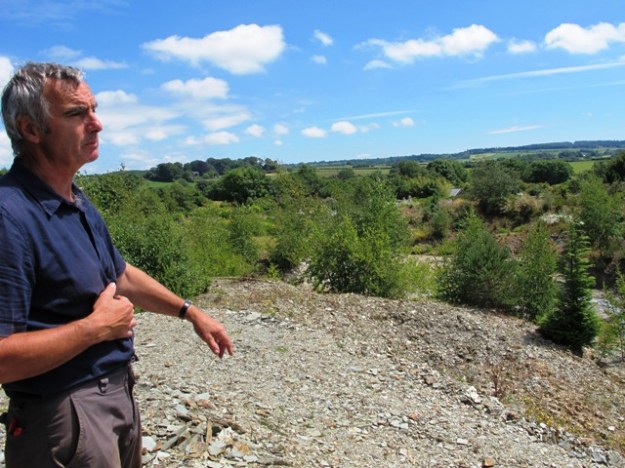
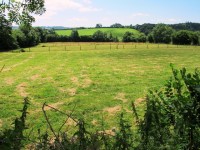 2) The creator, Keith Wiley (and let us acknowledge the active assistance from his partner, Ros) has taken a 4 acre (1.6ha) flat field and created a landscape. When he started, it looked identical to this neighbouring field. All the top soil was removed and substrata redistributed to create ponds, canyons, shallow valleys and hills. At this stage, it is still possible to see this process in the upper garden which has yet to be planted. Once shaped, Keith returned the top soil in varying depths, depending on what plants he planned to grow in each area.
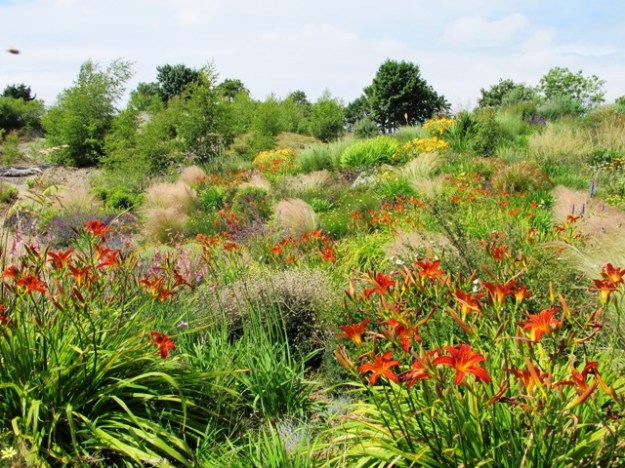 3) The interaction between the created landforms and the plants are the key components of this garden. When we visited, the upper garden was dominated by oranges, golds, yellows and whites. We would love to have been able to return a few weeks later because we could see that the dominant colour was going to change to blue and it would have looked very different. It takes exceptional plant skill to be able to get that transition and successional planting across seasons, let alone within the same season.
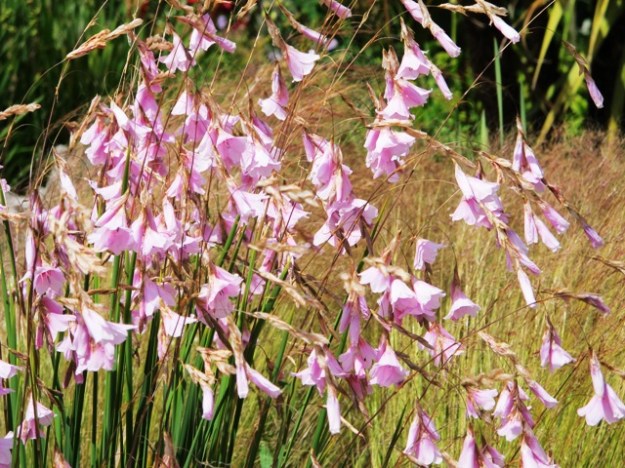 4) These are dierama, commonly called Angel’s fishing rods, one of the few corms and bulbs that were in flower in midsummer but this was a garden which was rich in drifts of bulbs – another layer of plant interest and a means of ensuring colour and detail when most perennials are either dormant or resting. In keeping with the modern perennials movement, there were grasses used but in moderation. Plants were in good sized clumps and often in drifts, but always in combinations, not chunky blocks standing in their own right as seen in many modern gardens.
 5) There is very little hard landscaping and very little ornamentation. There may have been one small lawn, from memory, but this is a garden of plants and flowers. Some may consider the lack of formality and structure to be a shortcoming, certainly in a country with a long history of landscaped gardens full of permanent features. We saw a garden that pushed the boundaries of the prairie style and New Perennials movement, combined with the creation of sustainable ecosystems, underpinned by exceptional plantsmanship.
 6) We travelled a long way to visit Wildside which is on the edge of Dartmoor, near Yelverton, and we would gladly travel a long way to see it again. However, it is currently closed to the public and it is uncertain when it will reopen. The owner told us that he needed to get the house built. After a decade of living in temporary quarters while giving priority to the garden, they had reached the point where the house had become a priority.
 Yes, a prologue. We first became aware of Keith Wiley’s style when we visited The Garden House in 2009 – the garden of the late Lionel Fortescue which Keith managed for many years. True, he had no hand in the first sight to gladden our eyes. As we went to enter the garden, lo and behold there was Mark’s very own Magnolia Felix Jury in prime position. To say we felt proud would be an understatement.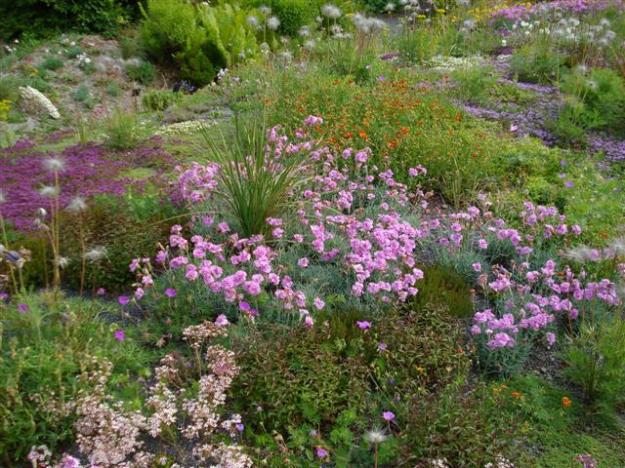
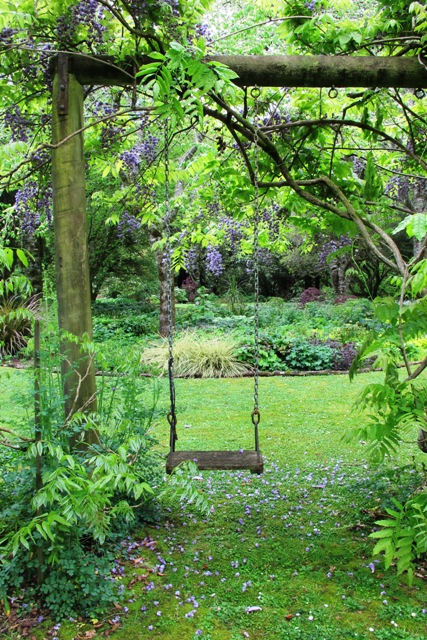
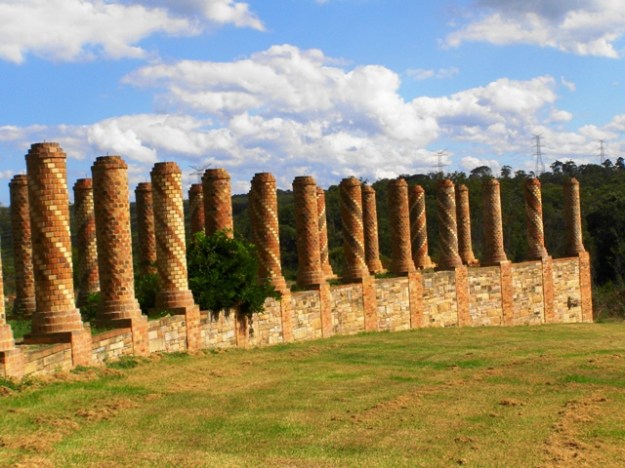
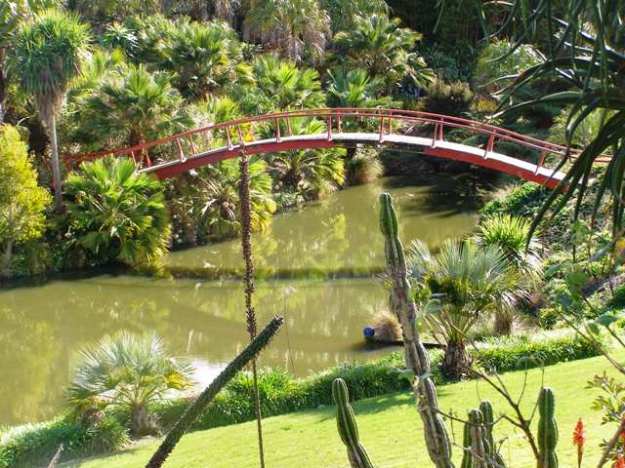
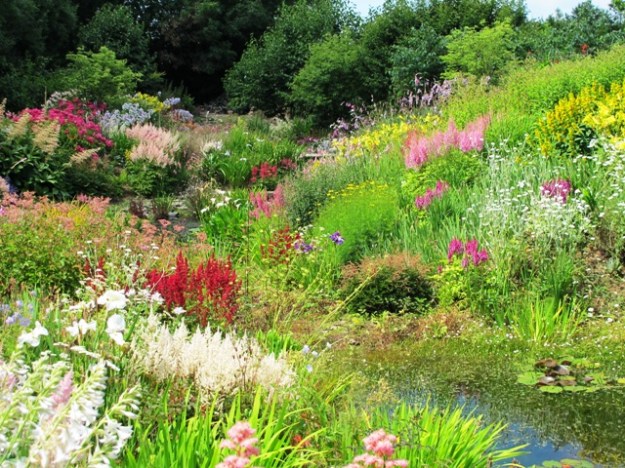
 My first encounter with a garden strongly promoted for its romanticism was in northern Italy – Villa San Remigio. If you have ever been to the Italian lakes district, you will nod in agreement when I say that the whole place seems impossibly romantic. Stresa, Mennagio, Bellagio (the Lake Como one, not the Las Vegas one) – in the right circumstances these are places of charm bordering on enchantment.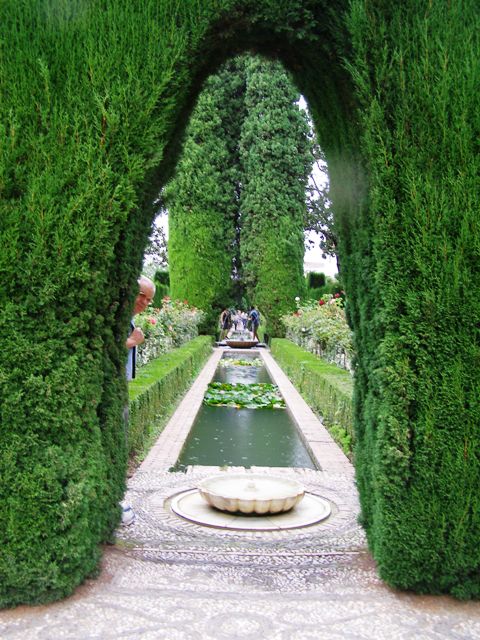

 Tikorangi The Jury Garden