
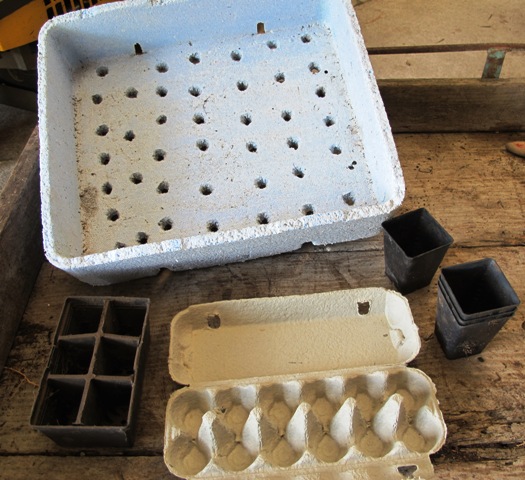
 1) Sowing seed should save you money, especially with vegetables and annuals and it is also the way of getting plants which may not be available otherwise – such as dwarf daffodils, English snowdrops or rhododendron species. We use polystyrene mushroom trays which we have been continuing to use for up to 20 years. Wooden or plastic trays can also be used but you need around 10cm in depth and plenty of drainage holes. Egg cartons can be used for quick turn around crops such as lettuce or peas. You can also reuse the punnets that come from garden centres. Mark likes small individual pots for vegetables.
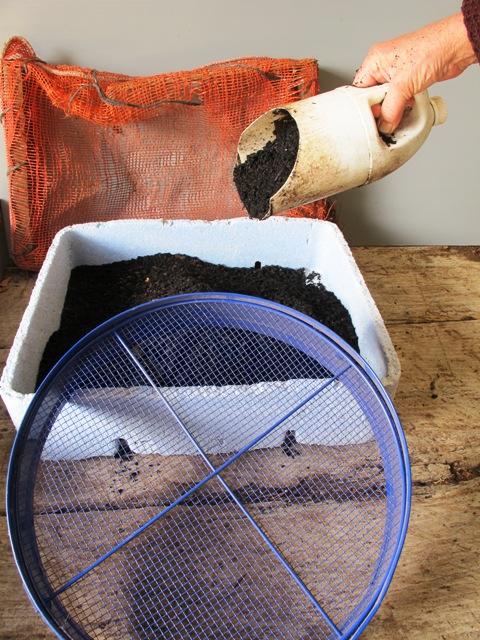 2) It is preferable to use proper seed raising mix which has less fertiliser in it than potting mix because fertiliser can burn young plants. These mixes are sterile, so you know when you see shoots that it is your seeds germinating. You can use garden soil if you want to but coarsely sieve it first to get rid of larger lumps and you need some fine sand or similar to sprinkle over the seeds on top. A home made sieve is fine. You can’t use unwashed beach sand because plants don’t like salt. A bag of seed raising mix is easier and goes a long way so is not expensive.
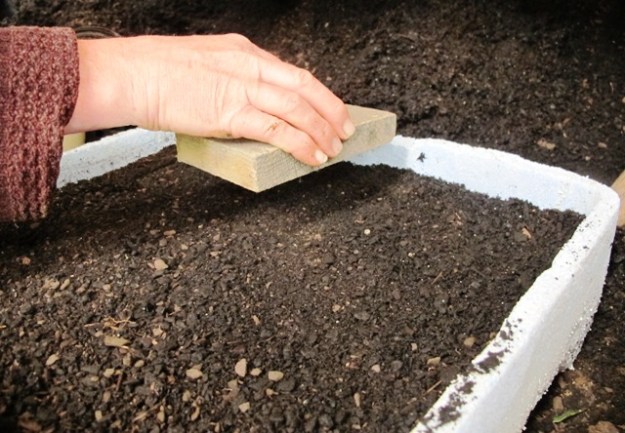 3) When filling with mix, tamp it down to get rid of air bubbles by pressing on top of the tray. If you are using egg cartons or individual cells, sharply rap the container on a hard surface to get the mix settling further. However, if you are using garden soil, don’t compact it.
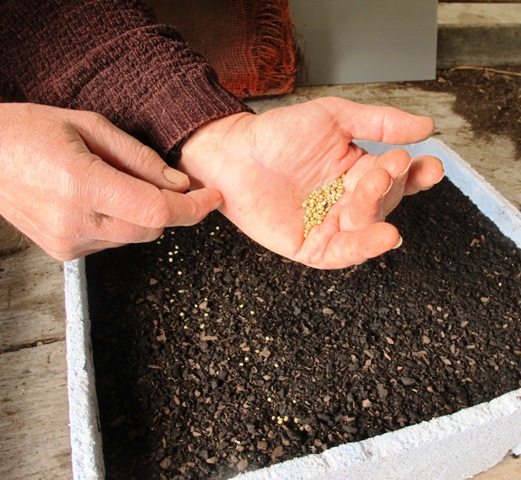 4) Large seed can be hand placed but fine seed is traditionally tapped out of the hand as shown in the photograph or dispersed in small quantities from a piece of folded paper. It can also be dispersed by pinching it between fingers like salt.
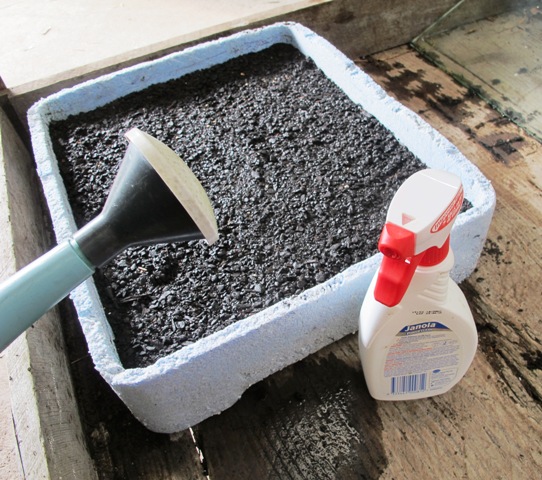 5) Spread a thin layer of mix on top of the seeds. The smaller the seed, the lighter the covering but almost all seeds need a complete cover (primulas and rhododendrons are an exception. These are surface sown – ie not covered). Water carefully. A misting bottle (a well-washed window or shower cleaner bottle with a pump spray) is ideal for fine seed. A watering can with a fine rose to disperse the water is also good. Don’t flood the seeds.
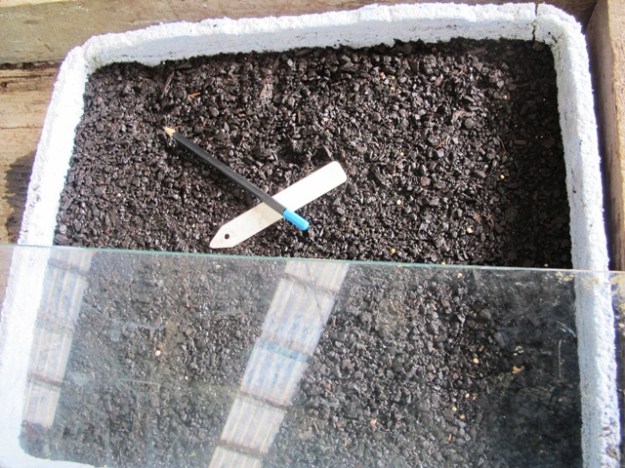 6) Label the tray. We favour a soft pencil and hard plastic labels which we scrub and reuse for years. Pencil lasts longer than marker pen and is easier to clean for reuse. Precious, fine seed can then be covered with a protective sheet of glass. Stretched plastic can also be used. Until seeds germinate, place the seed trays out of direct sunlight and in good light. It is usually wise to elevate the seed trays away from slugs and snails or cats who think it is a litter box. Check your seed tray daily for moisture levels but do not scratch around looking to see what is happening. When the seeds have germinated, move the tray to sunny conditions and increase the watering as required.
Tag Archives: Mark and Abbie Jury
Windflower romance
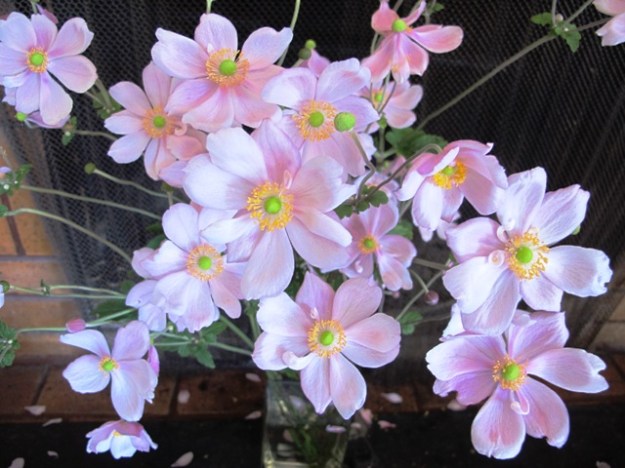
Wind flowers are a personal marker of our wedding anniversary
On the evening before we married, Mark turned up with an armful of Japanese anemones that he had gathered from the Taihape roadside. Don’t even ask why we got married in Taihape when we neither lived there nor came from there. It’s a complicated story. Wind flowers, he called the anemones and believe me, although back in the mists of time, it was a romantic gesture I have never forgotten.
Every year the wind flowers bloom on our wedding anniversary and he often brings some indoors. Last week he followed the old cut flower wisdom – re-cut the stems and burned the ends and they have lasted a full week in water.
We have three different Japanese anemones, in light pink, white and a semi double dark pink which is more compact in growth. It seems that the first two are the straight species, A. hupehensis. Although known throughout the world as Japanese anemones, they are originally Chinese – from the eastern province of Hupeh, in fact. They have been grown so widely in Japan for so long that common parlance attributes them to that country. It is no surprise that the Japanese, with their cultural penchant for simplicity and natural form, took a liking to them.

Japanese anemones are commonly found in pinks and white although selections are being made to extend the colour range into lilac blues
The semi-double darker one will be a hybrid and a named form that was purchased. Mark commented vaguely that he thought it may carry a woman’s name but I see that this plant family is more highly prized overseas than in New Zealand and there are a fair number of named forms, several of them named after women. For the botanically inclined, the Japanese anemones classified as A. hybrida are likely to be mixes of A. hupehenis with A. elegans and A. vitifolia. This is a plant family that crosses readily – though to get a cross you generally need plants that flower around the same time.
Weeds, I hear some readers saying. Weeds. Yes they can be overly vigorous, given the right conditions and become rampant, bordering on invasive because they spread below ground. You probably don’t want to unleash them in areas with plant treasures which they may out-compete. Lovely though they are in flower, you can have too many of them.
That said, I see that there is general agreement that they are not always easy to establish which made me feel better about our meagre showing of white ones in the woodland garden. I had spotted a pretty patch down the road, growing as a roadside wild flower and it is those I photographed. I love the combination of the single, white flowers dancing above the dried grasses.

The white Japanese anemone down the road looks better than the patch we have in our garden
Our pink ones are planted on our roadside and come into flower after the summer colour has largely faded. We have designated our rural road verges no-spray zones with the local council so we carry out our own maintenance. We mow a grassy strip immediately beside the road, get rid of noxious weeds like the dreaded bristle grass and we can do what we like with the rest. And what we like are roadside wild flowers – agapanthus, hydrangeas, robust begonia species, oenothera (evening primrose), belladonnas, crocosmia and the like. It is not just for passing motorists. It is also to feed the bees and to keep some roadside cover in an intensive dairying area which can otherwise resemble a green grass desert.
There are actually somewhere over 120 different anemone species. By far the most common in gardens are A. coronaria. These are the spring flowering corms that you buy as de Caen (the singles, mainly in blue and red but also in pinks and whites) and St Brigid (the doubles). They are very cheerful and cheap to buy. If you get a bulk pack, split it into four and soak one batch at a time overnight before planting. Done at weekly intervals, you can extend the flowering for the first season.
A. blanda is a little Greek species with predominantly blue flowers, more like a carpet if mass planted. A. nemerosa is the European wood anemone. We would like both of these dainty species to naturalise far more widely in our garden than we have achieved so far. They are transient early spring delights.
But in autumn it is time for the wind flowers to star.
First published in the Waikato Times and reprinted here with this permission.
Garden Lore
“It would be worthwhile having a cultivated garden if only to see what Autumn does to it.”
Alfred Austin, The Garden That I Love (1894).

 Garden lore – rat catching
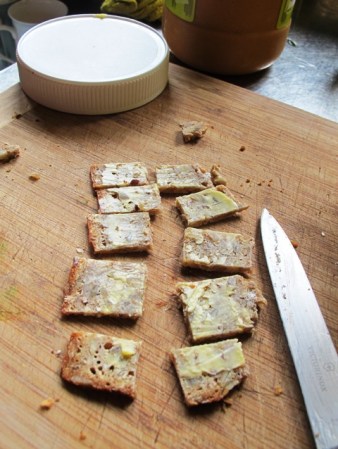
Sadly, rats are a fact of life and not an indication of squalor as I am sure many river-side residents will know. We get rats here because we have a macadamia nut orchard and processing plant immediately next door and we also have a flowing stream which can bring them in. The current tally this autumn is already 21 despatched. We have a strong preference for trapping, not poisoning these days and a trapping round is part of Mark’s daily routine. He uses small squares of stale bread spread with both butter and peanut butter as bait. The downside of trapping is that you do have to be willing to kill the rat. He used to leave this to the dogs but gave up when one escaped from them. Nowadays, he tips the trapped prey into a sack and whacks the sack on concrete. It is a quick end.
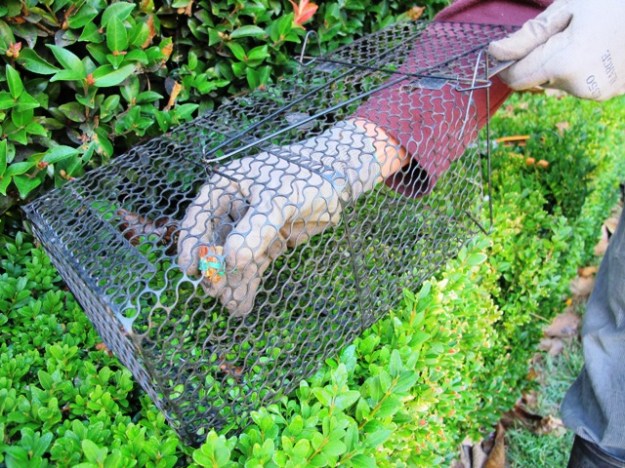
You can buy poison across the counter but follow instructions. A regional council pest control officer once told me he despaired at the number of people who thought they knew better than to secure the bait because the rat would take it back to its nest. He had pulled out a fridge in a shed and found maybe 200 baits behind, stockpiled by the rats (which were still alive) as a squirrel stockpiles acorns. The bait needs to be secured and out of the way of dogs. We had a dog once that ate rat bait. It was a traumatic wait to see if he would survive. He did. We have also seen one of our dogs and a cat from earlier days get quite ill after eating poisoned rats. The experience of having a dying, poisoned rat wedge itself in the chimney breast (they go in search of water), there to decompose over many weeks put us off poisoning once and for all. Hence the return to trapping.
And I managed to get that far without making a joke about the Pied Piper of Hamilton.
First published in the Waikato Times and reprinted here with their permission.
What price public accountability and garden reviews?

We put the closed sign up late last year
We have been part of the open garden scene in New Zealand for 25 years but at the end of last season we put the closed sign up. We don’t know what the future holds for us yet but we are certainly enjoying taking a year or two out. It is interesting taking a step back.
I have long advocated that it is possible to assess gardens and that not all gardens are equal. Like any other human endeavour, some gardeners are simply better at the task than others. Whether you like a garden is a matter of personal opinion. Whether it is a fine example of gardening is, to my mind, not a matter of opinion but able to be measured by certain criteria. I can think of some very good gardens that are not to my personal taste just as there are gardens that I really enjoy, even though they are not top notch. Mind you, I shy away from the very thought of ranking gardens in a single line hierarchy, as required by competitions. I am only willing to work in broad bands or categories.
I have also advocated strongly for accurate garden descriptions for open gardens. There is a certain folly in letting garden owners write their own descriptions. Some are far too modest and fail to capture the essence of their own place, shying away from anything that might be seen as boastful. Too many, alas, are not.
So it has been interesting this week to debate the issue of garden reviews. This came up on a British gardening website (www.thinkingardens.org.uk) where the editorial policy is of honesty, sometimes brutal honesty. A contributor posted a particularly critical review of the historic garden, Rousham.

Rousham House (photo credit Grahamec via Wikimedia Commons)
I have never been to Rousham which is in Oxfordshire and it is not likely to feature high on our visiting list because we prefer different gardening styles. My English garden guidebook (written by an independent, not the garden owners) describes Rousham as “the most perfect surviving example of William Kent’s landscaping….an Arcadian experience.” It dates back to the early eighteenth century, one of the earliest and best preserved examples of English landscape gardens, drawing on influences from ancient classical times. In other words, it is mostly green and architectural. It is still in private ownership, apparently run with a relatively small budget. According to the reviewer, the owners are not doing a very good job of it.
Does charging an entry fee make a garden fully commercial and therefore fair game for disaffected garden visitors? Most New Zealand open gardens are in a similar position to Rousham (though few are of any historic note). It is a rare garden here that is part of a fully commercialised set-up with cafe, craft shop, plant sales and a full complement of service staff. In fact I can only think of two such privately-owned gardens. Every other private garden I know is a labour of love by individuals where the entry fee, if charged, adds up to a minor contribution to the costs.
Would it help lift open garden standards here if there was a *robust* and public review system? The advent of the internet has made this possible – would the Trip Advisor garden section become an integral part of planning? The neo-liberal, consumer approach says yes. A comment on the aforementioned website by one such on-line reviewer defending himself read: “Being a petty, rude and generally disrespectful smart-arse is the right of those that pay money for a thing.”

We were underwhelmed in every way by this overseas garden so I prefer not to identify it or write about it
I may be a bit old fashioned in these matters, but I think it is a privilege to be able to get into private gardens irrespective of whether an entry fee is paid or not. If I really don’t like a garden after visiting, we analyse the reasons why in private discussion. Would I write a scathing review? No, that just seems discourteous. If I wrote about it, I would try and balance out the negatives with some positives. If there were no positives, I wouldn’t write about it.
On the day we put up the closed sign on our garden, we received our first ever letter of complaint. It was unpleasant, written by an angry woman who accused us of ripping her off. It hurt. Fortunately it is the only one but we have kept it as a reminder. Of course she had paid to come in so she had the right to vent her displeasure. Just as we have the right to decide that we don’t want people like that in our garden. It wouldn’t take too many experiences like that to make us decide never to open again.
So-called honest reviewing and feedback is a fraught path.
First published in the Waikato Times and reprinted here with their permission.
Outdoor Classroom: Layering plants
 1) Some plants are difficult to propagate from cuttings, even more so for home gardeners without temperature and moisture controlled conditions. If you are not in a hurry, layering a plant can be a simple way of increasing numbers or of getting a back-up plant for rare or special material which may not be available for sale. This rhododendron has layered naturally where branches lie on the ground.
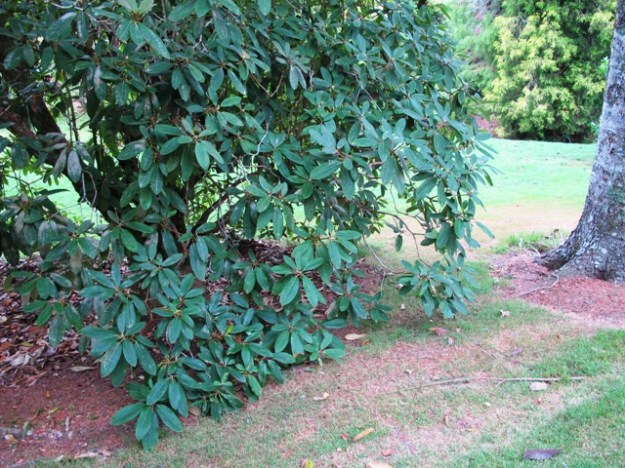 2) The plant needs to have low growing, flexible branches which reach to the ground. You may wish to try layering plants such as magnolias, rhododendrons, camellias, daphnes or conifers. Most woody plants can be layered over time but it is faster to do easily propagated plants like hydrangeas from cuttings.
 3) Select a firm branch or stem which can reach to the ground. It does not matter how old the wood is though young growths from last season may root faster. Remove the leaves from the middle if necessary. Slice a thin layer of bark off the lower side (called making a wound). You can paint the wound with rooting hormone if you have it, but this is not critical.
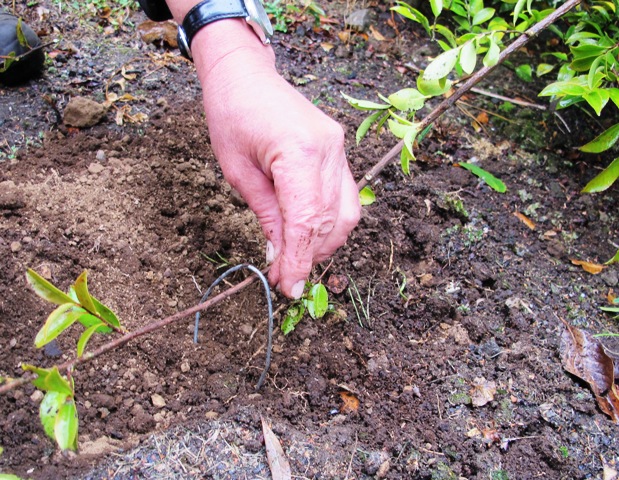 4) Cultivate a small area of ground beneath the branch or dig a small trench. Peg the branch down so the wound is in contact with the soil. A hoop of wire is ideal for this part of the process. Peg it firmly so it cannot move. Cover the pegged area with up to 10cm of soil. You want to prevent the layered stem from drying out. Leave the branch tip uncovered. Now be patient. It will take a year for easy material and maybe as long as three years for difficult to propagate plants such as many of the rhododendrons.
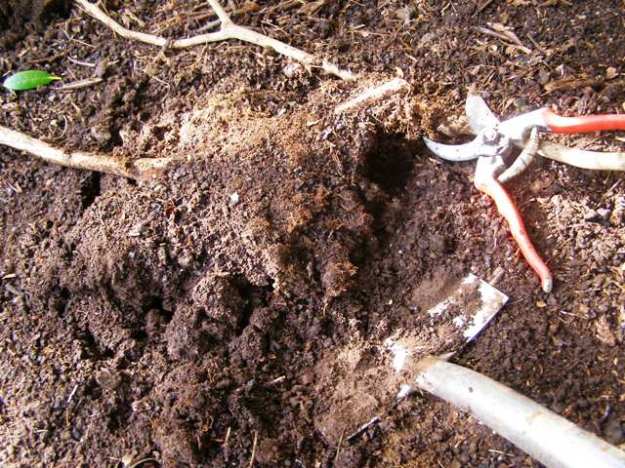 5) When the layer has formed a reasonable mass of roots, cut it from the parent plant (think of this as cutting the umbilical cord) and either let it grow a little longer where it is or move it to some well cultivated soil – the vegetable garden is often good – so you can take care of it while it develops into a more sturdy plant.
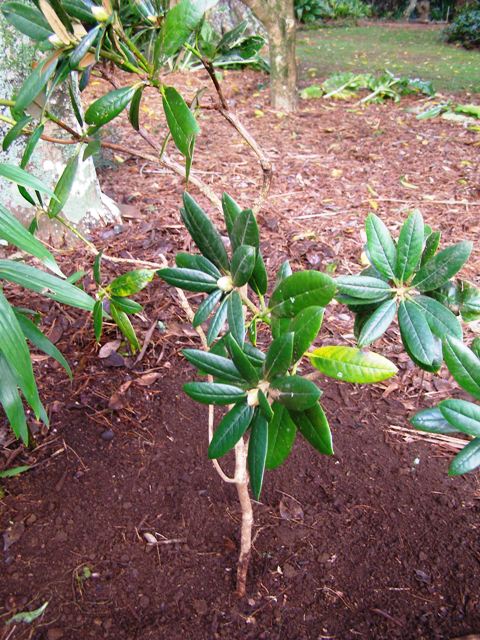 6) You will usually need to stake the plant to train it to grow upwards and to start developing a good shape although you can sometimes plant it on an angle to get the main leader almost vertical.
 Tikorangi The Jury Garden