Tag Archives: Mark and Abbie Jury

Tikorangi Notes: Friday March 23, 2012

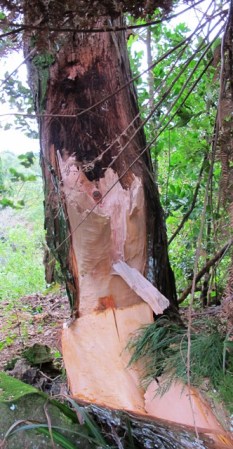
A salutary lesson in why trees should never be allowed to fork close to the ground - half the totara split out

A salutary lesson in why trees should never be allowed to fork close to the ground - half the totara split out

Latest posts:

1) Ugni molinae or the New Zealand cranberry – a plant that every good family should grow. When it comes to encouraging children to venture out browsing in the garden, it ranks right up alongside fresh peas as a must. It is also easy care and a small shrub so once planted, it will last for years.

2) Clematis tangutica I was a little taken aback to discover that it is regarded as a weed menace in some areas. It has never been a problem here and instead is a source of pleasure in late summer with its lovely pure yellow flowers and silky, tasselled seed heads.

3) Lower maintenance gardening. I am unconvinced that there is any such thing as a low maintenance garden. There are certainly high maintenance gardens, moderate maintenance gardens and lower maintenance gardens but drop down below that and you end up with no garden at all. This week’s column focuses on lower maintenance options as befits a rental property.

4) The Easy Fruit Garden by Clare Matthews might make fruit gardening easy for gardeners in the UK but has little or no application here.

Tikorangi Notes:
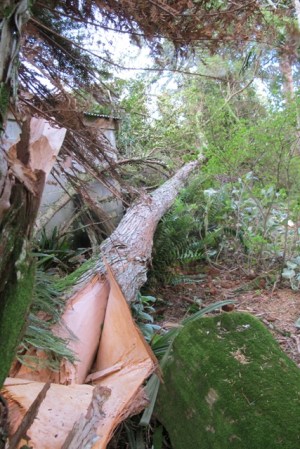
At least the falling totara missed the garage
At least the falling totara missed the garage

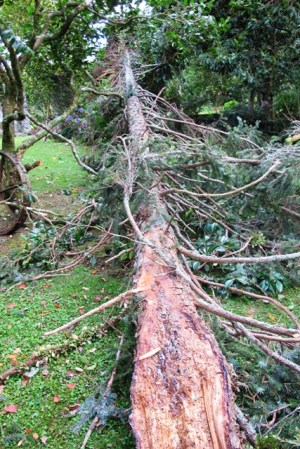
The Picea omorika felled itself

The Picea omorika felled itself

Last week was all about Womad and the weather held for a magic weekend of world music in the beautiful venue of Pukekura Park. By Monday evening, the magic was all used up and a storm of reasonably impressive proportions hit. Even Spike the dog was unnerved when we heard the unmistakeable sounds of large branches cracking and breaking. In the morning, the damage was clear. A large gust had taken out half a totara tree which would be around fifty years old. The wind tunnel created then broke out part of a Picea omorika around the same age. In falling, the totara twisted a large amelanchier and some drastic remedial action will be needed to save any of it.

The clear lesson here is the need to keep trees to a single leader and a good shape from the start. Forked leaders create a point of weakness, even though it may take 50 years to reveal itself.

We escaped lightly. Friends around Oakura report greater damage. It is only a few weeks since Patea to the south bore the brunt of hurricane force winds. The mess here is largely superficial and with the very large trees we have here, we are relieved that it was not a great deal worse.
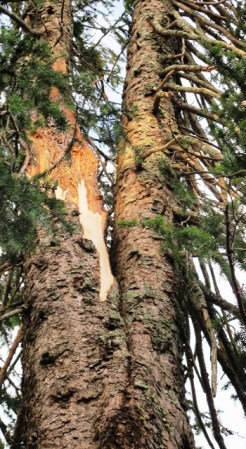
Damage to the multi forked Picea omorika several metres up


Damage to the multi forked Picea omorika several metres up

Tikorangi Diary: Friday March 16, 2012

What can I say? One of life's more unusual experiences this week. Anda Union.

What can I say? One of life's more unusual experiences this week. Anda Union.

Is that a Mongolian by my washing line? Why yes, actually, he is.

Is that a Mongolian by my washing line? Why yes, actually, he is.

Latest Posts:

1) Araucaria heterophylla commonly known as Norfolk Island Pine. All I want to do is to put a Christmas star on top each time I see one of these handsome landscape trees.

2) Grow it Yourself Fruit and Nuts by Andrew Steens – the latest offering in the New Zealand garden books market.

3) It’s a plant product so it must be natural and safe, right? Think again. Maybe natural, hardly safe Abbie’s column.

4) Onions. Are they worth the effort to grow?

Tikorangi Notes: Friday March 16, 2012

Each year at this time, New Plymouth hosts Womad, a remarkable event which brings a host of interesting world music performers and musicians to the area. This week we had the delight of hosting Anda Union in the garden giving a special performance for Tikorangi locals, including the two senior classes from the local primary school. These Mongolian performers keep the ancient music of their tribal homelands alive and this includes fascinating throat singing. It is like nothing else, really.

The whole experience was made more memorable because as soon as the musicians arrived, it was clear they wanted to see the garden. I took them on the short tour of the top garden (lunch, hosted by Todd Energy was awaiting them, to be followed by the performance). Their pleasure in seeing the garden was a delight, even if there were some language barriers.

The school children arrived a little early, while the adults were still eating. One of their teachers asked if they could also have a look in the garden so I headed off with them. They were entranced by the magical feel under the rimus (and some of the kids could even identify the trees). When we came to the path down to the park, these bright buttons of 8 to 10 year olds shrieked with delight and sprinted down the hill to play jumping games across the stream. We could have spent a great deal longer looking at different things. Glenys the Gecko was sunbathing on her tree and while it was possible to show her to a few children, pressures of time meant we had to head back to the marquee for Anda Union’s performance.

All this, and it was my birthday too. Mark, naturally, took credit for organising it all for my birthday, even down to the delicious lunch.

Anda Union - bringing the music of bygone Mongolia to Tikorangi.

Anda Union - bringing the music of bygone Mongolia to Tikorangi.

Tikorangi Notes: Friday 9 March, 2012

Latest posts:

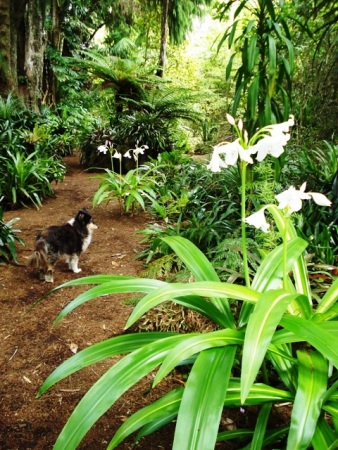
1) Big white, scented punctuation marks through the summer woodland – Crinum moorei variegated.

2) Lobelia lore, lest you are in search of a cure for syphilis. Or maybe good summer perennials are more to your taste. I adore blue flowers.

3) Personally, I am far from a fan of the traditional cabbage but should you be more enthusiastic, Grow It Yourself looks at the genre of cabbage this week (and yes, I did mean genre, not genus).

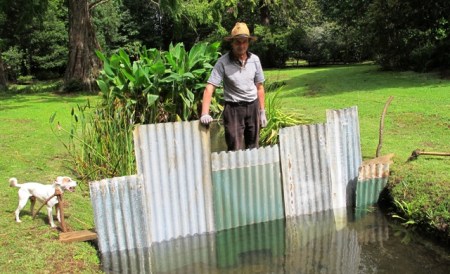
The low tech approach to flushing the stream bed

The low tech approach to flushing the stream bed

Tikorangi Notes

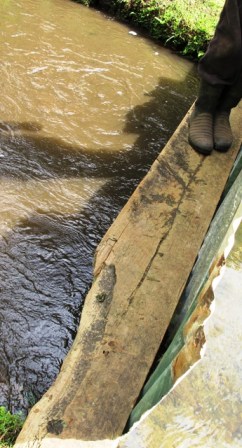
We have given up waiting for the summer which is clearly never going to arrive in full strength. At least the autumn bulbs bring some seasonal cheer. The exercise of cleaning out the stream continues in a very low tech manner. Mark has lifted the water level and channels it through a small opening in a purpose built corrugated iron barrier. The current generated is sufficient to flush the mud downstream as long as he stirs it up with the rake, to get the mud particles back in suspension mode. How far he can get it cleaned by this method remains to be seen – the ponds will represent a challenge to span with the barrier. A pontoon, he says he needs. I just can not quite visualise how he will manage a pontoon but all this saves the exercise of having to hire a sludge pump.

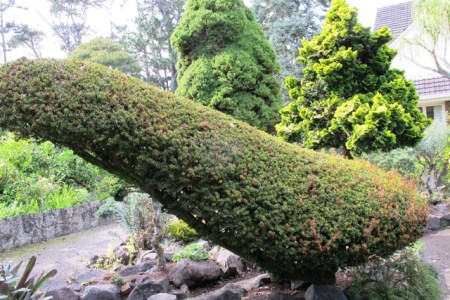
The disappointment this week is our yew tree which is looking alarmingly as if it is in decline. Fungal root disease is the verdict – a casualty of an unusually wet summer. As it is about 60 years old and a shapely, clipped feature defying the laws of gravity to lean on an angle, we would be sorry to lose it. We don’t spray much at all these days, but this tree warrants a dose of heavy duty fungicide to see if we can halt its rapid decline.

Felix the Kiwi, our clipped yew, may be succumbing

Felix the Kiwi, our clipped yew, may be succumbing

Plant Collector: Crinum moorei variegated

Fragrant Crinum moorei var.

Fragrant Crinum moorei var.

Crinums are a large family, belonging to the amaryllidaceae group so having some botanical connection to the likes of belladonnas and nerines. But despite there being over 130 different crinum species, not a lot make good garden subjects in this country. Sometimes you will see different crinums being grown in the tropics but the common form in this country is C. moorei which is a South African plant. It has big strappy green leaves, largely evergreen so it can get a bit scruffy, and big, strong spikes of scented flowers in shades of pink. It is a very easy plant, tolerant of woodland shade and near total neglect.

Tall, white punctuation marks in summer along a woodland walk - Crinum moorei var

Tall, white punctuation marks in summer along a woodland walk - Crinum moorei var

This is a variegated form and rather more desirable. It is deciduous which solves the scruffy problems. When the fresh growth comes in mid spring, it lights up a dark area with its bold pale gold and green striping. By mid summer, the variegation has toned down considerably to green which gives a splendid foil for the lovely tall spires of predominantly white scented blooms. These are around 150cm high but so strong, they don’t need staking. They are a wonderful late summer accent plant for shade gardens. The bulbs can reach extremely large proportions and are relatively slow to increase. As with a number of the amaryllis family, the bulbs sit half in the ground with necks exposed. We have never seen this variegated form set seed though the usual green moorei can be grown easily from fresh seed. We have to wait for our plants to form offsets on the bulbs in order to increase them, though enthusiasts could increase them by twin scaling.

First published in the Waikato Times and reproduced here with their permission.

Grow it yourself: cabbage

Cabbages are part of the brassica family, which includes broccoli, cauli and Brussels sprout. This means they are gross feeders (gross meaning greedy or hungry in a gardening context, not revolting) growing best in heavily fertilised soils, rich in nitrogen. To hold up their large heads on a single stem requires a good root system in firm soil so get the ground right from the start. You can plant for most of the year in warmer areas, though we avoid summer for the brassica family to avoid problems with white butterfly. Cabbage can be grown from seed sown directly into the ground or from small plants. Don’t get too carried away – consider how many cabbages you want to eat. They can be difficult to give away. Every plant is also going to need about half a metre clearance all round to give it space to grow. Cabbages take two to three months to mature so planted now, will be ready in winter.

However, for those of us are who are less than enthusiastic about large heads of cabbage with lots of white stalky centre bits (there is only so much cole slaw and stir fried cabbage one can eat), there is a much larger range available now for the home gardener. There used to be a choice of large red, green or crinkly savoy. Now there are a number of mini growing varieties available with heads around 1kg instead of up to 4kg for the larger types. There are also conehead types with softer leaves, assorted quick maturing Chinese cabbages and even the Italian Cavolo nero (which is more like kale). Check out the Kings Seeds catalogue for a good range which might encourage a rethink on the role of this vegetable garden standby.

For the record, we do not for one minute think there is any truth to the current theory that white butterflies are territorial so can be discouraged by eggshells on sticks. Wishful thinking.

First published in the Waikato Times and reproduced here with their permission.