Tag Archives: Mark and Abbie Jury

Plant Collector: Lepidozamia peroffskyana

Lepidozamia peroffskyana - an Australian cycad

Lepidozamia peroffskyana - an Australian cycad

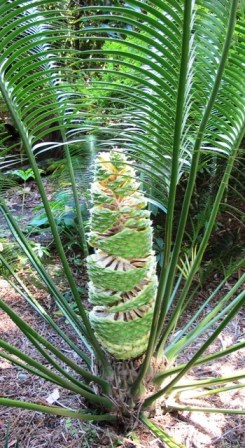
Difficult name, I know, but this plant does not appear to have a common name. It is a cycad and one native to Australia at that. Some mistake it for a palm because it grows a trunk and sprouts it leaves in a palm-like habit, fountaining from the top as it matures. Those leaves can be up to 3 metres long, which is extremely large when you think about it. But it is a cycad which is an entirely different plant family to palms. This particular plant is a seedling from a mature specimen we have and I photographed it because of its spectacular cone which has split open in a wonderful spiral. This split is to release its pollen, rather than to create a perfect pattern.

Lepidozamia peroffskyana cone

Lepidozamia peroffskyana cone

Normally we remove cones to stop the plant putting its energies into trying to set seed. It is suspected that forming the cone robs the plant of too many essential micro nutrients which can lead to yellow banding disfiguring mature leaves. It looks like sunburn. Our mature plant suffered badly in the past from this yellowing but it is still a little early for us to be able to state with confidence that de-coning it solves the problem, though it is looking hopeful.

This is an east coast rainforest plant from northern New South Wales through to Gympie in Queensland (I have been to Gympie though I cannot say I recall seeing lepidozamia there). In our conditions, it will tolerate light frosts and cooler temperatures overall. The natural rainforest habitat gives an indication that it likes fertile soils rich in humus, growing in company and in ground that never dries out. I had to go searching to find out for whom this plant was named – Count Peroffsky, a Russian nobleman and benefactor of the St Petersburgh Botanic Garden where this plant was first cultivated beyond its natural habitat. First in gets dibs on the naming rights even now.

First published in the Waikato Times and reproduced here with their permission.
Grow it yourself: garlic

Freshly harvested garlic is a very different proposition to the stuff that has been hanging about for ten months and has lost most of its potency. We are not, perhaps, served well by the traditional wisdom of planting on the shortest day and harvesting on the longest day. We prefer Kay Baxter’s advice and moved to autumn planting in order to get it in growth before it has to deal with the cold, sodden soils of a wet winter. You can even successionally sow from May to August to extend the harvest season. Fresh picked green garlic is delicious.

Garlic needs to be grown in full sun, in heavily worked, fertile soils. It is a greedy feeder and good drainage is critical. If you are organised, you can prepare the beds now and sow a quick green crop. Dig that green crop in two weeks before planting the garlic. This, allied to late autumn warmth, will give them a real kick start into growth.

Always plant only the biggest and the strongest cloves from the garlic bulb and never but never plant the cheap, imported Chinese stuff (wrong hemisphere so out of season, may be carrying virus which threatens the local strains of garlic and will have been chemically treated). If you follow Kay Baxter’s advice and plant at 10cm diagonal spacings, you can get 100 plants to the square metre. We prefer a wider spacing of up to 15cm in parallel rows. Cover the cloves with a couple of centimetres of soil. Keeping the area free of weeds stops competition but also keeps the soil well cultivated, thus helping with drainage in the wet months. Some gardeners liquid feed regularly. We don’t, but we mulch with compost which is effectively a form of slow release. It is important that the crop never dries out or it will stop growing so be particularly vigilant from November onwards. Garlic can be harvested as soon as the tips start to turn brown.

First published in the Waikato Times and reproduced here with their permission.
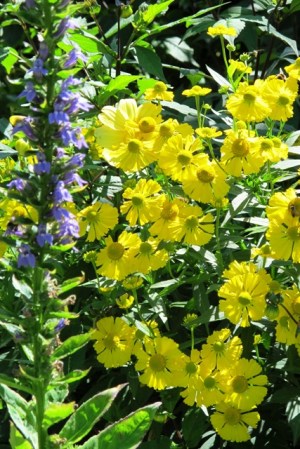
In the garden this fortnight: Thursday 23 February, 2012

The natural look can take a surprising amount of effort and intervention

The natural look can take a surprising amount of effort and intervention

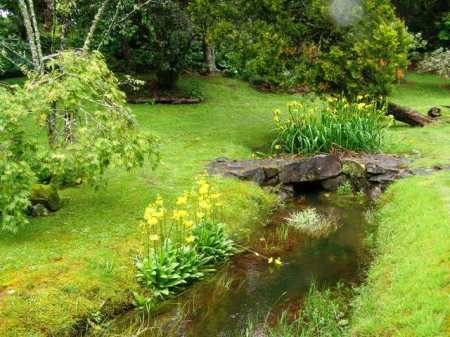
We have been making a major, combined effort to return our natural stream closer to something resembling pristine condition. I say natural stream because it is entirely natural where it enters and leaves our property but in between we manipulate it quite a bit. We have ponds, we play with the levels to create little rapids so we have the sound of water running and we have total control over what happens with flood water when we get torrential rain – achieved by a simple weir, flood channel and stopbanks. What we don’t have control of is the build up of silt and invasive water weeds.

What started as a pleasant summer activity reducing the water weeds (Cape Pondweed, oxygen weed and blanket weed are the worst), has grown to be something more major. We have hand pulled and raked most of the weed out. The clumps of streamside planting (mostly irises but also bog primulas, pontederia and a few others) are all in the process of being dramatically reduced in size. We hadn’t noticed quite how large they had grown in the years since they were first planted. The build up of silt in the water channel – up to my knees in places – is being stirred up and then flushed through to settle in the ponds. To flush it through requires holding the water back and then releasing it in one swoosh. To do it properly requires the building of a second, simple weir. Once all the silt is in the ponds, we will hire a sludge pump to clear it. Trying to stay on top of water weeds (none of which we introduced ourselves) is an ongoing task. We are thinking a bit more regular maintenance may keep the silt under control. Our access makes getting a digger in very difficult and the mess afterwards is such that we prefer to do things by hand.

The end result is that we will have a natural looking stream again. Sometimes it takes a lot of work to achieve and maintain a natural look in a garden.

Top tasks:

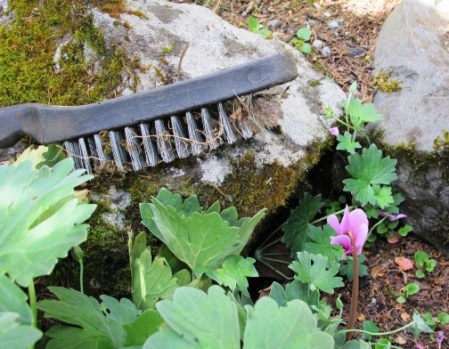
1) Continue reducing mossy cover and lichen on rocks and paths in the rockery. In our humid climate, we have continual moss growth and while some of it softens hard lines and adds a certain look, too much of it obliterates lines altogether and makes the place look unloved. I use a wire brush and I know I will probably have to continue doing it for the rest of my gardening life here.

2) And on the theme of having too much of something, no matter how good, I need to finish my radical thinning of the black mondo grass (ophiopogon) and the cyclamen hederafolium which seem determined to try to choke each other out. The mondo grass goes on the compost heap. The large cyclamen corms I am laying as ground cover in an area where I have given up on both Rubus pentalobus (orangeberry) and violets which both proved to be too strong growing.

A fortnightly series first written for the Weekend Gardener and reproduced here with their permission.
Plant Collector: Tecomanthe venusta

The pink bells of Tecomanthe venusta

The pink bells of Tecomanthe venusta

We are so excited by our Tecomanthe venusta in bloom. That is because it is tropical but we are not so it doesn’t often flower for us. And I have to admit that there are only a few clusters of these pink flowers in evidence. A garden visitor once told us there was a specimen at the entry to Whangarei Gardens’ glasshouse which flowers magnificently. We have not seen it but it would figure that it is happier further north because it originates in New Guinea and is the most cold-sensitive member of the tecomanthe family, all evergreen climbers in the bignoniaceae group.

The tecomanthe family is not large and some readers will know our own T. speciosa – a tender but rampant climber which was found in the wild as a single, surviving specimen on Three Kings Islands. It needs a frost free position which rules it out for most inland locations and it needs a bit of training and management if you want to see the lovely creamy trumpet flowers. It will shoot up the highest tree available and flower only at the very top if left to its own devices, but if you train it along a horizontal support, it can be encouraged to flower along its length.

Back to T.venusta. We grow it under the cover of a deep verandah with opaque roofing. When it does decide to flower, it puts out clusters from its bare vines, which is very obliging because they are so obvious. Most plants set flowers on either new growth or last season’s growth but venusta appears to be quite happy to do it on gnarly old growth. We get a far more spectacular display in spring from the species we have as T. montana, also from New Guinea, which is grown in the same conditions but there is a delicious unpredictability to venusta.

First published in the Waikato Times and reprinted here with their permission.

Tikorangi Diary: Friday 10 February, 2012

The bonus of summer flowers on Magnolia Black Tulip

The bonus of summer flowers on Magnolia Black Tulip

Latest Posts

1) From big picture gardening to small picture detail – Abbie’s column.

2) On the case with Ulmus “Jacqueline Hillier” in Plant Collector this week. It is not a dwarf grower as we were originally led to believe by somebody or other (probably the person we sourced the original plant from in NZ).

3) Grow it Yourself – spinach this week. Silver beet for refined tastes?

4) In the garden this fortnight – the latest instalment of our garden diary as written for the Weekend Gardener where we reference seeding and spreading plant pests (yes! Campanulata cherries, bangalow palms and Daphne bholua).

Magnolia Apollo in summer

Magnolia Apollo in summer

Tikorangi Notes:

In days gone by, the Jury name used to be synonymous with camellias. These days it is magnolias and we can chart the year by repeated requests for diagnosis. In late winter and early spring, it is always: “Help. My magnolia buds look fine but then the flower opens all distorted and misshapen.” In this country, the answer is that a possum has developed a taste for the buds and chewed out the centre at an earlier stage. They can do this without it being obvious from below. The solution is to catch the critter – we favour high velocity lead, as Mark says.

In spring and summer, the question is: “Help. The leaves on my magnolia tree are opening all yellow, distorted and sick-looking on one side. What can I do?” The answer is that somebody has used a hormone spray – usually a common lawn spray – at the time when the tree is just breaking dormancy and there is nothing you can do except wait to see if the tree can recover. Oh, and be more careful next year (or ask your neighbour to) because the slightest hint of hormone spray drift at the wrong time does major damage. Don’t spray your lawn in spring if you have magnolias nearby.

Magnolia seed pod, not a sinister growth

Magnolia seed pod, not a sinister growth

This summer, we have had repeated requests for information about alleged abnormal growths and cankers which have appeared. SEED PODS, dear Reader. There is nothing sinister. The plant has set seed and you have just noticed it. Some plants set a fair amount of seed, some none at all (they are sterile) and some only set seed occasionally. And yes, you can grow them but the chances of getting something exciting and better than the parent are extremely remote. And you need space because it may take many, many years before the seedlings get to flowering size – by which time they can be large trees. When the pod eventually turns brown and dry, it starts to crack open and release the red seed. For better germination, we rot that red coating off before planting the inner black kernel.

Out of season summer flowers on magnolias are often mentioned too. There is nothing unusual about this phenomenon. I wrote about it in Magnolia Diary 14. It is in the breeding, basically. And they are bonus flowers, not a major display.

The Tikorangi weather report is better this week – some sunny, warm, summery weather at long last though the lower than average night temperatures and sunshine hours mean the water temperature in our swimming pool remains too low to entice us in. The pool is unheated and would normally be a pleasant 26 degrees celsius by now, maybe more but it is not even close. The only consolation is that the entire country is having a cooler than usual summer. It is always nice to know that one is not alone. At least the auratum lilies don’t mind and flower on beautifully.