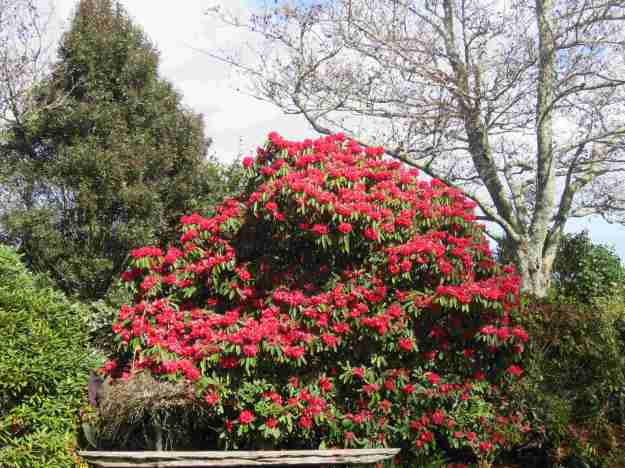
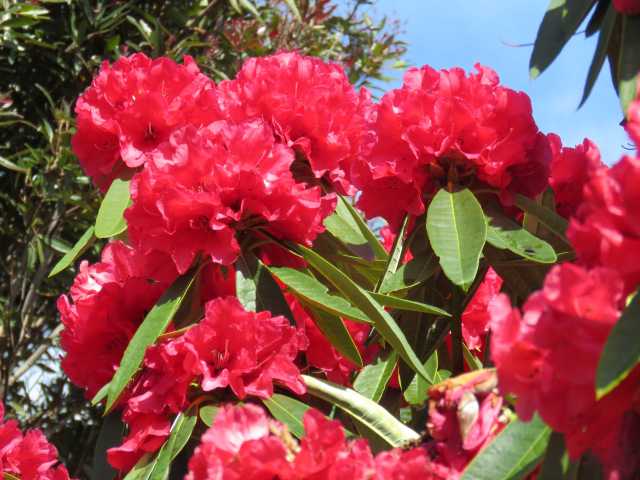
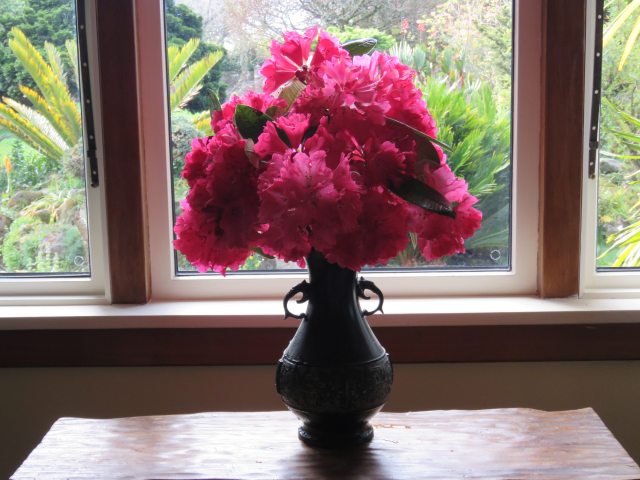
Rhododendron ‘Kaponga’ in Pat’s garden. We have a specimen planted somewhere in the garden but not in a prominent position because I would have to go looking for it.
I do not miss our days of retailing plants. Nursery work was simply a means to earn a living and now that we are retired from all but gardening and final selections from Mark’s plant breeding programme, we are reaping the benefits of those long hours and quite a bit of hard work. Nothing reminds me more of that than red rhododendrons.
“You should take a photograph of ‘Kaponga’, my friend Pat said last week. And indeed it did look as splendid as a full truss, red rhododendron can, when viewed from her window. I didn’t have my camera with me at the time. I am old school – I prefer to use a camera rather than my phone. So I called back in this morning and it is already just past its peak.
Rhododendron ‘Kaponga’
‘Kaponga’ is a local selection of a red R. arboreum hybrid, bred and named by the late Bernie Hollard of Hollard Gardens fame. We like arboreums in our conditions because they don’t get hammered by thrips (turning the foliage silver) or die-back so the plant stays looking well furnished and healthy without needing spraying and special attention. ‘Kaponga’ was never my favourite; I do not love the big ball trusses on rhododendrons so favoured and admired by others. The looser trusses and flower forms of the maddenii group are more to my taste. ‘Kaponga’ is not a pure red like ‘Rubicon’, having a slight pink cast to its tone but it is an exceptional performer.
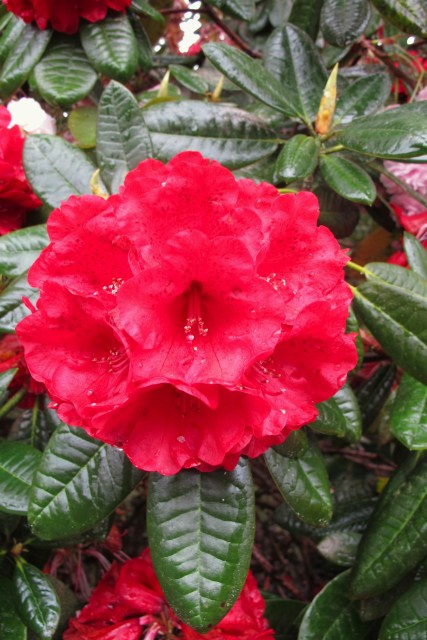
Rhododendron ‘Noyo Chief’ in our park, clearly planted in a more prominent position than ‘Kaponga’ because I know exactly where it is.
It is hard to capture reds accurately. The photo of ‘Noyo Chief’ in our park looks redder than it actually is. This photo of it in a vase is somewhat pinker than it is. The actual shade lies somewhere between the two photos.
Overseas readers will know ‘Noyo Chief’ better than our local selections and, while an excellent plant which performs well every year, it too has that slight pink cast to its full red trusses.
Coming back to selling plants, every person who sells plants will know that any plant in bloom sells on sight. Never more so than red rhododendrons with full, ball trusses. Over the years, I realised that men bought red rhodos. Almost every time. When women bought them, it was often as a gift for their husbands. I should not have been as surprised by this gender-based colour preference – there are still men today who won’t have anything to do with pink, pastel apricot or paler lilac colours, regarding them as too ‘girly’ or feminine for real men. Maybe gardening men have broadened their tastes in the time since we dropped retail about 15 years ago? I hope so.
‘Rubicon’ was my favourite – pure red and handsome foliage but prone to thrips. It needed spraying to keep it healthy and we are not willing to use sprays in the garden just to keep plants looking good. In the end the thrip infestation got so bad that they pretty much marched away with the plant. Brilliant red rhodo but best grown in a climate with a colder winter than we get.
I am sure I must have told the story before (but not, I hope, recently) of the Tauranga landscaper who came in to buy plants for a new retirement village. He would only buy red, yellow or orange flowered plants, maybe blue – no whites, creams, pastels and certainly no pretty pinks because he, personally, didn’t like them. At the time, selling plants was more important than my view, but I really, really wanted to point out to him that his retirement village occupants were going to have a majority of women owing to the fact that women have a longer life expectancy. Besides, some men do like pretty flowers and rise above the constraints of old fashioned, masculine expectations when it comes to colour choices.
It must have scarred me because, to this day, I find it hard to rise above my disinterest in big red rhododendrons. I can still admire a good plant that performs well but they never make my heart sing or lift my spirits. Each to their own.
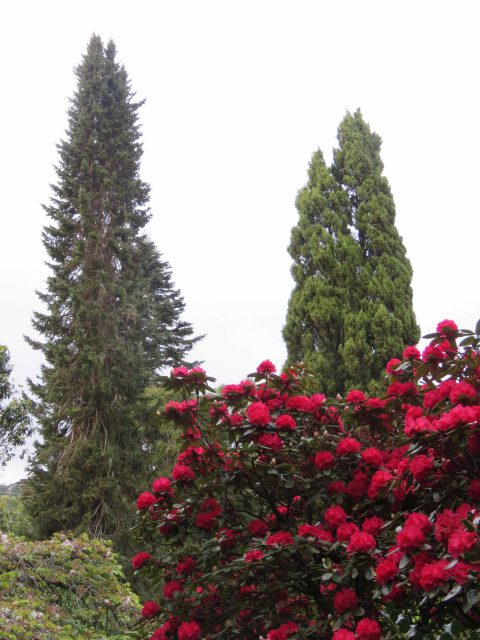
Pat, she of the ‘Kaponga’ plant, had a neighbour who planted a row of reds on their road boundary. I had assumed it was ‘Kaponga’ until I looked at the foliage today and it is not. It will be one of the common varieties in commercial production here these days but, since we stopped selling plants, my memory has filtered out information that no longer seems necessary to remember and confidently identifying many rhododendrons has gone with it.
Our world has shrunk again to a very small, very local area. Mark left the property this week for the first time since the Delta Covid outbreak started on August 17. To be honest, I wasn’t sure how he would cope with this new era of compulsory mask-wearing and scanning but he managed just fine. And if my Mark can cope with masks and scanning, so can everybody else. I know the rest of the world has been masked for the better part of the last 20 months but it is very new here, though I had our range of reusable, pretty masks at the ready.
On my weekly shopping trips (I am not just the designated shopper here, I am and always have been pretty much the only shopper), I have been amazed at the exceptional levels of compliance in our local areas. Everybody is not only masked, scanning and maintaining physical distancing, they are doing it with patience and good grace. Melbourne son keeps saying to me that New Zealanders are compliant people. I was surprised when he first said this because I do not think that we have a particularly compliant culture. Upon reflection, I don’t think what is happening here is unquestioning obedience. I think it is more about a shared vision and a strong sense of community and for that, we can thank the very clear messaging and communications from our government.
Fingers crossed that this Delta incursion over our border can be eliminated in good time so that our garden festival can go ahead in just over seven weeks. I am hoping we can do it without needing to mask but, if necessary, we will mask and not complain.
In the meantime, special thanks and acknowledgement to Aucklanders. Yet again, Auckland is bearing the brunt of lockdown measures to keep the rest of the country safe and free from Covid and it is really hard. The rest of us need to be very grateful to them. The alternative of having Covid running through our country is grim, indeed.
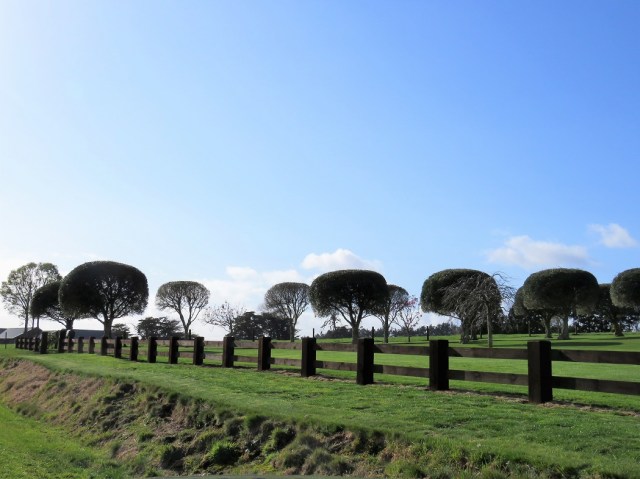
My eyes have been focused locally on my once-a-week trip out to get essential supplies. Somebody had been clipping hard but with great precision on this driveway sited on the crest of small hill across the river from here. I don’t even know what those trees are. I didn’t get close enough to inspect but they certainly make a sharp statement. Are they incongruous in their rural setting or a really interesting contrast? I lean to the latter.
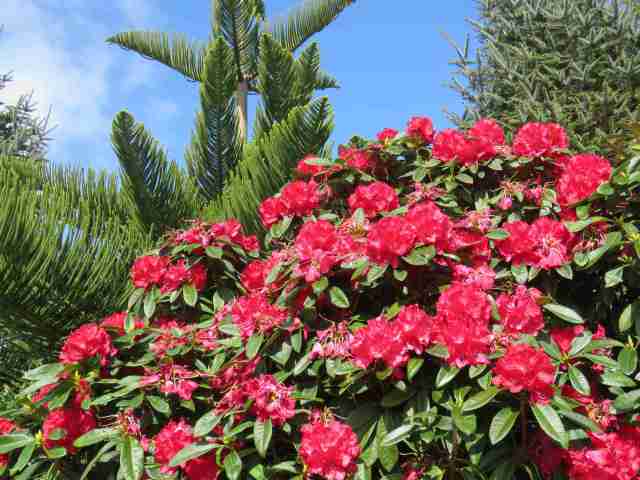
Rhododendron Kaponga
I spotted this red rhododendron last week and went back to have another look yesterday because I regretted not stopping at the time. Last week it was glowing brightly in the light, not quite so much yesterday but still bold and vibrant. It is a local selection of R. arboreum which is named ‘Kaponga’, renowned for its high health. When it comes to rhododendrons, those big ball trusses are not my personal favourite, but I couldn’t fault this handsome plant. The fact the property owners stained their fence dark rather than leaving it in its tanalised state helps show off all the plants to advantage.
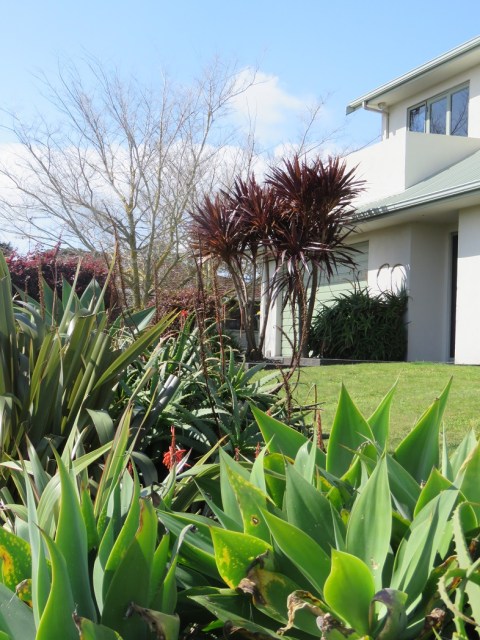
In my local town, I stopped to photograph this handsome pair of red cordylines (cabbage trees) which look very sculptural in front of a fairly plain house. There are a number of named red forms available, but they are generally just selections of our native C. australis ‘Purpurea’. True, close up the foliage looks as chewed as all other NZ cordylines but that is because it is a native moth whose caterpillar munches on the leaves.
Almost opposite was a new garden which was really quite amazing. I think we could describe it as largely Italianate with a touch of pre-Raphaelite. I will say no more except to note that it has been constructed and furnished with much care and attention to detail and is clearly a source of pride to its owners.
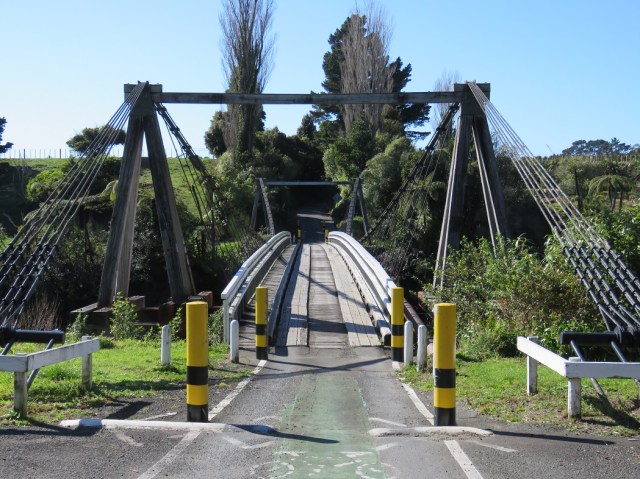
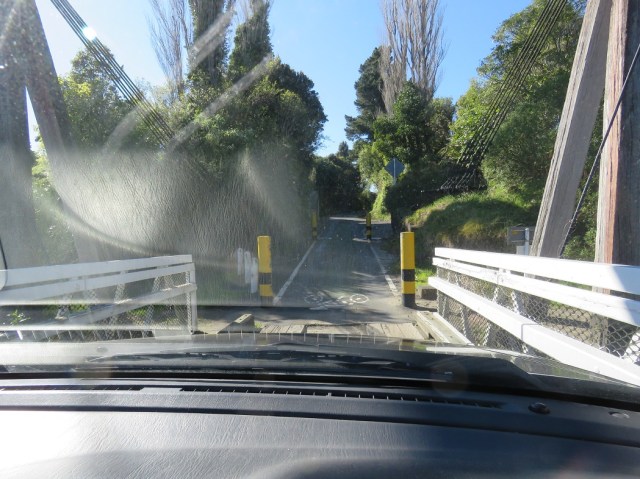
You do need to line up carefully. There is not a lot of room to spare.
Finally, back to the bridge at the top. It is the historic Bertram Road bridge, not far from us. I have a bit of a thing for bollards so I was delighted to find @WorldBollard on Twitter. It is the official account of the World Bollard Association (who knew?) and clearly over 30 000 other people have an interest in bollards, too.
There are eight bollards standing guard and all of them look something like this. Oh, the stories they could tell.
Bollards play an important role on this bridge. When it was restored and reopened to vehicle traffic, maybe back in the 2000s, the bollards were not quite as resolute as these current ones. But a stupid driver of a heavy transport truck thought he would ignore the warning signs and take a short cut over the bridge, demolishing the sides and a fair amount of the decking. Personally, I think he was lucky to get the truck off the bridge without it collapsing into the river because he far exceeded the allowable weight.
When the bridge was reinstated, the bollards were moved in to narrow the space further. Judging by the state of them, they have inflicted quite a lot of damage in the last few years as people have found their vehicles – particularly the modern twin cab utes – are too wide to fit. They are renowned too, I am told, for taking out wing mirrors.
It is just a question of lining the car up to stay very close on the driver’s side, keeping very straight and taking it slowly. Personally, I have never even brushed one of those bollards. Our Sydney daughter declared she would not be risking it herself when I took her over the new narrowed version on her last trip home.
From our neighbourhood to yours, stay safe. Fingers crossed for positive progress this week on dropping Covid case numbers down to low single figures.
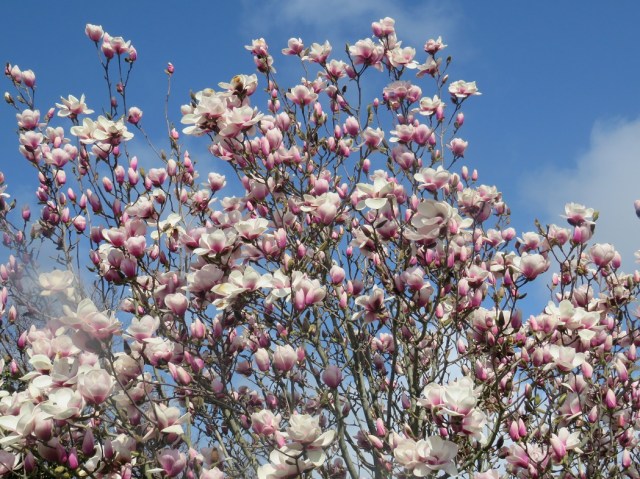
Magnolia Milky Way – a Felix Jury hybrid – out the front of Pat’s place on the drive home
For overseas readers: we had one Covid incursion that escaped our border quarantine and that one single incident has so far produced 902 community cases. We know they all came from that one single infection because all cases are genomically sequenced in NZ. New daily infections had dropped to just 11 on Friday so Saturday’s 23 cases were a disappointment. That is over the entire country but we want it back to zero again. We are playing the long game here, playing for time to get the population vaccinated and also to see how Covid is going to pan out internationally before we risk opening the border without the current tight quarantine. ‘Learning to live with Covid’ still looks pretty undesirable when we have been so successful in learning to live without it.