Tag Archives: Taranaki gardens

Tikorangi Notes: Friday 13 July, 2012

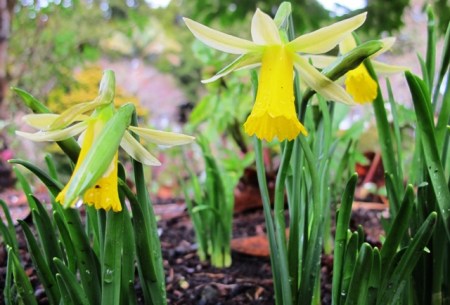
Spring must be getting close - dwarf Narcissus Twilight is opening

Spring must be getting close – dwarf Narcissus Twilight is opening


Last week was garden bed...

Last week was garden bed…

Latest posts:
1) The Great Garden Make Over (aka renovating the rose garden). Not quick, not even that easy, but hugely satisfying.
2) They were the first narcissi to flower this season – Narcissus bulbocodium citrinus ‘Pandora’. However, others are starting to open, including the little Felix Jury hybrid ‘Twinkle’ above.
3) Grow it Yourself – tamarillos, this week. Yet another subtropical fruit, from South America again this one, that we have taken over in this country as if it were our own – even to the extent of branding it tamarillo!
4) Away from gardening and on to recipe books – 500 Tapas reviewed.

Tikorangi Notes: Friday 13 July 2012

The work in the rose garden has absorbed all my recent energies, and a good deal of Lloyd’s too. If the rain had just held off for another couple of days, it would have been finished but intermittent showers and the developing mud has driven me indoors.
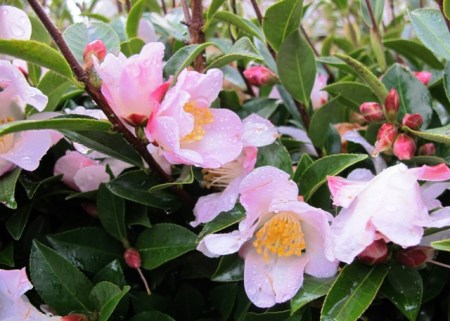
Camellia Fairy Blush

Camellia Fairy Blush

Camellia Fairy Blush is looking particularly pretty in our little hedge. This was the first camellia Mark ever named – a scented, lutchuensis hybrid. Mark is not given to exaggeration or overstating matters so he was always rather deprecating about Fairy Blush. “It’s just a little single,” he would say, “but it does flower well and has reasonable scent.” Yes, it is a little single that flowers for several months on end and is as fragrant as any camellia, on a compact plant which clips very well. These days we regard it as the one that got away from us. We should probably have taken out Plant Variety Rights (a plant patent) on it. It is now a market standard in both Australia and New Zealand and it can be a little galling when nurserymen tell you how very well they have done out of your plant. Such is life. But then we have learned the hard way that even agreements and Plant Variety Rights don’t necessarily give market protection either. We would still plant Fairy Blush in our own garden and recommend it to others, even if it wasn’t our cultivar and that is a fair testimonial.
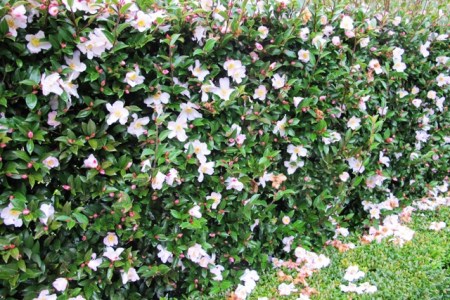
Our hedge of Camellia Fairy Blush


Our hedge of Camellia Fairy Blush

Plant Collector: Narcissus bulbocodium citrinus “Pandora”

The first narcissus of the season - N. bulbocodium citrinus 'Pandora'

The first narcissus of the season – N. bulbocodium citrinus ‘Pandora’

Always the first little narcissi to flower in winter, these lemon hoop petticoats are pretty as a picture at the moment. I guess they gained their common name because they resemble those wired underskirts from times past. The bright yellow bulbocodiums flower later in the season. In contrast, the citrinus are very early, coming out with the snowdrops. These are easy bulbs to grow. In fact this clump is naturalised in hard conditions where our gravel driveway meets an elevated concrete path – which is why the flowers show some splash and wear. There is no mollycoddling involved with them but they do need good drainage and full sun. N. bulbocodium is native to the south of France, Portugal and Spain so will occur naturally in relatively hard conditions. Given that the foliage is distinctly grassy in appearance, you just need to make sure you are not mowing it off in the early stages.

Daffodils go far beyond the common big King Alfred types and we like a range of them so we can have them in flower for many months. We prefer earlier flowering ones overall because they are generally finished by the time the dreaded narcissi fly is on the wing. It lays its eggs in the crown of the foliage and each bulb becomes home to one fly larvae (big, fat creamy grub) which spends a year sustaining itself by eating the bulb from the inside out, only to metamorphose and repeat the cycle. A breeder told me that narcissi only need 65 days of growth to build up strength in the bulb for next year’s flowering so you can remove foliage early if you need to beat the fly. We also favour the littlies, the dwarf varieties, which are much more compact and showy in the garden.

Bulbocodiums increase readily by division and some will set viable seed.

First published in the Waikato Times and reprinted here with their permission.

Tikorangi Notes: Friday July 6, 2012

Our maunga, Mount Taranaki

Our maunga, Mount Taranaki

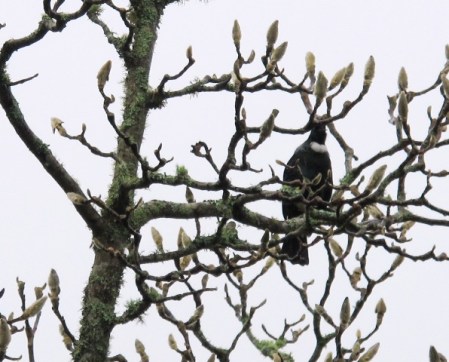
The tui are back

The tui are back

Latest posts: Friday July 6, 2012

1) Fragrant rhododendrons – the final feature article I have written for the Weekend Gardener. So you only want scented plants in the garden? There are fragrant rhododendrons to choose from.

2) The understated elegance of Helleborus orientalis in Plant Collector this week.

3) Reviewing the role of container plants. Do they add anything to the garden other than work?

4) Grow it yourself – celery. We don’t because Mark won’t, so I buy it but you can if you wish. The word from Mark is that it is not that easy to grow well and the one year he got it absolutely right, we only hate about two complete heads of celery and the rest went to waste.

5) In the Garden this fortnight. The final in this series I wrote for Weekend Gardener. It’s on gloriosas this week.

6) Outdoor Classroom revisited – sharpening garden tools. Everybody says do it but nobody says how.

Tikorangi Notes: Friday July 6, 2012

As you may gather from above, I have resigned as a contributor to the Weekend Gardener so the pieces first published there will cease after today. But do not let that stop you – please take the time to fill out their survey and let them know what you think of the changes they have made with their new management.

The three new posts a week from the Waikato Times will continue uninterrupted. Though if anyone has any ideas for replacing Grow Your Own, I would appreciate hearing. There are a finite number of vegetables and I am nearing the end of all available options, even allowing for extensions into some herbs and soft fruits.

In the meantime, great winter weather has seen plenty of sun, mild days (15 degrees yesterday) and very little wind. The mountain has a good covering of snow and is looking its most spectacular. More camellias are opening flowers and the tui and kereru are here in good numbers. It won’t be long before the magnolia season starts.

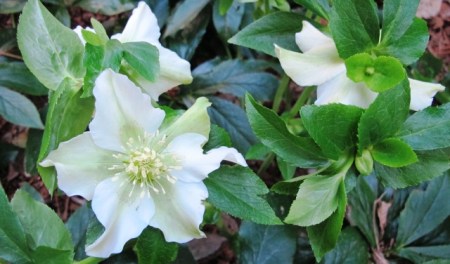
Plant Collector – Helleborus orientalis

Helleborus orientalis - quiet and undemanding stars of winter

Helleborus orientalis – quiet and undemanding stars of winter

Hellebores are quiet heroes in the winter garden. I have never seen a strident one. By far the most common hellebore is H. orientalis – though it is not from the Orient, being native to northern Turkey and Greece. It is a perennial which keeps its leaves all year round but in our experience it is not one that appreciates being dug and divided. Plants subjected to this routine can sulk for a long time afterwards. You are better to salvage some of the many seedlings you get around plants if you want more.

Given their origins, it is not surprising that these plants are happy to lead their quiet existence in fairly tough conditions, coping with root competition and shallow soils. This makes them ideal for semi shaded, dry areas beneath trees where it is not always easy to find suitable plants. However, they won’t appreciate dense shade. Lift the canopy of overhanging trees and shrubs to get more light.

Most hellebores come in shades of dusky pinks, reds, greens and white – or sometimes in blends of these colours and they often change colour with age. There are some highly desirable deep red and slate colours – the latter bringing blue-purple tones. However the performance of these appears to be temperature related. The colder your conditions (and these are cold hardy plants), the better colour you will get. The best ones we have seen were in Taupo and the UK where winters are considerably chillier.

If you have prized cultivars, keep them separate if you are hoping to raise seedlings. They are promiscuous plants and will cross readily. That said, to my mind, hellebores look best in big patches or drifts. Interplant with winter and early spring bulbs (bluebells, snowdrops, smaller growing daffodils are our preferences) to add interest.

First published in the Waikato Times and reprinted here with their permission.

THE FINAL In the garden this fortnight: Thursday 5 July, 2012

A fortnightly series first published in the Weekend Gardener and reproduced here with their permission. However, as I have now parted company from that publication, this will be the final in this particular series.

Gloriosa superba in summer

Gloriosa superba in summer

The comments about lilies in issue 339 reminded me that I needed to thin our Gloriosa superba. While these are often referred to as climbing lilies, they aren’t a lily at all, being an entirely different family. But they are a wonderful summer flower and very obliging at growing in parched, dry conditions in the front, sunny border under the eaves of the house. There are not a lot of plants that like those conditions. The tubers are very curious. As they get bigger, they grow into large V shapes and they find their own depth in the soil – sometimes very deep down. I do not understand how they do it. It is hard not to envisage them wriggling down. If they are happy, they can multiply a bit too readily and seed down as well. I dug out a bucket of spares from a short border. They are difficult to dig out without breaking them and if you lose both tips, they are no longer any good and will just rot.

Gloriosa superba tubers

Gloriosa superba tubers

These tubers come into growth in late spring. The stems need some support because they get about a metre long before they put up a succession of odd reflexed flowers in orange-red and yellow tones which look for all the world like a coronet. They lack any fragrance but they are an excellent cut flower and the season lasts months through summer. Curiously, they are the national flower of both Zimbabwe and Sri Lanka.

Top Tasks

1) Rose pruning. We like our roses to flush early here so that they are in full flower for our annual garden festival at the end of October. Being country residents, we are still allowed an incinerator and I pile up the prunings beside it so they can dry and then be burned.

2) I prefer to keep most of our roses in one area of the garden rather than spread throughout. After pruning, I rake out fallen leaves around the plants because these can harbour disease and then follow up with a mulch of fresh compost.

3) Carry my wire brush with me in my gardening basket. While the lichen growth we get here is apparently a sign of very clean air, we can end up with too much moss and lichen in our humid climate. I find it much easier to do a little often, rather than trying to clean entire areas at once. I have stonework, concrete, brickwork and plant trunks in my sights.