
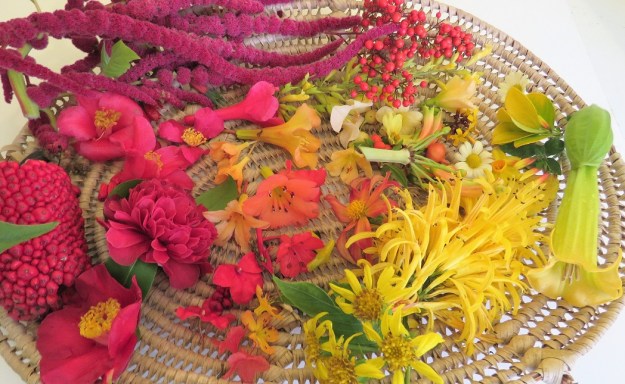
 Winter can be very pink, here. Or so I have often declared. I hereby move my position. Late winter and early spring can be very pink – all those camellias and magnolias. In late autumn to mid-winter, the dominant colours are more inclined to the oranges and yellows with a smattering of reds.
Having been relatively confined by a combination of wintery, wet weather (Mark says he is consistently tipping 2.5cm or an inch out of the rain gauge each morning) and a bad head cold, I decided I would go and see how many flowers I could find that are in the orange, red, yellow colour range. There is still the last of the autumn colour evident but I figured that I would keep to flowers without adding in coloured foliage. It is probably indicative of our soft climate that I can expect to find a range of different blooms in the depths of winter.
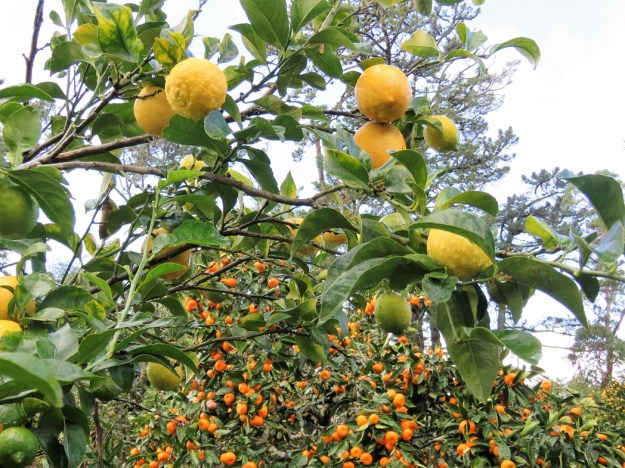 I could of course have added in fruit. The citrus trees add a glorious blaze of colour in the depths of winter – just a common old lemon and a very productive mandarin tree in this photo, but the orange trees we have scattered through the ornamental gardens are also indubitably orange and a very cheerful sight for that.
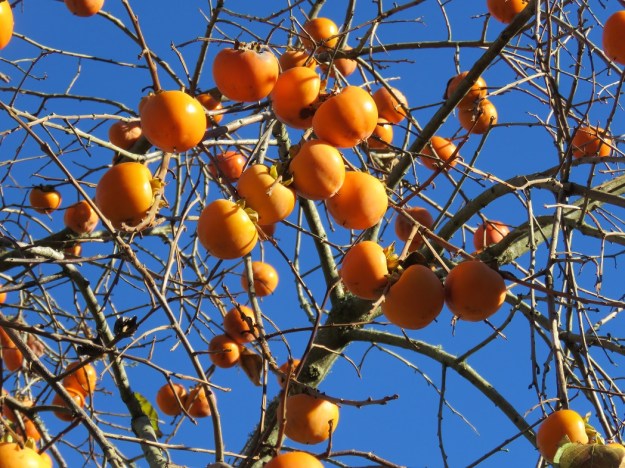 And it is hard to ignore the glory of the persimmon tree, be the sky grey or blue. It is a feature of our climate that we have high sunshine hours and bright, clear light even in mid-winter, albeit interspersed with the rain. We don’t get many days when it is irredeemably grey and gloomy, without spells of clear skies.
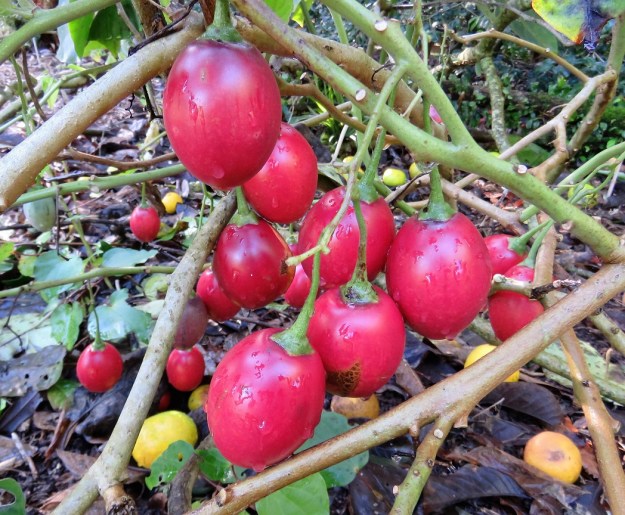 The tamarillos are also hanging decoratively. These used to be known as ‘tree tomatoes’, botanically Solanum betaceum. Apparently the ravages of the potato psyllid have hit commercial production hard, but our plants just continue on in a regime of benign neglect. The fruit is usually stewed with sugar but stewed fruit is not part of our diet. I enjoy them more as a fruit cordial. Mark’s father used to like eating them sliced on wholemeal bread with a little raw, chopped onion. The yellow fruit beneath are windfall grapefruit.
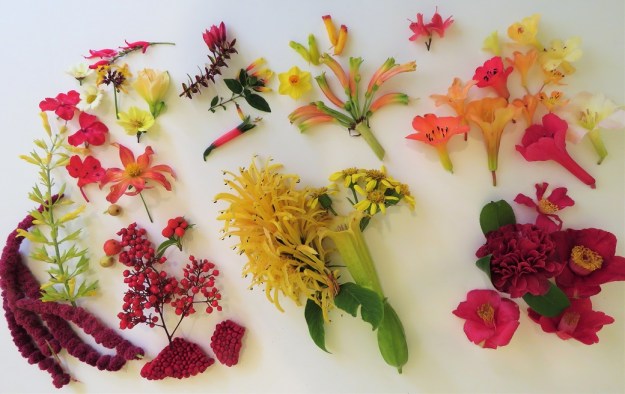 But to the flowers. On the left, we have the vestiges of autumn – salvias, impatiens, tree dahlia hybrids, daisies and Oxalis peduncularis. At the front are a few berries and seeds – baby figs from Ficus antiarus, Nandina domestica ‘Richmond’ , a small berrying shrub whose name escapes me at the moment and the showy seeds from Arisaema speciosum.
Moving to the middle, the winter bloomers include, excitingly, the first of the bulbs – Lachenalias aloides and reflexa, a brave jonquil and the lesser known Phaedranassa carmioli (both Mark and I had to look that one up). The big yellow candlewick flower is Jacobinia chrysostephana adjacent to the flowers of Ligularia reniformis and what I think is still classified as a datura, not a brugmansia. Also included is an early flowering clivia and Agapetes serpens.
There is only one red azalea out so far, several red camellias but interestingly, the stars are the vireya rhododendrons – plenty of these frost tender subtropicals flowering their socks off and lighting up the woodlands. I guess they speak volumes about the nature of a Tikorangi winter. We should not be complaining too much.
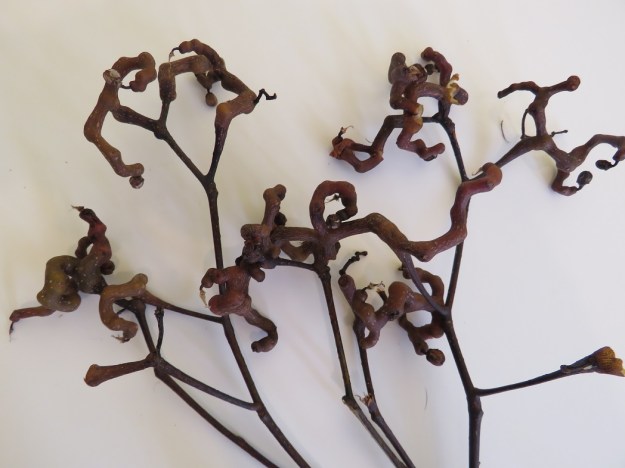 Finally I offer you… the ‘fruit’ of the Japanese raisin tree, Hovenia dulcis. I am guessing that as our plant is maybe 20 years old and planted in a somewhat out of the way position, we just haven’t noticed these before. They are actually the swollen tips of the stems and are edible. They even taste fruity, in a raisin-ish sort of way. Apparently drying them makes them even more raisin-y. It is more a curiosity than an edible essential, but we like these odd additions to our diet here.

 First published in the NZ Gardener April edition and reprinted here with their permission.
 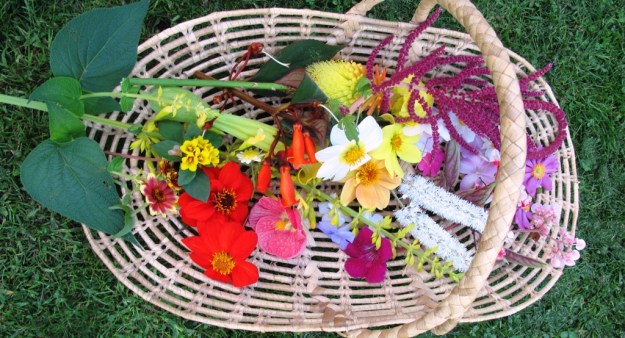 It is indubitably autumnal, but no sign of the leaves colouring or dropping yet as we gently drift into the cooler seasons. I shall do a survey of the plants that take us through autumn, I thought, and headed out to the garden with snips and a basket.
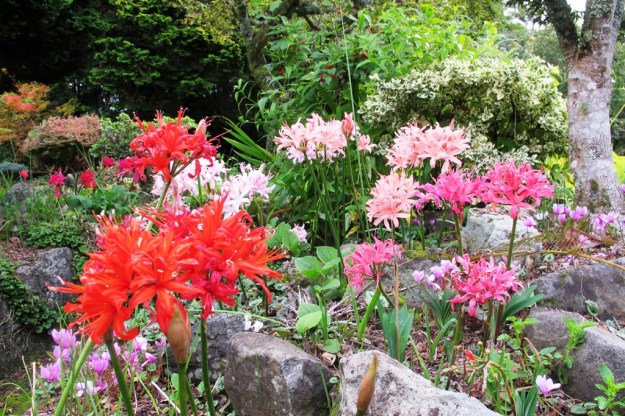
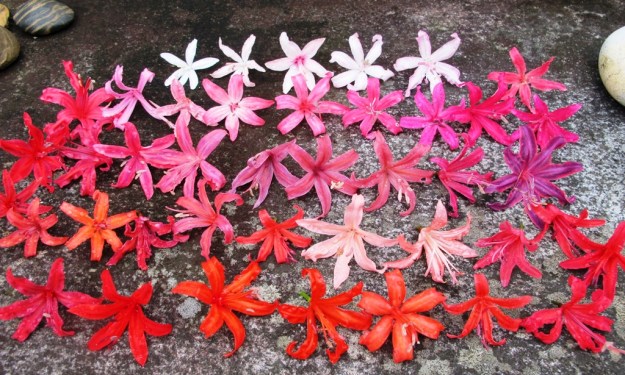
 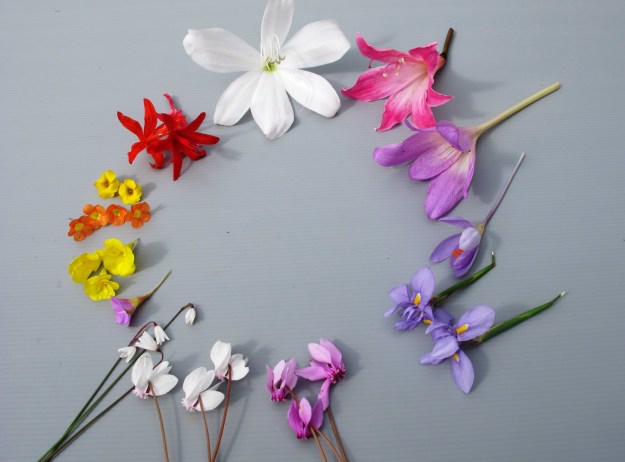 Despite that slight sense of mournful decay that can characterise the autumnal garden, there was so much flying the flag for flowers that I had to group them. It is still early for the autumn bulbs. There is a whole lot more to come but the nine in bloom at least indicate that not all bulbs belong to spring. Starting with the white flower at the top of the photo, going clockwise, these are: Crinum moorei, belladonna, Colchicum autumnale, one of the autumn crocus (could be C. serotinus), Moraea polystachya which is an unsung star amongst the autumn bulbs, Cyclamen hederafolium both pink and white, the dainty little Leucojum autumnale, the earliest of the oxalis (hirta, luteola, massoniana and lobata) and the first of the nerines that will become the rockery stars over the next few weeks.
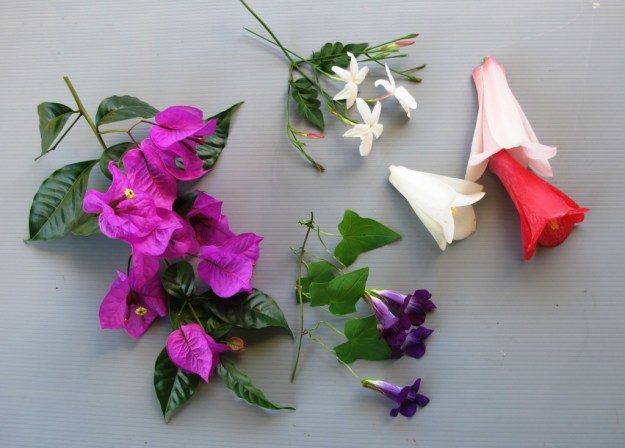 Climbers can be a little bothersome to place. Too many are strangling, invasive things, smothering their host as they scramble to the top, or, like the Rhodochiton atrosanguineus, seeding down in perpetuity. Others are such retiring little dainties that they can be difficult to keep going. Flowering for us at the moment are the bougainvillea (very much in the rampant camp) and one of the more garden-friendly jasmines at the top but we have lost track of which one it is. It has good fragrance, flowers pretty much all the time and is strong growing – bordering on rampant – but not as aggressive as the weedy jasmines. It is planted on the corner of the bedroom once inhabited by our daughter of the same name. Immediately below, the purple flower like a mini streptocarpus is on a soft vine, but its name escapes us at the moment. Well, I have never known it and Mark thinks he raised it from commercial seed but has yet to recall what it is. To the right are the lapagerias – Chilean bell flowers – with their wonderfully long blooming season and obliging habits. Sure it can take several – many, even – years to get a vine established but once there, these are rewarding plants for the shaded side of the house.
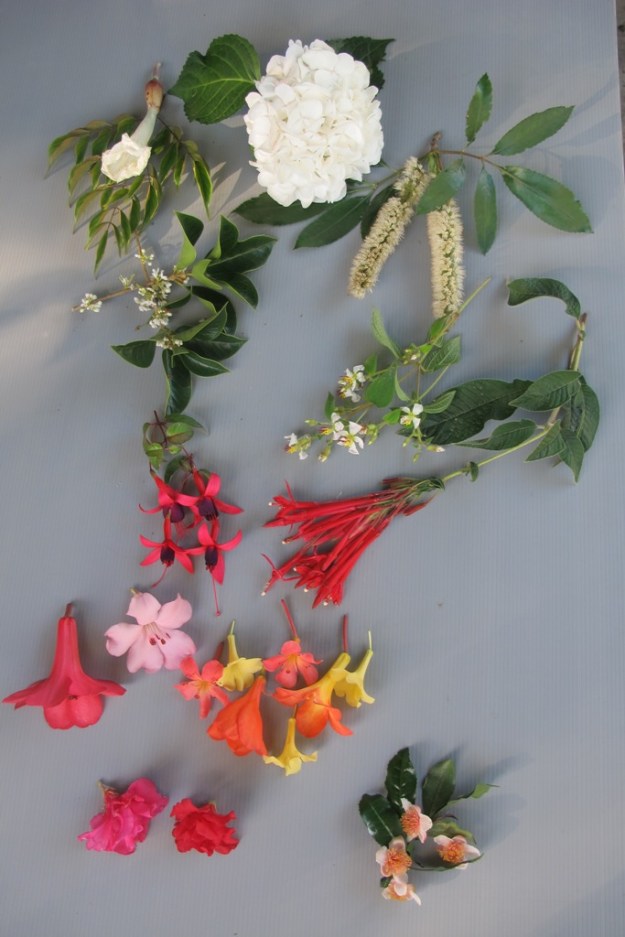 The flowering shrubs and trees are not so numerous at this time of the year. Top row left, we have Radermachera sinica (more on this below), Hydrangea Immaculata which is still at peak rather than that fading over to dusky spent flowerheads, next row down is the fragrant osmanthus (though not sure which one) and the so-called African butter knife plant or Cunonia capensis. Then comes the white flowered tibouchina which seeds down far too freely here but does compensate by flowering pretty much all the time in semi woodland conditions. Fuchsias are not a strong point for us, but the one on the left has been here forever it seems, surviving even falling over, splitting apart and drought. The one on the right is the attractive but dangerously weedy Fuchsia boliviana. Second row from the bottom is a sampling of vireya rhododendrons – have enough of these around the place and there are always some in flower, 52 weeks of the year. In the bottom row are the first of the evergreen azaleas embarking on their marathon blooming from early autumn right through to mid spring and the first camellia.
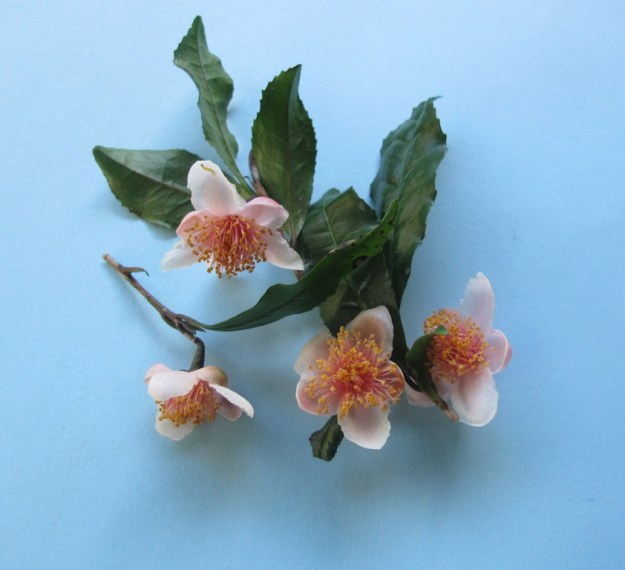 Camellia sinensis will no doubt be of interest to some. It is always the first to flower though with such insignificant blooms that they are easy to miss. This is the tea camellia, and yes, sometimes we do harvest the young leaves to make green tea. White flowered tea camellias are more common and we have a plant somewhere – in the “plant out” area, I think, waiting to get out of its pot.
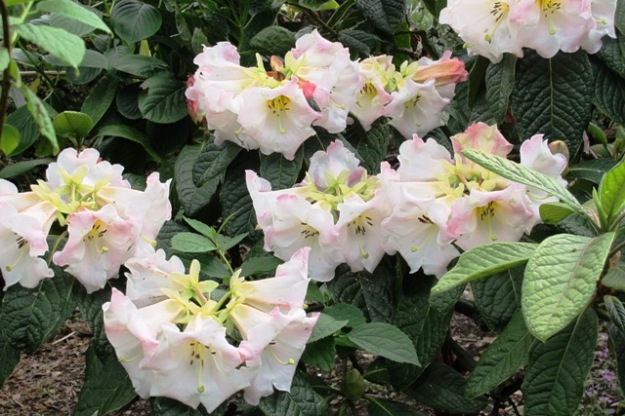
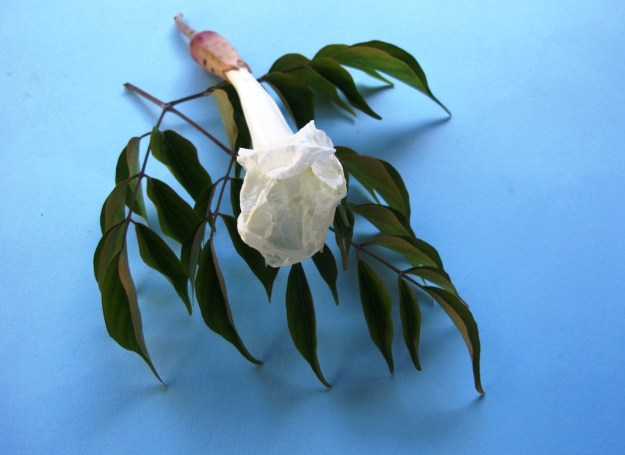 I was pretty thrilled by the Radermachera sinica when Mark alerted me to it in bloom. It has a divine and heady fragrance. The trouble is that it is sub tropical to tropical so treated as a house plant in the temperate world. But it is a tree and ours is shooting skywards. Besides, we don’t do houseplants so we are yet to decide what to do with this plant besides enjoying its current flowering.
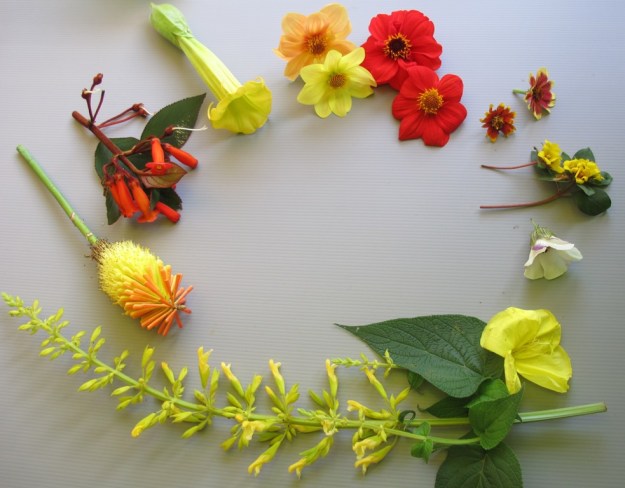 Finally there are the perennials and annuals still in full bloom. In brief in the yellow tones, we start with a damn big yellow salvia at the base and head around clockwise: kniphofia species, one of the gesneriad family whose name we have currently forgotten but which makes an excellent woodland plant, datura, dahlias, simple little autumn zinnias (none of the over-bred, bushy, compact, modern hybrid bedding plants), a handy yellow ground cover which flowers for a very long time and whose name will come back to us at some point, Hibiscus trionum and the common wildflower oenothera which is remarkably rewarding when it comes to blooming on and on.
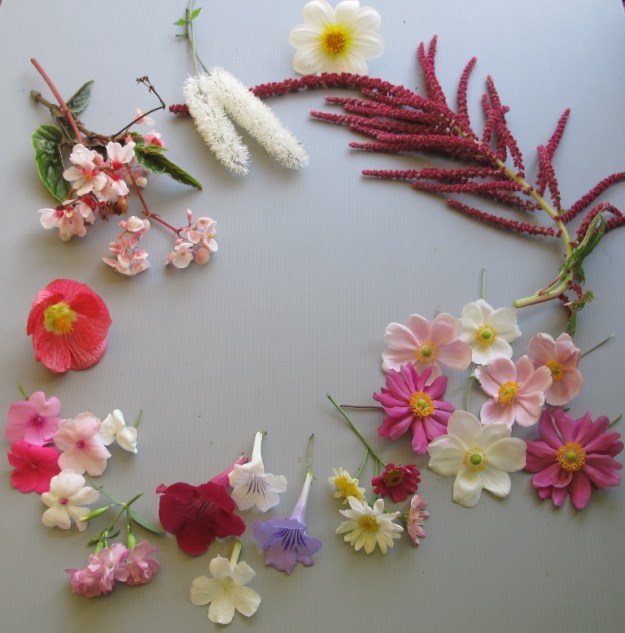 In the pinks and whites, we start at the top with the under-sung white plumes of Actaea racemosa (syn Cimcifuga racemosa) whose fairy candles light up a woodland area, a simple dahlia seedling, the annual Amaranthus caudatus which is self sown, the lovely wind anemones, assorted daisies, streptocarpus (bit of one-upmanship here – we use these as permanent bedding plants in frost-free locations), one of the saponarias, a really old, self-maintaining strain of impatiens that has naturalised in our woodland, a self-seeded abutilon which should have been amongst the shrubs and some rather large and resilient begonias.
 Tikorangi The Jury Garden