
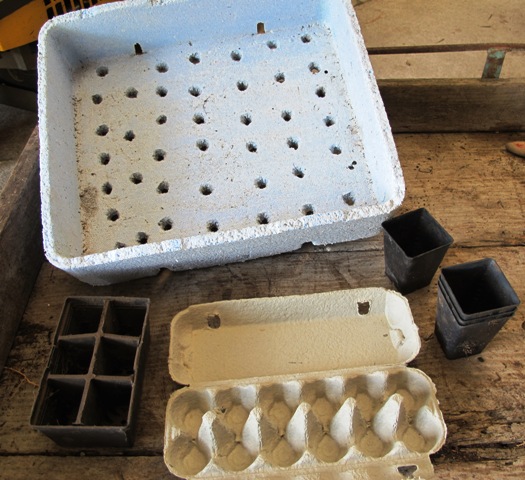
 1) Sowing seed should save you money, especially with vegetables and annuals and it is also the way of getting plants which may not be available otherwise – such as dwarf daffodils, English snowdrops or rhododendron species. We use polystyrene mushroom trays which we have been continuing to use for up to 20 years. Wooden or plastic trays can also be used but you need around 10cm in depth and plenty of drainage holes. Egg cartons can be used for quick turn around crops such as lettuce or peas. You can also reuse the punnets that come from garden centres. Mark likes small individual pots for vegetables.
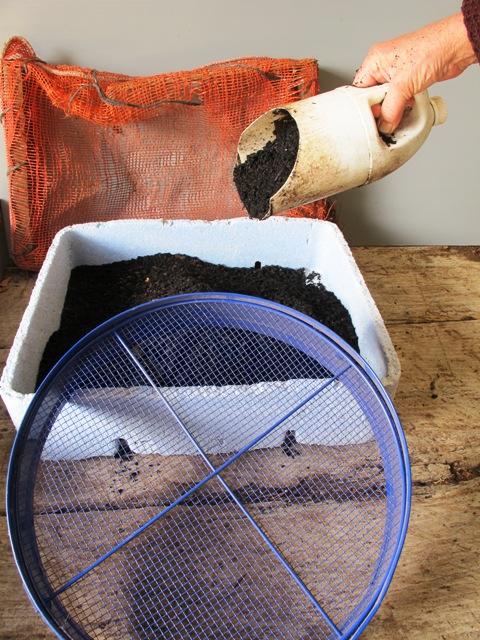 2) It is preferable to use proper seed raising mix which has less fertiliser in it than potting mix because fertiliser can burn young plants. These mixes are sterile, so you know when you see shoots that it is your seeds germinating. You can use garden soil if you want to but coarsely sieve it first to get rid of larger lumps and you need some fine sand or similar to sprinkle over the seeds on top. A home made sieve is fine. You can’t use unwashed beach sand because plants don’t like salt. A bag of seed raising mix is easier and goes a long way so is not expensive.
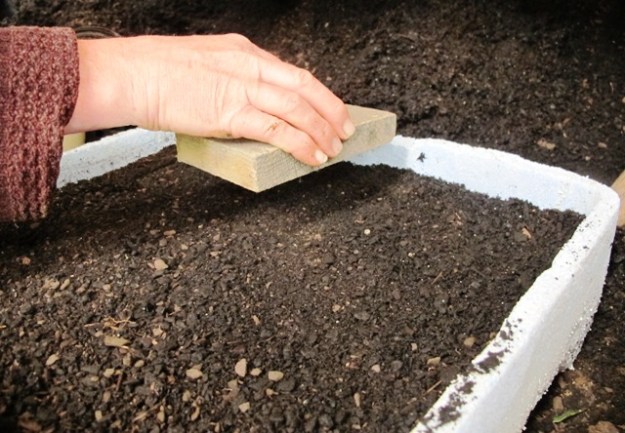 3) When filling with mix, tamp it down to get rid of air bubbles by pressing on top of the tray. If you are using egg cartons or individual cells, sharply rap the container on a hard surface to get the mix settling further. However, if you are using garden soil, don’t compact it.
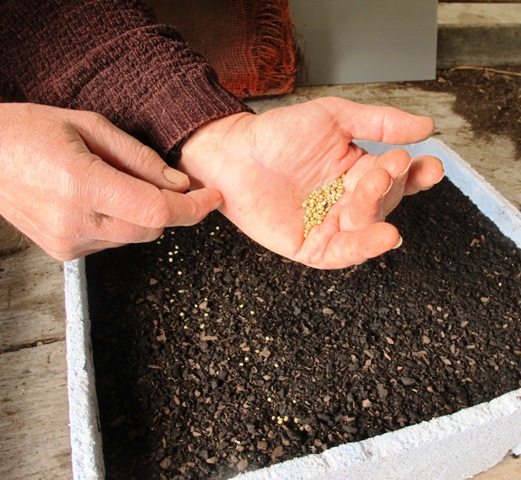 4) Large seed can be hand placed but fine seed is traditionally tapped out of the hand as shown in the photograph or dispersed in small quantities from a piece of folded paper. It can also be dispersed by pinching it between fingers like salt.
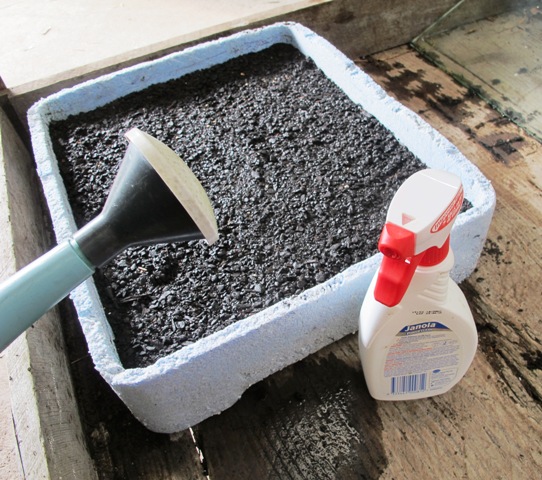 5) Spread a thin layer of mix on top of the seeds. The smaller the seed, the lighter the covering but almost all seeds need a complete cover (primulas and rhododendrons are an exception. These are surface sown – ie not covered). Water carefully. A misting bottle (a well-washed window or shower cleaner bottle with a pump spray) is ideal for fine seed. A watering can with a fine rose to disperse the water is also good. Don’t flood the seeds.
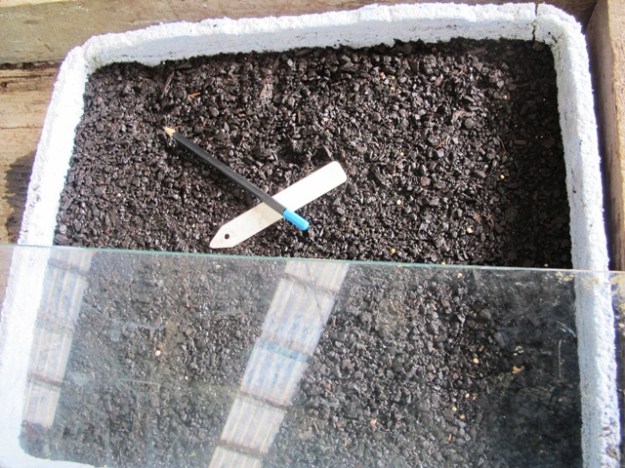 6) Label the tray. We favour a soft pencil and hard plastic labels which we scrub and reuse for years. Pencil lasts longer than marker pen and is easier to clean for reuse. Precious, fine seed can then be covered with a protective sheet of glass. Stretched plastic can also be used. Until seeds germinate, place the seed trays out of direct sunlight and in good light. It is usually wise to elevate the seed trays away from slugs and snails or cats who think it is a litter box. Check your seed tray daily for moisture levels but do not scratch around looking to see what is happening. When the seeds have germinated, move the tray to sunny conditions and increase the watering as required.
Tag Archives: Tikorangi: The Jury garden
An Easter legend – the Glastonbury thorn

I went looking for the Glastonbury thorn but it was not to be found at St Mary’s cathedral after all
The legend of the Glastonbury thorn seems timely as an Easter story. I started by setting out to find the local specimen at St Mary’s Cathedral in New Plymouth that is reputed to be the Glastonbury thorn, only to find it isn’t. We have our own legends too.
Glastonbury is in the Somerset area of the United Kingdom. The abbey site has had a Christian church on it since the seventh century, but legend takes it back further. One version has Joseph of Arimathea bringing his young nephew, Jesus Christ to Glastonbury where they built the first Christian church at that location. But the Glastonbury thorn tree is attributed to the second visit by Joseph of Arimathea soon after the death of Christ. Reportedly landing in a state of exhaustion, he thrust his staff into the ground on the slope now known as Wearyall Hill. The staff took root overnight and grew into the Glastonbury thorn tree, revered as sacred through the ages since.
Interwoven through the Glastonbury thorn legend, is the more powerful myth of the Holy Grail that Joseph was believed to have brought and buried just beneath the Glastonbury Tor. The Holy Grail of course is the cup used by Christ at the Last Supper and subsequently used by Joseph to catch his blood at the crucifixion. And with the Holy Grail come the legends of King Arthur and the Knights of the Round Table. Glastonbury Abbey is reputedly the final resting place of both Arthur and Guinevere. Sadly, after about 1000 years, they got a bit careless with the remains and when the abbey was sacked and largely destroyed in the 1500s, Arthur and Guinevere’s remains were no more.
But the Glastonbury thorn endured. Not the original tree. It had a bit of a rough history and still has as replacement plants either die, are vandalised or maybe attacked in spiritual fervour. But as the plant does not strike from cutting or grow true from seed, it has to be grafted. And it does appear that the plant has remained true and been distributed for many hundreds of years.
It seems a little mean-spirited to disturb such a wonderful legend with botany. But whatever the truth is about the Holy Grail, it is a fact that that the Glastonbury thorn is simply a variation on Crataegus monogyna that is the common hawthorn of the UK – the fragrant Mayflower. It seems unlikely that Joseph of Arimathea’s wooden staff at the time of his alleged arrival in Britain was fashioned from a plant native to that country. What makes C. monogyna “Biflora” different is that it has two flowerings a year. Its main flowering is in spring but it also puts up a minor second blooming in winter. The tradition of sending a spray of Glastonbury thorn to the monarch at Christmas started back in the time of James 1 at the turn of the sixteenth century and apparently continues today.
These days Glastonbury is probably associated as much with the annual music festival which, despite being timed for the end of June, seems to be a particularly muddy affair. Despite its very early Christian history and even earlier pagan history, or maybe as a result of it, modern Glastonbury apparently now resembles something more akin to Diagon Alley from the Harry Potter stories.
I noticed the wry comments on a BBC New Magazine site from 2012. “The former mayor John Coles tends to the remnants of the thorn. In recent years, people have tied ribbons to it bearing messages, prayers and maybe even spells. Coles removes them. “It takes daylight away from the trunk,” he explains. He also prises out the coins that people have jammed into the bark.”This never used to happen even eight or nine years ago,” he says sadly.The apparent takeover of the town by new age believers disturbs him. “There’s nothing wrong with paganism but there is a certain taste of Satanism as well and I have always regarded Glastonbury as a Christian town.”
Many St Mary’s parishioners in New Plymouth were proud of their Glastonbury thorn until it was revealed that it is Crataegus crus-galli from the eastern states of North America. Apparently it was planted back around 1860 by Archdeacon Govett. This makes it one of the oldest known introduced trees in the province but the Glastonbury thorn it ain’t. This is a bit of a shame as the Cathedral of St Mary is the oldest stone church in New Zealand with its foundation stone having been laid in 1845. It would have been a charming connection back to the Glastonbury Abbey history and legend where the lady chapel is still referred to as ‘Our Lady St. Mary of Glastonbury’. Instead they just have a scrubby but venerable North American species.
First published in the Waikato Times and reprinted here with their permission.
Windflower romance
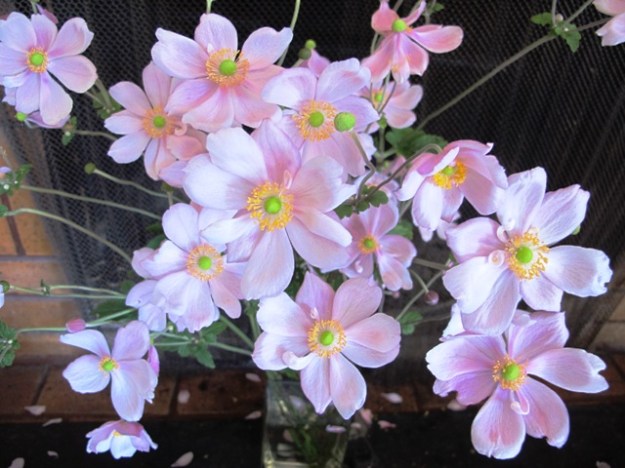
Wind flowers are a personal marker of our wedding anniversary
On the evening before we married, Mark turned up with an armful of Japanese anemones that he had gathered from the Taihape roadside. Don’t even ask why we got married in Taihape when we neither lived there nor came from there. It’s a complicated story. Wind flowers, he called the anemones and believe me, although back in the mists of time, it was a romantic gesture I have never forgotten.
Every year the wind flowers bloom on our wedding anniversary and he often brings some indoors. Last week he followed the old cut flower wisdom – re-cut the stems and burned the ends and they have lasted a full week in water.
We have three different Japanese anemones, in light pink, white and a semi double dark pink which is more compact in growth. It seems that the first two are the straight species, A. hupehensis. Although known throughout the world as Japanese anemones, they are originally Chinese – from the eastern province of Hupeh, in fact. They have been grown so widely in Japan for so long that common parlance attributes them to that country. It is no surprise that the Japanese, with their cultural penchant for simplicity and natural form, took a liking to them.

Japanese anemones are commonly found in pinks and white although selections are being made to extend the colour range into lilac blues
The semi-double darker one will be a hybrid and a named form that was purchased. Mark commented vaguely that he thought it may carry a woman’s name but I see that this plant family is more highly prized overseas than in New Zealand and there are a fair number of named forms, several of them named after women. For the botanically inclined, the Japanese anemones classified as A. hybrida are likely to be mixes of A. hupehenis with A. elegans and A. vitifolia. This is a plant family that crosses readily – though to get a cross you generally need plants that flower around the same time.
Weeds, I hear some readers saying. Weeds. Yes they can be overly vigorous, given the right conditions and become rampant, bordering on invasive because they spread below ground. You probably don’t want to unleash them in areas with plant treasures which they may out-compete. Lovely though they are in flower, you can have too many of them.
That said, I see that there is general agreement that they are not always easy to establish which made me feel better about our meagre showing of white ones in the woodland garden. I had spotted a pretty patch down the road, growing as a roadside wild flower and it is those I photographed. I love the combination of the single, white flowers dancing above the dried grasses.

The white Japanese anemone down the road looks better than the patch we have in our garden
Our pink ones are planted on our roadside and come into flower after the summer colour has largely faded. We have designated our rural road verges no-spray zones with the local council so we carry out our own maintenance. We mow a grassy strip immediately beside the road, get rid of noxious weeds like the dreaded bristle grass and we can do what we like with the rest. And what we like are roadside wild flowers – agapanthus, hydrangeas, robust begonia species, oenothera (evening primrose), belladonnas, crocosmia and the like. It is not just for passing motorists. It is also to feed the bees and to keep some roadside cover in an intensive dairying area which can otherwise resemble a green grass desert.
There are actually somewhere over 120 different anemone species. By far the most common in gardens are A. coronaria. These are the spring flowering corms that you buy as de Caen (the singles, mainly in blue and red but also in pinks and whites) and St Brigid (the doubles). They are very cheerful and cheap to buy. If you get a bulk pack, split it into four and soak one batch at a time overnight before planting. Done at weekly intervals, you can extend the flowering for the first season.
A. blanda is a little Greek species with predominantly blue flowers, more like a carpet if mass planted. A. nemerosa is the European wood anemone. We would like both of these dainty species to naturalise far more widely in our garden than we have achieved so far. They are transient early spring delights.
But in autumn it is time for the wind flowers to star.
First published in the Waikato Times and reprinted here with this permission.
Plant Collector: Hibiscus probably trionum
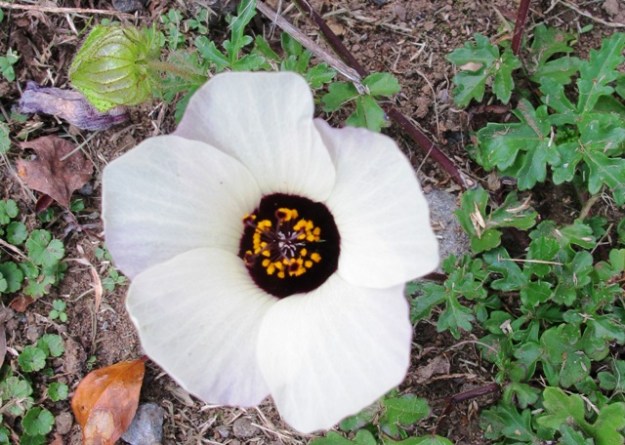
Hibiscus probably trionum
This plant took a little unravelling. It is a self sown seedling with large, short-lived flowers and serrated foliage which is lying almost flat to the ground. Mark thought it was a native but I think he is wrong. There is no shame in that. Most of the country thinks it is native and it is only recently that it has been separated from a very similar species, now called H. richardsonii, which is truly indigenous and indeed critically endangered in its natural habitat of northern east coast areas.
If I am right, this is actually H. trionum which originated in the Levant area of the Eastern Mediterranean, which more or less stretches from Cyprus to Palestine. It seems that the very dark eye to the flower is what makes it H. trionum rather than H. richardsonii. Well, that and chromosome counts. There are countless references on the internet to H. trionum being native in New Zealand as well as being widespread internationally. It has certainly naturalised here and by the time common usage catches up with the differences, it is likely that what we will have are hybrids between the two. It will fall to the botanists to try and keep a pure strain of the native H. richardsonii.
Both forms of hibiscus are usually short-lived perennials, often behaving as annuals, especially in frosty areas. They are in the mallow family (or malvaceae) and are showy, even if the individual flowers don’t last long. The common name is the unromantic bladder plant, though that is more correctly applied just to H. trionum. We do have one other native hibiscus and that is H. diversifolius.
First published in the Waikato Times and reprinted here with their permission.
Garden Lore
“I like trees because they seem more resigned to the way they have to live than other things do.”
Willa Cather (1876-1947)

Autumn harvest and freezing tomatoes
The autumn harvest is being wheeled into house by the barrow load at the moment. They are melons in the photo – both water and rock varieties. The annual challenge for Mark is to get good crops of both through and to this end he takes some care and plants several different varieties of each. This year we have a bumper crop – too many to eat and give away so we have gone to juicing them for lunchtime smoothies. I did worry this week that the current fad of mixed fresh fruit and vegetable smoothies may in fact be the hipster take on Complan, that powdered product that used to be fed to fading elderly folk with no teeth. My anxiety is that we may be on the cusp of moving way past hipster age and approaching the elderly door.
But about the tomatoes. Experienced preservers will have their own tried and true techniques. For novices, faced by a surplus of tasty toms, I offer my method. In a fair division of labour, Mark grows them, harvests them, washes them, cuts out the tough stem end and any bad bits and lays them in a single layer in baking dishes. They are fan baked for a couple of hours around 130C. I then take over, strain off much of the clear liquid which is very flavourful and excellent for creamy winter soups. This I decant to plastic bottles and freeze. I then pull all the skins off the baked tomatoes. It takes a fraction of the time to do it after cooking rather than before. I then pack to meal-sized containers and freeze them. That is it. I add any extra flavourings at the time I cook with them, not at the time of freezing. I know tinned tomatoes are cheap to buy, but the only dollar cost in freezing our own is running the oven. The time required in preparation is minimal and, given the choice, we prefer to know where our food came from.
First published in the Waikato Times and reprinted here with their permission.

