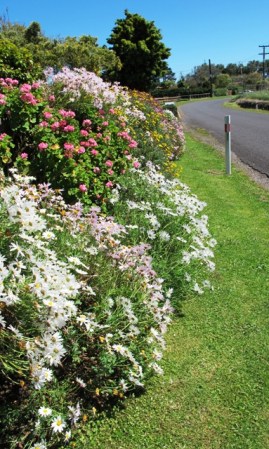
 I smile each time I pass a property down our road. The frontage is a froth of flowers for much of the year. There is nothing choice. Most of them are common enough daisy bushes and pelargoniums which balloon out onto the road verge. It is just a delightful picture for the passing motorist – it being in a position where there is no foot traffic. What makes it a little bit special, to my mind, is that the sole reason for this planting is to bring pleasure to passersby. From my vantage point on the road verge, it looks as if the property owner would not really see this particular planting from their house windows or indeed from inside their garden. That shows a generous gardening spirit, in my opinion.
The contrast to the bleak hillside on the edge of my local town could not be more extreme. Until about two years ago, this hillside was fully planted in mixed trees and shrubs, many of which were flowering varieties. I am guessing the property was sold and that it was the previous owners who had planted it up two decades ago. We always enjoyed the roadside view, particularly because at the bottom, it had a well established specimen of our Magnolia Vulcan which the owners must have planted in a prominent position not long after we released it on the market. Being in town, the air temperature tends to be a degree or two warmer so this Vulcan would come into bloom every spring just ahead of the time it opens in our own garden. It was such a feature and was on the way to becoming a mature specimen.
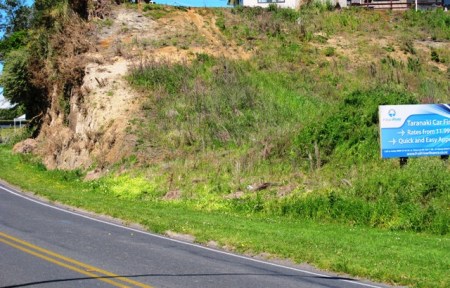
Cleared entirely and left to weeds and erosion
The hillside is too steep to garden intensively or indeed to mow or graze, and it lacks sufficient space to be terraced so there is very little that can be done with it beyond establishing permanent plantings. It took a lot of plants to cover the area but over twenty years, they had grown to give an attractive cover which had knitted together in a patchwork of colour, foliage and flowers. It would have stopped most of the weed growth below, prevented the risk of slipping in rain and given an attractive drive in to reach the house at the top. It would also have required very little maintenance yet it brought a great deal of pleasure to passersby who stood to benefit the most. The house, perched on the top, looked over the plantings.
It must be two years ago now that I drove past as the hillside was being stripped. By stripped, I mean every tree and shrub was removed, even the Magnolia Vulcan at the base of the hill. My heart sank but I thought they must have plans to develop the property differently. Not so. After two years, all that remains are weeds, rank grass growth and clay. But wait – a billboard has appeared, advertising loans at 11.9% to people who cannot afford them to buy new cars. It’s a destructive travesty.
My guess is that new owners moved in and found the shrubs at the top of the slope were starting to block their soaring views across the town and maybe distant views of the river and sea. You have to understand that these are soaring views of a former freezing works town which is not noted for the beauty of its architecture. Rather than seeking advice as to how to frame views, to establish view shafts and to thin or selectively remove problem plants near the top of the slope, they went in and cleared the lot from top to bottom. Believe me, the house will have unimpeded views (and wind) at the top and the owners may never realise how much pleasure people used to receive because of the generous gardening spirit of the previous owners.
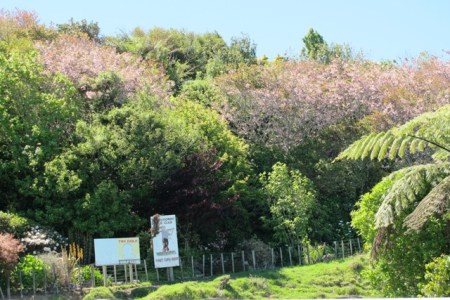
Fortunately, this planting facing State Highway 3 still grows and blooms
Fortunately a similar planting alongside the state highway survives. A different owner with another difficult slope of some area, she planted it around the same time. Many rhododendrons, camellias and flowering cherries grace this hillside along with a large specimen of Magnolia grandiflora at the base of the slope. Very little of it will be visible from the house and again it is relatively steep. It too has billboards but in this case they are faded old ones promoting the activity of golf, rather than the town’s newest finance company. Every day thousands of motorists pass the boundary and for three months in spring, many of them will notice seasonal blooms and maybe it will bring a smile to their day.
To me, that sets a standard for generous gardening, way beyond the sharing of cuttings and divisions. With no expectation of admiration or appreciation, these good folk create beautiful plantings in areas where they can see little from their own homes or outdoor living spaces. They are there to be enjoyed by passing strangers.
-39.042098
174.300314

 Choosing plant containers