Tag Archives: Tikorangi: The Jury garden

Grow it Yourself: Cavolo nero (Tuscan black kale)

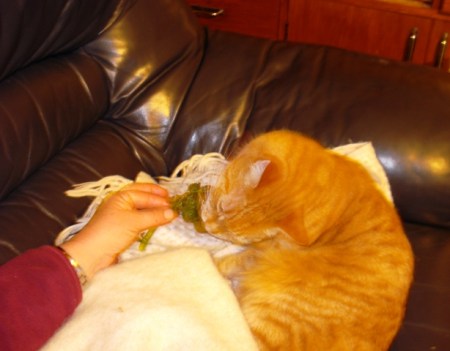
Buffy, the contrary cat, tries to convince us that kale is delicious
Buffy, the contrary cat, tries to convince us that kale is delicious

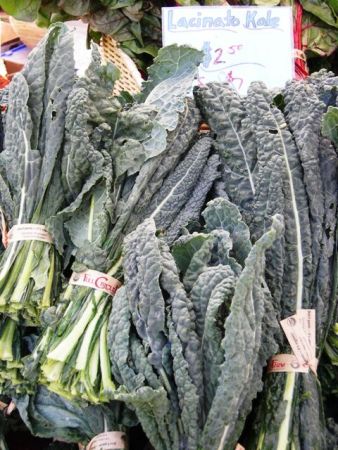
Cavolo nero - photo Joe Mabel

Cavolo nero – photo Joe Mabel

In the odd world of fashionable vegetables, Cavolo nero ranks high enough to be showing in trendy recipes, putting it above even options like cardoon and burdock. It is a kale, a member of the brassica family, but coming from Italy and being of an interesting appearance, it is seen as a sophisticated option. It does not form a heart but instead has very long leaves in a palm-like formation, heavily crinkled or puckered (like a Savoy cabbage) and blackish green in colour. We tried growing kale one season but found it tough and unappealing. Mark commented that there may be reasons why our forbears preferred other brassicas to kale. Our cat at the time, the contrary Miss Buffy, confounded us by eating the cooked kale we rejected, but that should not be taken as an affirmation of taste and texture. Kale is very hardy and reliable in conditions where even other brassicas struggle.

Despite its unusual appearance and trendy reputation, Cavolo nero is a typical brassica – cold hardy, will hold in the winter garden but best avoided for mid summer growth because it is just as vulnerable as others in the family to white butterfly and aphids. You are unlikely to find plants for sale so will almost certainly have to start with seed. You can source seed from Italian Seeds Pronto or Kings Seeds. If you are really keen, you could try an early spring sowing for harvest two months later though it is more commonly sown in late summer to grow through autumn and to hold in the garden for winter harvest. Frosts are reputed to intensify and sweeten the flavour, somewhat akin to swedes, but some of us think this may have more to do with wishful thinking.

First published in the Waikato Times and reproduced here with their permission.

Plant Collector: Picea albertiana 'Conica'

Picea albertiana 'Conica' after a mere 20 years

Picea albertiana ‘Conica’ after a mere 20 years

“So how old is the small Picea albertiana ‘Conica’?” I asked. “Not very old,” he replied. Then we worked out that this little specimen, under 2 metres high, is in fact over 20 years, whereas the big one (a scaled up version about 4 metres high) is 60 years old. Time can fly in the garden.

When conifers fell from grace after their heyday in the 70s, we threw some babies out with the bathwater. P. albertiana ‘Conica’ is a dwarf sport from the timber tree, Picea glauca. Glauca just means blue, and the fine foliage of the dwarf form retains a blue-grey hue. P. glauca is commonly known as the white spruce growing naturally right across from east to west of the northern states of USA, Canada and even Alaska. It is a valuable timber tree. You would be waiting a long time to get any timber out of P. albertiana ‘Conica’. In fact it is such a slow grower that it is a favourite candidate for bonsai. Our two specimens are in our rockery and the perfect icecream cone shape that gives them a wonderful silhouette. The leaves are fine, short needles, densely packed. I always want to put stars on top of them at Christmas.

That said, they may be on borrowed time. Coming from a very cold climate, they survive here because Mark is willing to treat them each year for red spider. These are two of the only plants in the garden he still sprays. If we get much more purist in our quest to garden without chemical sprays and fertiliser and shun treating even these, they are likely to kark it over time. We know this because the one in our park that he didn’t get around to spraying died. I would miss their tight cones.

Tikorangi Notes: Friday June 1, 2012

A true blue verbascum - Blue Lagoon (Photo: Thompson and Morgan)

A true blue verbascum – Blue Lagoon (Photo: Thompson and Morgan)

Latest posts: June 1, 2012
1) Astoundingly, a blue as blue verbascum. Currently only available in the UK, as far as I know, but we seriously covet it for our garden. Abbie’s column.
2) The last nerine for the season, N. bowdenii, standing up to late autumn with brazen pinkness.
3) Grow it yourself – a bay tree. It is easy.
4) And, nothing to do with gardening, but a slew of new reviews on http://runningfurs.com – children’s books this time (mostly picture books) with three really good ones amongst them.

After last week’s column about reviewing our mixed borders, I have been having such fun reworking some of the borders. But I think my concept (and practice) of unifying the underplantings is on a somewhat different page to that of the author, Anne Wareham, who motivated me in this direction. True, in one border, I drifted the blue corydalis, yellow polyanthus and blue lobelia, but also retained the Rodgersia aesculifolia and Mark’s showy arisaemea hybrids. I cast out the dreadful mondo grass which seems to inveigling its way in everywhere (compost heaps are so useful) and figured that the interesting Manfreda maculosa would be better being interesting somewhere else. Same with the burgundy eucomis and a few other plants. But I was always bound to fall off the simplifying wagon. It being the coldest border we have in the upper gardens, I simply could not resist trying some meconopsis (blue Himalayan poppies) to see if they would like the spot. Ditto, some Higo iris, because we are looking for the right conditions for these.

The proof of the pudding is in the eating. We will see how my border looks in the spring and then for the next two or three years. There is little dross left but I realise it is just not in my nature (nor, indeed, in Mark’s) to switch to simple, unified plantings. We just have to work harder at getting the combinations better and establishing different looks so they don’t all start to meld and look the same.

Plant Collector: Nerine bowdenii

Nerine bowdenii - the last of the season to bloom

Nerine bowdenii – the last of the season to bloom

When other nerines have long since passed over, the tall, sugar pink Nerine bowdenii are looking remarkably elegant in full bloom. They flower before their foliage appears and they are happy in congested clumps, though it takes a few years to get a clump this size if you start with a single bulb. Each head has about 10 individual flowers held up on a good strong stem so it doesn’t need staking. They can bend a little in our torrential downpours but don’t flatten. N. bowdenii has particularly long stems, 80cm or even taller at times.

These South African bulbs like to have their necks out of the ground so are planted at a shallow depth only. They are best in full sun; clearly they thrive on being baked in summer when they are dormant. As with all bulbs, good drainage is critical. The strappy foliage follows soon after flowering and will hang on until late spring. This means they can look a bit tatty in the spring garden but who can complain when they cheer up an early winter day with their splendid display?

N. bowdenii only comes in shades of pink and is often grown as a cut flower. Nerines last well in a vase, though I admit we leave ours in the garden. When a bulb only puts up one flower spike, it seems mean to cut it off in its prime. You can grow them from seed (make sure the seed is fresh and sow it immediately) but you will be waiting several years for them to get to flowering size.

First published in the Waikato Times and reprinted here with their permission.

Grow it yourself: bay tree

The culinary bay has a long and noble history

The culinary bay has a long and noble history

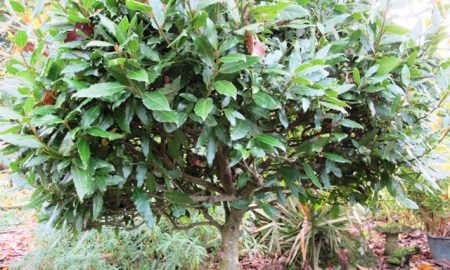
The culinary bay is Laurus nobilis, also referred to as sweet bay. It has a long history dating right back to ancient Greece and Rome yet is still widely used today. It is easy to grow and hardy for all conditions in this country. However it needs to be kept trimmed. Left to their own devices, bay trees can reach 15 metres. Fortunately once a year is usually sufficient. We trim ours hard in early spring and the fresh growth soon appears to cover up the unsightly woodiness. At the same time, we clean up the base. Bays will sucker and shoot all over the place. If you train the plant to a standard lollipop shape, it is easy to cut away growth at the base.

One plant will yield plenty of leaves for any family. The current fashion is to use clipped bays as formal standards in potagers, but you will never need that number of leaves and there are other more interesting plants you can clip for effect. Besides, as well as suckering, bays are vulnerable to thrips – tiny insects which live on the underside of the leaf and suck the chlorophyll out, turning the leaf silver. We never spray our bay and would not want to spray insecticide on an edible leaf. Planting in a position with good air movement helps (thrips don’t like drafts) and stopping the plant from being too dense will also help reduce infestations.

Bay is not difficult to strike from cutting, though most people buy it. It grows reaonably quickly so it is not necessary to pay over the odds for a large one, unless you are impatient. If you have an abundance of leaves, they are reputed to repel pantry moths when you strew them through your food cupboard.

First published in the Waikato Times and reprinted here withe their permission.