Tag Archives: Tikorangi: The Jury garden

Outdoor Classroom – Rhododendrons: common problems and solutions

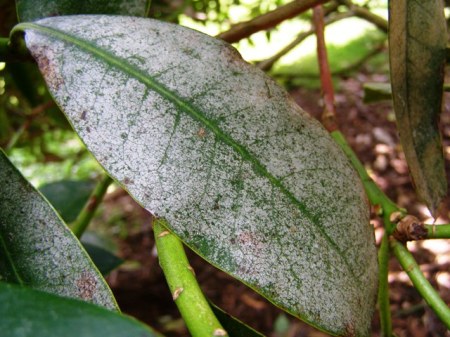
1) Silver leaves. By far the most common problem is thrips sucking the chlorophyll out of the leaves, turning them silver and weakening the plant. Turn the leaf over and you may find black, thread-like insects on the back. Replace heavily infested plants – some varieties are more susceptible than others. Open up around the plant for more air movement and light. You can use a systemic insecticide – spray November, early January and, for really bad cases, late February. Neem oil is recommended by some as an alternative to insecticides.

2) Leaves with dry brown patches and edges. This is usually a sign of stress. The plant may be too dry or too hot. Move it if necessary (sun for half the day or dappled light is best) and get a blanket of mulch over the roots. Some varieties prefer a much colder winter than we have and these tend to burn and crisp on the leaves. Replace them. Some plants get touched by mildew and lichen. Open up to allow more air movement.

3) No flower buds. This is usually a sign of too much shade. Move the plant or open up around it to allow more light.

4) Leggy, bare and stretched. Again, this is usually a sign of too much shade. Some varieties have a tendency to get rangy and open, others are naturally more compact and bushy. You can rejuvenate a leggy plant by cutting back very hard but it is really too late in the season now. It is best done in the middle of winter. You are more likely to kill the plant if you cut it back to bare wood now. This plant was cut back hard two months ago and has made its new growth already.

5) Plants which make only one new growth from each stem can be encouraged to make several growths by pinching out the single shoot. Do this as early as you can or you will be pinching out next year’s flower buds. In the right hand photo, you can see a plant making several new shoots instead of only one.
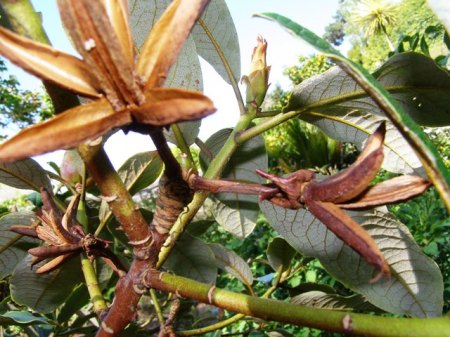
6) If not deadheaded, some rhododendrons set so much seed that it can weaken and even kill them. It can also reduce flowering the next season. This plant missed being deadheaded last year. Varieties that don’t set seed are generally deadheaded for aesthetic reasons, not because it is necessary.
Tikorangi Notes: Saturday 23 October, 2010

Latest Posts: 23 October, 2010

1) Rococo gardening in Portugal – the garden at the Pink Palace in Queluz.

2) A lilac that is happy in our mild climate with acid soils: Syriniga palibiniana from Korea.

3) Our hints for garden tasks for this week.

4) It is only one week out from the single biggest event on our garden visiting calendar in Taranaki – Counting Down to Festival.

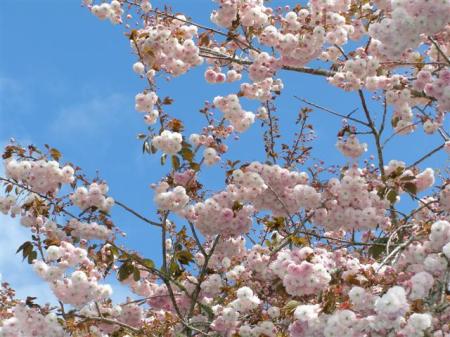
The fluffy pink pompoms of Prunus Pearly Shadows
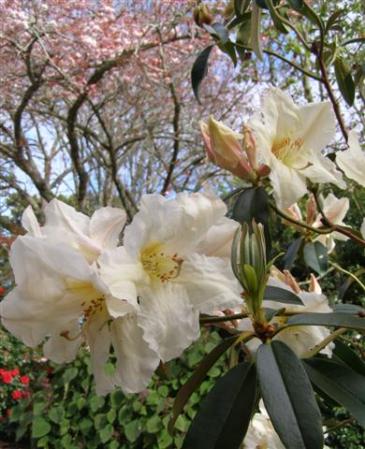
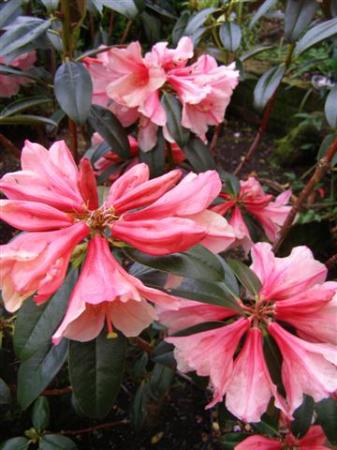
Rhododendron Bernice flowering this week

Rhododendron Bernice flowering this week

Tikorangi Notes: 23 October, 2010
With under a week to go until the start of the Taranaki Rhododendron and Garden Festival next Friday, the pressure is on to complete the garden preparation. Expectations are high when it comes to standards of presentation and grooming here. With various factors mitigating against meeting our deadlines this year (an appalling early spring of wind and rain, the odd bout of illness and injury, not to mention my disappearance overseas for three weeks), we have been grateful for extra assistance from some able friends this week. The plants are unconcerned by the flurry of activity – rhododendrons and azaleas opening every day, Prunus Pearly Shadows is a picture, the Scadoxus puniceus are eyecatching and everybody asks about the arisaemas (Mark’s hybrids). It promises to be as colourful and fragrant a display as ever.

Tikorangi Notes: Friday October 15, 2010

Latest posts:
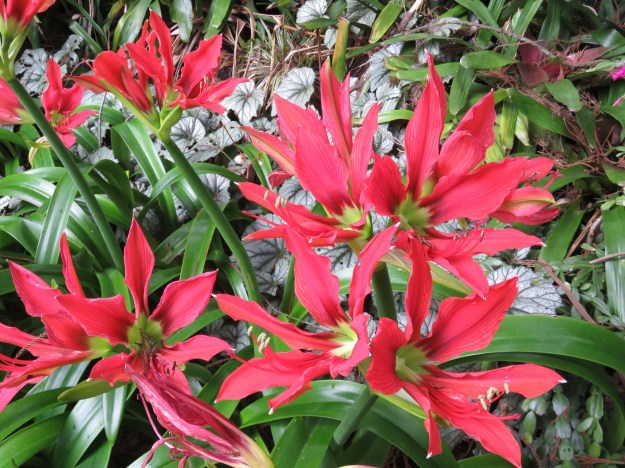
1) Hippeastrum aulicum is flowering in abundance in our woodland gardens.
2) Garden tasks for the upcoming week as we hurtle along in spring.
3) Choosing a wheelbarrow – the latest in Abbie’s Outdoor Classroom series.
4) Two weeks until our annual Taranaki Rhododendron and Garden Festival – the pressure is on as we count down.
5) Tried and True – ligularia reniformis (widely referred to as the tractor-seat ligularia).
6) A hot, dry autumn in Spain and Portugal – the first of Abbie’s columns on her recent jaunt to those countries.


Rhododendron polyandrum - big and very fragrant

Rhododendron polyandrum - big and very fragrant


Tikorangi notes
: October 15, 2010
I went away for three weeks and came home to find that I had entirely missed the erythronium flowering for the year, the magnolias are all but over, the michelias are past their peak, but the pleione orchids and rhododendrons are looking great. This is R.polyandrum, one of our favourite species. The fragrance is divine and it is one of the breeder parents of a whole range of cultivars bred by both Felix Jury and Mark, bringing healthy characteristics, flower size and its delicious scent. This is one of those plants where the scent can hang heavy in the air metres away from a large specimen. Others might think it can be a bit open, leggy even, but we don’t mind that because it has splendid peeling bark and we like the open habit rather than a heavy, dense shrub which sits solid on the ground.

Plant Collector – Hippeastrum aulicum


Hippeastrum aulicum

Hippeastrum aulicum

At this time of the year the big red flowers of Hippeastrum aulicum look like Jacobean lilies. We use it as a woodland plant because our past experience is that narcissi fly can devastate hippeastrums planted in the sun but the flies don’t go into the shaded areas to lay their eggs in the crowns of the bulbs. It takes a while for the bulbs to get large enough to flower but they are happy to be planted and left alone, gently increasing year by year so, after several decades, we have large clumps of them which oblige with gorgeous blooms in spring, standing 60 to 70cm high on strong stems. With us, they are completely evergreen though they may drop their foliage in harsher conditions.

A colourful woodland plant - H. aulicum

A colourful woodland plant – H. aulicum

Just for a change, the hippeastrum family doesn’t come from South Africa which is home to the majority of bulbs that we grow successfully here. Instead they hail from South America and this particular one is native to Brazil and Paraguay. H. aulicum is a species and not widely available though the curious H.papilio is sometimes offered for sale (expect to pay about $30 for a single, flowering sized bulb) and there are many hybrids which are brightly coloured, big flowered things for growing in containers. I am not so keen on the hybrids, papilio is less obliging as a garden plant but aulicum is both exotic to look at and a consistent performer.

Countdown to Festival: October 15, 2010

• With only two weeks left before Festival starts, I am sure we could all have done without the savage winds early this week. In our case it felled yet another massive Lombardy poplar along with the power lines which service a fair number of properties along the road. We are desperately hoping that is the end of any of our trees committing hari-kari before the chainsaw wielding men get to the vulnerable ones straight after Festival. But as we waited for the Powerco crew to arrive, our trees festooned in broken power lines, Mark and I were deeply shocked to see a pair of visitors come out from the garden. They had found the honesty box and the directions and taken themselves around, presumably stepping over and under power lines. We have informed our two dogs that they failed entirely as an early warning system when it could have really mattered.

• Chris Goodin, who gardens around Pungarehu way on Mirihau Road, is very excited about the exhibition of flower paintings by Auckland artist Karl Maughan which she is having in her home this festival. Because the artist will be overseas during the event, they are planning a small exhibition opening at daughter Nicci’s florist premises in town this coming Wednesday, 20 October when the artist can be present. If you are interested in attending, call Chris on 7828 160 or Nicci Goodin on 757 2233. The paintings have all been inspired by Taranaki with a particular link to Pukeiti.

• At La Rosaleda in New Plymouth, Coleen Peri’s best laid plans have been disrupted. She had been feeling confident and well on track until the really awful early spring. She lost two weeping silver pears in one gale and has had to resort to some reasonably expensive, specialised metal staking for her tall standard roses as she feared they could snap in the wind. However, despite the cold, wet and windy conditions, her roses are well advanced and she says most will be flowering for festival. While Coleen describes herself as an impatient gardener, her delight that her Phlomis tuberosa is about to bloom after about three years would suggest that she has more patience than some. She is hoping the Crambe cordifolia will follow suit and finally flower.

• In Waitara, Margaret Goble reports that her roses are already starting to show colour so there should be a splendid display from this experienced rosarian during festival. She is really pleased with how her window boxes are looking – a froth of lobelia and pansies – but her hanging baskets are letting the side down and languishing behind. They need some warmer weather to hurry them along in time. The bearded irises (Margaret has a substantial planting of these and was kind enough to give me some of a pure blue one I admired greatly) are spiking up right on cue this year. Margaret is keeping mum on the design changes she has made in her garden this year (though she did let me into one secret) – you will just have to visit and see for yourself.

• At the time of writing, it seems like a distant memory but Maree Rowe had the sunblock out last week after she unwittingly burned herself the previous day. Weeding has been keeping her very busy. As a certified organic property, she does not use weedkillers but does it all by hand. Readers of the Weekend Gardener should have spotted the feature on Havenview Vegetable Garden in the issue which came out last week.

• How apt to see that the winner of the Early Bird Prize Package (that is the garden visitor’s equivalent of a goody bag) is none other than Stratford’s Shirley Greenhill. Shirley is a renowned gardener herself who opened her large garden as part of the Festival for many years before she retired and downsized. Those of us who know Shirley will be looking forward to seeing her out and about the gardens wearing her complimentary hot pink and white festival tee shirts.