Author Archives: Abbie Jury

Unknown's avatar

About Abbie Jury

jury.co.nz Tikorangi The Jury Garden Taranaki NZ

Plant Collector: Dactylorhiza maculata

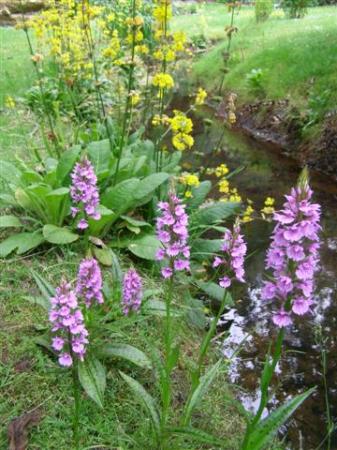
Dactylorhiza - doing better on our stream margins than in the garden

Dactylorhiza - doing better on our stream margins than in the garden

Dactylorhiza are terrestrial orchids – in other words, ground orchids. We have had this purple one for many years. It is likely that Felix Jury imported it here in the early fifties and it has gently increased ever since. It has taken us a long time to realise that it is happier in the cooler, damper conditions of our stream margins where these specimens are growing taller and lusher than those we have in rockery or other garden positions.

The rhiza part of the name refers to the root which is liked a forked tuber, or rhizome and it increases in a similar manner to many bulbs. Dactylorhiza are very widespread in the cooler areas of the northern hemisphere, occurring as far north as Scandinavia and even Alaska. While we have always had this one as D.maculata, otherwise known as the Heath Spotted Orchid, there is a bit of a question mark over that and it may in fact be D. fuchsii, the Common Spotted Orchid or even a hybrid between the two. The differences are subtle – are the markings lines? Is that pointed area in the lower lip like a small middle tooth or is it a lobe? Whichever, the foliage generally has interesting deep maroon spots which are an attractive feature, even without the flowers. Each flower spike is about 20 to 30 cm high (a happy plant will put up a taller spike) and carries masses of individual orchid flowers which open pretty much all at once. The yellow behind the plants in the photograph is the common Primula helodoxa.
In the garden this week: December 10, 2010

Alas, not from our garden

Alas, not from our garden

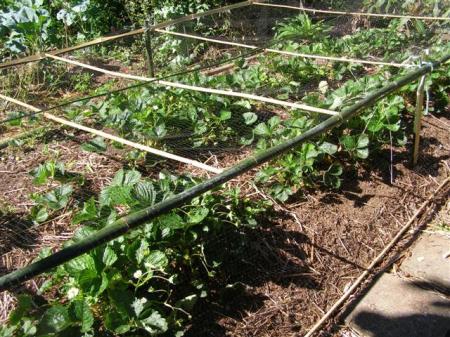
Better late than never - covering the strawberries

Better late than never - covering the strawberries

· The bright side of the current dry spell is that fungal diseases are not as common as usual. These tend to flourish more in times of high humidity. Despite that, it is a good idea to get a copper spray on to citrus trees as flowering finishes. We will not stay this dry and a copper spray can prevent premature fruit drop and a tendency to drop leaves.

· Pinch out laterals on tomatoes to keep them to one or two stems only. You want the plant to put its energy into forming fruit, not leafy growth.

· You can still plant for a late crop of tomatoes but you need to use small plants now, rather than seed. Get pumpkins and main crop potatoes in without delay.

· With summer just starting, it may seem far from your mind, but get leeks and celery in now if you want to be eating them in winter. They need all summer to reach a decent size.

· It is the last chance to start annuals from seed for late summer and autumn colour.

· There is not a lot you can be doing in the ornamental garden in this current extended dry spell, but continue with deadheading and deal to weeds. Push-hoeing is ideal in the current weather because the weeds will wither and die very quickly.

· The first flush of monarch caterpillars has eaten the swan plants of many, as far as I can tell from Google searches. You can finish off relatively large caterpillars on sliced pumpkin but it is not a total diet so no good for little ones. If you have the space, sowing a row of swan plant seed right now and making sure you keep it covered, will give you feed for later flushes of caterpillars. We target the late season, so we can get the monarchs wintering over in the garden, by sowing seed now but you do have to protect the crop to stop any eggs being laid on small plants. Very hungry caterpillars will demolish the lot extremely quickly with no regard for later generations.

· Mulch asparagus beds and let the remaining spears develop into leaf to strengthen the crowns for next season. Asparagus is a permanent crop but the crowns do have a finite lifespan – usually said to be about 15 years. Ours are considerably older than that but the crop this year was so poor, despite regular care, that we have had to resign ourselves to the thought that the bed has passed its use by date.

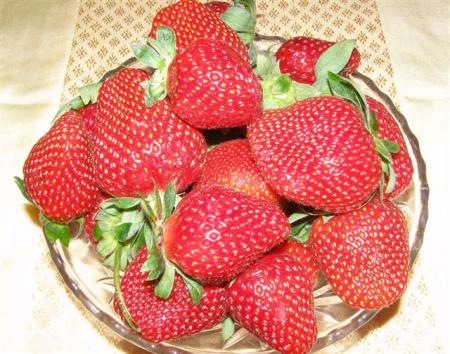
· Shamed by the very handsome strawberries I brought home from a local PYO place, Mark finally built an impressive netting cover for our bed, using our own bamboo, and we look forward to beating the birds to fresh fruit on Christmas Day.

Dreamers of the Day: A History of Auckland’s Regional Parks, by Graeme Murdoch.

This weighty, hardback tome is more likely to be a presentation book throughout its life than a best seller. Presumably the new Super City council will be quite happy to continue presenting it, even though it is clearly the legacy of the Auckland Regional Council. One hopes the new council will value these regional parks as much as those who were the original instigators followed by those who kept the dreams alive by protecting and developing these publicly owned areas. There are quite a few such parks ranging from the well developed Auckland Bot Gardens, through reserves at Muriwai and Long Bay to the larger tracts of regional parklands in the Waitakere and Hunua ranges, along with many others in between which are probably largely taken for granted. The author has meticulously documented everything and there are many photographs, both historic and modern, in a book that has spared no expense or detail. The book will be of limited interest outside Auckland but these records are important to have, if only to avoid corporate amnesia and to prevent a repeat of the era in the mid eighties which threatened the future of these valuable and valued open spaces. Open spaces are going to become more important in the future, not less, but possibly even harder to protect from the ravages of development.
(Random House; ISBN: 978 1 86979 332 6)

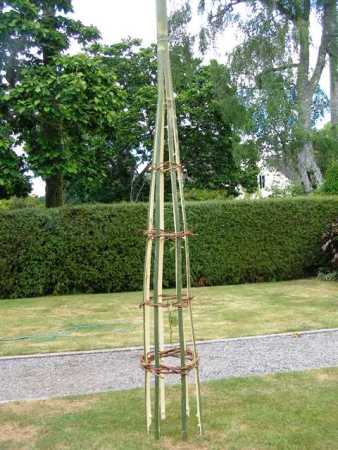
Making a bamboo support or obelisk for climbing plants, step-by-step with Abbie and Mark Jury

1) If you have access to a stand of giant bamboo, making an obelisk or stylish tepee to act as a frame for climbers such as clematis or runner beans is not difficult. With bamboo’s often wayward habits, owners of such stands may be willing to part with a stem or two. It needs to be freshly cut to split easily.

2) Cut to the required length – two to two and a half metres is about right. Tie a wire about 25cm from the top, just below a node, to prevent the length from splitting right to the end. Use pliers to secure the wire tightly and trim it off neatly.

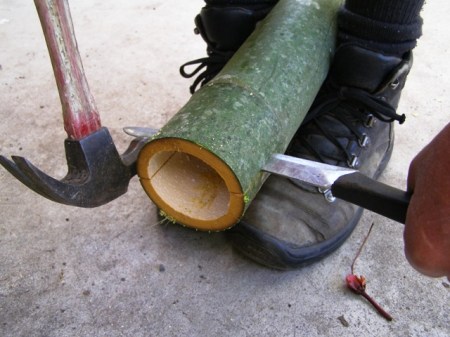
3) Using a hammer and an old knife as a cutter-wedge, make a cut exactly in the centre of the bottom of the pole. Tapping on alternate sides, work the split up to just below the wire. The first cut is the most difficult but once started, you can pull apart the two sides. With bamboo, lift up one side and start splitting. Then turn it over and split from the other side, alternating so that it splits evenly. If you keep lifting from one side only, that side will keep getting narrower.

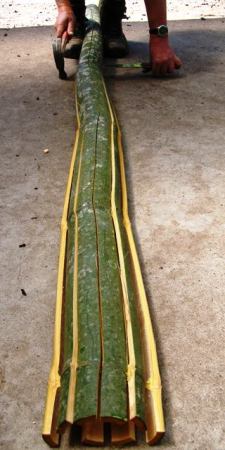
4) Repeat the previous step four times in total, so you have eight separate sections. Our sections are about 3cm wide. The difficult part is splitting the nodes on the length of bamboo which can take some strength.

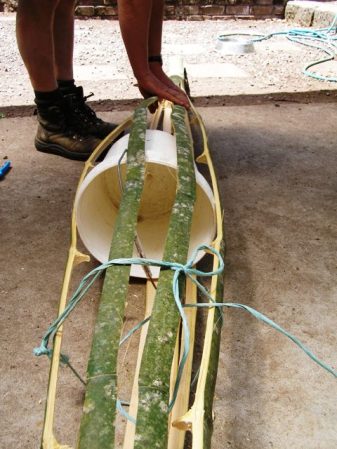
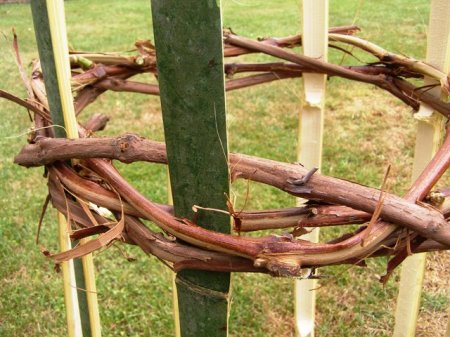
5)Use flexible ties such as grape vine, wisteria or willow to weave between the struts at intervals. Inserting a bucket will hold the shape while you do this, along with a temporary tie of baling twine. It is the ties that will keep the splayed shaped and give the climbing plant something to cling to.

6) The tepee will need to be secured to stop it blowing over. We tie the bases to simple bamboo stakes in the ground. You could use longer lasting pegs but we usually bring our teepees under cover in winter to prolong their life expectancy so old bamboo stakes as pegs are all we need to last for eight months.

Tikorangi Notes: Friday 3 December

Latest Posts: Friday, December 3, 2010

1) Why there is only one plant clearly and unmistakeably labelled in our garden – well, signposted might be more accurate – Ficus antiarus and related matters. Abbie’s column.

2) The attractive flowers on the sarracenia are a surprise to those who think the insect catching pitcher is the flower. Plant Collector.

3) Hints and tips on garden tasks for the week.

4) A Green Granny’s Garden – more a light holiday read than a gardening book.

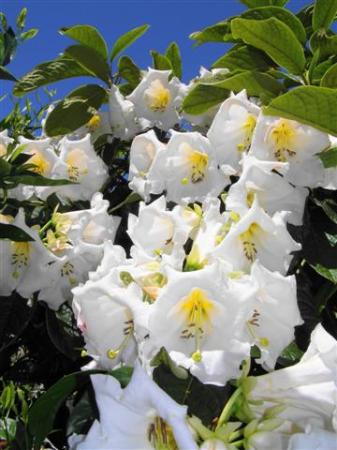
Rhododendron sinonuttallii in all its glory this week

Rhododendron sinonuttallii in all its glory this week

Tikorangi Notes: Friday, December 3, 2010
We hurtled from a very wet and cold September (or so I am told – I was in the south of Spain at the time) straight into a very dry and mild October and November. We usually joke that three weeks without rain constitutes a drought in this green and mild area we live in. It is now two months since we have had any significant rain and there is none in sight. The garden looks more like late February. This is not weather we are at all accustomed to getting and there is growing anxiety in the rural sector. Notwithstanding that, the late rhododendrons have been flowering on cue and the R. sinonuttalliis have been a wondrous sight over the past week or two. Fragrance, big, beautiful pure blooms and astoundingly large, bullate foliage – what more could one ask?