Author Archives: Abbie Jury

Unknown's avatar

About Abbie Jury

jury.co.nz Tikorangi The Jury Garden Taranaki NZ

Countdown to Festival: October 15, 2010

• With only two weeks left before Festival starts, I am sure we could all have done without the savage winds early this week. In our case it felled yet another massive Lombardy poplar along with the power lines which service a fair number of properties along the road. We are desperately hoping that is the end of any of our trees committing hari-kari before the chainsaw wielding men get to the vulnerable ones straight after Festival. But as we waited for the Powerco crew to arrive, our trees festooned in broken power lines, Mark and I were deeply shocked to see a pair of visitors come out from the garden. They had found the honesty box and the directions and taken themselves around, presumably stepping over and under power lines. We have informed our two dogs that they failed entirely as an early warning system when it could have really mattered.

• Chris Goodin, who gardens around Pungarehu way on Mirihau Road, is very excited about the exhibition of flower paintings by Auckland artist Karl Maughan which she is having in her home this festival. Because the artist will be overseas during the event, they are planning a small exhibition opening at daughter Nicci’s florist premises in town this coming Wednesday, 20 October when the artist can be present. If you are interested in attending, call Chris on 7828 160 or Nicci Goodin on 757 2233. The paintings have all been inspired by Taranaki with a particular link to Pukeiti.

• At La Rosaleda in New Plymouth, Coleen Peri’s best laid plans have been disrupted. She had been feeling confident and well on track until the really awful early spring. She lost two weeping silver pears in one gale and has had to resort to some reasonably expensive, specialised metal staking for her tall standard roses as she feared they could snap in the wind. However, despite the cold, wet and windy conditions, her roses are well advanced and she says most will be flowering for festival. While Coleen describes herself as an impatient gardener, her delight that her Phlomis tuberosa is about to bloom after about three years would suggest that she has more patience than some. She is hoping the Crambe cordifolia will follow suit and finally flower.

• In Waitara, Margaret Goble reports that her roses are already starting to show colour so there should be a splendid display from this experienced rosarian during festival. She is really pleased with how her window boxes are looking – a froth of lobelia and pansies – but her hanging baskets are letting the side down and languishing behind. They need some warmer weather to hurry them along in time. The bearded irises (Margaret has a substantial planting of these and was kind enough to give me some of a pure blue one I admired greatly) are spiking up right on cue this year. Margaret is keeping mum on the design changes she has made in her garden this year (though she did let me into one secret) – you will just have to visit and see for yourself.

• At the time of writing, it seems like a distant memory but Maree Rowe had the sunblock out last week after she unwittingly burned herself the previous day. Weeding has been keeping her very busy. As a certified organic property, she does not use weedkillers but does it all by hand. Readers of the Weekend Gardener should have spotted the feature on Havenview Vegetable Garden in the issue which came out last week.

• How apt to see that the winner of the Early Bird Prize Package (that is the garden visitor’s equivalent of a goody bag) is none other than Stratford’s Shirley Greenhill. Shirley is a renowned gardener herself who opened her large garden as part of the Festival for many years before she retired and downsized. Those of us who know Shirley will be looking forward to seeing her out and about the gardens wearing her complimentary hot pink and white festival tee shirts.
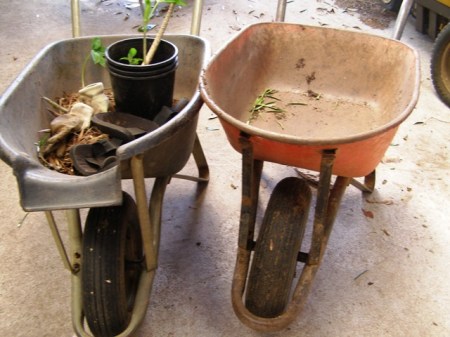
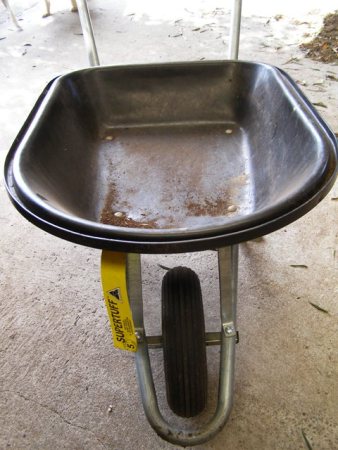
Not all wheelbarrows are equal

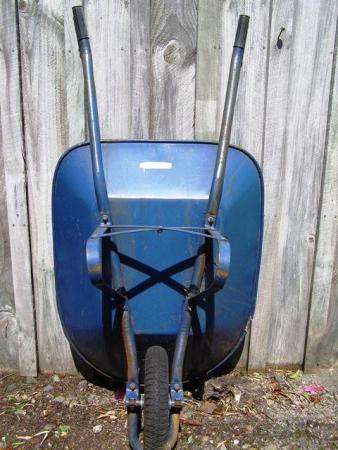
1) Contractor’s barrows tend to be larger, more solidly built, heavier and more expensive than garden barrows. Better quality barrows can cost from $200 but these two barrows have been used on an almost daily basis here over 10 years. Some women may find the handles too thick to use comfortably and the barrow too heavy.

2) Metal or plastic tray? Metal trays can last the distance if you look after them and don’t leave them out in the rain or full of debris. Because I am guilty on all counts, I strongly prefer a plastic tray with galvanised steel frame, neither of which will rust, but this is considerably more expensive. This garden barrow is pretty much top of the range, costing around $180 but I like its wider shape and its stability and I have two of them.

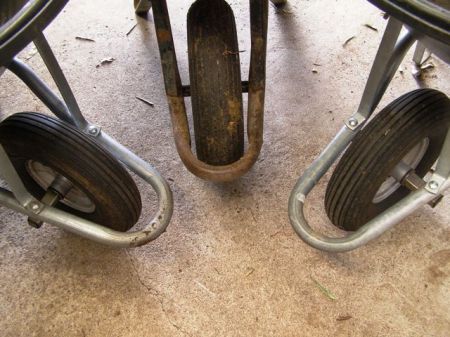
3) Cheap barrows are usually in the $38 to $60 range and commonly have a light metal construction which is prone to rust if you don’t look after them. They also have a tendency to tip back if you don’t load them properly. However, with some care, the much cheaper price may be sufficient to offset those disadvantages.

4) Most wheelbarrows are sold in flat packs. Make sure you try out an assembled one in the store before you buy so that you know that you will find it comfortable to use and that it has acceptable stability. If you assemble the barrow at home and find that the wheel is loose with no means of adjustment, return it to the store. A wobbly wheel is a major weakness from the start. If you ever come across barrows with small or narrow wheels, shun them. You need a robust wheel to support the weight of a load.

5) If you store your barrow leaning against an outside wall, make sure that rain can not get down the handles because it will pond in the pipes and quickly rust from the inside out.

6) I have never tried the new tub style of barrow and can’t see that they have any advantage over the traditional barrow which has been around in more or less the same form for 800 years in Europe and up to 2000 years in China where they were invented to carry military supplies. However, should any readers swear by this new design, I would be happy to hear. Otherwise, I suggest you borrow one to try before you spend between $75 and $150 on buying one.

Tried and True: Ligularia reniformis

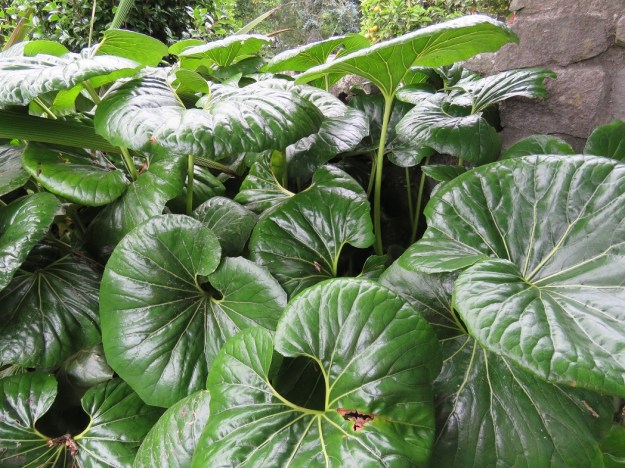
  • img_6451* Impressive in size and lush appearance.
    * Evergreen.
    * Looks tropical but can withstand light frost and cool winters.
    * Widely available for sale.

 In this country, as in Australia, we all know this plant as the tractor seat ligularia, which says quite a bit about our rural origins. I guess the leaves could be said to resemble a traditional tractor seat in shape and when growing strongly, getting pretty close in size. We have almost made this plant our own in New Zealand and have certainly pushed the boundaries of where it is grown – it is technically sub tropical and from East Asia. In warm areas, it gets considerably larger but even in cooler areas with a bit of frost, it makes an impressive clump a metre across and a metre high over time. It will need more protected conditions where frosts are more frequent but it is happy in high shade and on woodland margins. Typical of any perennial, it likes rich, well cultivated soil with plenty of humus and good moisture levels. While not immune to the munching ways of slugs and snails, it is nowhere near as tasty as hostas and we have never worried about pests or diseases on our plants. It is grown for its foliage and if you have the space for a large and impressive plant with large and impressive leaves (think giant water lily pads), it is a good addition and easy to contrast with a whole range of other plants. Reniformis is widely available in garden centres.

A hot, dry autumn in Spain and Portugal

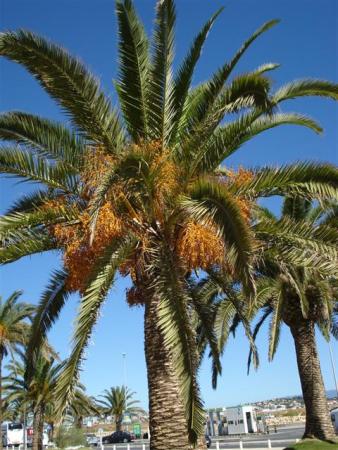
The ubiquitous date palm was everywhere in the south of Spain and Portugal

The ubiquitous date palm was everywhere in the south of Spain and Portugal

Even as September melts into October, Spain is hot and dry. Alas Professor Higgins had it entirely wrong when he made Eliza Doolittle recite that the rain in Spain falls mainly on the plain. He certainly was not referring to the plains beyond Madrid where the rain clearly falls on rare occasions at best. They are dry and arid, too inhospitable even for the hardy olive tree. Nearer the mountains (the sierras, but more hills than mountains by NZ standards), it is clear that more rain falls. There were olives as far as the eye could see. Don`t be imagining romantic old olive groves. This was monoculture on an industrial scale (viz a viz Blenheim vineyards). I had to ask about harvesting. It seemed incomprehensible that such vast acreages are still picked by hand but apparently that is the case. Teams of itinerant pickers, many of North African origin, travel the area at harvest time. I suspect I have seen the origin of all the imported olive oil on the shelves of every supermarket at home. Maybe.

The olives are usually planted in groups of three, each leaning outwards to grab its own space, and pruned to around 2.5 metres in height. Presumably this makes picking easier because the olive tree, left to its own devices, reaches higher. We are working to keep our one at home down to about 4 metres.

The olive plantations looked to be corporate farming, much as our dairy farming is headed. The era of the small family farm appeared to be over in much of the countryside that we passed through. Often there were no residences visible for considerable distances and no indications of boundaries to suggest the smaller holdings of old. It was interesting to reflect on the debate at home regarding lifestylers populating our countryside. We had been discussing it before I left and came to the conclusion that, on balance, small holdings and lifestyle blocks add a welcome diversity to the countryside. Without lifestylers planting gardens, shelter belts, home orchards and landscape trees, Taranaki could well become even more of the unrelieved green desert favoured by modern dairy farming methods. In the centre and south of Spain, it is not a green desert but red-brown dirt with multitudinous grey-green olive trees and not a lot else.

In urban areas, living is in high density housing, usually 3 to 5 stories high. I peered at balconies and roof terraces, looking for signs of green-fingered locals which is so evident in British high density housing. It is not here. I came to the conclusion that your average Spaniard does not nurture an irrepressible desire to grow plants and the G.I.Y. (that is: grow it yourself) and back to nature drive that is currently so strong in NZ, Australia and Britain is not to be seen. Any outdoor space is rare. The delightful inner courtyard or patio which has a debt to Moorish ancestors must be the preserve of the wealthy. A mere six, or maybe nine square metres of outdoor space is a privilege in many parts of urban Spain. But in a climate where temperatures can soar to 40 degrees (and stay there), a cool house is more desirable than al fresco living.

Were it not for the public plantings, this would be an even more austere environment. Fortunately, there has been a heavy investment in greening urban spaces in recent times. Not grass, which does not grow here unless irrigated. Ground surfaces are all paved but trees are being planted in abundance. Madrid has the harshest of climates – very hot and dry in summer and remarkably cold and dry in winter – so there is not a large plant palette to work with. The stately plane tree is the most dominant but it was interesting to see the number of Australian plants being used, most notably the good old gum or eucalyptus.

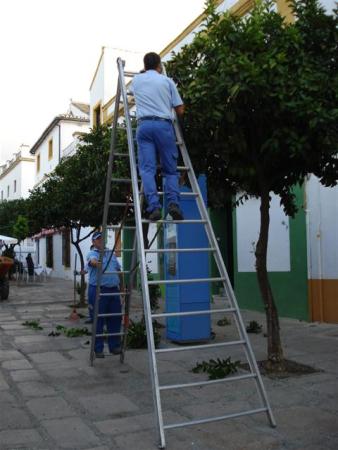
Clipping the street plantings of orange trees to lollipops in Cordoba

Clipping the street plantings of orange trees to lollipops in Cordoba

We just do not grow plane trees well at home in Taranaki (we are too wet and they are inclined to drop limbs too readily) so we don´t get to enjoy their wonderful bark. There does not appear to be any fear of large trees. The bigger the better for they provide welcome shade.

Cordoba has a milder climate and orange trees dominate as a street tree. Flowering time must be magical with the strong scent of orange blossom hanging in the air. I briefly indulged a fantasy of the entire local populace being able to gather tree-ripened oranges in season. After all, they have nowhere to grow their own. No. I was told that it is a bitter orange which is harvested commercially and shipped off to the jam factory!

By the time we reached Cadiz on the southern coast, it was the palm tree that prevailed. As far as I can work out, (and I freely own up to the sparsest knowledge of palms at best), it is almost exclusively the common date palm which Google tells me is Phoenix dactylifera. It is certainly a most handsome palm and remarkably tolerant of salt winds, growing even on the waterfronts. Mind you, it is so common that locals may well take a scathing attitude similar to Taranaki people with our adaptable pohutakawa.

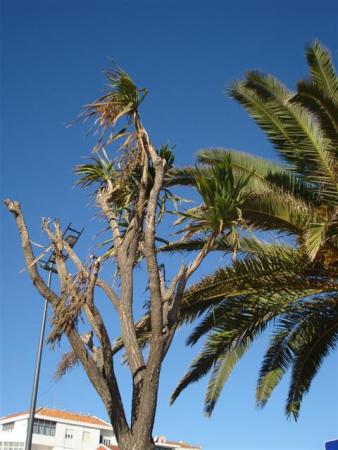
The cordyline australis had seen better days on the Algarve but had done well at some stage to reach this size

The cordyline australis had seen better days on the Algarve but had done well at some stage to reach this size

Crossing to Portugal, it became clear that more rain falls. I even saw a little green grass with no evidence of irrigation. In Lagos where I write (prounced Lagoosh and not to be confused with Lagos in Nigeria), the date palms continue but the real delight is the large number of blue-as-blue jacaranda trees which continue to flower even as autumn starts. The New Zealand cabbage trees interplanted between the date palms by the river do not look such happy campers, alas.

Yuccas and oleanders flourish everywhere – both plant families which prefer drier conditions. But just to prove that bad taste crosses all borders, the new cultivar of oleander favoured in public plantings in Seville was a thoroughly nasty novelty selection – yellow and green variegated foliage with dirty pink flowers. I think we saw a new spirea sporting a similar colour scheme in the United Kingdom last year.

Tales of the gardens I have visited will have to wait until after I return. Yes there are gardens and the historical gardens of Andalucia are rooted in impossibly romantic Moorish architecture. At the time of writing, I have yet to see the famous gardens of Lisboa and Sintra in Portugal. I have contemplated an Outdoor Classroom on the DIY Moorish garden but the prospect scared me. The likelihood of achieving something unbelievably naff is greater than the likelihood of successfully adapting such a unique and culturally distant style to home!

In the garden this week: October 8, 2010

  • Leave spring bulbs to die down at their own speed, no matter how untidy they look. Resist the temptation to tie the foliage in knots because this interferes with the plant’s ability to build up its energy for next season’s appearance. If flopping foliage is a real problem, construct a low trellis out of twigs or old bamboo stakes criss-crossed to keep the plants tidier.
  • Keep earthing up potatoes (piling on the garden soil to build ever higher mounds) to stop the tubers going green. Both potatoes and broad beans may need a copper spray to stop rust or blight taking hold.
  • Basil can be started now but it will need to be kept warm for a few weeks now before planting out in the garden.
  • Parsley can be sown any time but if you lack a perpetual supply self seeding down and keeping you going when green vegetables are in short supply, you can sow it down. A visiting expert here advocates sowing the seed, covering it and then head out with jug of boiling water and pour it over the row to aid germination.
  • It is the last chance for getting a crop of Florence fennel (finocchio) in for eating over summer. After this, you are best to leave it until late summer or early autumn and sow then for winter harvest because it will tend to bolt to seed too early over summer. We rate this as a fantastically versatile vegetable and are working to increase production on a regular basis here.
  • Time is running out for winter/spring pruning. Shortly it will be time to put away all the loppers and the cutters until the summer prune of cherry trees calls.