Author Archives: Abbie Jury

Unknown's avatar

About Abbie Jury

jury.co.nz Tikorangi The Jury Garden Taranaki NZ

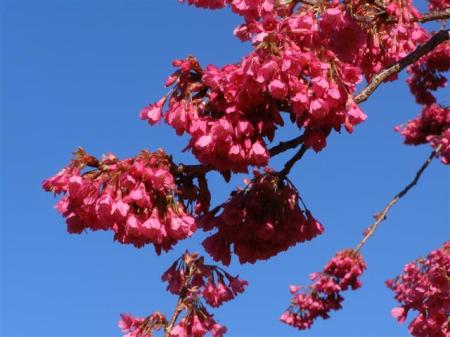
Prunus campanulata

campanulata (Small)
Most people call these flowering cherries and locals tend to take them for granted, unlike those people who live in colder parts of the world where they can not be grown. The ones flowering now are the Taiwanese or Formosan cherry (although only readers over about sixty will recall when the island of Taiwan was still Formosa). They range in colour from mid pink through bright sugar pinks to cerise or carmine and almost red. The reddest form on the market just happens to be called Prunus Felix Jury. We have a series which come into flower over a period of weeks and at times it can seem as if the trees are erupting with feeding tui. While it is hard to take a census (the birds won’t stay still long enough), it is common to find about 20 in one tree at any hour of the day. We think we must currently have at least 50 resident tui.

The downside to campanulatas is that some forms can seed down badly. If you are within a few kilometres of the national park or a nature reserve, make sure you search out forms advertised as sterile (in other words they don’t set seed). These late winter flowering cherries combine well with the early magnolias and because they are not a heavy looking tree, you can often tuck them in nearby so their mass of small flowers contrasts with the over the top magnolia blooms of campbellii or Vulcan. Campanulatas appear to be more disease resistant and healthier in our climate and are not susceptible to witches broom.

August 14, 2009 In the Garden

  • Heed the news story in our local paper last Saturday. Despite the fact that most of us feel that winter is wet here in Taranaki, we are in fact well below normal rainfall levels and entering some reasonably serious moisture deficit territory. For gardeners in areas which dry out quickly, this means getting a good layer of mulch onto your ornamental gardens before the soils dry out. The mulch will help conserve existing moisture.
  • When planting trees and shrubs, spread a layer of mulch on top of the soil but keep the area around the trunk or stem clear to avoid collar rot.
  • If you are new to vegetable gardening, stockpile leaf litter and get compost bins underway. You can not mulch vegetable gardens once in late winter and leave them for the rest of the summer as you can with some ornamental beds. You need a constant supply of mulch to use in the vegetable garden.
  • We are strong advocates of mulching with compost which adds natural nutrients and allows the build-up of beneficial microbes, insects and bacteria while it enriches the soil. It is also pleasing to the eye, or at least to our eyes. If you don’t have plenty of compost, organic materials such as leaf litter, pine needles, bark chip, wood shavings or, at a pinch, sawdust (if not tanalised) can all add a layer on top to conserve moisture, nourish the soils and to suppress weeds. You need a maximum depth of about 5cm. More is not better.
  • If you are doing a feeding round, spread the fertiliser and then put the mulch on top. It may discourage the dog from ferreting out the blood and bone, stop powdery fertiliser from blowing away, suppress the aroma of the Bioboost and it does get the fertiliser closer to the roots which is where it is needed.
  • Those die-hard lawn fanatics who are still of a mind to use hormone sprays on the grass (and we don’t expect any of you to own up to us), get onto to it now to minimise the potential damage to fresh spring growth on trees and shrubs. No matter how careful you are, the slightest drift will cause considerable distortion and damage to new leaves, particularly on magnolias so get in before such plants break into leaf. Hormone sprays are used to take out flat weeds and broad leaves.
  • The clock is starting to tick on the pruning of deciduous plants. Don’t delay any longer on these.
  • You won’t achieve much by rushing into planting out vegetables and annuals too early. Despite the glorious spring weather last weekend, we will have more cold snaps and early plantings will just sit in the ground awaiting the right temperatures. You are better to start these plants early in pots and trays and keep them in a protected spot for a few more weeks before planting out. However you can keep sowing hardy winter vegetables such as peas, brassicas, carrots and onions.
  • Stay on top of freshly germinating weeds and on terminating the spring crop of slugs and snails.

A step-by-step guide in creative camellias with Abbie Jury

A step by step guide by Abbie and Mark Jury first published in the Taranaki Daily News and reproduced here with permission as a PDF.

New Outdoor Classrooms are uploaded fortnightly.

Magnolia Diary number 3, 13 August 2009

Click to see all Magnolia diary entries

Click on the Magnolia diary logo above to see all diary entries

Black Tulip opening now

Black Tulip opening now

At this time of the season, it is all the dark magnolias coming into flower. The only other colours we have are the soft pink campbellii and one early pink and white seedling which has been left in situ because it provides a contrast to the wine red, purple and deep rosy colours coming out all around the property.

Black Tulip is opening more flowers every day. This one has caught us by surprise with its instant popularity in the market place. Mark named it because the flower, while not large, had such a lovely tulip form and very heavy, dark petals which gave it good weather hardiness. And it is never going to become an enormous tree. The original plant never throws a pale flower so we were disconcerted to see that pale flowers can appear on trees in other locations. While we accept the occurrence of both dark and light flowers on Lanarth, modern hybrids are expected to be uniform.

If you line up a Black Tulip flower beside a good Vulcan flower, there is not much difference in colour. What makes Black Tulip appear so dark on the tree is that the petals (or, more correctly, tepals) are so thick that no light can shine through.

Black Tulip

Black Tulip

We usually advise people to plant Black Tulip in locations where it is to be viewed close up. In the landscape, the flowers can be so dark and relatively small that they tend to meld into the environment whereas viewed close up, it has certainly captured the imagination of the public. It is being trialled as a street tree in New Zealand and we recommend it for driveways, lawn specimens or back of the flower border in home gardens. On a very recent visit, we were gratified to see it as a flagship plant for John Woods Nursery in the UK and to hear that it is performing better than Vulcan. It appears that the British public are as charmed by the perfect flowers as the New Zealand public and can see it fitting into smaller, modern gardens.

But on a larger property, our personal tastes lean to something more over the top and flamboyant which has maximum wow in the landscape – Felix Jury is opening its flowers.

Magnolia Diary number 2, 11 August 2009

Click to see all Magnolia diary entries

Click on the Magnolia diary logo above to see all diary entries

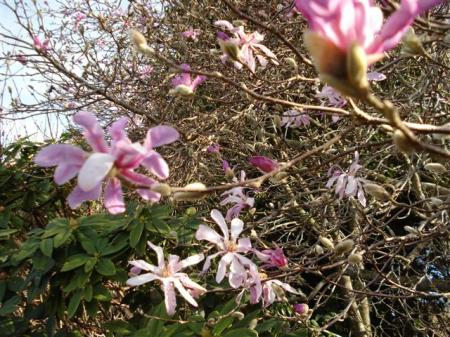
Leonard Messel, just opening

Leonard Messel, just opening

Our magic early spring weather continues (and believe me, we never take the absence of both wind and rain for granted here) and more magnolias open every day. Leonard Messel is showing his first flowers. Leonard is sold as a small growing magnolia in this country, to be planted perhaps where something shrubby rather than a tree is required. So we were amused to pace out our plant which is only about 20 years old at the most and to find that its footprint is not a lot smaller than many of our substantial magnolia trees. It is just shorter in stature so it looks smaller but it still measures nigh on nine metres across. Leonard Messel looks splendid on its day when in full flower, but the petals and form lack much substance and in a windy climate such soft characteristics mean it can start to look rather raggy.

One of the early flowering Snow Flurry series

One of the early flowering Snow Flurry series

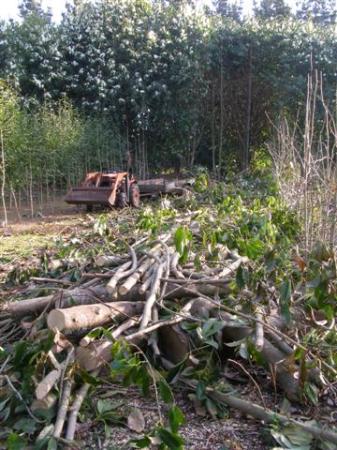
Michelias have been the subject of an intensive breeding programme here for some time now and the early whites are all coming into flower. Botanically michelias have been reclassified as magnolias, but we admit that for clarity and understanding, we lean towards calling them michelias in conversation. We refer to these early whites as the Snow Flurry series and while we can not post a photo of the one we have selected for probable release, we have shelter belts full of the also rans, or rejects. Indeed we have so many that Mark now calls them his sustainable woodlot as he chainsaws off branches to feed our small (very small in number but increasingly large of size) herd of beef cattle to get them through the shortage of late winter feed. Coppiced michelias – these may be a first.

Mark's sustainable woodlot of reject michelia seedlings

Mark's sustainable woodlot of reject michelia seedlings

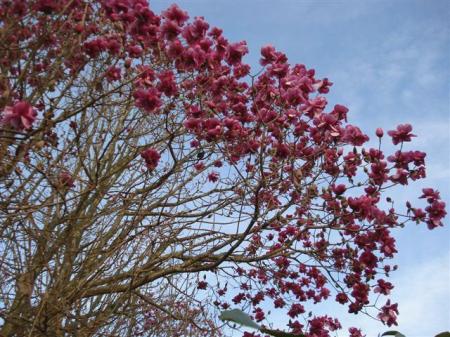
Besides Lanarth and campbellii, it is the also rans in the deciduous magnolias which are the most spectacular today. Too good to chainsaw out but not quite good enough to put into commercial release, we have a run of what Mark calls his instant campbelliis flowering around the boundaries. Instant because they flower on very young plants (it can take many years for campbellii itself to flower), but this strain of magnolias bloom too early in the season and the trees grow too fast and too large for modern gardens. It is likely that they will remain forever in our shelter belts and on our boundaries where they can look splendid for us.

Rejected campbellii type hybrids

Rejected campbellii type hybrids