
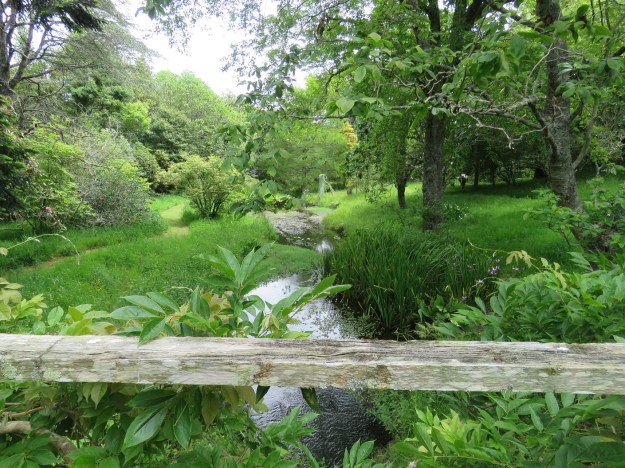
The new meadow look in our park – long grass and mown paths
Wildflower meadows sound so delightfully romantic and evocative. And they can be in practice, but there is not just one way of achieving this.
When we talk about ‘wildflowers’ in New Zealand gardening, we are not talking about our own native wildflowers. They are native to somewhere but not here. Most people think of mixes of cornflowers, simple poppies, nigella, cosmos, maybe Queen Anne’s lace and the like. What are sold as wildflowers here are generally a mix of flowering annuals, though not the highly-bred ones that are used for potted colour and bedding plants. You can call it gardening because it is generally necessary to cultivate the soil, eliminate at least some of weed regrowth which will swamp the chosen annuals, plant the seeds and water them in. Merely broadcasting them on poor ground is rarely successful. These sowings of mixed annuals are usually disappointing in the second year because the influx of weeds and grass will swamp out most of the plants that have managed to seed down and the effect is very different. So it is gardening with annual flowering plants in its simplest form with next to no hard landscaping. It is also best suited to drier climates without the strong grass growth we get here and not prone to torrential downpours which will flatten these gentle, elongated plants. Charming though areas of mixed annuals sown in this way can be, it is not for us. And I would describe it as gardening with annuals, not a wildflower meadow or a wildflower garden.
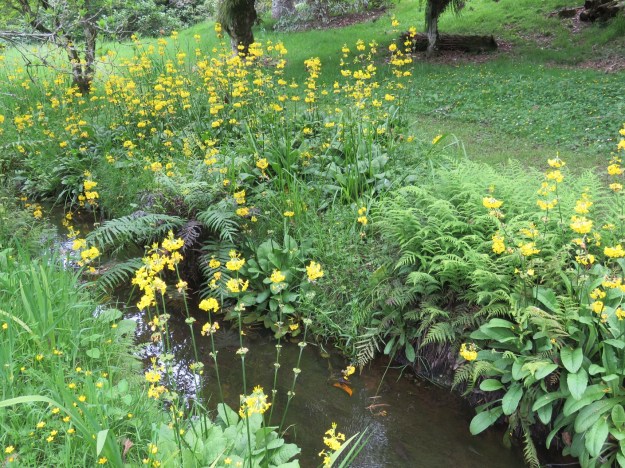
Lots of Primula helodoxa in our meadow at this time of year
Our interest starts with meadows now. This presupposes a heavy presence of grass and many plants that are deemed weeds in more cultivated areas. Why meadows? Four reasons:
- Meadows make a hugely greater contribution to natural ecosystems than mown grass. They provide food for bees, butterflies and other insects while offering cover to the smaller creatures of the natural world.
- We are seriously discussing and experimenting with techniques of lower input gardening where possible. Mark has become increasingly concerned at our heavy reliance on the internal combustion engine to maintain our garden – the lawnmower, weed-eater, leaf blower, hedge trimmer, rotary hoe and more. We have already phased out most spraying and fertiliser use – preferring to use our own compost – so the run-off from our property will be neither toxic nor high in nitrogen. Next up was to consider ways to significantly reduce our usage of petrol powered engines.
- We are mindful that we have a large garden managed by just three of us. Because we have no plans to retire off the property, we need to ensure that we can maintain the garden to the standard we want into the future as we age. This is another reason for finding ways that are more sustainable in the long term.
- We like the simplicity of meadows, the romanticism and the natural feel. We wanted to see if we could manage it in our garden.

Higo iris and primula are looking pretty this week
We closed the garden to the public three years ago and immediately started experimenting in the area we call the park. With its variable terrain and a stream flowing through, this area was originally planted by Mark’s father, solely in trees and shrubs, and it covers about 4 acres. A small flock of sheep kept the grass down and most weeds at bay. When we bought the Rolls Royce of lawnmowers (a Walker mower) that could cope with all the steep slopes, we banished the sheep, removed the fencing and started mowing the park on a regular basis. The areas that couldn’t be mown were kept down with the weed-eater. Finally, Mark could start some underplanting.
 Now we have long grass with mown paths through it. After three years, there is increasing diversity in the plants moving in. Many are commonly seen as weeds and the whole debate about weeds needs more attention another time. Not just buttercups, daisies and dandelions, though we have those in abundance. We also have Herb Robert moving in (Geranium robertianum), clover pink and clover white, foxgloves, self-heal (Prunella vulgaris), Mark’s stinking billy-goat weed (a stachys), montbretia and more. I am not keen on the docks or thistles, so I try and dig those out. Mark is particularly pleased that we had a lot more brown top in the existing grass mix than he had thought because it has beautiful silky seedheads that wave in the lightest of breezes.
To these ‘volunteers’ (or genuine wildflowers that have made their way of their own accord), we add our own enhancements – primulas beside the stream, along with a range of other marginal plants and irises. Even sarracenia and a few orchids (the dactylorhiza orchids work though most of the disas died out). The Higo iris are coming into bloom and what a delight they are. In autumn and spring we have bulbs and we no longer have to worry about mowing off the foliage too early.
The placing of mown paths throughout has been successful, giving a contrast between the walking areas and the natural meadow, though it helps to have Mark’s good visual instinct to get the form of the paths sorted from early on so that they meander gracefully. At my request, these were widened to be two mower widths across – a single width looked a bit mean and perfunctory.

The Walker mower
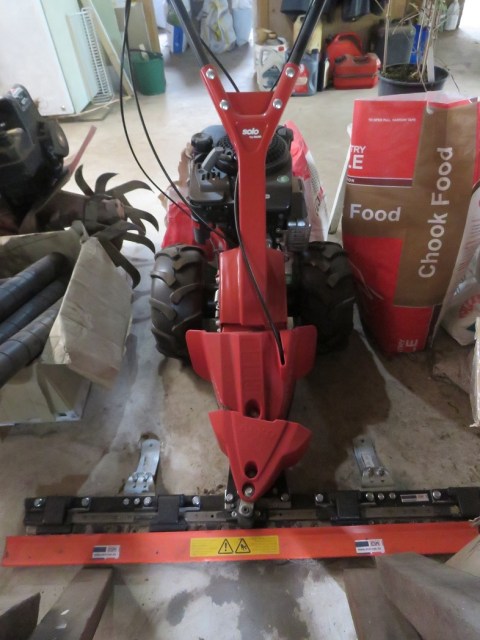
New sickle bar mower
We mow everything once a year in autumn and I have to admit this involved the purchase of a new internal combustion engine – the sickle bar mower. The lovely ride-on Walker was never designed for the mowing of the meadow, being better on grass that is kept consistently shorter. The sickle bar emulates the motion of an old-fashioned sickle and is designed to cope with this sort of situation. We do not follow the British wisdom of removing all the hay to keep fertility low. It is not practical in our situation and our meadow is a year-round affair because of our mild climate where plants keep growing even through winter.
Going into our fourth year, we are saying ‘so far, so good’. It is not for everyone, but we love the look. If we are still continuing the park as a managed meadow in another five years, we will then be willing to announce that it has been successful for us. The mid-term report is that we have achieved a meadow and it is certainly meeting our four reasons for starting the experiment.

A treasured memory – our second daughter in a dry climate flowery field in the Nelson area around 1994
Postscript: Ken Thompson in The Sceptical Gardener writes about real meadows and I quote just a brief excerpt there: “it actually is a meadow in the sense of an area of perennial grass and wildflowers, managed by annual cutting.” He goes on to discuss what he calls the ‘annual meadow’ – drifts of annuals. “The problem is that ‘annual meadows’, whatever they are, are not meadows; they don’t look like meadows, and nor are they managed by meadows.”
He draws on a British garden writer and TV presenter about poppies. “Nigel Colborn reports that a visitor to his garden asked why his meadow had not wild poppies in it. Nigel had to explain, kindly and tactfully I’m sure, that no meadow since the dawn of time has had poppies in it, and that poppies belong in cornfields.”
Thompson also has an interesting chapter about the common lore that wildflowers do better in areas of low fertility. This is a book to put on Christmas present lists, as I said in my review earlier.


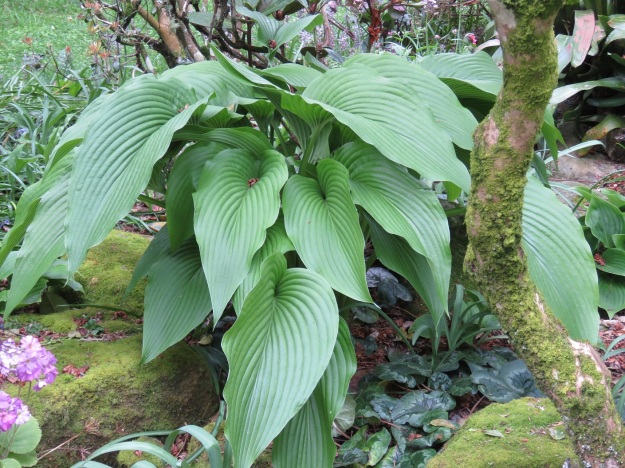
 Many gardeners seem to prefer to group their hostas together in a hosta bed. It is not compulsory to plant them this way but if you prefer this look, I will repeat my advice given often to customers back in the days. Don’t be wooed into buying only the showy, variegated ones and bunging them all in together. It is the plainer hostas in single colours, and the variety in leaf form, shape and size that set off the fancy ones and avoid a mishmash. One fancy one to at least three plainer ones is my rule of thumb. These days, our preference lies with the solid coloured ones rather than variegated varieties.


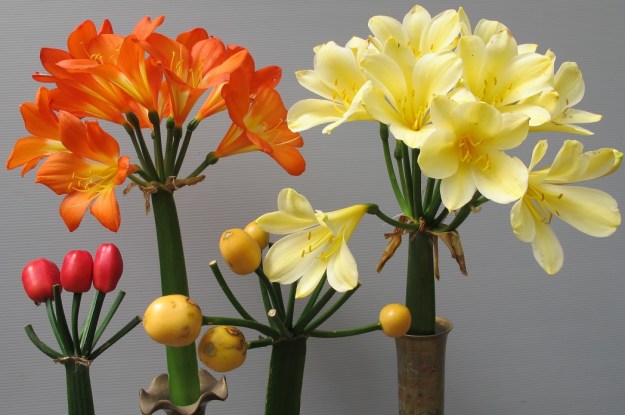
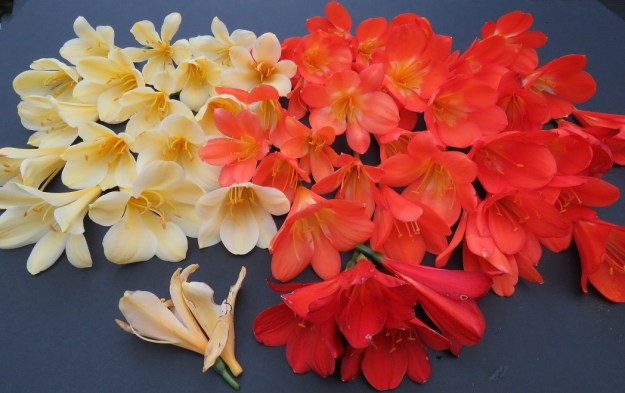 Mid spring brings us vibrant clivias in bloom. The ”contemporary” or “landscaped” look is to block plant in a single colour so you may have a swathe of orange clivias with the yellow ones segregated in a different area. This is not our style, in a garden where we strive for far more of a naturalistic, woodland look – “enhanced nature” seems to be the latest descriptor for this style though it is not a term you are likely to see me using often. We like to blend our plantings and combine the clivias with ferns, astelias, bromeliads and any and all of the other plants we use as the understorey in our shady areas.
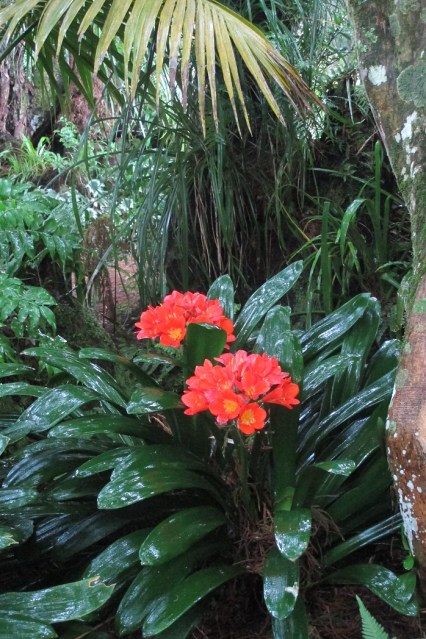 This completely confused a self-described Auckland landscaper I once took around the garden. This must have been back in the 1990s when ambitious but unqualified young people who, in a previous generation would likely have done an apprenticeship, discovered they could earn more money by dispensing advice and services to the growing wealthy of our largest city. He patronised me all the way around the garden – landscapers, you understand, rated themselves further up the social scale than mere gardeners – and at the end pronounced his surprise that we didn’t grow any clivias. I may have a been a little tart when I pointed out he just hadn’t noticed them, for they are there in abundance.
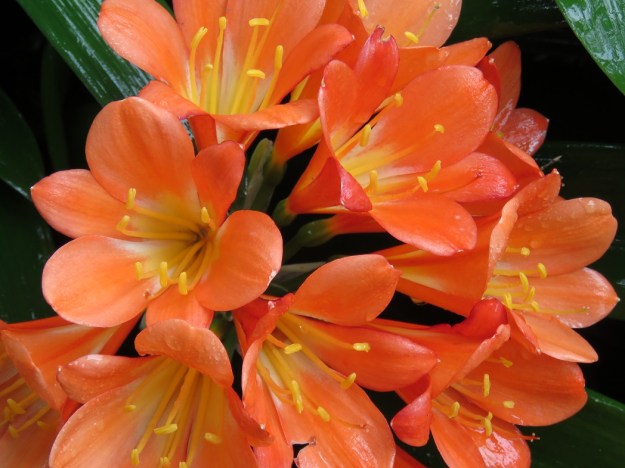
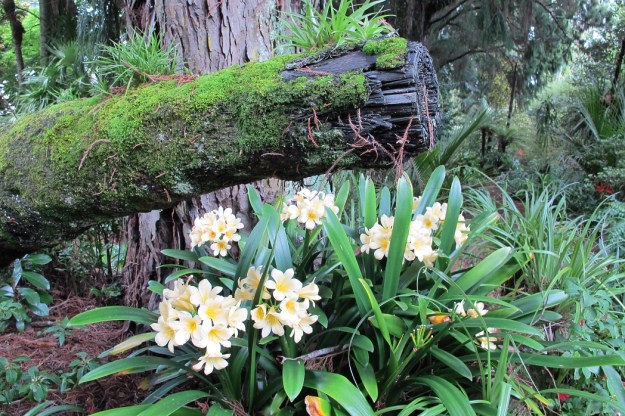 The soft yellows are still a recent introduction but already widely grown, readily available and making a huge contribution in gardens. Extending the colours into peach tones is well underway and of late the combination of white and green in clivias represents another development. One can, when all is said and done, have too much orange in the garden (NABOC syndrome – Not Another Bloody Orange Clivia) whereas the option of other, softer shades can bring welcome variety and interest. If you covet red clivias, you need to be aware that they open orange and age to red. Do not be like the gardener I heard of who bought a swag of large red clivia plants at considerable expense. When the first ones opened orange, she dug them all out.
 Considering the easy care nature of clivias, you may wonder why they are often relatively expensive to buy. It is all to do with time because they are slow to get established and to reach flowering size. In these days of instant gratification, most gardeners want plants that will perform and be showy in the garden from day one. In the case of clivias, be prepared to pay because it costs nurseries money to hold slow growing plants much longer to reach saleable size.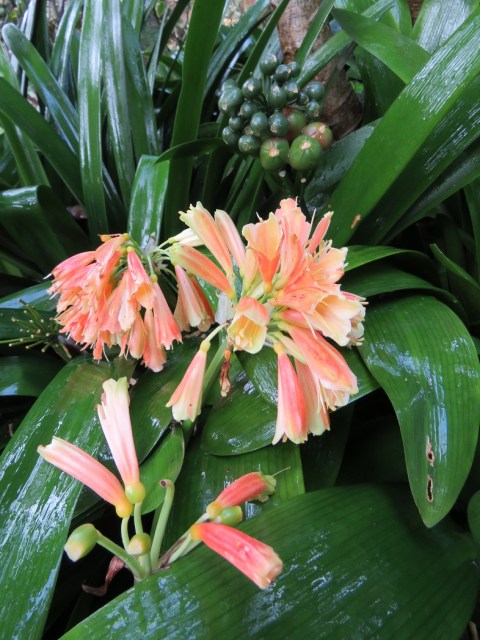
 Tikorangi The Jury Garden