Category Archives: Abbie’s column

Abbie’s newspaper columns

The silver fern

IMG_3735IMG_3738 - CopyAll New Zealanders know the silver fern, but usually as the logo or motif, not the real thing. Sure it is closely associated with our national rugby and netball teams, but how many realise it is a ponga? A native tree fern.

Botanically it is Cyathea dealbata. New Zealand doesn’t have a world monopoly on tree ferns but we do have some special ones which are native only to our lands and the silver fern is one. It has a wide distribution through the North Island and in the north and east of the South Island. We have it seeding down in our garden in that wonderfully casual way that pongas do. It can reach as high as 10 metres but it takes a while to get there, at which point it may also measure a huge 8 metres across.

It is only silver – or white, really – on the underside of the leaf and it takes about two years for that white colouring to develop. Maori were reputed to use the white undersides to mark tracks for travelling at night although they also stand out during the day and bush walkers often know this trick.

It was TV gardening host and now National Government minister, Maggie Barry, who presented a little piece many years ago on the silver fern which falls into the “once seen, never forgotten” category. Surrounding herself with a circle of cut fronds placed pale side up, she advised us that if you are ever lost in the wild then using this technique makes you easy to spot from the air. So there you have it – a survival strategy from Maggie.

Maggie Barry's tip, my gardening shoes

Maggie Barry’s tip, my gardening shoes

Tui, kereru and korimako

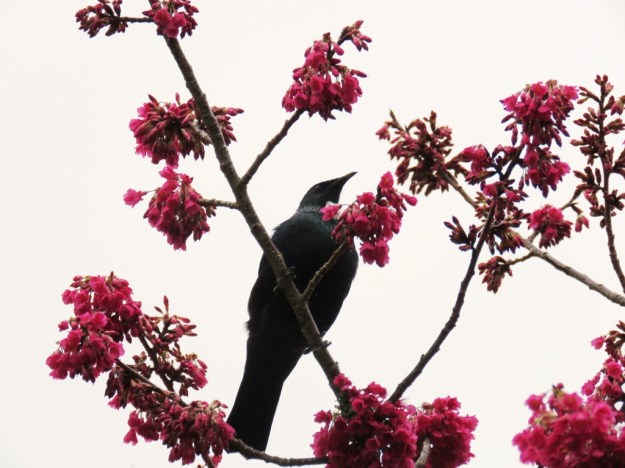
Tui in the cherry tree

Tui in the cherry tree

It is the time of the year when I spend a great deal of time trying to get the perfect images of the scores of tui we have feeding in the Prunus campanulata. Because we have a number of trees, the birds migrate between them but never sit still long enough for us to count.
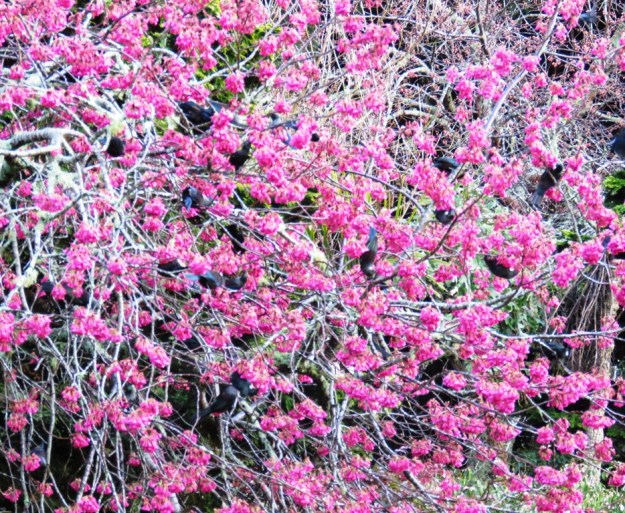
Too many to count. All the black shadows are tui.

Too many to count. All the black shadows are tui.

These early flowering cherry trees from Taiwan get a mixed reception in New Zealand. There is no doubt that our native birds find them hugely appealing. In an environment filled with food sources, it is the campanulatas to which they head en masse. But, and it is a huge but, most campanulatas set prodigious amounts of seed and because these form as little cherries, tasty to our fruit-eating native birds, they are spread far and wide. Indeed, seedling cherries are one of the worst weeds we have in our own garden and it takes constant management to stop the spread. So bad is it that the councils further north have banned seeding campanulata varieties and some folk would like to see total eradication across the country.

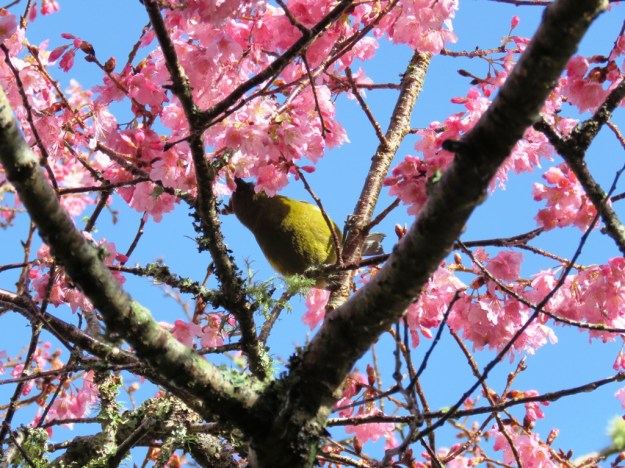
Shy korimako in Prunus Pink Clouds. It was soon banished by the bullying tui

Shy korimako in Prunus Pink Clouds. It was soon banished by the bullying tui

We would be very sorry to see all campanulatas banned but certainly the future lies in sterile selections. Sterility means that they don’t set seed so they won’t spread but we get to keep the mass blooming and the tui – and indeed korimako, our shy bellbirds – get to keep their favourite food source. Pink Clouds and Mimosa are both sterile varieties which date back to the work Felix Jury did on them, but the sugar pink colour is often less favoured to the cerises and reds. Unfortunately, the good compact growing, dark flowered variety named for Felix by Duncan and Davies – Prunus Felix Jury – is not sterile.

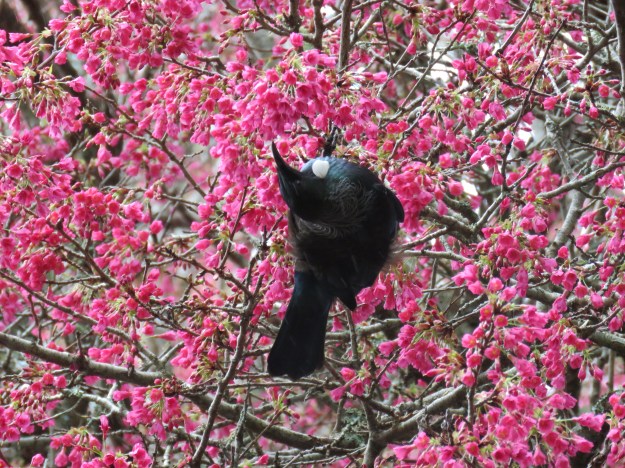
Acrobatic tui in a campanulata that is sterile but much too large for most gardens

Acrobatic tui in a campanulata that is sterile but much too large for most gardens

We have a sterile cerise red which is a great performer but at over 12 metres tall and 10 metres wide, it is far too large for domestic gardens. But there is hope. Mark has identified one which is sterile, has good colour and does not look as if it will get anywhere near as large.

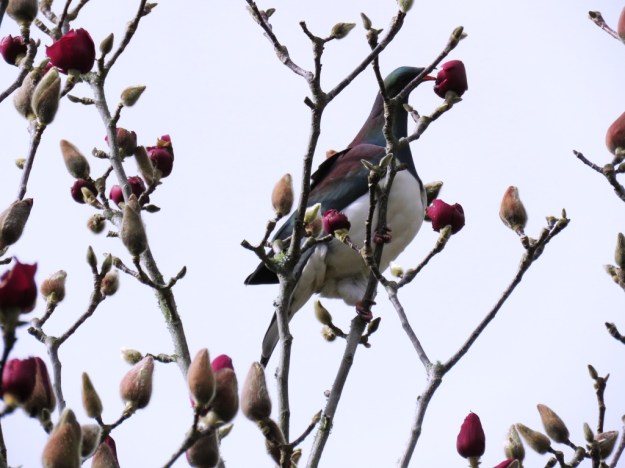
Kereru feasting on Magnolia Vulcan buds

Kereru feasting on Magnolia Vulcan buds

“Now look ‘ere, Mr and Mrs Kereru, we need to have words about this latest taste treat you have found. This just won’t do at all. There is plenty of other food here for you but magnolia buds are off limits, especially the first flowers opening on Magnolia Vulcan.”

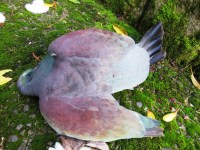
Poor kereru died after flying into a window

Poor kereru died after flying into a window

I would make jokes about Mr and Mrs Kereru dicing with death on this latest escapade, but some sensitive soul would take me seriously. Kereru are our large native wood pigeon and were a valued food source for Maori in times past. But they are very slow breeders and are suffering from habitat loss so are now totally protected. 056There has been a bit of a scandal recently about kereru being served as part of a traditional feast – did the Parliamentarians know they were eating kereru? – so it is poor form to even make jokes about eating them. Besides, even when a beautiful plump specimen died before my eyes after flying into one of our house windows, we could not bring ourselves to try cooking it. Instead we bought window decals from Bird Rescue to try and prevent such a thing happening again.

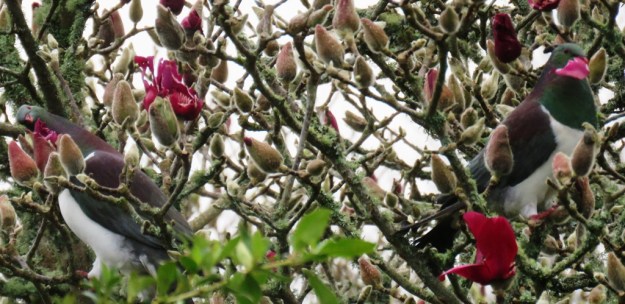
Apparently Vulcan scores highly on the kereru taste test

Apparently Vulcan scores highly on the kereru taste test

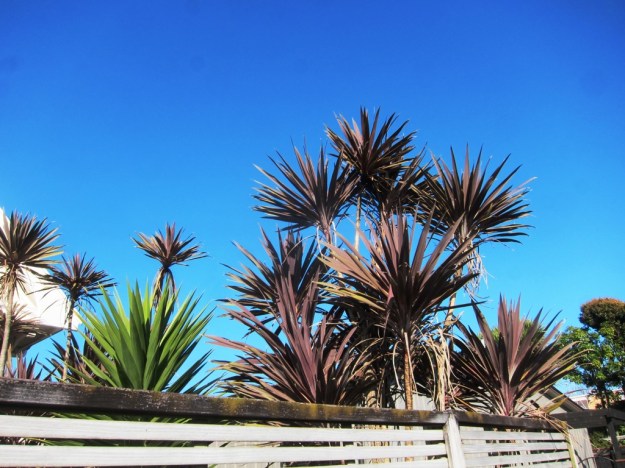
The cordylines on Devon St and Devon Rd

I went to town last Saturday on one of those glorious winter days we get here with its blue as blue sky and nary a breath of wind. When I say I “went to town”, I mean the small provincial city of New Plymouth which is about 24km from where we live. One of its claims to fame is the phenomenally long main street, called Devon Street. The first settler boats to arrive sailed from the English port of Plymouth, drawing on folk from South Devon and northern Cornwall in search of a better life. When Devon Street leaves the city limits, it becomes Devon Road and stretches out a great deal further along what has now become state highway. And on Saturday, I noticed just how many cordylines there are planted along the way.

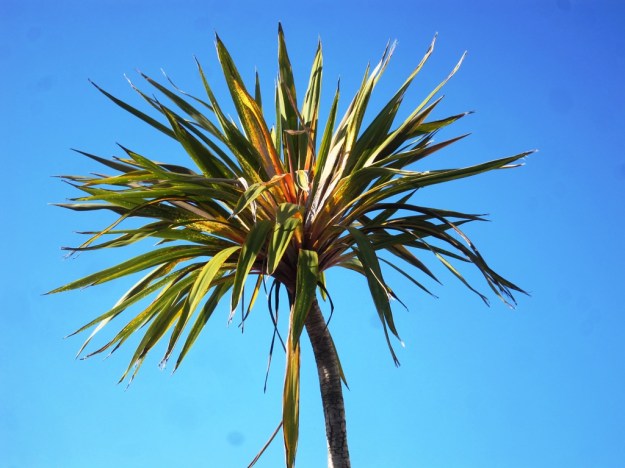
Cordyline australis is by far the most common variety where we live and despite the ‘australis’ part of its name, it is a native tree of New Zealand. Local parlance still has these trees referred to often as ‘cabbage trees’ although the Maori name of Ti kouka (with macrons over the i and the o but I am not sure where macrons are on this keyboard) is increasingly widely used. Botanically, they are cordylines.

Cordyline australis 'Purpurea'

Cordyline australis ‘Purpurea’

It was the purple version – Cordyline australis ‘Purpurea’ that caught my eye in a garden first. This is just a natural variant on the more common green form. The modern trend is to favour yuccas over cordylines as garden plants but I prefer our native plant. However, as we all know, the falling leaves play havoc with lawnmowers and too often the machine can come off second best. I have read several times recently of folk gathering the leaves, drying them out and using them as fire starters which seems a resourceful activity to me.
039 - CopyCertainly for those who crave perfection in their garden plants, our native cordylines can develop a motheaten appearance. Caterpillar damage from a native moth – Epiphryne verriculata – is typical in this country whereas the cordylines I have seen overseas, particularly in the UK where they are a prized plant, keep cleaner foliage.
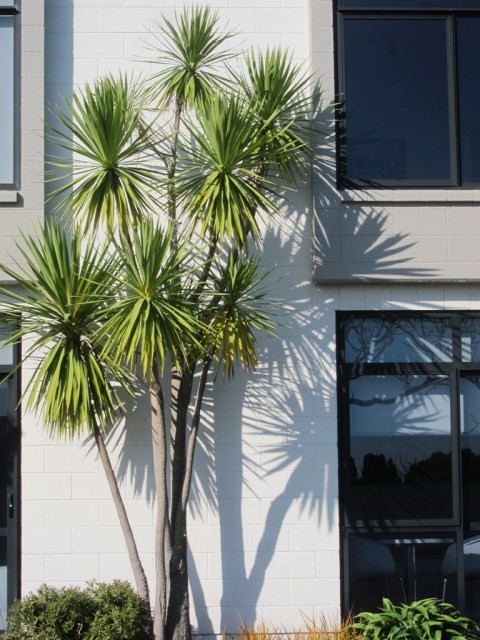
Cordyline australis outside Devon Hotel

Cordyline australis outside Devon Hotel

Along the road a little were cordylines planted outside the Devon Hotel, casting shadows on the plain wall behind. They were as sophisticated as any imported plant genus would be. They are also remarkably practical as an amenity plant because the multi trunks can be thinned as required without harming the plant.
053 - CopyHeading out of town, I stopped by the recent planting of an avenue of cordylines leading up to the golf club. You may notice it is an informal avenue which seems a wise decision given that this is not a plant that is particularly cooperative when it comes to straitjacketing it into precision formation. It is much too individual and unpredictable to achieve rigid conformity.
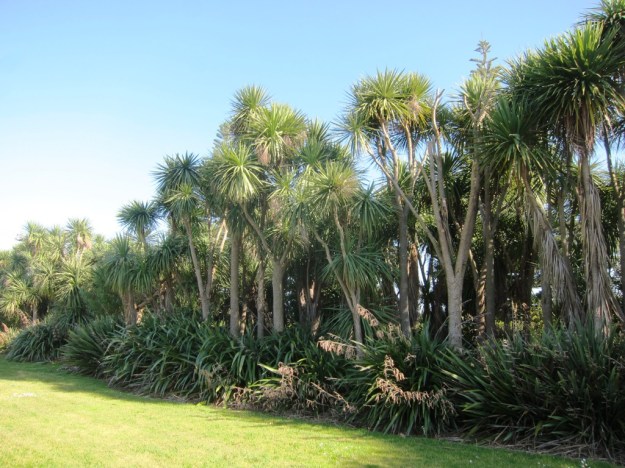
062 - CopyThe established block beside the airport turnoff has been there for a fair time now. They were both eye-catching and appropriate when first planted and I think they are maturing well. The planting beneath is our native flax or phormium.
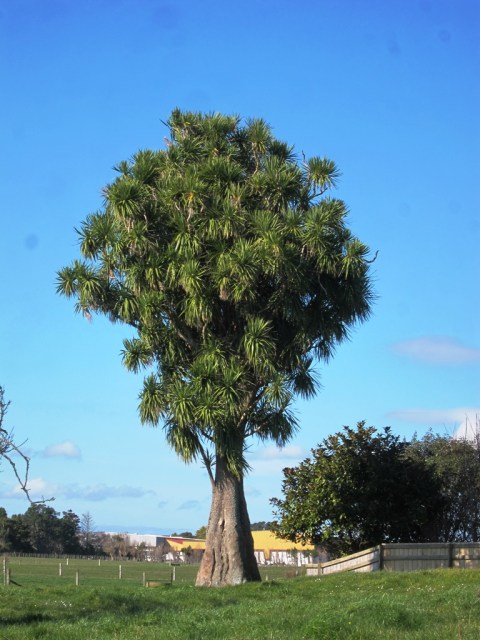
Cordyline australis at a grand old age near Waitara

Cordyline australis at a grand old age near Waitara

The crown of glory must surely go to this solitary specimen standing alone in a paddock near Waitara. It will be many decades old – at least 60 years and quite likely more. It takes a long time for Cordyline australis to reach this stature and what a magnificent plant it is.
031 - Copy
I have used my image of the tui feeding from the mandarin tree with the sunburst Cordyline australis “Albertii” before and it is in our garden, not Devon Road but I remain amazed that I ever caught this little scene on camera.

Earlier stories I have written on cordylines include:
A step by step guide to propagating cordylines
The blue flowered Australian Cordyline stricta
The pink flowered Australian Cordyline petiolaris
The travesty of claiming that Cordyline Burgundy is distinctively different to our Cordyline Red Fountain
002 - Copy
Finally, these Cordyline australis ‘Alberti’ are not on Devon Road and I felt sure I had shown them before but I cannot find where. They are on the main road through Eltham. The sunburst effect made me laugh on the day and they still make me smile.

The magnolia and the mountain

Magnolia campbellii in our park and Mount Taranaki

Magnolia campbellii in our park and Mount Taranaki

I prefer not to leave a negative post heading my home page for long (for an update on That Matter, refer to the last paragraph here), so here instead is the magnolia and our maunga*. I am waiting for more flowers to open so I can catch the hero shot of Magnolia campbellii in full bloom against the snow. This photo was taken in the early morning light at about 8am, as the sun was rising.

campbellii again

campbellii again

Mark is anxious that I point out I am using a zoom lens and the mountain is not 300 metres away from us. It is more like 35 kilometres distant. In this case, I feel it is appropriate to use the word iconic about our maunga. It is a beautiful volcanic cone which stands in splendid isolation on the coastal plain beside the sea and it is such a strong presence in Taranaki that it is etched into the very being of everybody who lives here. It is still active, although it is a long time since it has done much more than gently rumble to remind us not to take him for granted.

Magnolia campbellii

Magnolia campbellii

M. campbellii is always the first of the named magnolias we have here to open for the season. The tree is a fraction of its former size, having been clipped by a falling poplar tree a few years ago but it continues to grow and will regain its former glory over time.

Just an unnamed seedling

Just an unnamed seedling

For early glory, this unnamed seedling in one of our shelter belts takes the first medal. It is looking great, but it won’t be named or released. It flowers far too early for most climates and is not sufficiently distinctive. It is a good reminder that on their day, many plants look magnificent but they need to continue looking glorious in competition with many other candidates, not just on their day.

First bloom of the season on Felix Jury

First bloom of the season on Felix Jury

The first few flowers have opened on Felix Jury, which is still a source of real pride and joy to us. Felix beat Vulcan to the draw on first bloom this year, although the latter is now showing glorious colour. Felix will also outlast Vulcan when it comes to the length of the flowering season. In colder climates, these earliest bloomers open later. We are lucky where we live that we have clear, intense light – even in mid winter when these magnificent flowers start opening for us.

Mark's Fairy Magnolia White

Mark’s Fairy Magnolia White

Michelias have now been reclassified as magnolias and the earliest varieties are opening. This is Mark’s Fairy Magnolia White which has the bonus of a lovely perfume. Magnolia season feels like the start of a new gardening year for us and each day is filled with anticipation to see what else is opening. Many of our trees are now large, so I find I am often photographing up against the sky. Hence I often refer to this time of the year as the season of skypaper.

As far as my previous post on the magnolia and the well site goes, for those of you curious about the reaction of the company I can report that so far, the reaction has been… nothing. Nothing at all, although I know they spent a lot of time checking it on my site on Tuesday. I fully expect that situation to remain, although I will certainly be pleasantly surprised if the company responds to the challenge.

*Maunga is the Maori word for mountain and is widely used in New Zealand, especially when referring to mountains which have long held particular spiritual significance for tangata whenua – the first people of the land in this country.

Magic carpet

Snowdrops on a hillside

Snowdrops on a hillside

July may be the bleakest month of winter for us but it is also snowdrop time and these little charmers brighten the greyest of days. You can never have too many snowdrops in my opinion, and the varieties that do well with us are building up to a satisfying level. By definition, that is when we have enough to move them out of optimal garden or nursery conditions and start establishing them in carpets.

It is our interest in what we call “romantic gardening” – others refer to it as “naturalistic gardening” – that we derive as much, if not more pleasure from plants naturalised in meadow conditions as we do from cultivated, tightly maintained garden beds. It is a blurring of the edges in gardening, exploring how far we can replicate the simple charm of wildflowers but in a managed situation.
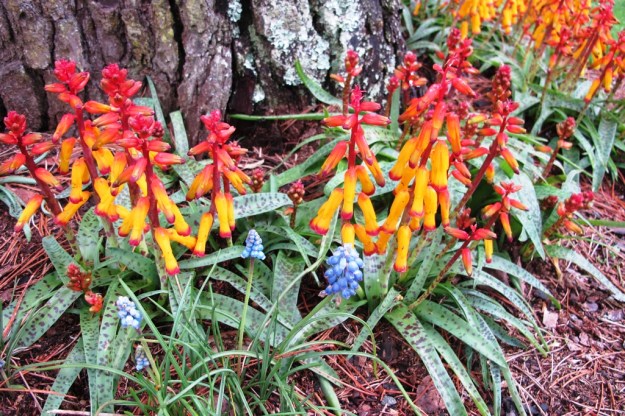
Lachenalia aloides and grape hyacinths (muscari) at the base of Pinus muricata

Lachenalia aloides and grape hyacinths (muscari) at the base of Pinus muricata

It is not as easy as it sounds. Many of the charming bulbs in their natural environment have conditions which are much harsher than here. Winters that are very cold and often dry mean that most growth stops, as do summers that are hot and dry. But in our dairy-farming heartland, soft conditions keep grass growing all year round and that growth will simply swamp most bulbs. It has taken us some years to learn to manage this. Selecting bulbs that will cope in our conditions has been trial and error.
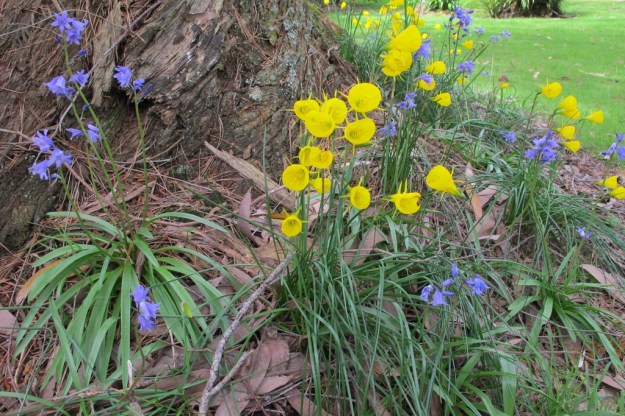
Bluebells and hooped petticoats (Narcissus bulbocodium) planted at the base of a eucalypt

Bluebells and hooped petticoats (Narcissus bulbocodium) planted at the base of a eucalypt

It also takes eleventy thousand more bulbs than you think it will. Even bulk buying a couple of hundred bulbs is not going to create much of a carpet in the short term. To get a quick result using large bulbs like daffodils or bluebells, planting at one every 10 square centimetres means 100 per square metre. I worked this out because I was planting a little mixed area. Using dainties like erythroniums, dwarf daffodils, snowdrops, crocus and rhodohypoxis, it took about 4 of these small bulbs per 10 square centimetres – or 400 per square metre. That is a large number and may explain why we don’t see many bulb meadows in this country, beyond well established fields of daffodils dating back many decades. Obviously, if you plant at greater spacings, you can cover a larger area but you will wait longer for the carpet effect.
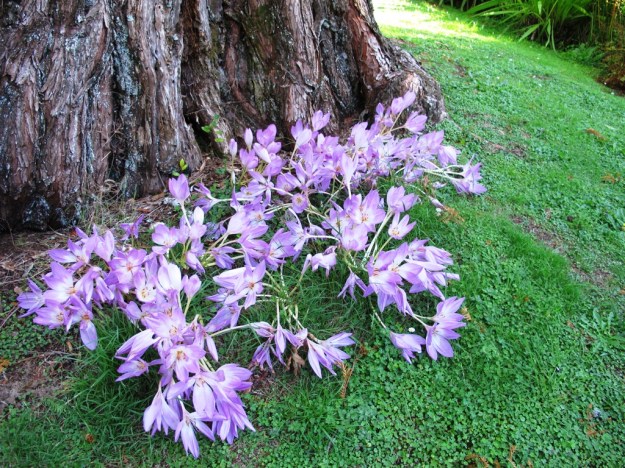
Colchicum autumnale flowering at the base of a metasequoia

Colchicum autumnale flowering at the base of a metasequoia

While planting around tree trunks is not the same thing as naturalising bulbs in a meadow situation, it proved to be a good place to start for us. We have many trees in fairly open situations where it is possible to establish easy bulbs beneath. Most bulbs need sun so these need to be trees with a higher canopy to allow light below. Planting amongst the exposed roots of established trees ensures the bulbs don’t get mown off or trampled as they surface and generally they get established with little competition. It is also an effective way of controlling some of the invasive bulbs like ipheions and ornamental oxalis.

Scattering seed is hit and miss and slower to give any results but much easier. We were delighted this year to see Cyclamen hederafolium showing its colours where Mark had scattered fresh seed several years ago. He had given up hope that it would work but lo, there are rewards for patient gardeners and the older we get, the more patience we seem to be developing.
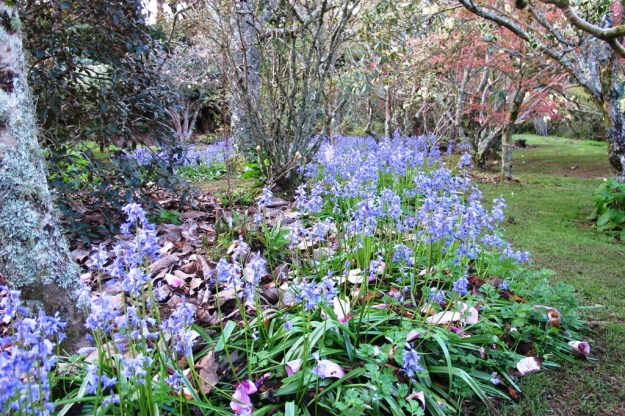
 Bluebells planted on the margins, drifting through our park area

Bluebells planted on the margins, drifting through our park area

Bluebells are easy and we have used them in swathes around shrubs in the area we call our park. Because they are flowering at the same time as the full flush of spring grass growth, we have to keep them to the side of areas we need to mow. Bluebell, and indeed snowdrop, woods that we have admired in Britain are carpets beneath deciduous trees. Our woodland areas are heavily dominated by evergreens so we don’t get enough light to replicate those carpets here. That is why we have to opt for the margins instead.

The triumph of experience has been getting grassy banks with dwarf narcissi and snowdrops naturalised. To do this, Mark spent some years establishing the native grass, microlina. It is finer and less vigorous so doesn’t swamp the bulbs and can be controlled with minimal cutting – just a pass over with the weedeater from time to time. It is not quite the same as a bulb meadow, but we have learned to work with what we have here.
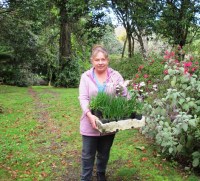
Carrying a tray of Nerine pudica, in case you are wondering (which I admit I planted in the rockery, not in meadows)

Carrying a tray of Nerine pudica, in case you are wondering (which I admit I planted in the rockery, not in meadows)

First published in the July issue of New Zealand Gardener and reprinted here with their permission.