Category Archives: Abbie’s column

Abbie’s newspaper columns

Magic carpet

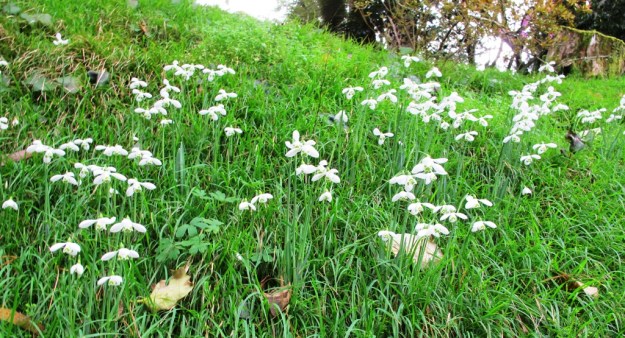
Snowdrops on a hillside

Snowdrops on a hillside

July may be the bleakest month of winter for us but it is also snowdrop time and these little charmers brighten the greyest of days. You can never have too many snowdrops in my opinion, and the varieties that do well with us are building up to a satisfying level. By definition, that is when we have enough to move them out of optimal garden or nursery conditions and start establishing them in carpets.

It is our interest in what we call “romantic gardening” – others refer to it as “naturalistic gardening” – that we derive as much, if not more pleasure from plants naturalised in meadow conditions as we do from cultivated, tightly maintained garden beds. It is a blurring of the edges in gardening, exploring how far we can replicate the simple charm of wildflowers but in a managed situation.
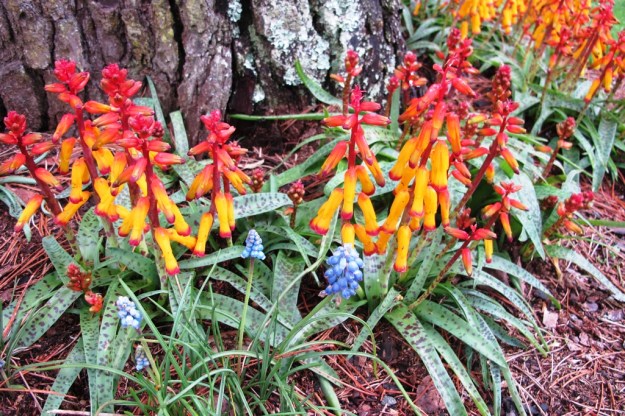
Lachenalia aloides and grape hyacinths (muscari) at the base of Pinus muricata

Lachenalia aloides and grape hyacinths (muscari) at the base of Pinus muricata

It is not as easy as it sounds. Many of the charming bulbs in their natural environment have conditions which are much harsher than here. Winters that are very cold and often dry mean that most growth stops, as do summers that are hot and dry. But in our dairy-farming heartland, soft conditions keep grass growing all year round and that growth will simply swamp most bulbs. It has taken us some years to learn to manage this. Selecting bulbs that will cope in our conditions has been trial and error.
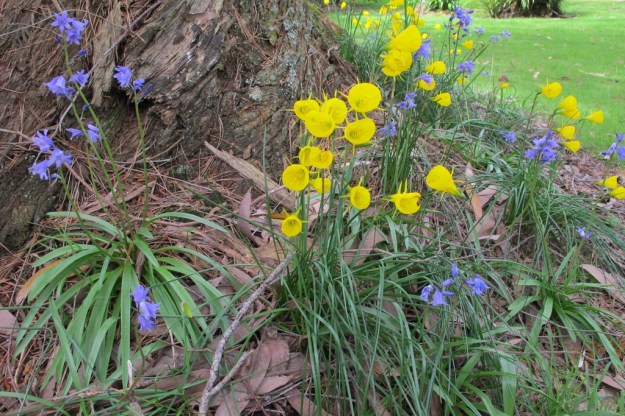
Bluebells and hooped petticoats (Narcissus bulbocodium) planted at the base of a eucalypt

Bluebells and hooped petticoats (Narcissus bulbocodium) planted at the base of a eucalypt

It also takes eleventy thousand more bulbs than you think it will. Even bulk buying a couple of hundred bulbs is not going to create much of a carpet in the short term. To get a quick result using large bulbs like daffodils or bluebells, planting at one every 10 square centimetres means 100 per square metre. I worked this out because I was planting a little mixed area. Using dainties like erythroniums, dwarf daffodils, snowdrops, crocus and rhodohypoxis, it took about 4 of these small bulbs per 10 square centimetres – or 400 per square metre. That is a large number and may explain why we don’t see many bulb meadows in this country, beyond well established fields of daffodils dating back many decades. Obviously, if you plant at greater spacings, you can cover a larger area but you will wait longer for the carpet effect.
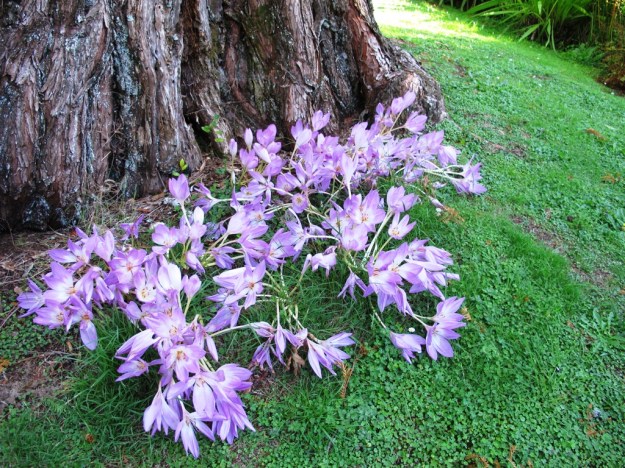
Colchicum autumnale flowering at the base of a metasequoia

Colchicum autumnale flowering at the base of a metasequoia

While planting around tree trunks is not the same thing as naturalising bulbs in a meadow situation, it proved to be a good place to start for us. We have many trees in fairly open situations where it is possible to establish easy bulbs beneath. Most bulbs need sun so these need to be trees with a higher canopy to allow light below. Planting amongst the exposed roots of established trees ensures the bulbs don’t get mown off or trampled as they surface and generally they get established with little competition. It is also an effective way of controlling some of the invasive bulbs like ipheions and ornamental oxalis.

Scattering seed is hit and miss and slower to give any results but much easier. We were delighted this year to see Cyclamen hederafolium showing its colours where Mark had scattered fresh seed several years ago. He had given up hope that it would work but lo, there are rewards for patient gardeners and the older we get, the more patience we seem to be developing.
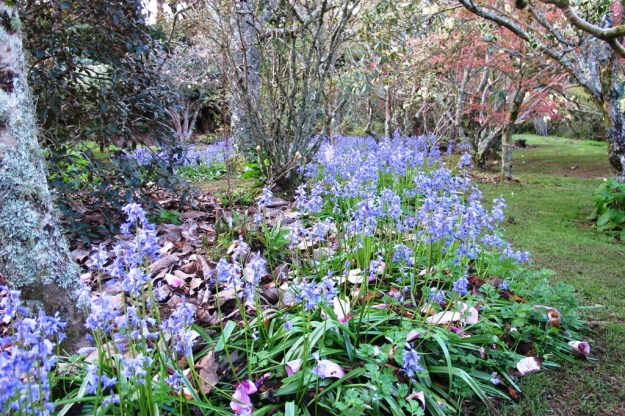
 Bluebells planted on the margins, drifting through our park area

Bluebells planted on the margins, drifting through our park area

Bluebells are easy and we have used them in swathes around shrubs in the area we call our park. Because they are flowering at the same time as the full flush of spring grass growth, we have to keep them to the side of areas we need to mow. Bluebell, and indeed snowdrop, woods that we have admired in Britain are carpets beneath deciduous trees. Our woodland areas are heavily dominated by evergreens so we don’t get enough light to replicate those carpets here. That is why we have to opt for the margins instead.

The triumph of experience has been getting grassy banks with dwarf narcissi and snowdrops naturalised. To do this, Mark spent some years establishing the native grass, microlina. It is finer and less vigorous so doesn’t swamp the bulbs and can be controlled with minimal cutting – just a pass over with the weedeater from time to time. It is not quite the same as a bulb meadow, but we have learned to work with what we have here.
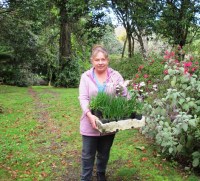
Carrying a tray of Nerine pudica, in case you are wondering (which I admit I planted in the rockery, not in meadows)

Carrying a tray of Nerine pudica, in case you are wondering (which I admit I planted in the rockery, not in meadows)

First published in the July issue of New Zealand Gardener and reprinted here with their permission.

Winter whites

Ripples on the ice formed on a farm trough

Ripples on the ice formed on a farm trough

July is our bleakest winter month here. We feel the cold, especially this week with three sharp frosts in a row which is unusual for us, but the daytime temperatures rarely drop below double figures (Celsius). The ice photo is from a water trough on the coldest part of the property. Mark was very taken with the patterns.

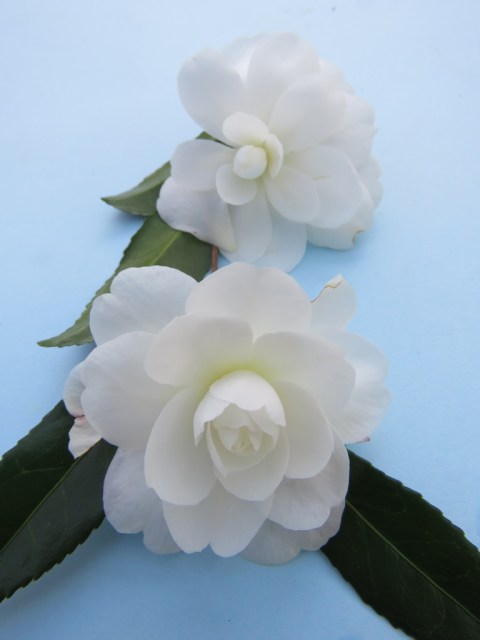
Early Pearly - the loveliest of sasanqua camellia flower forms

Early Pearly – the loveliest of sasanqua camellia flower forms

But cold is a relative thing and a winter here in Taranaki remains full of flowers. I was playing around with white camellia blooms because I had been reminded of our love affair with white flowers in this country. The ‘any colour is fine as long as it is white” syndrome, perhaps. I am sure gardeners in parts of the world which spend many weeks or months or under snow might find this national obsession with white flowers puzzling. I suspect it may derive from a sense of social envy – Sissinghurst’s white garden has a lot to answer for here in the antipodes.

As I progressed on my white flower assemblages, often having to pick the flowers because it has been raining or windy, I began to feel positively bridal despite the winter chill.
029
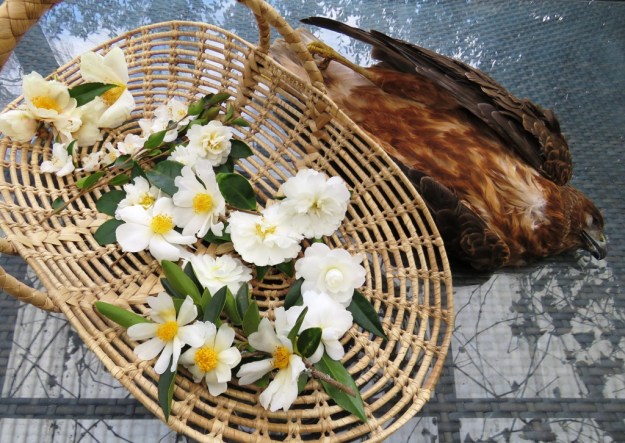
The Montanoa bipinnatifida has passed over and the monarch butterflies have moved onto an obscure michelias species that is flowering. The frosts have dealt to the Dahlia imperialis alba this week and Luculia ‘Fragrant Pearl’ is passing over, but there is plenty of white in evidence. Yes, it is a dead harrier hawk above – killed on the road but passed on to a Maori weaver to use the feathers. In the basket starting at the back is one of the gordonias. They have been particularly good this season. Then the small flowers are Camellia transnokoensis  which we rate highly as a small leaved, miniature flowered species which we are using as hedging. We replaced some buxus hedging with this camellia. For, Mark reasoned, how much better to have a hedge that has pretty flowers which make a contribution to the ecosystem by feeding birds and insects. Next is another species, Camellia gauchowensis, Camellia sasanqua Mine No Yuki, Early Pearly and at the front Camellia drupifera. 

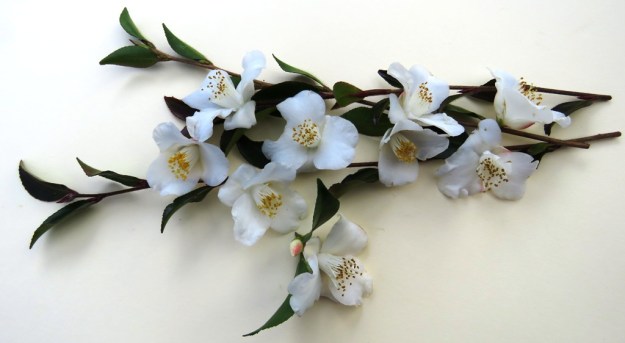
Camellia transnokoensis

Camellia transnokoensis

Picked in the rain today

Picked in the rain today

Daphne bholua

Daphne bholua

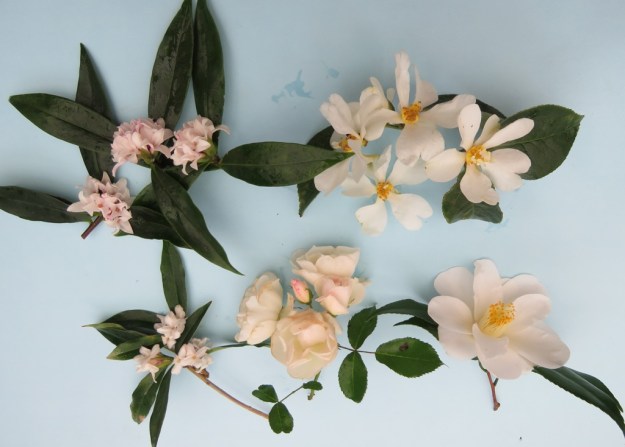
At the top we have Mark’s new Daphne Perfume Princess – not pure white by any manner of means but the overall display is more white than coloured. Next to it is one of our favourite species, Camellia yuhsienensis, whose flowers are like the michelias of the camellia world. Below is the Himalayan daphne,  Daphne bholua  , which has the sweetest perfume of any daphne we know but suffers from scruffy growth and badly behaved habits of suckering and seeding. Next is Rose Flower Carpet White (does it ever stop blooming?) and then the pretty bloom of Superstar – another white camellia which we rate highly on garden performance and weather hardiness – at least when compared to most larger flowered whites.


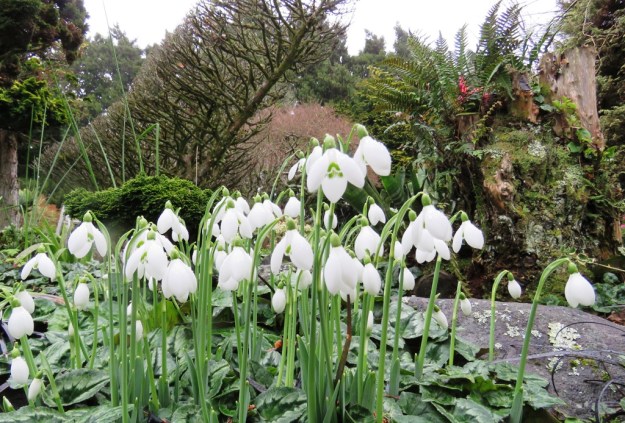
Galanthus - the winter snowdrops
We may not get a long season from the galanthus and they certainly don’t peek through the snow here, but the simple charm is constant. Galanthus elwesii and Galanthus ‘S Arnott’ are the most reliable performers in our conditions. Although we grow some other varieties, these two are our mainstay.

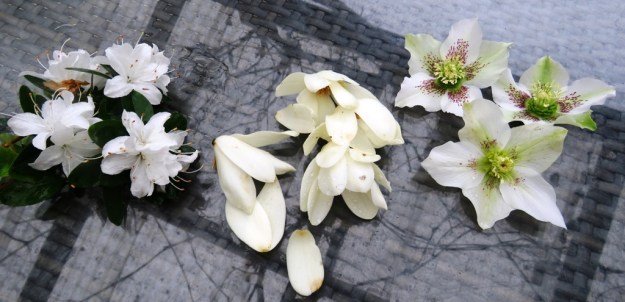
067Finally today, I headed out into the chill to find the white evergreen azaleas, the very first of the new season’s michelias (deliciously fragrant) and white hellebores. By this time, I found my eyes being drawn to colour and red blooms were demanding my attention. I would find a monochromatic garden soon palled but the colours  will have to wait for another day as I end with the simple perfection of Camellia Superstar below.

Superstar (6)

The Avocado Thief

Avocado tree

Avocado tree

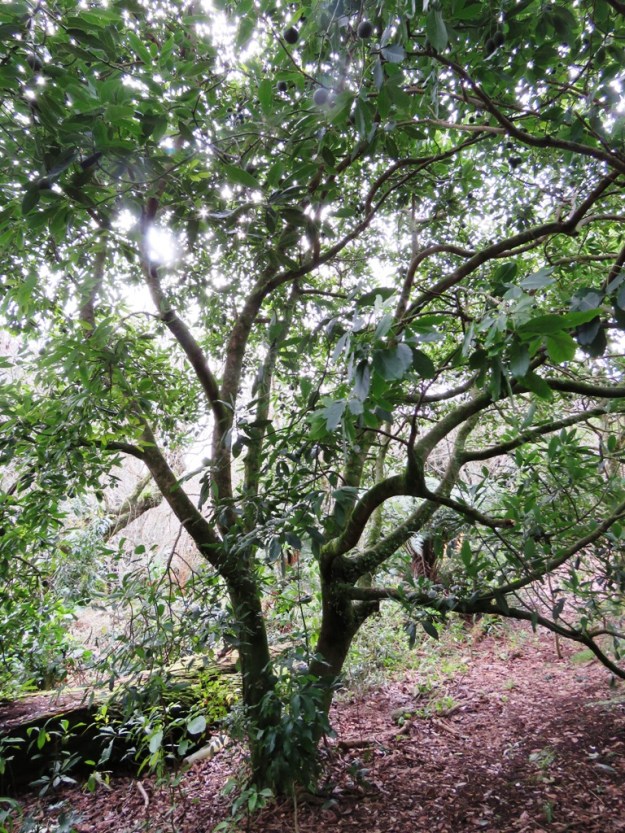
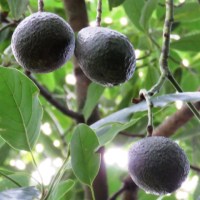
023 - CopyBehold an avocado tree. A tree, I admit, that demonstrates a case of allowing a twin trunk to develop though I am told that is permitted with avocados. It is a tree which has had the best ever crop of Hass avocados this year. It has truly been a mast year. We are a bit marginal when it comes to avocados and they tend to crop biennially. There is no crop next year so we are making hay (or guacamole, to be precise) while the winter sun shines.


Exhibit A

Exhibit A

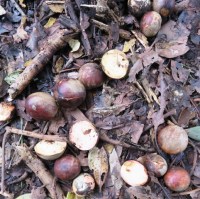
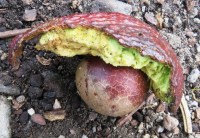
Exhibit A is the pile of avocado pits around the place. These tell us that we are not alone in harvesting the crop. In fact given the predations of waxeyes, starlings, blackbirds, rats and possums, it is a miracle that we still collect fruit by the bucket load. Possums are a major pest in this country and Mark and the dogs do a round each evening checking for them. Mark conducts an autopsy on the stomach contents of each possum he shoots – mostly to check who is eating the buds of the magnolia trees at this time of the year – and noted last week that one appeared to be full of guacamole.

Exhibit B

Exhibit B

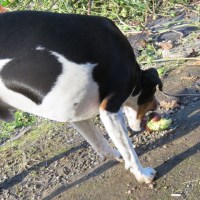
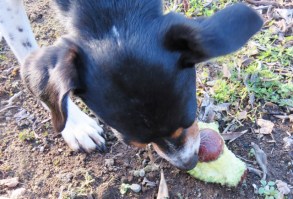
But exhibit B fingered another avocado thief. None of the aforementioned raiders stashes partially eaten fruit all round the place. We had noticed that new dog Dudley was looking particularly glossy and plump. The natural avocado oils are clearly kind to his fur. Mark has taken to doing a circuit twice a day to pick up whole fruit that has fallen in an attempt to beat Dudley to the draw but any time the dog disappears from view, it is a fair bet that he can be found near the avocado tree.

005 - Copy009 - Copy


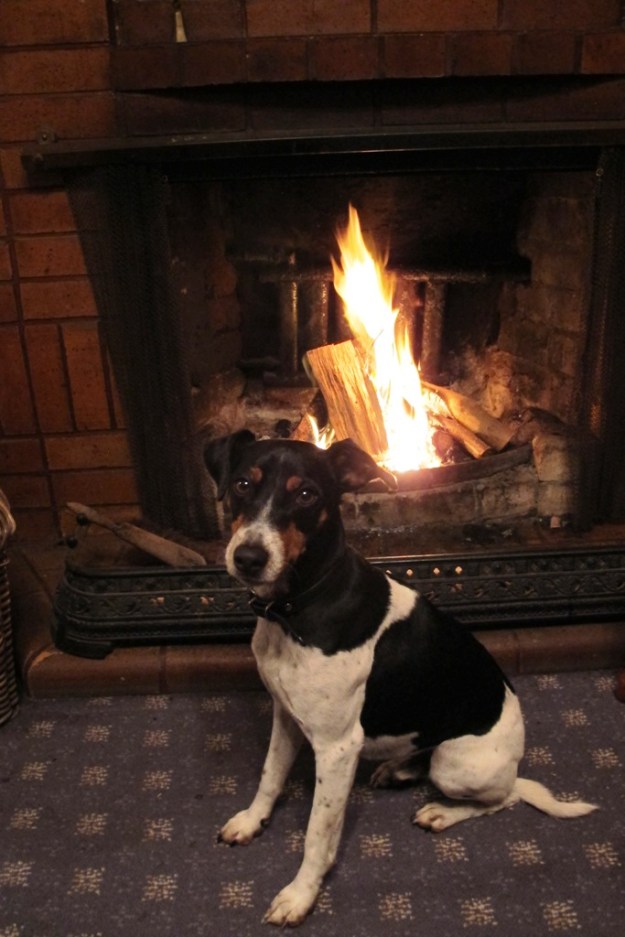
Dudley is a four year old fox terrier, surrendered by his previous owner to the SPCA for re-homing. He came to us in January – clearly a well-loved townie dog used to being fed tidbits any time his previous owner was eating, allowed on any furniture and accustomed to sleeping in his owner’s bed. He was a little timid at the space here and confused by the changes in rules. But now he has taken on the role of estate dog as though he were to the manner born. He is a whizz on rats, a keen possum dog, happy to assist with moving the four beefies that comprise Mark’s little cattle herd, patrols the boundary to ensure that Sam the neighbour’s dog does not make incursions and  he is more than happy to deal to the perceived surplus of avocados.


To the manner born

To the manner born

Not quite lawn-free but leaning more to meadows

019 (3) - Copy
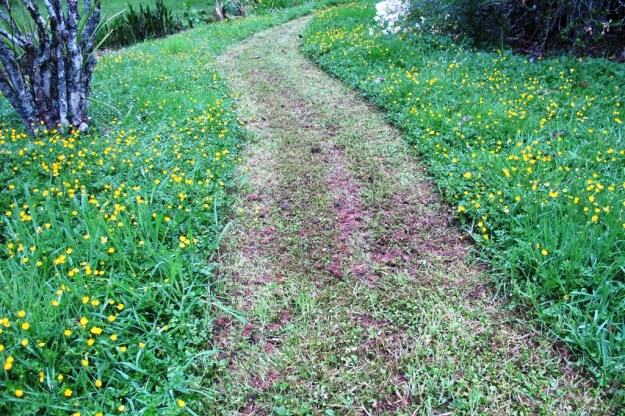
One of the advantages of having our garden closed to the public for a year or two, or maybe more, is the freedom to experiment. And experimenting we are with lawns – or mown green areas may be a more accurate description. We stopped mowing half our park at the end of last winter, choosing instead to keep to a mown track meandering through, so it is possible to walk without getting wet feet.

We have been talking about lawns and grass for years here. Lawns are arguably the most environmentally unfriendly gardening practice of all. Yet there is considerable value placed on the perfect lawn and some people take great pride in achieving this. Perfection is measured against the bowling green which has no connection whatever to the home garden, let alone to nature.

I have never forgotten taking Mark along when I was doing an interview for a commissioned garden story. The owners were very proud of their lush, green sward and claimed that garden visitors often said they wanted to take their shoes off and walk barefoot or roll on it. I saw Mark throw me a telling glance and later he expostulated: “You want to let your bare skin touch that?’ For we both knew that sort of lawn perfection is only achievable by regular spraying with a fair range of chemicals, as well as fertiliser application and the usual frequent mowing, scarifying and over sowing that is required to keep it in such an artificial state.

The perfect lawn is a triumph of man or woman over nature, a dominance achieved at considerable cost to the environment and no small financial cost. There are all sorts of concerns around the western world about run-off from domestic lawns and frankly, when your lawn clippings are too toxic to put into the compost without risking your tomatoes and other crops for the next six months, there is a problem. Some folk will even kill off the worms with a residual spray in the quest for lawn perfection.

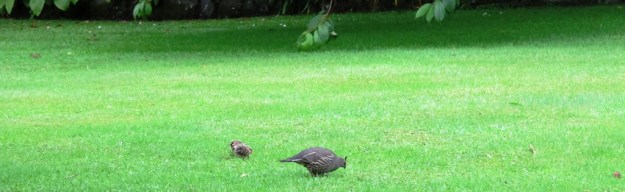
Mama Quail and two little feathered bumble bees of babies feeding on the lawn

Mama Quail and two little feathered bumble bees of babies feeding on the lawn

Mark is keen to have grass expanses with at least one flowering a year to feed the bees and other insect life. An added bonus has been unexpected. We made a decision a few years ago not to replace our cat, even though I adore fluffy felines. As a result, the Californian quail population has been steadily increasing and these lovely birds are a delight, foraging across the house lawns for seed. We might feel differently about a flowering lawn if we had small people in our lives running around bare footed, but in their absence, there is no need to worry about the bees.

We use a mulcher mower so the clippings are returned to the grass and this has eliminated any need to feed the lawn. Come early November, we let the grass grow long before cutting because then the dreaded Onehunga weed gets stretched and cut off before it can set its prickles. We do a certain amount of hand weeding to keep the flat weeds and undesirable grasses at bay in the house lawns. Beyond that, as long as it is fine or small leaved and cuts neatly, it is allowed to stay. Our lawns are more mixed colony environments than controlled grass species. We still mow regularly, but we are stretching out the intervals between mowing because we have become very aware of how dependent we now are on the motorised gardening aids and just how much fuel we have to buy to keep the mower, strimmer, chain saw and leaf blower running.

One of the delightful gardening books on my shelf is early Alan Titchmarsh, the Yorkshire gardener who is now a star TV presenter in the UK. Back in 1984, he wrote about The Lawn:
“Avant-gardeners do not have lawns; they have grass….The ‘bowling green’ lawn is a feature that belongs in front of council houses where it is surrounded by borders of lobelia, alyssum, French marigolds and salvias with standard fuchsias used as ‘dot plants’.

The avant-gardener’s grass is intermingled with daisies, plantains, buttercups… and plenty of moss (usually at least of 50% of the total coverage). This is a state of affairs to be encouraged. The grass is mown (avoiding a striped effect at all costs)…” (Avant-Gardening, a guide to one-upmanshop in the garden).

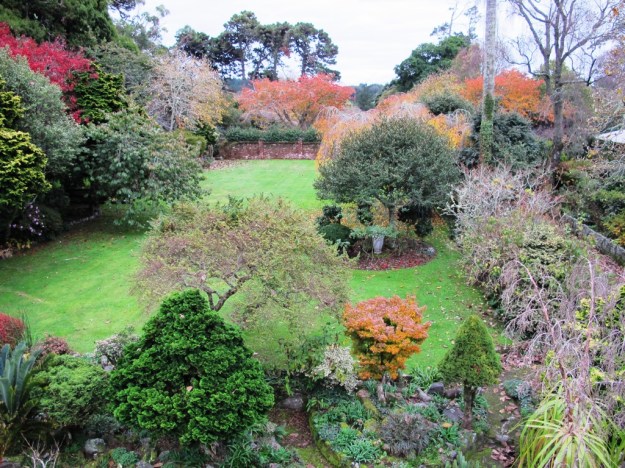
We have extensive areas of grass but have already decided that the front lawn should remain mown lawn rather than mixed meadow

We have extensive areas of grass but have already decided that the front lawn should remain mown lawn rather than mixed meadow

I admit we own the Rolls Royce of lawnmowers. It cost more than our car to buy

I admit we own the Rolls Royce of lawnmowers. It cost more than our car to buy

It does not appear that we have moved a long way since 1984 avant-garde thinking. If you are wondering what half our park looks like after six months without cutting the grass, I can report that the buttercup and self heal are thriving. To a critical eye it probably looks better in the shady areas than in the full sun but the mown strip is indeed like a path through a meadow and that is the effect we now want. We have worked out that we want the lawns immediately around the house more tightly maintained but, even in a large garden, we can achieve that without chemical intervention and top-up feeding. We see that as far more sustainable and environmentally friendly than the suburban value of an immaculate lawn.

First published in the June issue of the New Zealand Gardener and repinted here with their permission.
Gone in a morning – the loss of the Waitara riverbank pohutukawa

Gone. The view from the lookout on Manukorihi Hill.

Gone. The view from the lookout on Manukorihi Hill.

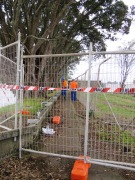
Regular readers will know of our battle to save the pohutukawa trees that line our local river. We lost. Today the chainsaws moved in. In a couple of short hours, trees that were over sixty years old were felled to the ground.
001047068043
Clearly there was some concern about the possibility of protests. Ironically the body that was hellbent on felling these trees is also the body charged with protecting the environment – that is what we call a Tui billboard moment in New Zealand vernacular. In a case of overkill, Taranaki Regional Council marshalled their staff to patrol the entrances to the area. Why, there was even a boat patrolling the river access. They would have been very cold out there on the river for a few hours. Truly, it is mid-winter here and most of us feel a little too old to scale large trees in order to protect them, so the fear of the operation being disrupted by protest was unfounded.

But oh, how sad to see the needless desecration of handsome, well established trees. Despite their public relations spin, the Taranaki Regional Council didn’t consult widely. They preferred to talk to people who said what they wanted to hear. As the protesting voices grew, rather than taking another look at the plans and seeing whether saving the trees could be accommodated, they set about discrediting, denying and deriding the opposing voices.
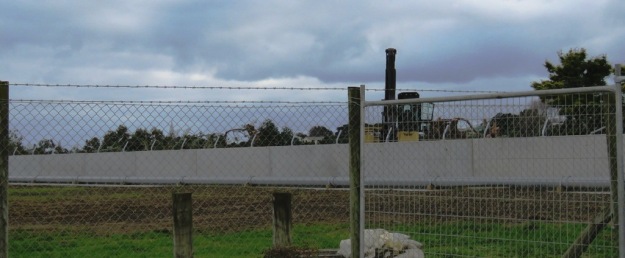
053How anybody in their right mind could think that the hostile expanse of concrete flood wall, topped with barbed wire (it is doing double duty as a security wall for the meat packing works behind) was an appropriate form of town flood protection in this day and age is beyond comprehension. It looks like a prison wall. This is the face of Waitara in 2015. We regard it as simply shameful action by Taranaki Regional Council.

042While the chainsaws worked at one end of the row, the digger driver proved that you don’t need chainsaws at the other end – the might of the machine means you can break apart the trees. There was no sign that the men on the site felt any sorrow at the unceremonious felling.

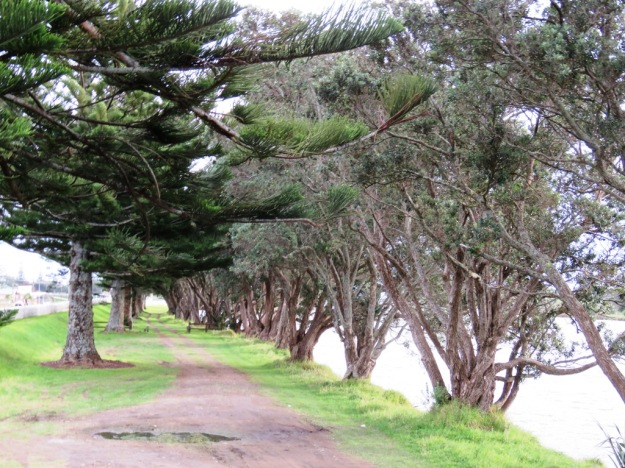
Once were trees. The new view from our town bridge

Once were trees. The new view from our town bridge

With ever increasing population in urban areas, we had thought that the role of protecting mature and handsome trees fell increasingly upon our local bodies, particularly in public spaces. These trees had the potential to live for many hundreds of years without causing any harm or inconvenience to residents while enhancing the centre of Waitara. No more.

Will this pretty scene downstream be allowed to remain?

Will this pretty scene downstream be allowed to remain?

Earlier plans were to fell ALL the riverbank trees. There is fear that this might yet happen. I found this pretty scene just down the river a little further. I wonder if it, too, will suffer the same treatment in the next year or two because the engineer who designed the flood protection doesn’t think there is any place for trees on river banks.

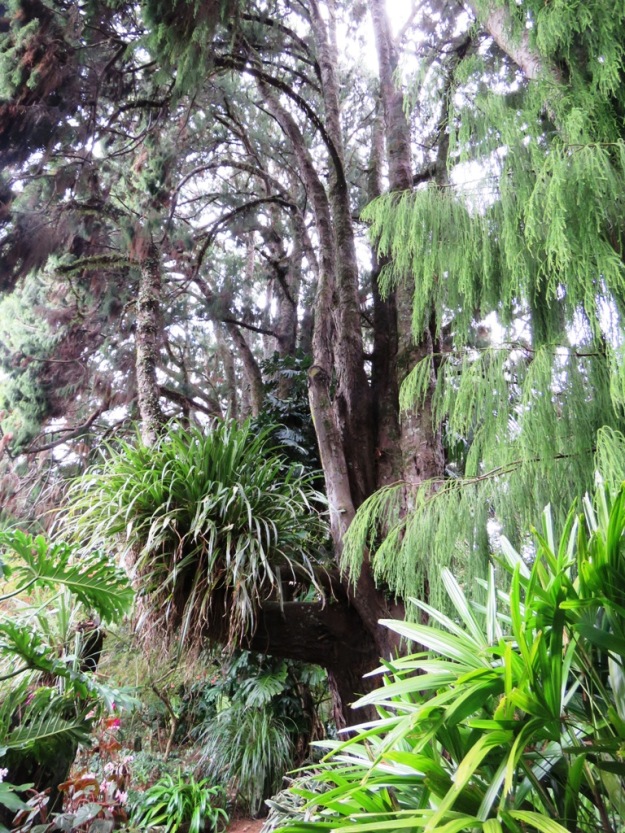
There is no place like home

There is no place like home

Fortunately, I do not live in the town itself so I could come home to our own place with its many, very large trees to soothe my heavy heart. These at least are beyond the reach of the chainsaw-happy regional council.