Category Archives: Abbie’s column

Raspberry nostalgia

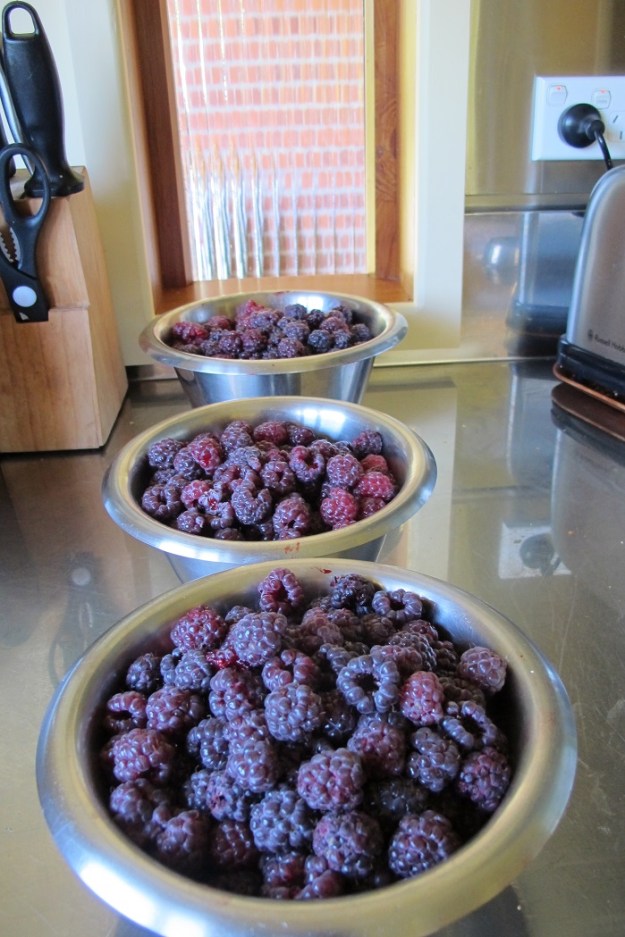
There is only so much disaster news I can cope with. Usually I find solace in the flowers and trees of the garden. Yesterday, as I picked the raspberries, it was nostalgia that struck me in a huge, sentimental wave. One of the better aspects of growing older is that the store of memories grows greater with each passing year and sometimes I find myself drawing out past memories that I have not thought about for a long time. Though my raspberry memories flood back every year as I carry out the harvest here.

The summer of 1969 was a seminal event in my teenage years – the first experience of adult freedom. We grew up earlier then. I was only fifteen when, with my three best girlfriends at the time, we organised a summer stint fruit picking. We would rather have been picking cherries or apricots but it was a raspberry orchard in Beaumont, Central Otago, that was willing to employ us. In those days, orchardists provided basic accommodation and meals for their seasonal workers. In this case, it was a boys’ bunkroom and a girls’ bunkroom.
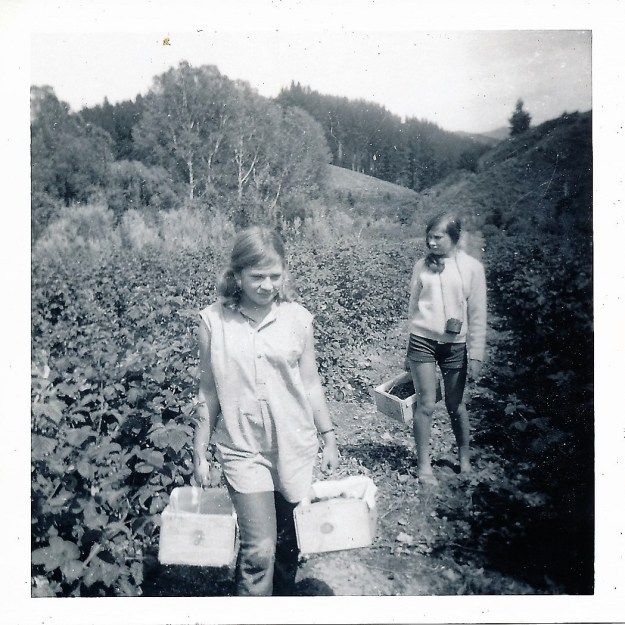
The picking of the raspberries. I think we were paid 45c a box. That is yours truly at the front.

Kate, Pippa, Clare and I thought we would have a great time – get suntanned, lose weight and earn money. We had a great time but none of the rest was the case. It rained. A lot. The raspberries went mouldy on the vines. The orchardist wife catered lavishly for us. With fresh scones, raspberry jam and cream on offer every morning and afternoon tea, I think all of us put on weight. The money was scant. Based on the kilo and a half of raspberries I am currently harvesting every second day, I think those wooden boxes probably held about 10lb or 4 ½ kilos. From memory, we were paid 45c a box. I remember working out that if the weather held and I picked as fast as I could until there was no more daylight, it was possible to pick eight boxes in a day. Even back then, $3.60 a day for close to 10 hours work was not great money.

Suffering from cabin fever in the rain, we persuaded Kate – the oldest one in our group and the only one with a driver’s licence – to requisition her mother’s car. Her parents were particularly amenable even when they were not best pleased. Four girls, cheap petrol and a Ford car. I have photos of the time taken on my Box Brownie camera. Very democratic, those photos were. One of each of us at Kate’s parents Arrowtown holiday house, then posing at the top of the chairlift on Coronet Peak (Pippa had the most model potential, I had all the glamour of a sack of potatoes) and heading out to the Beaumont pub for a celebratory dinner.
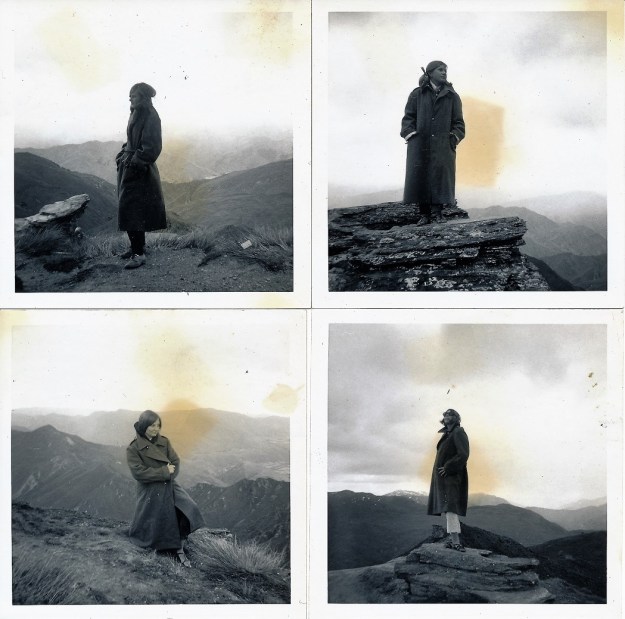
Posing on Coronet Peak. It may have been mid summer but it was still alpine.

Clare, Pippa and I had all sat School Certificate that year and the results came out in January. Kate was a year ahead of us at school. On the day the results were released, we clustered around the one phone in the house to make the all-important calls. I think I am right to say that a combined total of 200 across the top four subjects constituted a pass overall. The school we attended had set a mark of 330 as the point where they encouraged a student to skip the next year and go straight into the final year of schooling. Clare and I were aiming for that and to this day, I still feel a sense of guilt that Pippa’s relief at passing fairly comfortably (from memory, I think she got 246) was eclipsed. At 336, I met the school criteria for promotion (this is why I was only 16 when I started university a year later). Clare achieved a massive 372 and went on to study at Cambridge University. Memories can be oddly specific.
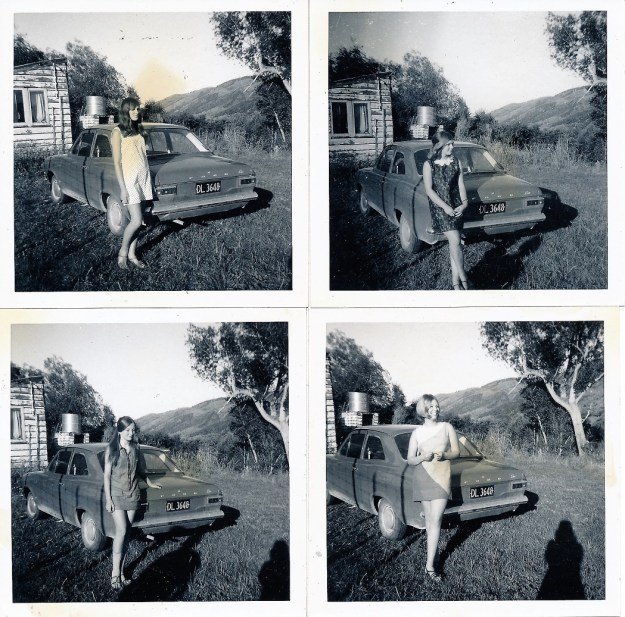
Ready for a celebratory dinner at the Beaumont pub. I am top right. Kate’s mother’s car and the bunkhouse also included, along with the shadows of the photographers with Brownie Box cameras.

I can’t remember what we ate at the Beaumont pub celebration on the day although I can still picture the setting in my mind. What I remember most is that they sold us a bottle of Gimlet, even though the legal age for drinking was still 21. Times were different. Gimlet was an early premix of gin and lime. Given our ages, I am guessing we diluted it with lemonade. With hindsight, it was just as well that Kate, as our driver, was a very modest drinker because the rest of us were certainly very merry, though not paralytically drunk.

Harvesting the raspberries always makes me think back to that summer of freedom, youth and naïve innocence.

In a sign of the times, Kate made contact with me through Facebook after a gap of maybe 40 years and honestly, social media has some very good points.
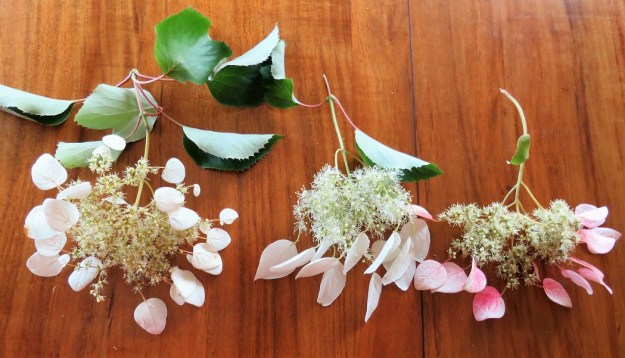
Spot the difference

I was going to write a piece this week shouting that now IS the very time we should be talking about climate change, aimed at the Australian prime minister, Scott Morrison, who left his burning country to holiday in the cleaner air of Hawaii, declaring that now is not the time for knee-jerk reactions to a major drought and extreme fires and neither is it the time to talk about climate change.

But the majority of Australians voted that man and his government in this very year and I decided that maybe I would leave it to those voters to reflect upon their collective decision and respond to their own environmental crisis. Instead I will focus on flowers.

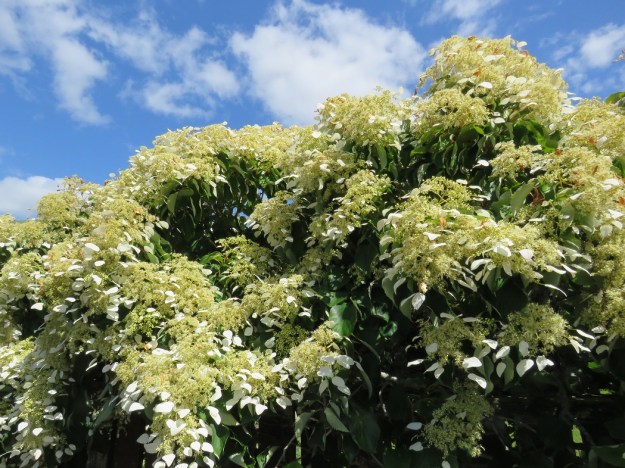
Hydrangea petiolaris, resplendent in full sun, although it has its roots on the cool side of the fence. Most climbers appreciate a cool root run.

Both the common climbing hydrangea, H. petiolaris, and the less common Schizophragma hydrangeoides are in full bloom here and I have never lined them up side by side to compare them. We produced both commercially in our nursery days but concentrated more on the allegedly more refined and desirable schizophragma. What were the differences, I wondered, in visual terms?

Hydrangea petiolaris to the left and the white and pink forms of Schizophragma hydrangeoides. Petiolaris looks creamier because it is an older flower grown in full sun. 

Not a whole lot, was the answer when I lined them up. The pink form of the schizophragma is  indubitably a different colour – rosy pink sepals, not white. H. petiolaris has more fertile flowers (the central tiny blooms on the lace-cap) and somewhat smaller outer petals (ray florets or sepals). It makes it appear a little bit heavier perhaps, than the light dancing of the sepals on the schizophragma. The hydrangea also has larger leaves overall. All of them have a light scent with a slight variation between the two species but nothing of great note.

Schizophragma hydrangeoides ‘Roseum’

Botanically, there is a difference. They are distinct species, though from similar parts of the world (woodland Asia, particularly Japan) and liking similar conditions. Schizophragma is nowhere near as common as H. petiolaris and has the reputation of being slow to establish. But I planted that petiolaris many years ago and it took several years to reach its stride, too. Mark reminds me that the reason he went for the schizophragma over petiolaris was because the latter would not set flowers on young plants.

Schizophragma hydrangeoides

Plantspeople and those with refined visual sensibilities will pick the difference. I prefer the lighter, more ethereal look of the schizophragma. But overall, I concluded that Mark’s ‘man on a galloping horse’ analogy applies. A man (or woman, presumably) passing on a galloping horse would not pick the difference. To be honest, most gardeners wouldn’t either. They are both lovely at their peak and well behaved as far as climbers go.

Seasons greetings 2019

Meri Kirihimete

Merry Christmas

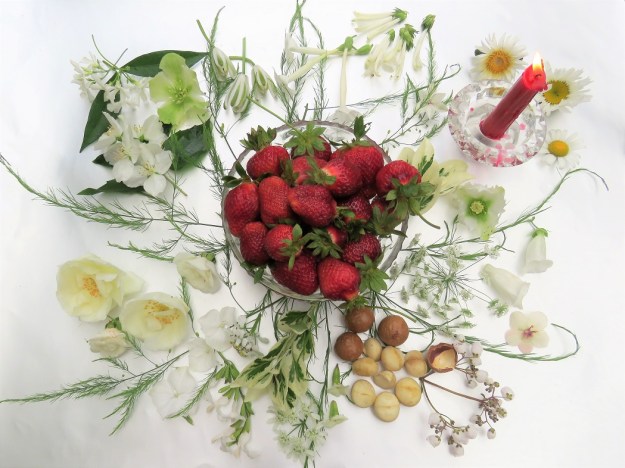
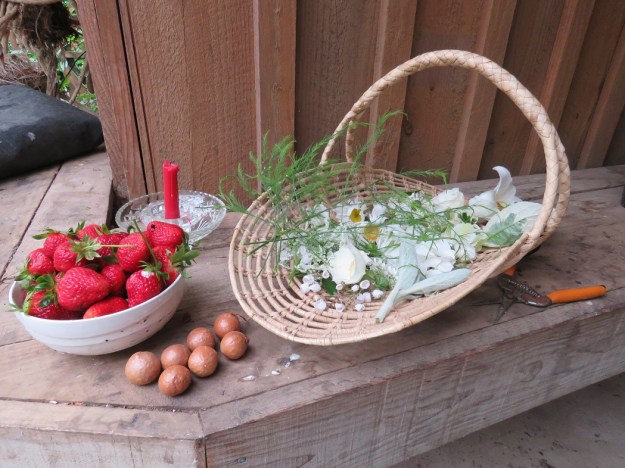
As another Christmas arrives, please accept my very best wishes for a safe and happy time to all readers and followers of this page. While we settle in to our version of a New Zealand Christmas (yes, the raspberries will ripen in time and the fresh peas are ready to be harvested for the day), I spent a rainy day this week gathering one of every white flower I could find in the garden to contrast with the homegrown strawberries. I did not feel the need to buy Christmas nuts this year since we have diligently applied ourselves to gathering and drying the macadamia harvest. 

But my heart goes out to our neighbours across the Tasman Sea in Australia. With unprecedented bush fires, drought and extreme temperatures, the simple pleasures of a temperate Christmas – or even a wintry one with or without snow in the northern hemisphere – seem irrelevant. Our three children all live on the east coast of Australia, fortunately in urban areas so not in physical danger except from the appalling air quality in recent weeks. Like many New Zealanders, we are tracking the devastating impact of catastrophic fires and it is so far beyond anything we experience in this country as to be incomprehensible. All we can do is watch from afar and hope that people stay safe. Kia kaha, Australia.

Abbie 

Assembling the bits in one place

From the nurseryman’s pen – the yellow pohutukawa

Metrosideros excelsa aurea

The much more common red Metrosideros excelsa

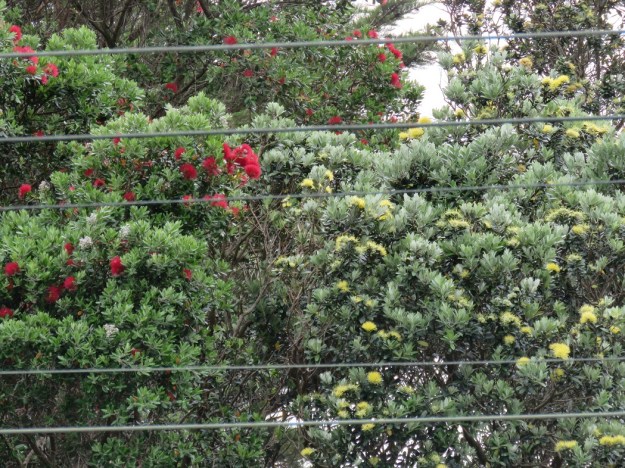
The yellow pohutukawa are flowering in my home town of Waitara. Metrosideros aurea. This is not without a tinge of sadness because the four biggest and best specimens on the bank of the Waitara River were felled – in our opinion unnecessarily – by a stubborn regional council despite a strong community effort to try and save them.

The letter reproduced this year in NZ Gardener

I have written about the yellow pohutukawa before, but my interest was piqued by a 1968 letter reproduced in the September issue of the New Zealand Gardener magazine. The letter writer was Victor Davies, who headed the powerhouse nursery Duncan and Davies and who was responsible for introducing the tree to mainland New Zealand by putting it into commercial production. I think we can take the letter as the most accurate historical record of that process.

It is interesting reading it 50 years later and realising how much times and attitudes have changed. The tone is a bit redolent of the old blankets, beads and muskets method employed by early colonialists to get down on treasures held by indigenous people. That is not a criticism of Sir Victor. It is just the way things were done.

A surviving yellow pohutukawa in Waitara

Sir Victor heard about the tree and was greatly interested because all the known pohutukawa on the mainland were shades of red. He could see the commercial potential of a yellow one so he tried repeatedly to get plant material. He thought he was successful when he managed to get somebody to send him scion wood. When the plants flowered five or six years later, they were all red. This may not be a surprise to many of us. In his own words, “After complaining, the reply I had was that as the tree was tapu they would never get any more material for me.” Personally, I think he was lucky to get a reply but his use of the word ‘tapu’ back in 1968 was interesting because not many Maori words had been incorporated in New Zealand English back then. ‘Tapu’ translates, more or less, to sacred. The yellow pohutukawa were a taonga – a sacred treasure to the original people of the land.

Undeterred, Sir Victor kept trying. Through a third party, a ‘friendly’ Maori was found who supplied material for twelve grafts – six red and six yellow. Allegedly, supplying the mix of red and yellow scions circumvented the tapu restrictions. Hmmm. Pretty dodgy, that.

Sir Victor goes on to say that they raised many thousands of seed and they all flowered true to type without any variation so the yellow form was deduced to be a stable species. I am sure the nursery would have sold thousands of plants too but not a single cent would have been returned to the original owners of the sacred tree.

The red pohutukawa make better landscape trees but the yellow is certainly an interesting variant, plus power lines

Some of those trees were planted in Waitara, the closest town to Duncan and Davies Nursery and the surviving plants are what I photographed yesterday. Victor Davies was renowned for many traits, amongst them his remarkable sales ability. And the 1968 letter is headed “The Golden Pohutukawa” and he describes the flower colour as “dull gold”. There is a marketing ploy. Not gold, pretty lemon yellow. It is certainly lovely viewed close up but it doesn’t show out in the landscape as do the more common red forms, Metrosideros excelsa.

Christmas is coming and the red pohutukawa are widely known as the New Zealand Christmas tree.

Way up high, where the birds fly

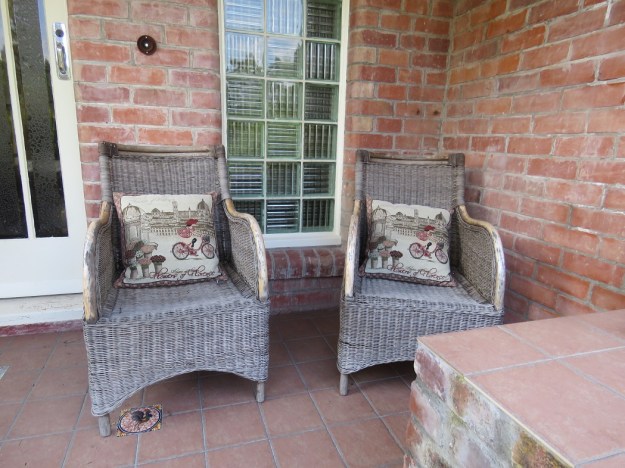
There is an entire ornithological condominium in the Queen palm at this time of the year. We know this because it is also the time of year when we retire to our Darby and Joan chairs on the front porch for the pre-dinner drink, As we sit gazing out to the garden, the flurry of feathered activity in that particular location is unmistakeable. There is a lot of coming and going.
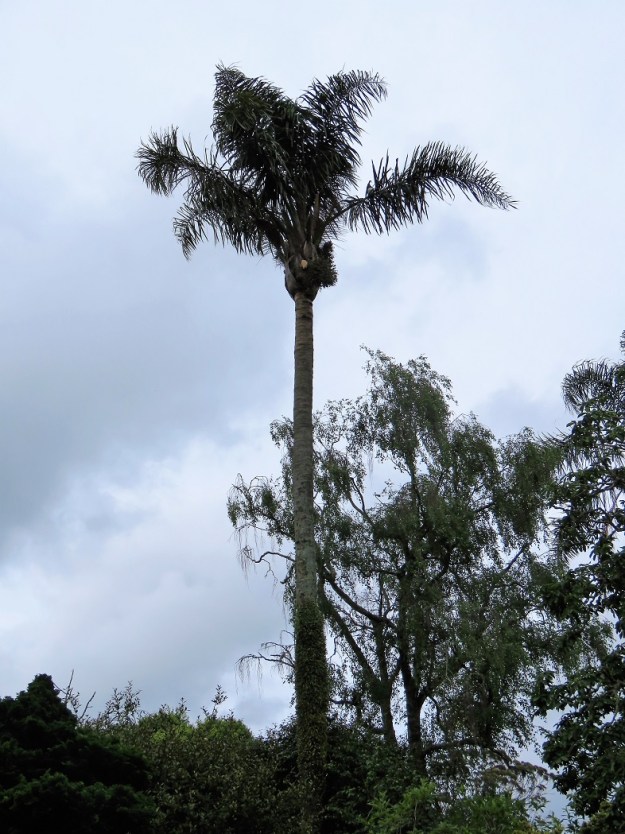
The palm is Syagrus romanzoffiana, a fine South American variety.

Syagrus romanzoffiana

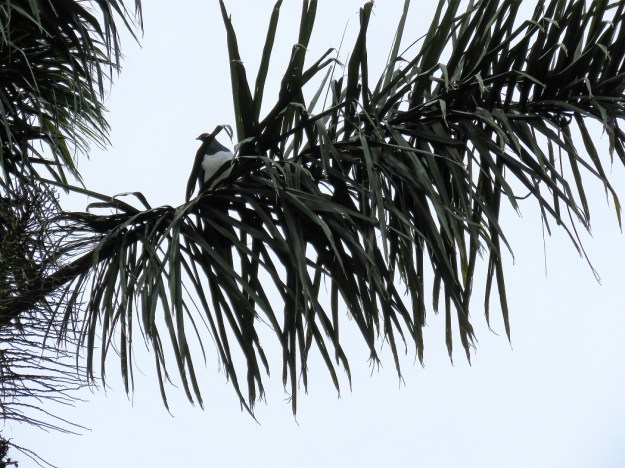
The nests are way up high – a good fifteen metres or more. Sadly, when fledglings fall or are pushed out of the nests, they can not survive that drop and we get a few fatalities lying around the base of the tree. But every year, we are surprised by just how many birds are occupying their nest apartments way up high. Mark has better identification skills than me so I will take his word for it that there are miners, starlings and sparrows nesting in amongst the fronds but we have not managed to work out how many of each there are. These are all birds that have been introduced to New Zealand.

The rent collector

But what is the kereru doing there, I asked him as I zoomed the camera in on the unmistakeable figure of our native wood pigeon.  Quick as a flash came the reply: “Collecting rent.”

Our Darby and Joan vantage point