

I think the Americans will like our sino nuttallii rhododendrons in bloom (and we won’t mention their new president)
It has been a discombobulating week. For overseas readers, I should explain it started with another major earthquake. Despite the quake being centred on the east coast of the South Island (we are the west coast of the North Island), it was the worst one Mark and I have ever felt. And I say that as inhabitants of what are sometimes called the shaky isles where we have all been raised with advice and practice at school on how to behave in an earthquake. Even here, the rocking ground was enough to significantly drop the water level in the swimming pool and to have the water sloshing out of the upstairs toilet cistern. Fortunately, after the Christchurch earthquakes, we had secured our tall pieces of furniture and bookcases.
Further south the damage has been huge and the enormity of this event is still being revealed. It is major and will take years to repair – damaged townships and settlements but also the main trunk road and rail services are completely out of commission and it is difficult to see how and when repairs will be possible. Being a sparsely populated area of this country, there is very little in the way of alternative routes available. Our hearts go out to the people so badly affected.
Closer to home, we have been sprucing up for a small American tour due on Wednesday. This is the first tour we have accepted since we closed the garden three years ago and there is nothing like knowing you will be hosting an overseas group to focus one’s eyes differently. We will not be raising the topic of their recent presidential elections (I think there may be a huge gap – a chasm, even – between how much of the world views that event and how it is seen internally by too many in the USA, so best avoided).
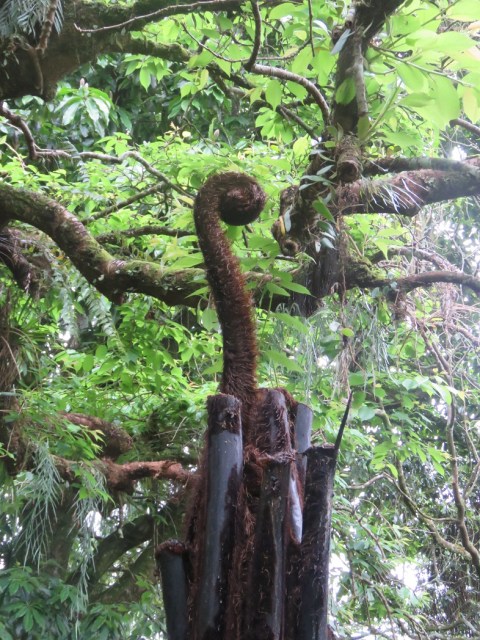
New shoot on black mamaku
I expect they will notice our tree ferns. Here they just seed down and we cut them out (eventually) if they are in the wrong place. I cut all the fronds off the wheki (Dicksonia squarrosa) and the black mamaku (Cyathea medullaris) in preparation for the chainsaw. I have no intention of ever learning to use the chainsaw myself. It terrifies me. It is one job I leave for the men in my life. The new shoots on the denuded trunks are wonderfully decorative – icons, even, of New Zealand design. We also have plenty silver ferns (Cyathea dealbata) popping up around the place.

I think it is a wheki (Dicksonia squarrosa)
While tree ferns, or pongas as we call them here (pronounced ‘punga’) are closely associated with New Zealand, the most common form grown with care – bordering on reverence, almost – in Europe and the UK is actually an Australian native, Dicksonia antarctica. Visitors from the northern hemisphere are usually in awe of them occurring naturally here and being seen as expendable when they pop up in the wrong place.
Tomorrow morning on Radio Live’s Home and Garden Show, Tony Murrell and I will be discussing meadow gardens. **** Given that these discussions take place between 6.30 and 7.00 in the morning, it is always something of a surprise to me when people comment that they listen. But it is quite liberating to be chatting that early because it gives a certain freedom in these extended conversations which both Tony and I enjoy a great deal. If you are interested in listening later, the link gets posted on both Radio Live’s Facebook page and, I think, their website. Last week we were talking about Piet Oudolf and the new perennials style.
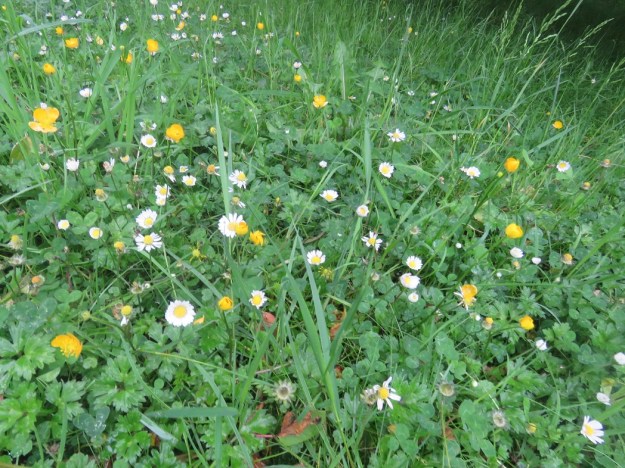
Buttercups and daisies – weeds or a meadow?
We are into our fourth spring season of experimenting with letting much of the park develop into a meadow. At this stage, our meadow is a mix of naturally occurring plants with the addition of bulbs, irises and primulas, managed with minimal intervention. It is a challenging process in terms of how we view weeds. Certainly it is looking very pretty at the moment with carpets of buttercups and daisies and even the dandelions look colourful. I am okay with some pink Herb Robert getting away, also monarda (bergamot or bee balm) but I draw the line at docks. Mark’s particular hate is the plant he refers to as ‘stinking billy goat weed’ but the internet does not appear to agree with him on the name. Also, it is not to be confused with horny goat weed or blue billygoat weed. He is right that it is a stachys and a stinky stachys at that. It is the smell that he hates so we are generally pulling it out. I did a search and the photos seem to correlate with Stachys macrantha. If that is correct, it is a great deal more appreciated overseas than in our park. Maybe a reader can enlighten me whether S. macrantha has a pungent odour when disturbed?
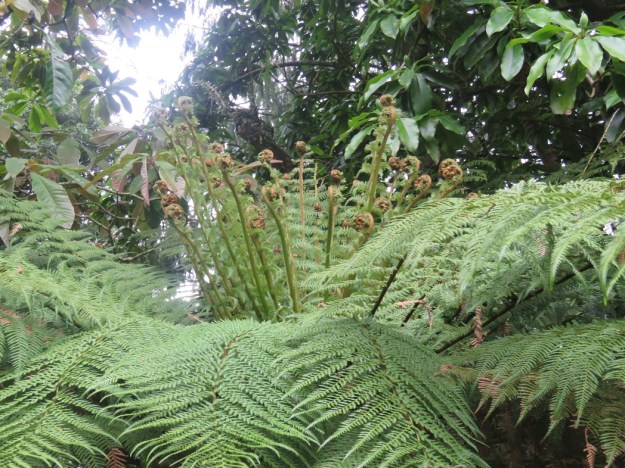
A wheki which still has its old foliage undisturbed
*** Update: No discussion on meadows this morning on Radio Live, due to circumstances beyond everybody’s control. Instead I discussed outdoor furniture with Hamish Dodd. Meadows with Tony Murrell next Sunday at 6.35am.
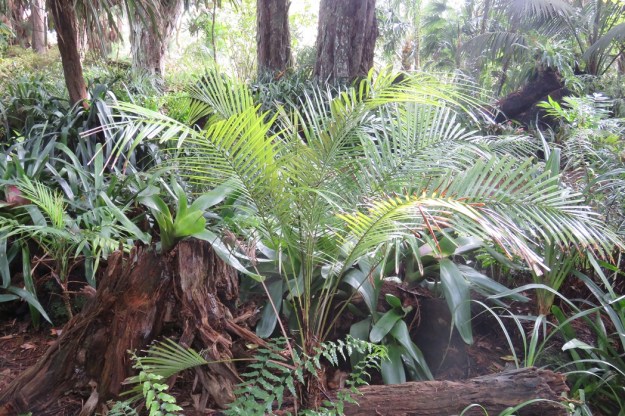 In the meantime, it is The Challenge of the Lytocaryum weddellianum. This is a very pretty little, feathery palm from Brazil, a close relative of the coconut palm but small. It is sometimes referred to as the wedding palm (presumably because it is favoured in pots as green decoration at wedding receptions?). There are a reasonable number of them sitting out in the nursery that Mark bought as baby plants years ago. It is doing particularly well in the subtropical gardens beneath the rimu trees.
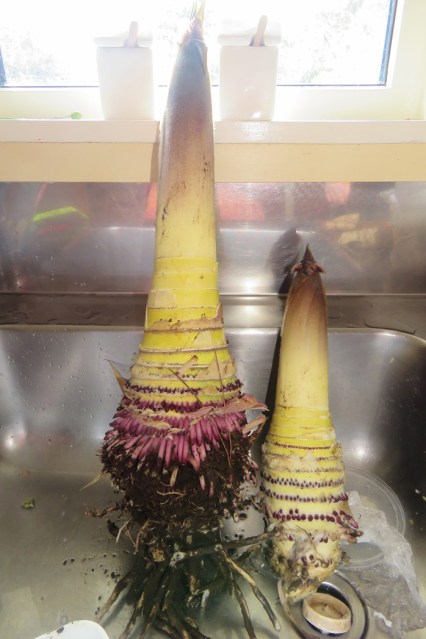
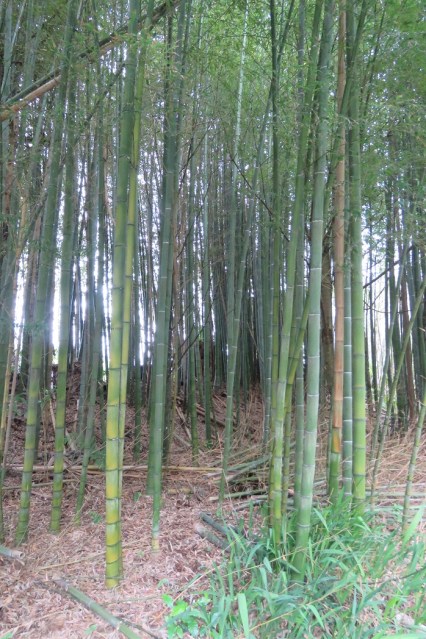 We have a relatively large forest of a giant bamboo – in this case Phyllostachys edulis. The neighbour wishes it was not on the boundary and we are trying to be vigilant this spring and doing a weekly round of jumping the fence to grub out the new shoots that insist on popping up in the farm next door. It is a handsome bamboo and of some use as cut lengths in the garden. It is also edible. Sadly, panda bears have not arrived to take advantage of the food source (further proof that the cargo cult does not work) but I am having another go at cooking the fresh shoots this year. To be honest, the bamboo shoots that you buy in tins taste more of the brine than anything else. And even fresh, they are more textural and a carrier of other flavours (as tofu is) than a taste treat in their own right. But they add variety to our diet and I can see a use for them in stirfries. “Please bring me some bamboo shoots for dinner,” I asked the other night. And he did. The big one is past cooking stage. The trick seems to be to harvest them just as they come through the ground and to prepare the white sections that are below the surface. I shall slice some, blanch them quickly in boiling water and then freeze them to see if we use them later in the year. The first batch I poached gently in stock before adding to the dinner that night and they were pleasant, if not life-changing.
 The deciduous magnolia season is over, bar
  Now it is bluebell time. It appears that ours are all Spanish bluebells or hybrids. The pink and white variants are a bit of a giveaway. Ken Thompson in
  Bluebell Woods
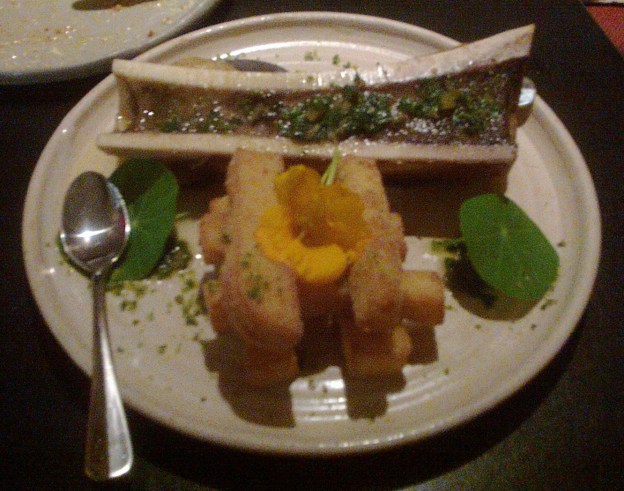 Their menu describes the dish as “Brussel sprouts** with almond tarator and zhoug”. I had to google both tarator (usually a yoghurt, cucumber and walnut based sauce) and zhoug (hot green spice paste of Yemeni origin). From memory the sprouts were not boiled or even steamed. They may have been lightly roasted.
 Alas, my plans to attempt some re-creation of this taste treat at home this season have been thwarted by our resident Californian quail. We are very fond of these charming birds which are slowly increasing in number but have no intention of consuming either the birds themselves or their lovely speckled eggs. When you have watched Mama and Papa Quail herding their young, which resemble fluffy little bumblebees, around the garden, the thought of putting them on the dinner plate is unimaginable. But it was a close-run thing when a mob of them found a way into the protective cloche Mark has placed over this season’s crop of Brussels sprouts. The crop was decimated and the few we have salvaged are poor, shredded examples of this vegetable.
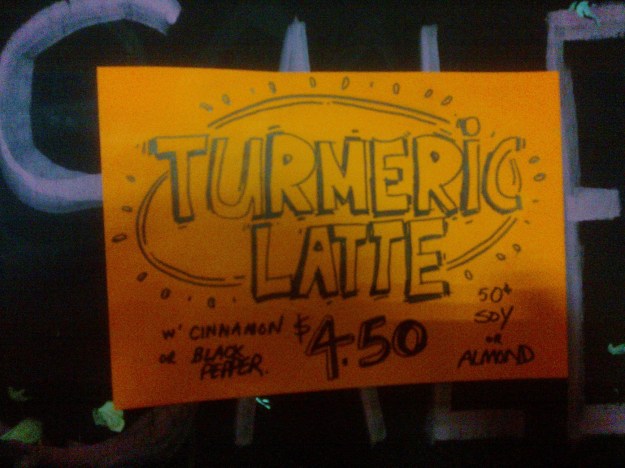 I give you the ultimate example of Bondi hipsterdom in Sydney.
 And the somewhat quaint example of hipsterdom in Canberra. No, I do not think pulling out the stained, blue woolly hat that my late mother in law used to adorn her teapot will achieve the desired level of hipsterdom when I lack the gluten-free friands as accompaniments.
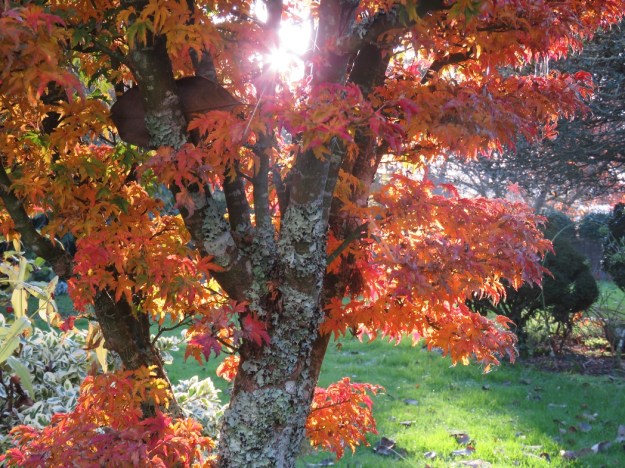 ‘tis the winter solstice today. This marks the point where the days will start to lengthen again, which is always encouraging. However, it usually marks the point where we descend into the worst of winter weather from here through July. But I tell myself that a winter so brief is not too bad, really. We are still enjoying plenty of autumn colour – which is more early winter colour here – and more camellias are opening every day. The spring bulbs are pushing through the ground.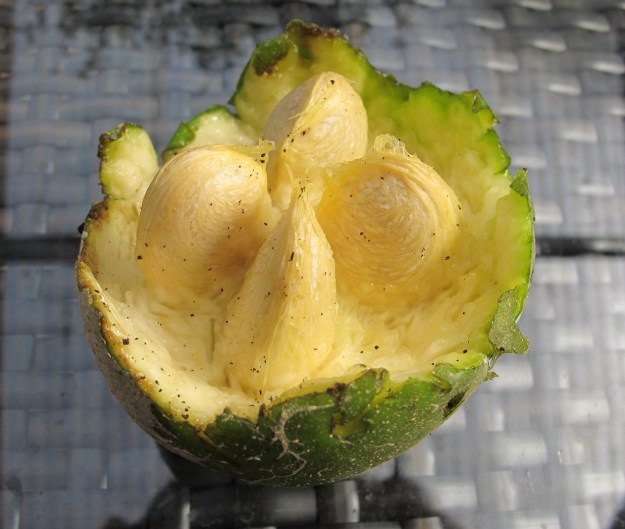
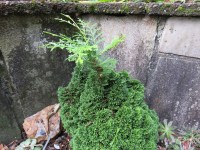 I had been meaning to photograph this reversion on a dwarf conifer. Many plant selections, especially amongst the conifer families, are sports or aberrations on a parent plant. Part of plant trialling is to test that sport for stability but even so, you may often see reversions to the original plant. Generally, it is going to be much stronger growing so if you don’t cut it off, over time it will dominate. A quick snip with the secateurs was all that was required on this little dwarf in the sunken garden. The major growth that Mark removed from the top of the variegated conifer in the centre of this photo required a tall ladder, some tree climbing and a pole saw.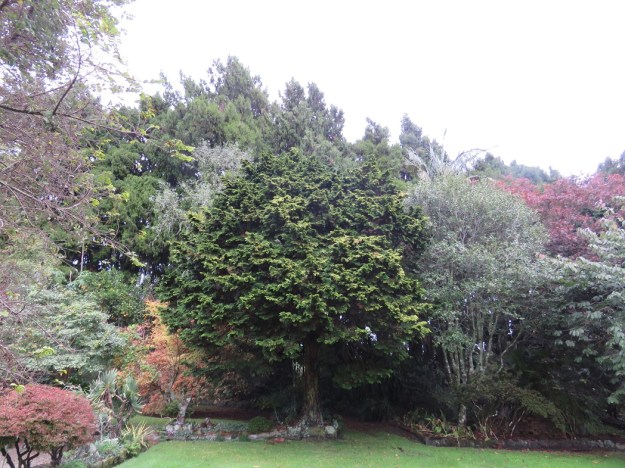
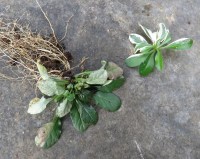 Reversions are also apparent in these perennials. The silver leafed ajuga to the left is showing reversion to plain green. While that particular ajuga is not my favourite (the silver reminds me a bit much of thrip-infested foliage on rhododendrons), it is better than the boring green which barely blooms. I weeded out an ever-growing patch of the plain green. The other little groundcover must have a name but I have no idea what it is. The clean white variegation is sharp and smart but it has a definite inclination to revert to its plain green form, which is much stronger growing. The same rules apply where variegated hostas are reverting to a plain colour. If you want to keep the variegated form, cut out the reversion or you will end up with just plain foliage.


 Tikorangi The Jury Garden