
I vowed I would complete The Mission of the 78 Azaleas in July. I am almost there, which is to say I am down to the last two plants needing a home. The trouble with being down to the last two, is that they suddenly take on psychological significance. There are no more sitting in the nursery to draw on so I must make sure that these last two are in The Right Place. I don’t want to suddenly find a spot which I missed that is calling out for a bright spot of colour. It may take a little longer.
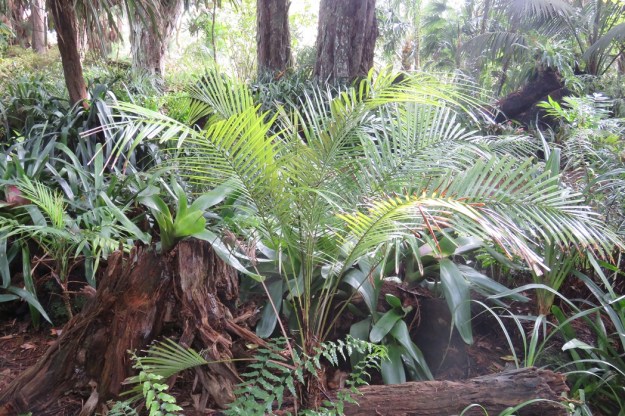 In the meantime, it is The Challenge of the Lytocaryum weddellianum. This is a very pretty little, feathery palm from Brazil, a close relative of the coconut palm but small. It is sometimes referred to as the wedding palm (presumably because it is favoured in pots as green decoration at wedding receptions?). There are a reasonable number of them sitting out in the nursery that Mark bought as baby plants years ago. It is doing particularly well in the subtropical gardens beneath the rimu trees.
Lytocaryum weddellianum is a bit of an in-house (or in-garden) gag here. Others often give the advice to repeat a plant in a garden to give unity. I have always doubted this because too often it is done with common plants like renga renga lilies (arthropodium) or the tractor seat ligularia (L. reniformis). I once saw it done with Dahlia ‘Bonne Esperance’ and I came to the conclusion that all that repetition does is to ensure that your garden all looks the same. Nevertheless, I am threading the lytocaryum through one area on the grounds that if you are going to repeat a plant to gain unity, you might as well do it with class and botanical depth.
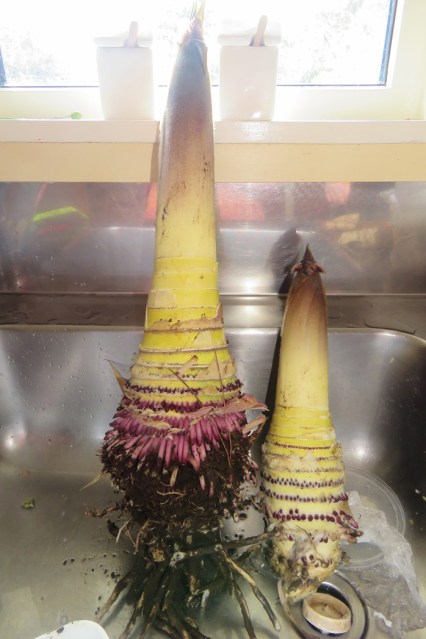
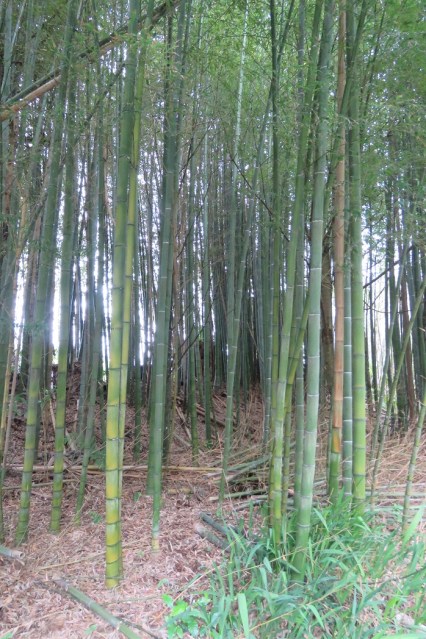 We have a relatively large forest of a giant bamboo – in this case Phyllostachys edulis. The neighbour wishes it was not on the boundary and we are trying to be vigilant this spring and doing a weekly round of jumping the fence to grub out the new shoots that insist on popping up in the farm next door. It is a handsome bamboo and of some use as cut lengths in the garden. It is also edible. Sadly, panda bears have not arrived to take advantage of the food source (further proof that the cargo cult does not work) but I am having another go at cooking the fresh shoots this year. To be honest, the bamboo shoots that you buy in tins taste more of the brine than anything else. And even fresh, they are more textural and a carrier of other flavours (as tofu is) than a taste treat in their own right. But they add variety to our diet and I can see a use for them in stirfries. “Please bring me some bamboo shoots for dinner,” I asked the other night. And he did. The big one is past cooking stage. The trick seems to be to harvest them just as they come through the ground and to prepare the white sections that are below the surface. I shall slice some, blanch them quickly in boiling water and then freeze them to see if we use them later in the year. The first batch I poached gently in stock before adding to the dinner that night and they were pleasant, if not life-changing.
 The deciduous magnolia season is over, bar Magnolia Serene which is always the last to bloom and is still a picture. So I can now admit that 2016 was not a memorable year. The rain, rain and yet more incessant rain combined with mild temperatures turned many to slush – botrytis, Mark says, on a scale we have not seen before. I really struggled to get good photos. There is always next year when the weather gods may be kinder.
 Now it is bluebell time. It appears that ours are all Spanish bluebells or hybrids. The pink and white variants are a bit of a giveaway. Ken Thompson in The Sceptical Gardener gave me a handy guide to tell the difference between the blue ones – which are English, Spanish or hybrids. I stopped by the site of one of the original houses in Tikorangi where bluebells continue to flower. Mark thought that they are probably the oldest bluebells in Tikorangi so may date back to the early settlers and therefore more likely to be the English bluebell. Nope. Indubitably of Spanish origin too.
But Spanish or English or a mix of the two, a carpet of bluebells is a pretty sight and leads in to a poem written by a friend who stayed with us last week.
 Bluebell Woods
Red Riding Hood haunts the Bluebell Woods
plucking her squelchy bouquet.
Nasturtiums Humpty down the bank
trumpeting and capering on their way.
Celandine tells of golden cups
quaffed by golden kings
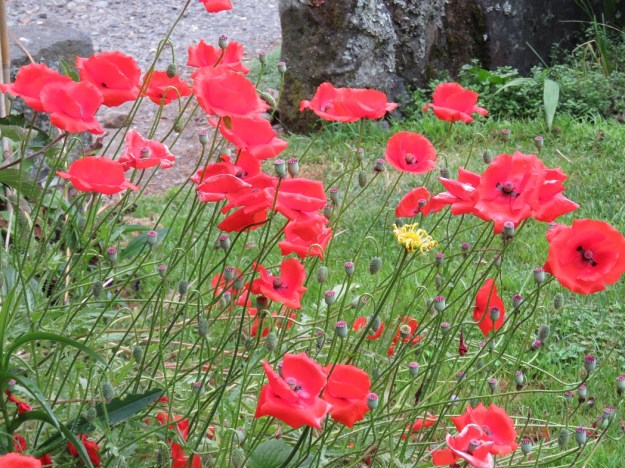
But the scarlet poppies alone in the field
have only songs of war to sing.
J F Panting
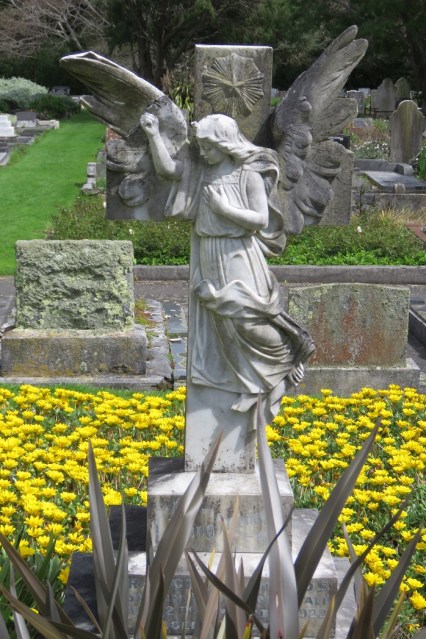
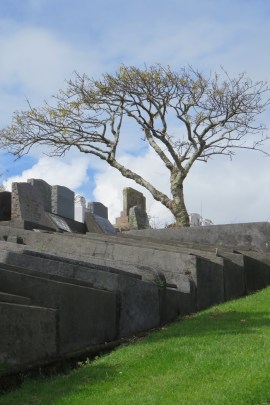
 Somebody, or probably several living bodies, must have lavished a lot of love and care on this section of the graveyard over many years. It was so well done and individualised that it did not have the look of institutional management. Nor indeed of relying on family or descendant management of individual graves – though there were some examples of these.
 It was the wide range of plants used, the attention to detail and the many delightful little pictures that were created as a result, the careful colour toning in some areas and the soft-edged maintenance that made me think it was not chance that created these scenes. Many are created as individual small gardens for a specific grave. I could not help but notice that the space of an individual grave back when the 1800s turned into the 1900s was considerably larger than a modern grave; family plots were larger again.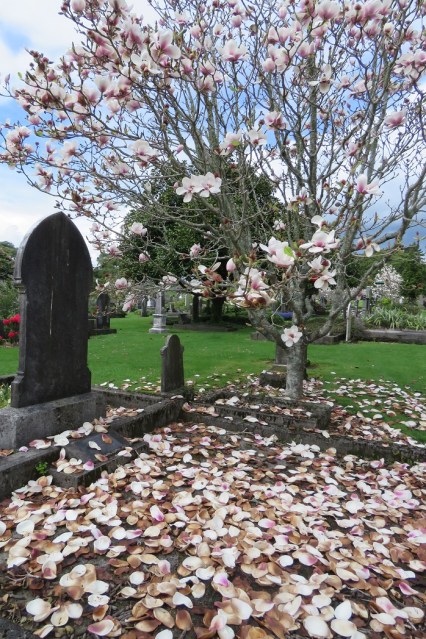
 For spring scenes, the cemetery was unsurpassed. I must go again in summer and see if the secret hands have wrought similar magic into the next season.
 If you are on Facebook, I have posted an album of additional photos to our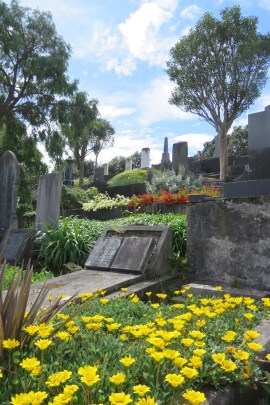
 A sign of an interesting book is when you find yourself keeping it to hand so that you can refer to it in numerous conversations. Not a showy book, in this case. There is a not a photograph in sight and the production values are what might be called utility, so it fails to fit the traditional definition of a coffee table book. Perhaps the descriptor of ‘aircraft reading’, or even ‘loo reading’ captures the format – short pieces between about 700 and 1200 words long which can be read in a few minutes. But for the last few weeks it has been sitting close to hand as we discuss many of the points made in its text.
 It was a second visit to the National Arboretum in Canberra that had me thinking along these lines. This enormous project, encompassing 250 hectares, is a response to the devastating bush fires of 2003 which burned out the area. It is a grand vision, still in its infancy, that will create a legacy for generations to come.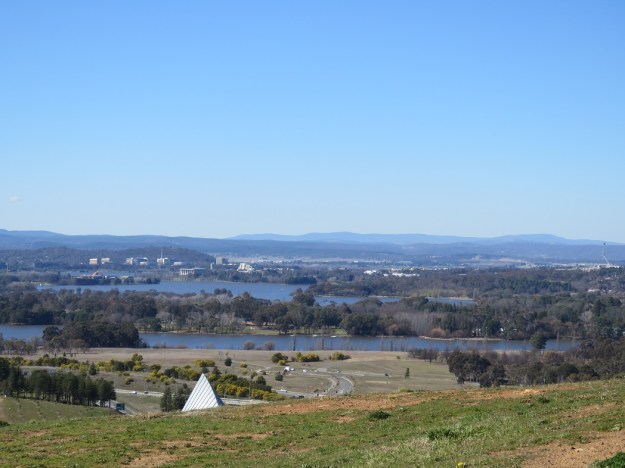

 Tikorangi The Jury Garden