Magnolia Diary number 3, 13 August 2009

Click to see all Magnolia diary entries

Click on the Magnolia diary logo above to see all diary entries

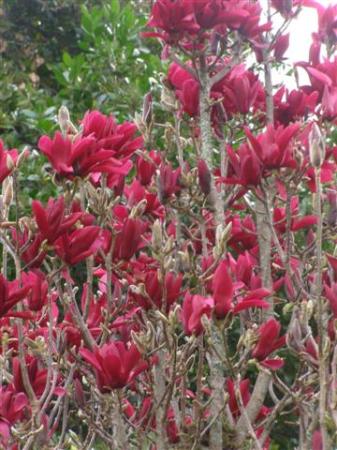
Black Tulip opening now

Black Tulip opening now

At this time of the season, it is all the dark magnolias coming into flower. The only other colours we have are the soft pink campbellii and one early pink and white seedling which has been left in situ because it provides a contrast to the wine red, purple and deep rosy colours coming out all around the property.

Black Tulip is opening more flowers every day. This one has caught us by surprise with its instant popularity in the market place. Mark named it because the flower, while not large, had such a lovely tulip form and very heavy, dark petals which gave it good weather hardiness. And it is never going to become an enormous tree. The original plant never throws a pale flower so we were disconcerted to see that pale flowers can appear on trees in other locations. While we accept the occurrence of both dark and light flowers on Lanarth, modern hybrids are expected to be uniform.

If you line up a Black Tulip flower beside a good Vulcan flower, there is not much difference in colour. What makes Black Tulip appear so dark on the tree is that the petals (or, more correctly, tepals) are so thick that no light can shine through.

Black Tulip

Black Tulip

We usually advise people to plant Black Tulip in locations where it is to be viewed close up. In the landscape, the flowers can be so dark and relatively small that they tend to meld into the environment whereas viewed close up, it has certainly captured the imagination of the public. It is being trialled as a street tree in New Zealand and we recommend it for driveways, lawn specimens or back of the flower border in home gardens. On a very recent visit, we were gratified to see it as a flagship plant for John Woods Nursery in the UK and to hear that it is performing better than Vulcan. It appears that the British public are as charmed by the perfect flowers as the New Zealand public and can see it fitting into smaller, modern gardens.

But on a larger property, our personal tastes lean to something more over the top and flamboyant which has maximum wow in the landscape – Felix Jury is opening its flowers.

Magnolia Diary number 2, 11 August 2009

Click to see all Magnolia diary entries

Click on the Magnolia diary logo above to see all diary entries

Leonard Messel, just opening

Leonard Messel, just opening

Our magic early spring weather continues (and believe me, we never take the absence of both wind and rain for granted here) and more magnolias open every day. Leonard Messel is showing his first flowers. Leonard is sold as a small growing magnolia in this country, to be planted perhaps where something shrubby rather than a tree is required. So we were amused to pace out our plant which is only about 20 years old at the most and to find that its footprint is not a lot smaller than many of our substantial magnolia trees. It is just shorter in stature so it looks smaller but it still measures nigh on nine metres across. Leonard Messel looks splendid on its day when in full flower, but the petals and form lack much substance and in a windy climate such soft characteristics mean it can start to look rather raggy.

One of the early flowering Snow Flurry series

One of the early flowering Snow Flurry series

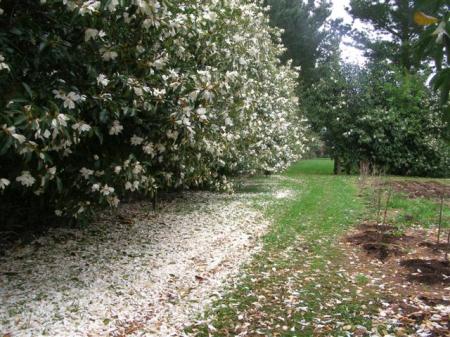
Michelias have been the subject of an intensive breeding programme here for some time now and the early whites are all coming into flower. Botanically michelias have been reclassified as magnolias, but we admit that for clarity and understanding, we lean towards calling them michelias in conversation. We refer to these early whites as the Snow Flurry series and while we can not post a photo of the one we have selected for probable release, we have shelter belts full of the also rans, or rejects. Indeed we have so many that Mark now calls them his sustainable woodlot as he chainsaws off branches to feed our small (very small in number but increasingly large of size) herd of beef cattle to get them through the shortage of late winter feed. Coppiced michelias – these may be a first.

Mark's sustainable woodlot of reject michelia seedlings

Mark's sustainable woodlot of reject michelia seedlings

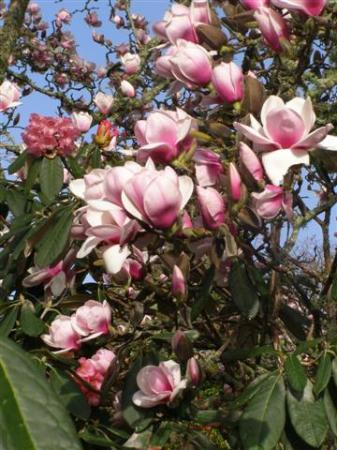
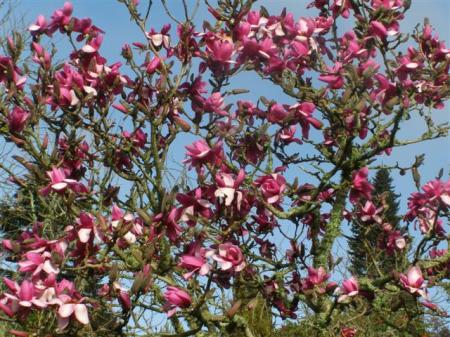
Besides Lanarth and campbellii, it is the also rans in the deciduous magnolias which are the most spectacular today. Too good to chainsaw out but not quite good enough to put into commercial release, we have a run of what Mark calls his instant campbelliis flowering around the boundaries. Instant because they flower on very young plants (it can take many years for campbellii itself to flower), but this strain of magnolias bloom too early in the season and the trees grow too fast and too large for modern gardens. It is likely that they will remain forever in our shelter belts and on our boundaries where they can look splendid for us.

Rejected campbellii type hybrids

Rejected campbellii type hybrids

Magnolia diary the first, 9 August 2009

Click to see all Magnolia diary entries

Click on the Magnolia diary logo above to see all diary entries

On August 9, 2009, it would be fair to say that we are a week or two late starting a magnolia diary. M.campbellii is already in full flower down in our park. Our tree dates back to the mid 1950s and is one of the oldest magnolias we have here. It is set in front of distant Mount Taranaki, our near perfect iconic volcanic cone and the reason why the movie, The Last Samurai, was filmed locally. It is cheaper to film here than in Japan and our mountain is a reasonable ring-in for Mount Fuji (I have even encountered a film crew shooting a Japanese car commercial down our road!) In New Zealand, campbellii is the first to flower and at times it can be a close run thing to see if the leaves fall before the flowers open.

M.campbellii and Mount Taranaki at Tikorangi

M.campbellii with Mount Taranaki beyond at Tikorangi The Jury Garden, Taranaki New Zealand.

Magnolia Vulcan is opening its flowers. The tree in our carpark has maybe a dozen early flowers open but it is clearly warmer down the driveway where a Vulcan tree has many more flowers. The original tree, bred by Felix Jury, is in the neighbour’s property (formerly the Jury farm) and we no longer have access to monitor it. Vulcan was a true colour break in its day and opens remarkable wine coloured flowers in NZ and in Australia. However it is patchy at best in Europe and inclined to be disappointing in the UK. We rate it as a small tree here. The first flowers are always the deepest colour and the largest in size.

Early season flowers on Vulcan in our carpark

Early season flowers on Vulcan

The original Lanarth in our park is a week into opening though not quite at its peak yet. It shows blooms in that beautiful, intense stained glass purple but also pale flowers at the same time. This tree dates back to the mid fifties and it took three attempts to import and successfully establish the genuine article. One of the early attempts, however, yielded up the Lanarth seedling subsequently named Mark Jury, which became the secret weapon in the early magnolia breeding programme here. Mark is not yet showing colour.

Lanarth

Lanarth

Magnolia Black Tulip in warmer positions on our property has opened its first flowers but the original tree has yet to show colour. We have the very first flower on Felix Jury opening. Along with M. campbellii, our reds are the earliest of the season.

Our winter this year has been colder than usual (visible frost on a number of occasions although we rarely drop below zero degrees celsius at night), drier than usual, not very windy but with our usual high winter light levels.

Narcissus cyclamineus

Flowering now - narcissus cyclamineus hybrids

Flowering now - narcissus cyclamineus hybrids

If ever there was a reason to learn how to grow plants from seed, these little charmers are it. You can’t expect to buy these from your local plant shop. In common language, dwarf daffodils or botanically, narcissus cyclamineus. That last word just means that they are part of the group where the skirt of petals is completely reflexed as if the flower is a force 10 gale. In the wild they come from north west Portugal and Spain and are endangered. They are not endangered in our garden where we love them for winter cheer, though many that we grow are hybrids. They are classified as dwarf, not miniature, because they are on stems around 15 to 20cm long. Flowering long before the large, modern daffodils, we find they are nowhere near as susceptible to the nasty narcissi fly which can lay its eggs in the crown of the bulb (so the larvae hatch and eat out the bulb). The silver leafed plants beside are a wide leafed hybrid of our native mountain daisy or celmisia.

From meadows to motorway sidings with the classic border inbetween (part 4 English summer gardens)

Nobody does steps quite as well as Lutyens did

Nobody does steps quite as well as Lutyens did

Note: this follows on from the earlier column: English Summer Gardens – part 3.

I wrote two weeks ago about the English summer garden being a continuum stretching from natural meadows through to plantings on the sides of motorways or NZ traffic islands. I was gently drifting my way along this journey until I reached my word limit around the classic English country garden as exemplified by Penelope Hobhouse and the late Rosemary Verey. I had to stop there because suddenly there is a great big punctuation point with the late Christopher Lloyd at Great Dixter.

Great Dixter can be controversial. Mark stood in the garden and commented that it was a bit like an ongoing negotiation with nature. At its best, it is gifted and has clearly had an enormous influence on the direction taken in many New Zealand gardens. In the middle it can be somewhat serendipitous, but there are parts where there is a suspicion of the emperor’s new clothes. As a garden it sits between the meadow gardening–wildflower end of the spectrum which relies on a great deal of self seeding (and good chance) and the controlled Edwardian arts and crafts style synonymous with Edwin Lutyens and Gertrude Jekyll. Christopher Lloyd experimented all his life but his legacy to modern gardening is arguably the mixed border (using shrubs and clumping perennials in tandem and brave colour combinations) and the managed meadow. In New Zealand, we seized on the mixed border as if it was our own but alas it is not often carried out with the panache of Christo Lloyd and is frequently rather dull.

Historically Lutyens and Jekyll pre-dated Christo Lloyd and in fact Lutyens redesigned Great Dixter for the Lloyd parents. But on my continuum, they are more to the ordered and managed side. We travelled in part to see their legacy. Famous examples are Sissinghurst and Hestercomb but we also visited lesser known gardens. The spirit of the Lutyens-Jekyll style was formal landscaping by Lutyens in the Arts and Crafts mode (confined and defined spaces of the garden room type), softened by sweeping plantings designed by Jekyll. If you imagine beautiful stone work, clipped hedging, masses of blue delphiniums, extravagant fluffy pink peonies, pink and white roses and drifts of underplanting such as lambs’ ears (stachys), you will be on the right wavelength. It is very pretty although the borders and beds could be a bit on the narrow and busy side and it can get a little formulaic when you see a number of such gardens in a row. I suspect that it may be a little dated now. Certainly the very narrow borders worried me and I would want to rip them out. Keep the trademark Lutyens rounded stone steps, though. Nobody does steps like Lutyens.

Fortunately it was towards the end of our trip that we ended up at Wisley because there we saw a range of garden styles which gave us the framework to make sense of what we had seen.

Gifted and unusual colour combinations at Hyde Hall

Gifted and unusual colour combinations at Hyde Hall

Cue in the classic long border. Yes Great Dixter has one but Wisley sets the standard. Hyde Hall has a shorter long border divided into colour segments. Lots of gardens have the long border. At its Wisley splendour, it is two parallel borders with a wide grassy path between and we are talking a hundred and thirty metres long, each, and (here is the rub for many home gardeners) six metres wide. Beth Chatto’s garden is a whole series of freeform borders which curve and flow but are still following the principles of the long border. Such borders are often planted on terrain contoured to give extra height at the back. Because they froth out at the front (alchemilla mollis is a great favourite to achieve this effect and seems to be regarded as colour neutral), there is often a boundary of wide pavers defining the edge. This stops the frothing from killing the grass. Generally plants are layered from tallest at the back to lowest at the front and the crux of this type of planting is combinations of plant foliage and flower throughout the season. There is no mass planting. Many plants will need staking and deadheading and it is all extremely labour intensive. You need plenty of space for this type of voluptuous display.

For us, this is the zenith of summer gardening. On the days we visited, we ranked Beth Chatto top of the list for plant combinations and quality management of this intensive style of gardening, Hyde Hall top in genuinely original colour and flower combinations and Wisley all round top in the total package of scale, design, plant combinations and management.

But, Wisley does not stop at the long borders. Dutch designer Piet Oudolf has moved herbaceous planting on a few steps and, in front of the spectacular new glasshouse, Tom Stuart-Smith has taken it further. There is an element of modern pragmatism and indeed we were told that the new borders only require a third of the input of the traditional long borders and that is a huge difference. The Oudolf borders have attracted both praise and criticism. They are a great deal more controlled. The plant palette is restricted and most of the plants chosen do not require staking (or, I think, regular dead heading) and they are pretty much of a standard height. But it is not mass planting and the skill of striking plant combinations remains to the fore. Oudolf has worked with parallel borders again but used different plant combos in rivers flowing across, more or less in diagonal lines when viewed from above. Each river is comprised of three or four different types of plants.

Tom Stuart Smith has further refined the Oudolf technique, bringing it together with the sweeps of colour first espoused by Gertrude Jekyll and the prairie meadow concept currently in vogue to give grand sweeps of herbaceous plantings for the larger canvas. Much of the detail and complexity of the long borders has now gone, as has the need for intensive maintenance. But plantsmanship and design lifts it well above utility mass planting and while it may not appeal for smaller scale domestic gardens, it is a modern and more practical approach for public plantings.

So how do we end up at the traffic islands filled with tussock or the motorway sidings of utility clumpy plants? Take the simpler blocks of colour planting done by Tom Stuart-Smith. Eliminate any plants that are pink flowered (not fashionable), anything that is deciduous (need foliage 12 months of the year), anything that is grown more for its flowers than its foliage, anything that requires more than a very occasional clean up. You are left with reliable, utility, evergreen clumping perennials which in recent years have become the repertoire of many landscapers for mass plantings – the liriopes, mondo grass, ligularia type of plant. Now reduce the range further. Take out any plants which are less than 30cm high, any plants which require good soil conditions or shelter, any plants which look sufficiently desirable to be stolen, and any plants which are not available dirt cheap and preferably from a native plant supplier or prison nursery. You are left with mostly tough grassy type plants which on their own are as dull as ditchwater. It is the end of the road.