Tikorangi notes: narcissi, garden edgings and a happy plant breeder

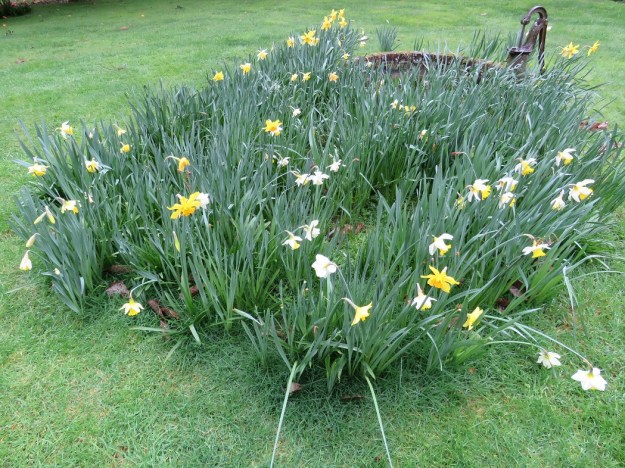
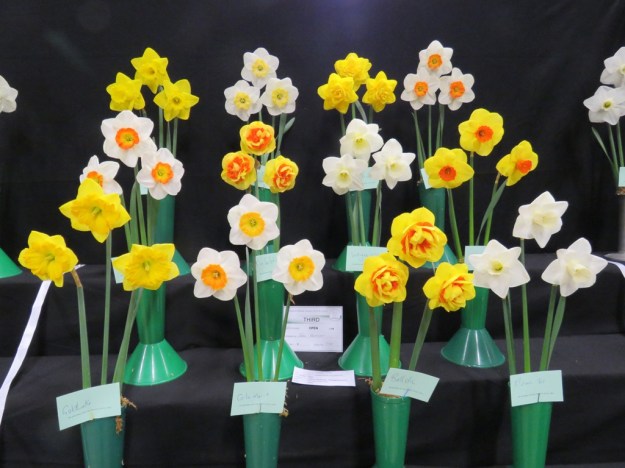
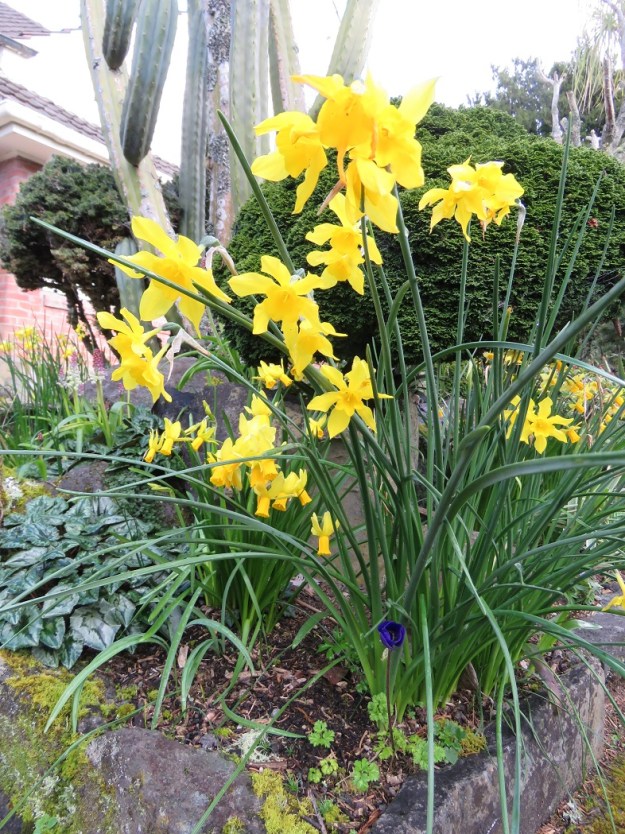
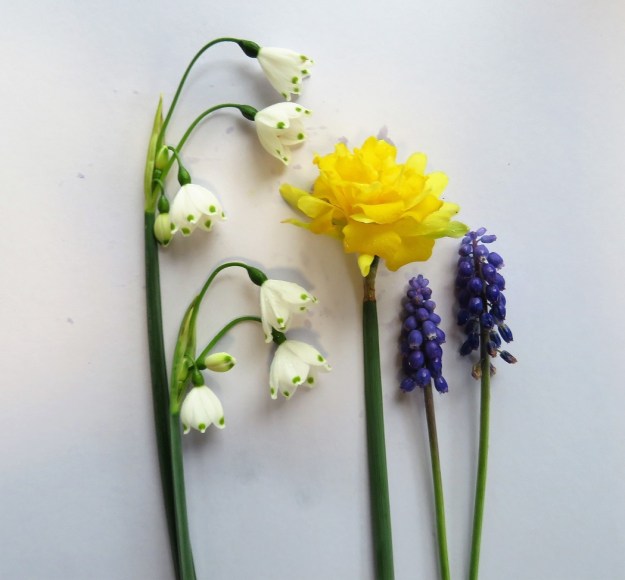
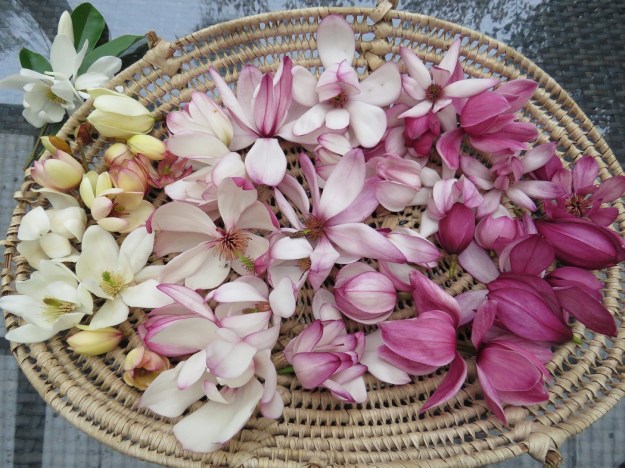
The snowdrop season is all but over already. It is charming but brief. The narcissi, however, have a longer season, at least in part because we can grow a much wider range of species and hybrids. Yesterday felt like a winter’s day – the last gasp of winter, I hope – so I headed out to pick one each of the many different varieties in flower. We don’t grow many of the larger ones at all, preferring the charm of the littlies, the dwarf ones. Bigger may be better when it comes to magnolias – at least in our eyes – but daintiness wins with the narcissi. Most of these are named varieties though Mark is also raising cyclamineus seedlings to build up numbers for planting out and to get some seedling variation within them. The cyclamineus are the ones where the petal skirt sweeps back, sometimes completely reflexed, giving them a slightly startled appearance. He was intending to plant many of these down in the park but hadn’t got around to it so offered them to me for the new grass garden.

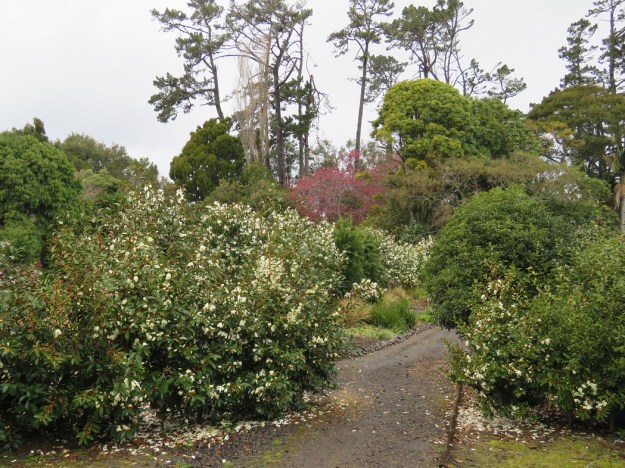
Drifting dwarf narcissi through the new grass garden. Camellia Fairy Blush hedge and Fairy Magnolia White edge the garden on both long sides. 

I have now compromised the big, bold, chunky planting in waves that is the hallmark of the new grass gardens by drifting hundreds of dainty, dwarf narcissi through them – though far enough out to escape being swamped by the large plants, for several years at least. It adds seasonal interest to an area that will not come alive again until later in spring.

Informal bark edging and bark and leaf mulch define the garden area

After much consideration as to how we wanted to complete the grass garden with regard to edging, mulch and path surfaces, we have gone for the casual, organic and local options. As soon as I started to load in the wood and leaf mulch that a local arborist delivered, I realised that the beds would need an edging to hold the mulch from spilling over. My idea of a seamless transition between bed and path was not going to work. We have pine bark to hand – left over from getting the firewood out from a fallen pine tree so I am constructing small edges out of that. It lasts for many years. The paths are still bare earth (we will probably use granulated bark on those) but as soon as I made the edgings and laid the mulch, it took on the appearance of a garden. It is a casual look but one that sits easily with us with the benefit of being low cost and, as Mark keeps saying, the use of organic materials adds carbon to the soils.

I am laying the mulch on fairly thickly – around a forefinger in depth which I measured to be about 7cm. Because it is fluffy, it will compact to less than that but if I see any weeds coming through, I can top it up.

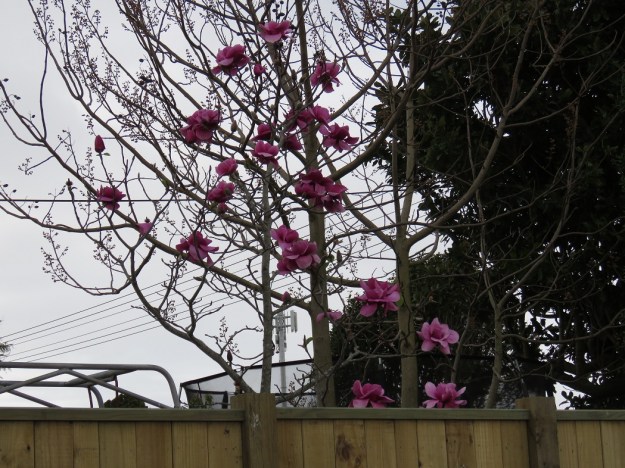
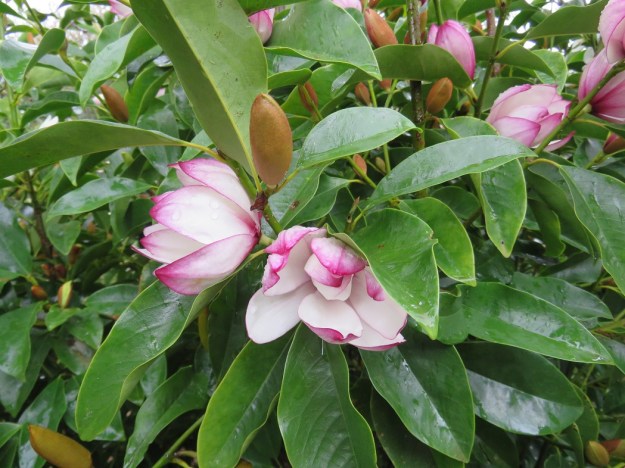
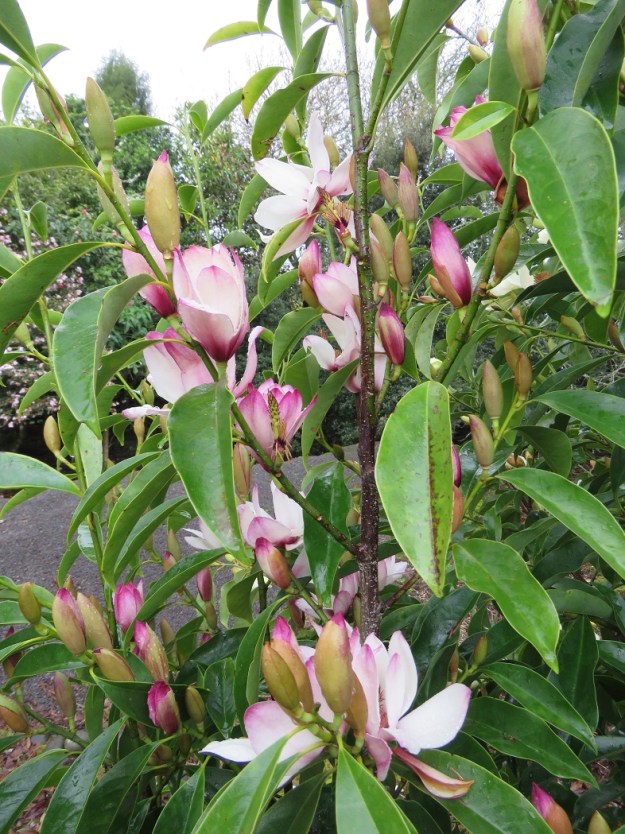
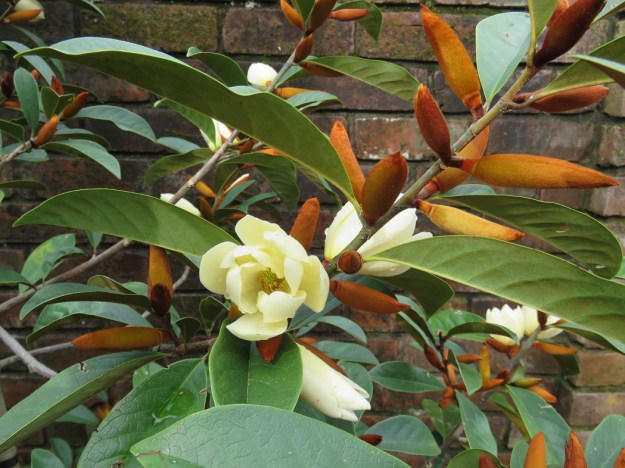
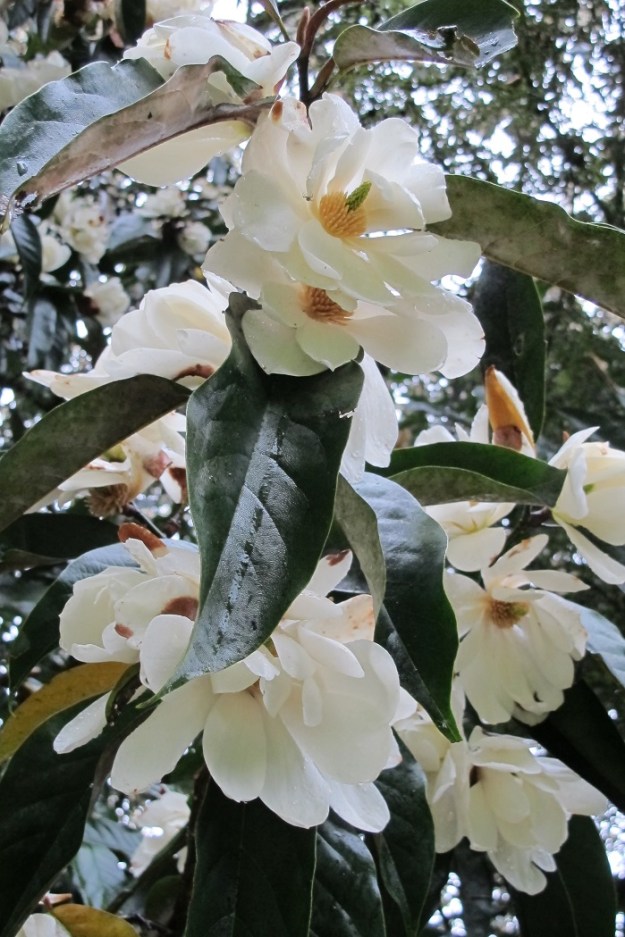
Fairy Magnolia White – not only a beautiful flower form but a very long flowering season, beautiful velvety buds, good foliage and perfume

Mark is a quiet man, not given to blowing his own trumpet, but sometimes I hear him murmur a comment of deep contentment at a plant he has bred and named. So it was this week as we looked at the avenue of Fairy Magnolia White and Camellia Fairy Blush. “I picked White because it had a pretty flower,” he said. And it does. In a world of floppy white and cream M. doltsopa flowers, Fairy Magnolia White stands out with its beautiful star form. There were a lot of very similar sister seedlings to choose from in that cross and as a breeder, he always worries whether he picked the best one. I think he finally decided that he had indeed chosen the best which is just as well, when you think about it, because he will only ever name and release one of that cross

Camellia Fairy Blush also has a long flowering season, drops its spent flowers cleanly and clips well

Camellia Fairy Blush, planted as a hedge beneath the two avenues of Fairy Magnolia White, is also a continuing source of satisfaction and delight to us, even if it is a constant reminder of a missed commercial opportunity. It was the first camellia he ever named and sold. Back in those days, protecting a plant as our intellectual property was not even on the radar and now Fairy Blush is sold widely throughout the world and few know that it originated here and was Mark’s selection. We have even seen it branded overseas with other nursery names but we know it is ours. That is life and it is a very good camellia and continues to be a source of pride and pleasure to the breeder.

Fairy Magnolia White and a very blue spring sky

On the right track, at least

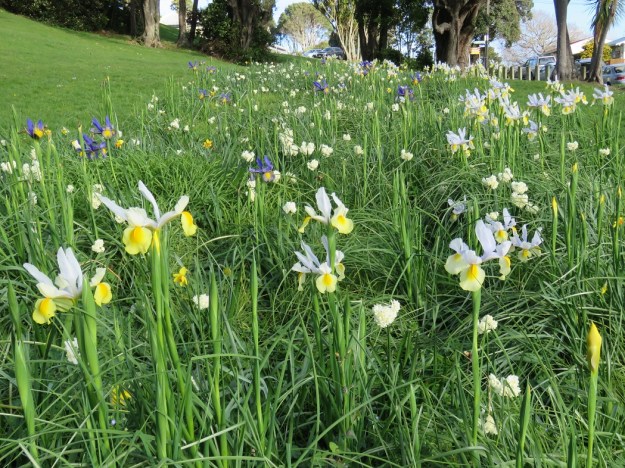
I came across the sight of this bulb drift in town and had to stop and look more closely because it seemed so unexpected. It is on Marsland Hill, for local readers. All credit to Council for putting it in and braving local flower thieves, but as I walked around it, I thought it was a good example of how it could be more exciting. My photos are less than ideal, sorry, on account of my mobile phone being a cheap one with a utility camera.

The paperwhite narcissi are gorgeous and deliciously fragrant but they aren’t exactly mass flowering in comparison the amount of foliage. I think they may be interplanted with other varieties that will come into bloom later which is good planning. But if that is the case, the paperwhites could have been concentrated in maybe four separate clumps with others planted between. It would give more visual oomph.

The combination with Dutch iris is a really good idea. But the selection of a pale variety in pastel shades is a bit insipid from a distance, though pretty enough close up. I saw a blue bud and my eyes lit up. But when I found one open, it was not a good blue. In fact, I would deem it an awful colour combination of yellow, purple and brown that should never have been selected in the first place.

Purple, yellow and brown to the left… our blue to the right

I am no expert on Dutch iris and we don’t have many in the garden. But we do have a pretty blue. It was a bit coarse and out of scale in the rockery (they are not a plant of great refinement) so I relocated them to the new perennial borders where they are right at home, multiplying satisfyingly and putting on a pretty show at this time of late winter. And it is a much prettier blue than the murky mix of the one in the planting I was looking at.

I feel I am learning constantly so I enjoy analysing what I think works and doesn’t when it comes to plantings. And while this planting was sufficiently delightful to make me stop and turn the car around, I think it would have worked better with concentrated patches of paperwhite narcissi interplanted with purer blue Dutch iris. Now I am going to have to go back in the next few weeks to see what comes into bloom next and how it changes through the spring. I will take my good camera with me. And I do hope that rogue flower pickers leave it alone so we can all enjoy it.

From cob to cracker

Indian corn or flint corn

Really, I wanted to show the photo of Mark’s pretty corn cobs. This is commonly called Indian corn or flint corn. It is maize, not sweetcorn so not suitable for eating as corn on the cob. Modern sweetcorn is a very different crop after a great deal of selection to get strains with very high sugar content – so much so that I often find them too sweet.  I think Mark just grew the Indian corn out of curiosity the first time. This year he put in a bigger row of it because we used all the previous crop and he is looking for grain crops that we can grow, harvest and use here.

I only have a photo of dead pheasant. We found two which had been hit on the road but he counted more than that in the patch.

He was loving the presence of the growing population of beautiful pheasants in his cropping area across the road until he realised they had quietly consumed about a third of the Indian corn. We are still delighted to have a local population of exotic-looking pheasants but he hastily harvested the remaining cobs.

Curiously, when I dehusk the dried cobs, the remaining core also shows colour variation. Red kernels usually mean a red or purple cob.

Kernels, maize flour and the handy old coffee grinder I kept in case it was needed again one day

What do we do with the corn? Home made corn crackers! I first tried grinding the kernels in the food processor and it had to work hard to achieve a fairly coarse result. I worried the meal may crack tooth fillings. Then I remembered the old electric coffee grinder I put away in a top cupboard when we upgraded to a burr grinder for coffee beans. It does an excellent job. The texture is not completely consistent and I don’t think I can manage the process to get polenta meal out of it, but it is fine for crackers. I have stopped buying corn chips and taco shells. My thin crackers make a more than acceptable substitute, though I would be lying if I said they tasted the same. I have learned that the kernels need grinding immediately before they are used because the flour goes mouldy really quickly.

I doubt that many readers have a crop of maize or Indian corn sitting around waiting to be used, but just in case, I offer you my recipe which I adapted from a great recipe I was given for making seedy crackers.

About 1 ¾ cups of fresh ground maize flour

¾ cup of spelt flour

2 tbsp chia seeds

1 tsp salt

1/3 cup olive oil

½ cup water

Mix and then roll out thinly on baking paper with another sheet of paper on top. Sprinkle the top with coarse salt flakes and grated parmesan cheese or similar (I used grana padano because that was what I had) and cut the sheet of cracker into suitable sized squares but leave it as a sheet.

Bake in a medium low oven (about 130 on fanbake) until it is golden brown and crisp (about 30 mins but keep an eye on it).

That is it. From grinding the corn to getting crispy, tasty crackers out of the oven takes about 40 minutes. We ate them this evening with chilli beans (homegrown, of course) and will continue to eat them during the week as a snack, with or without toppings.

Rolled and ready for baking 

The finished crackers

Started at last – a perennial meadow

Not a blank canvas – closer to a wasteland with potential

Sometimes a garden can catch you unawares. At least, that is the case in a large garden. It is probably harder to avert your eyes from messy areas in a small garden. So it was that I found myself in the Iolanthe garden this week, thinning both the Daphne bholua forest that had formed (there is a plant that can seed and sucker alarmingly if you turn your back on it) and the sugar cane patch.

The original plant of Iolanthe is the dominant feature on one side 

Iolanthe has only opened her first two blooms this year but here is a view I prepared earlier

I paced out the Iolanthe garden and it is somewhere over 500 square metres so it is not a small space, though it is in a prime position and has a mix of shade and sun. It lost its way some years ago. In Mark’s father’s time, it was his vegetable garden but as the original plant of Iolanthe grew ever larger, the shade increased. I admit to having done a major effort on it back in the early 1990s, attempting to turn it into a stylish potager. In self defence, it was the fashion at the time and I was following Rosemary Verey’s example. I divided the space into rectangular areas defined by square, concrete pavers and planted rather a lot of twee buxus hedges. Of course, anybody with experience can tell you that little buxus hedges are not actually compatible with growing plants like vegetables that require friable soils to be dug over every season. Their root systems encroach ever more on the surrounding areas.

At its best, Mark’s chaotic butterfy garden could look like this – but all too briefly

Mark’s dad was patient with my efforts to pretty up the area but Mark removed most of the buxus in the years that followed. He then relocated the vegetables to a sunnier area on the property and the Iolanthe garden became the holding area for plants that needed to be relocated to other parts of the garden ‘in due course’ and the trial area for growing perennials he was buying in to see how they would perform here. And it became increasingly chaotic. At its best, in summer, it was Mark’s butterfly and bee garden with a riot of unrelated flowers, both self-seeding and planted. At its worst, it was a mess and that was for most of the year. I could no longer ignore it and it needed more than just an annual spruce-up.

This is a massive job and I had already started when I realised what I was doing – making a perennial meadow. We have made a considerable study of meadows and I have written plenty about different meadow styles. In our climate and conditions, we have to maintain some level of weed control at all times so that pretty mix of flowering annuals and field grasses is not a look we can maintain. But finally, I think the threads are coming together and I can plant a perennial meadow that will require only light maintenance and flower for maybe nine months of the year. The influence is very much Nigel Dunnett and some of the plantings I see on Pictorial Meadows. If you want to know more about this, google the work Dunnett has been doing at Trentham Gardens, near Stoke-on-Trent.

Existing citrus trees in this area

We are extending the permanent trees and shrubs. Mark has long talked about establishing an orange grove to give some purpose to the area. There are already about 10 citrus trees there (tangelo, limes, lemon, oranges and mandarins) and another three plants were hanging around the old nursery waiting to be planted. And feijoas. There was one growing and another two waiting for a home. Same with the tea camellia (C. sinensis).  While we are never going to be self sufficient in tea, I have taken to harvesting the big plant each spring and Mark had another two or three waiting to be planted.

Planting beneath the widely-spaced trees and shrubs is the big task but also the most interesting one. The meadow effect. Liberated from the feeling that I must manage the colours carefully and follow certain rules for herbaceous planting, all I am doing is thinking as I go about sustainable combinations planted in loose blocks. I am using the plant material we have to hand but avoiding using the perennials I have already featured heavily in the sunny perennial plantings around the new Court Garden area. In other words, really casual plantings but strong growers, a different plant palette so it doesn’t all look the same. Am I lucky that we can go into planting a fairly large area drawing on plant material we already have around the place or is that good management? Using material we already have does mean we know how it will perform in our conditions and how to manage it.

It was a throwaway comment from Mark that made me think more clearly about what I was doing. “I’ve always thought wind anemones have a place in an orchard,” he said. Yes! I thought. We have two shades of pink Japanese anemones on our roadside that I can raid and this is a place where they can grow in their own space and star in their season.

Elsewhere, we have a variegated agapanthus that I have never found the right place to feature in the garden. I have yellow day lilies I could use with that in one block. It is painting with plants and that is fun. I have already interplanted the purple eucomis with yellow crocosmia and am now interplanting bluebells and a pink alstromeria.

I have more confidence with this venture having ascertained that a small area I replanted two years ago and mulched heavily with fresh bark and leaf chip has stayed weed free. This week, I found that the price of a truckload of up to 6 cubic metres of such mulch material can be delivered here for a mere $100. This seems like a bargain to me. I am waiting for my first load and will mulch heavily. As with everything we do in the garden here, we factor in sustainability and maintenance from the very start.

Our bulb hillside plantings are successful but do not a meadow make

We have always wanted a meadow and have had success with bulb hillsides but have been apprehensive about going full-on into a more extensive area. There is romance in the simplicity of flowery meadows but that does not mean they are simple to create. I am hoping that we now have sufficient experience and knowledge to make it work. It may be the last piece in the assemblage of sunny perennial gardens we have been putting in – all different in style and concept with very little overlap in the plant selection for each area.

I have a lot of work to do before summer to get the meadow planted. I just wish it wasn’t quite so muddy at the moment and that the weather gods would give us a spell of several dry days in a row.

It is an old photo but one of my favourites and is the view at one end of what is to be a perennial meadow

A tribute to the mountain – despite its lack of bears

Photographed from the path down to our park – the mountain and the magnolia

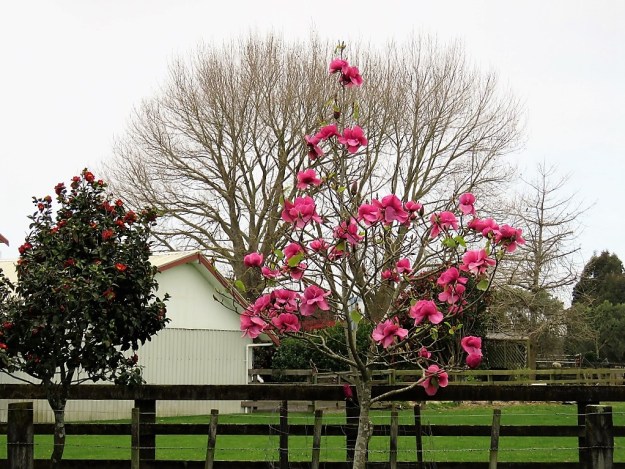
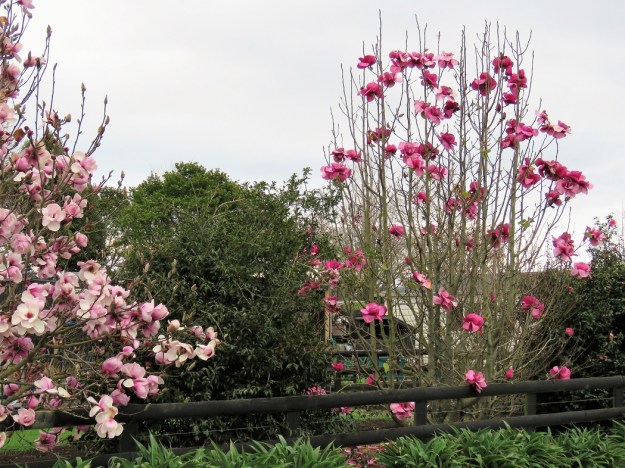
It was perhaps the desire to post more photos of our Magnolia campbellii and the mountain that motivated me to write about te mounga.

It remains an active volcano and most of the province is urged to have evacuation plans at the ready. At least we can head north or inland to get away. I am not sure how those around the coast are meant to evacuate should a major eruption occur because either way, their escape routes take them around the base of the mountain – unless they evacuate by sea. In reality, it is more likely to be lahars or ash clouds that are the problem. As you head around the coastal side of the mountain, the remains of lahars are a dominant feature in the landscape.

Photo credit: u/apexcutter on Reddit

Flying in to New Plymouth from the south takes one over the mountain and on a clear day, the sight is breathtaking. It is a near-perfect cone sitting alone, very close to the sea and surrounded by what is called the ring plain – land that is rolling to flat farmland. Lacking my own image, I found this photo on Reddit. That is the Tasman Sea in the upper section. The dark circle around the lower mountain is where the native bush ends – the boundary of the National Park giving way to farm land.

As seen from an Inglewood garden in late spring

It is an extremely accessible mountain which makes it one of the most dangerous in the country because inexperienced people underestimate it and fail to factor in that it has alpine conditions at higher altitudes. The fatality rate is high. In icy conditions, people can slip a long way. Neither Mark nor I have ever climbed it. As Mark says, he loses interest really quickly once above the bush line. Plants, not rocks are his thing. And I am wary of mountains. My brother remains buried in the ice of the Himalayas on the slopes of Mount Makalu.

Whereas Mount Fuji in Japan is widely accepted as being of sacred status, going well beyond just those of the Shinto faith, we are such a secular and residual colonial society that many people struggle with the thought that of course our Mount Taranaki has deep spiritual significance for the original people of the land. When Maori politely requested that people stop standing right on the top point of the pinnacle and, if my memory serves me right, refrain from carrying any bodily functions at the summit, the howls of outrage were loud. For what is the purpose of climbing a mountain if you can not place your footprints on the very highest point? The same people who are appalled at the thought that anybody might vandalise a graveyard and who would never dream of urinating on an altar regard it as a civil liberty that they can do what they wish on the highest point of te mounga.

Mind you, that outrage pales into insignificance compared to the outpouring of anger when the name of the mountain was addressed in 1983. Captain Cook named it Mount Egmont in 1770, after the Earl of Egmont who never came to New Zealand and died before he got to hear of the honour. But of course the mountain had names before that and a long campaign led to the decision that it could be called either Taranaki (the most common of its pre-European names) or Egmont. This might be called hedging bets but to some, this outrage was tantamount to the end of western civilisation. There are even a few older people who insist on continuing to make a stand by calling it Mount Egmont but they are a dying breed. Literally. The name ‘Mount Taranaki’ has taken precedence in official usage and to people beyond the region. To locals, it is simply ‘the mountain’, or ‘te maunga’ (in standardised Maori) or ‘te mounga’ with an o in the local dialect.

While sacred is rarely used as a descriptor and spiritual connection makes some people scoff, there is no doubt in my mind that our mounga is embedded into the very souls of people who are born here or spend time living here. Long before I ever came to Taranaki, I noticed that most people identify where they come from by the nearest town or city. Not Taranaki folks. They commonly declare themselves as coming from Taranaki and that, I think, has more to do with the mountain than the province. It is widely visible throughout the region. In summer, we make small talk about when the very last vestiges of white ice will melt. In autumn, we chart the first snowfalls. Through winter, we note how low the snow is lying and in spring we observe the retreating snow line. If it is blocked from view by cloud (as mountains often are), we can make that the marker of small talk about weather. Every rescue or dramatic event, including avalanches, makes headlines as do the relatively few days that the club skifield is open.

Te mounga just is. It was there before any humans populated this area. It will be there long after we have shuffled off the mortal coils. If that is not a shared spiritual connection that transcends all other social constructs, I am not sure what is.

An image search on line will yield many astounding photographs of our mountain. Some are even untouched by filters and other enhanced editing techniques. There are countless references giving more information but these give a brief, and probably accurate oversight.

The legends: https://taranakimounga.nz/the-project/about-taranaki-mounga/history/

The official history: https://www.linz.govt.nz/regulatory/place-names/tuia-%E2%80%93-encounters-250/mount-taranaki-or-mount-egmont

Climbing advice: https://www.doc.govt.nz/parks-and-recreation/places-to-go/taranaki/places/egmont-national-park/things-to-do/tracks/mount-taranaki-summit-track/

Amusingly, I found an article from Wilderness Magazine comparing NZ mountain peaks to more famous international peaks. Of course the comparator for Mount Taranaki is Mount Fuji in Japan.

“Why they’re similar: Are you kidding? Look at them!

Why they’re not: Taranaki seriously lacking bears and a summit post office

This comparison is a no-brainer. The two mountains look almost identical – so much so, that Mt Taranaki was famously used to represent Mt Fuji in the Tom Cruise film The Last Samurai.

They look like cartoon summits – ask a five-year-old to draw a mountain and they will quickly pencil something that looks very much like Fuji or Egmont.

Both have erupted within the last 350 years, both take about four or five hours to climb from where the road ends and both involve steep rocky ascents.

But the fact that they’re relatively straight forward to climb means both are commonly underestimated. The changeable weather makes Taranaki statistically one of the most dangerous mountains in New Zealand. And regular deaths on Mt Fuji have resulted in Japanese authorities urging wannabe peak-baggers to climb only in July and August, when conditions are mildest.”

The Japanese can keep their summit post office but I am now worrying about the distinct lack of bears to spice up a summit attempt on our mounga.