
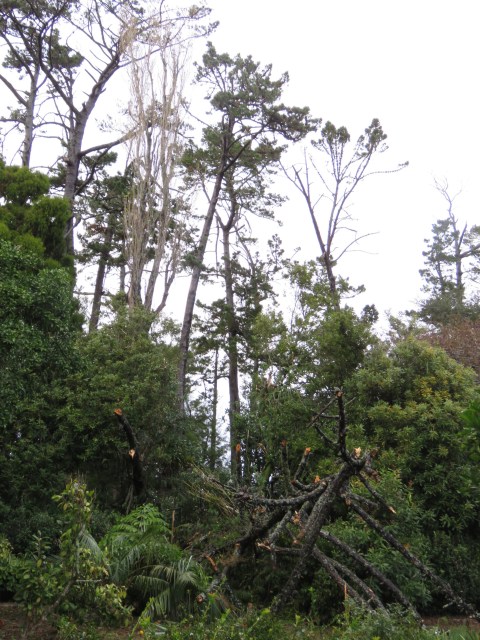
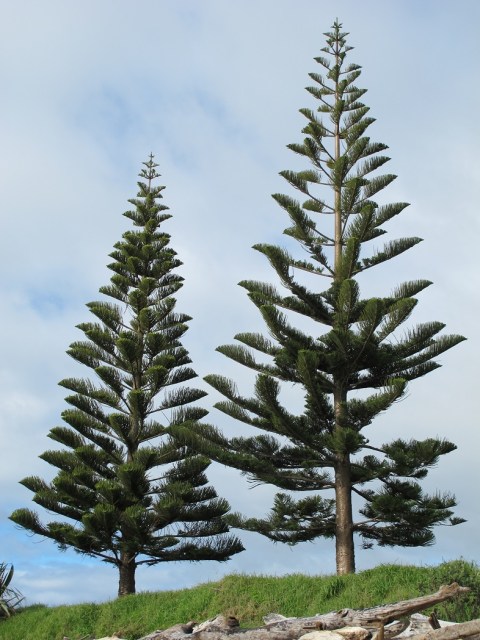
 With an increasing number of what are called ‘extreme weather events’ in the face of climate change, we just have to accept that falling trees are a fact of life here. We have a garden created amongst large trees. But none are as vulnerable as our old man pines (Pinus radiata). Planted in the 1870s by Mark’s great grandfather, some tower as high as 45 or 50 metres. We just have to accept that they appear to be reaching the end of their life span. And as yet another one falls, the next trees in the row lose their shelter so may be weakened.
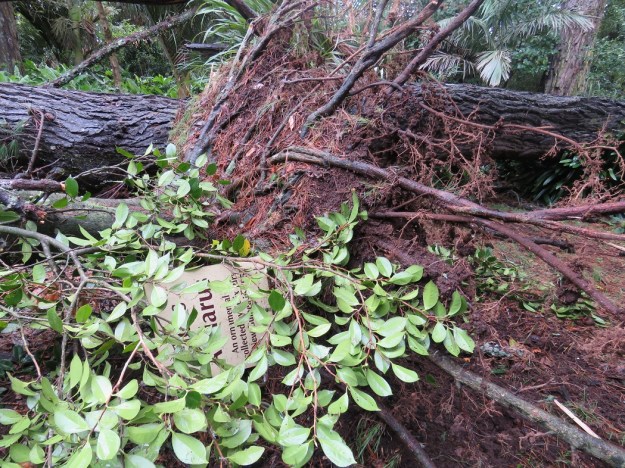
Totally uprooted, the Ficus antiarus which dates back to 1957
We usually say that it is amazing how cleanly big trees can fall, especially ones that don’t have a lot of big side branches or a great deal of foliage. But not the one that fell last night. It has clearly done substantial damage as it came down. The worst is the total uprooting of the rare Ficus antiarus which will require a major effort to get back upright and planted again. The macadamia nut tree is probably unable to be salvaged. Mark is a bit sorry that it only brought down part of the expendable Lombardy poplar and not all of it.
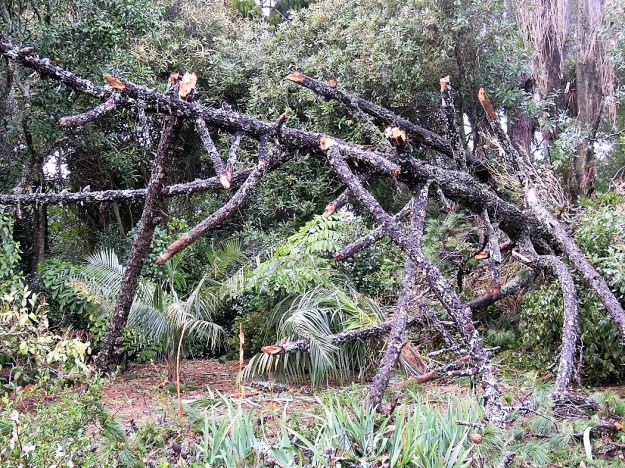
The tree tips, like a giant spider, descending on the new caterpillar garden area
And 50 metres of tree coming down as one long length extends… well, it extends 50 metres really. So this one lies through the avenue garden, across the intervening hedge, through part of Mark’s tropical palm border and the top landed in my recently planted perennial beds of what we call the caterpillar garden. I am not thrilled by this.
With Auckland being badly hit by falling trees in last night’s storm, I come back to my position on the chilly moral high ground. With these increasingly frequent events, it is not a sign that we should be felling all trees. Yes, it is important to keep a close eye on vulnerable trees and branches. But we need to match the felling or falling of trees with the planting of more trees in places where they have a reasonable chance of growing to maturity without causing problems to life and property. Which usually means on public reserves when it comes to cities. A dendrologist friend said that it should not be a one-for-one replacement but a five-for-one ratio to allow for those trees that die or are killed before they reach maturity. And that is just to maintain the status quo. We need to think about these issues because the planet needs more trees and city folks should not be consigned to living in concrete and tarmac environments where nothing is allowed to grow over two metres tall. The problems lie not with the trees themselves but with where they are planted, how they are maintained and which varieties are being grown.
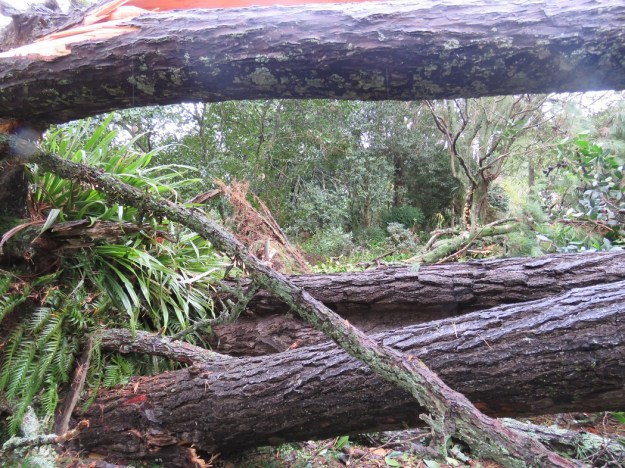 I wryly suggested to Mark that maybe we should be renaming our Avenue Gardens the Pine Log Gardens and he quipped that our stumpery is growing. We will follow our practice of clearing paths, removing all the side branches and cleaning up the collateral damage but leaving the body of the trunk where it fell and gardening around it. As more huge trees fall, we have a stumpery by chance, not design.
 Overseas,
  It may come as no surprise to regular readers that I also chose
 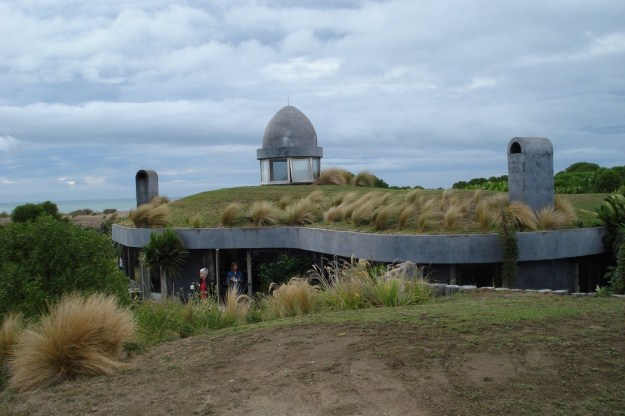 Nor have we visited the Garden of Cosmic Speculation or any of the Wirtz gardens. Landform as sculpture is a different aspect altogether and I haven’t seen enough to comment. I have seen one garden that took this approach in a naturalistic style and I have never forgotten it (years ago –





 Tikorangi The Jury Garden