Tag Archives: Abbie Jury

Future New Zealand – the Simon Bridges and National Government vision

This is little Pouri A, up the road. The way things used to be

This is little Pouri A, up the road. The way things used to be

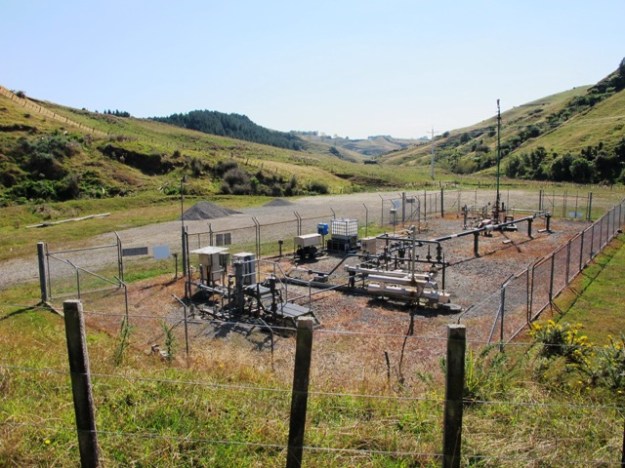
This is what a well site used to look like, in days past. Maybe this is what the Minister for Energy thinks a little bitty well site in a small corner of conservation land will look like. We will hardly notice it is there, will we?

Mangahewa D (photo: Fiona Clark)

Mangahewa D (photo: Fiona Clark)

In fact, a modern well site is much more likely to look like this. Difficult to ignore. But it is not just the well sites that people should worry about. It is what happens if the exploratory well is successful. I realized this week that while I have shown a multitude of well sites, heavy road transport, helicopters even, I have overlooked showing what successful well sites can mean.

Motunui (photo by Fiona Clark)

Motunui (photo by Fiona Clark)

This is Motunui. It is just over 5km down the road from us. It dates back to the Think Big era of the early ‘80s. Now it is back in full production (methanol) and…roaring. We get to hear it some days, particularly when we get the frequent cloud inversion layers. Some think it means jobs and wealth. Shame about the closest neighbours who get unrelenting noise.

Waitara Valley

The Waitara Valley Plant is just over 4.5 km from us, as the crow flies. It is another Think Big relic brought back into production with the current boom. It is also appallingly sited for noise dissemination and impacts on a large number of people. The low frequency noise resonates through the upstairs of our house. Since Christmas, we have gone to sleep listening to the droning hum every night and whenever we wake, the droning hum is still there. The quiet nights of our countryside appears to have gone. We fear this may be permanent noise which resonates through our house despite our double glazing. The prospect is unutterably depressing but how much worse must it be for the many neighbours who live closer?
McKee (photo by Fiona Clark)

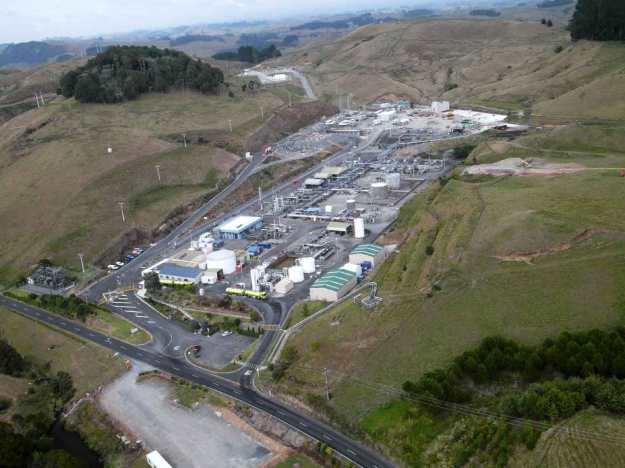
McKee (photo by Fiona Clark)

McKee is just over 5.5km up the road from us. We can’t hear it but ALL the heavy traffic passes us. It started life as just a production station but has grown and grown and then grown some more until the area was rezoned industrial. It probably seemed a good idea at the start to locate it out the back in the countryside but locals living nearby or on the sole transport route may beg to differ.
036

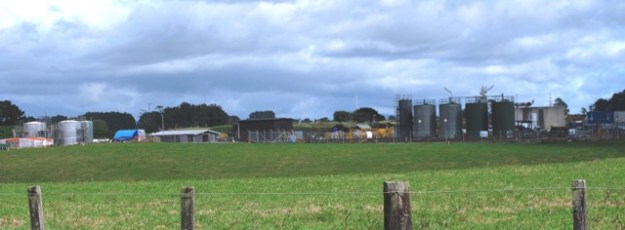
This is Turangi A, a few kilometers away heading towards the coast. It is early days yet but it looks to be on track to be another McKee. There is near continual flaring there now, belching black smoke. I keep hearing claims that we lead the way in Taranaki with best international practice. So how come we mandate ongoing flaring when other countries have banned it?

The mistake is to think that there is anyone tasked with planning, should the exploratory exercise be successful. No sirree. It is more a case of: “6 E. Can we place a tick in box 6E? Okay, yes. So 7A – what do they say for that?” And then we get: “Oh, they’ve found potentially commercial reserves. Well they are already there, so there is precedent to continue.”

Look to Tikorangi and North Taranaki for the future this government wants for the country. Our fresh-faced Minister of Energy, Simon Bridges, could be mistaken for the taxpayer-funded PR spokesman for the petrochemical industry – in my opinion at least. In a move of wonderful irony, young Simon is also the Associate Minister for Climate Change Issues and doesn’t that speak volumes for what this government thinks of climate change? There is a Tui billboard moment for you. This is the Minister who didn’t know there was a 200 000 hectare pristine forest park in an area he put up for petrochemical exploration This is the Minister that refers to ecological issues as “emotive claptrap”.

This is the New Zealand the National Government sees as the way of the future. Industrialising the countryside. Climate change? Let others worry about that.

Motunui (photo by Fiona Clark)
Motunui (photo by Fiona Clark)

Plant Collector: Hibiscus probably trionum

Hibiscus probably trionum

Hibiscus probably trionum

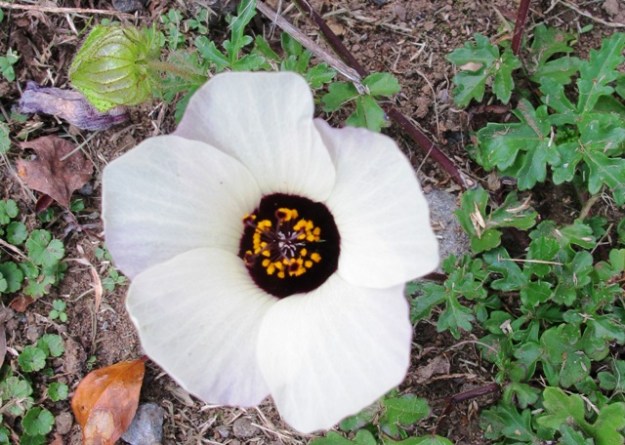
This plant took a little unravelling. It is a self sown seedling with large, short-lived flowers and serrated foliage which is lying almost flat to the ground. Mark thought it was a native but I think he is wrong. There is no shame in that. Most of the country thinks it is native and it is only recently that it has been separated from a very similar species, now called H. richardsonii, which is truly indigenous and indeed critically endangered in its natural habitat of northern east coast areas.

If I am right, this is actually H. trionum which originated in the Levant area of the Eastern Mediterranean, which more or less stretches from Cyprus to Palestine. It seems that the very dark eye to the flower is what makes it H. trionum rather than H. richardsonii. Well, that and chromosome counts. There are countless references on the internet to H. trionum being native in New Zealand as well as being widespread internationally. It has certainly naturalised here and by the time common usage catches up with the differences, it is likely that what we will have are hybrids between the two. It will fall to the botanists to try and keep a pure strain of the native H. richardsonii.

Both forms of hibiscus are usually short-lived perennials, often behaving as annuals, especially in frosty areas. They are in the mallow family (or malvaceae) and are showy, even if the individual flowers don’t last long. The common name is the unromantic bladder plant, though that is more correctly applied just to H. trionum. We do have one other native hibiscus and that is H. diversifolius.

First published in the Waikato Times and reprinted here with their permission.

Garden Lore

“I like trees because they seem more resigned to the way they have to live than other things do.”

Willa Cather (1876-1947)

002 - Copy

Autumn harvest and freezing tomatoes

The autumn harvest is being wheeled into house by the barrow load at the moment. They are melons in the photo – both water and rock varieties. The annual challenge for Mark is to get good crops of both through and to this end he takes some care and plants several different varieties of each. This year we have a bumper crop – too many to eat and give away so we have gone to juicing them for lunchtime smoothies. I did worry this week that the current fad of mixed fresh fruit and vegetable smoothies may in fact be the hipster take on Complan, that powdered product that used to be fed to fading elderly folk with no teeth. My anxiety is that we may be on the cusp of moving way past hipster age and approaching the elderly door.

But about the tomatoes. Experienced preservers will have their own tried and true techniques. For novices, faced by a surplus of tasty toms, I offer my method. In a fair division of labour, Mark grows them, harvests them, washes them, cuts out the tough stem end and any bad bits and lays them in a single layer in baking dishes. They are fan baked for a couple of hours around 130C. I then take over, strain off much of the clear liquid which is very flavourful and excellent for creamy winter soups. This I decant to plastic bottles and freeze. I then pull all the skins off the baked tomatoes. It takes a fraction of the time to do it after cooking rather than before. I then pack to meal-sized containers and freeze them. That is it. I add any extra flavourings at the time I cook with them, not at the time of freezing. I know tinned tomatoes are cheap to buy, but the only dollar cost in freezing our own is running the oven. The time required in preparation is minimal and, given the choice, we prefer to know where our food came from.

First published in the Waikato Times and reprinted here with their permission.

Autumn seed

Autumn can seem a slightly melancholy time of year, the opposite to the bright promise and floral extravagance of spring. It is that sense of ‘passing over’, of annuals dying and other plants retreating in preparation for winter. We tend to focus on the flowering capacity of most plants but some have a subtle, understated beauty on the other side with their seed heads. Not all, of course. Some simply look scruffy, brown and of no interest. But once you get your eye in, there is an astonishing range of different forms and some are well worth admiring in their own right. Where plants are not weedy, leaving the seed heads in place provides a valuable food source for birds.

Fennel - foeniculum vulgare

Fennel – foeniculum vulgare

“Don’t buy any more fennel seed,” he said as these plants crossed over from flowering to seeding. Fennel is one of my favoured cooking herbs. In fact these are the seed heads of Florence fennel or finocchio which never made it as far as the vegetable garden. The common fennel that flowers on many a roadside but never develops that edible bulbous base is the usual one that is harvested for herbal purposes.

Phlomis russeliana

Phlomis russeliana

We find Phlomis russeliana an undemanding, handy little perennial which flowers well even in conditions of high shade. Its flowers are soft yellow, arranged like a tiered cake stand and the stiff seed heads retain that interesting form. I had to pick these to photograph them and you can see the see the seed falling out. Usually the birds – and maybe the mice – will clean up this seed.

Clematis tangutica

Clematis tangutica

While these cute seed heads are from Clematis tangutica, it is a typical clematis seed form, although these are silkier and greener because it is a late season bloomer. That light ethereal form is usually a sign that the seeds are spread by wind, as indeed is thistledown from dandelions. The plant of course has evolved not to please humankind but to ensure its own survival.

Pachystegia rufa

Pachystegia rufa

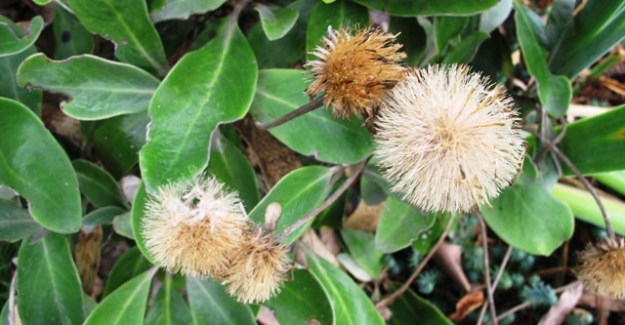
Pachystegia have fluff balls of seed, another wind dispersal candidate. This one is P. rufa, a different form of the Marlborough rock daisy to the highly prized, larger-leafed P. insignis. There is something very tactile about these soft pompoms.

Arisaema seed head, in this case A. tortuosum

Arisaema seed head, in this case A. tortuosum

Arisaemas are bulbs from the Asian subcontinent with hooded flowers somewhat reminiscent of a cobra. Many of the arisaemas, and indeed other aroids like arum lilies and zantedeschia, set attractive seed pods. The birds don’t touch these which is usually an indication that they are poisonous. Small children are not as discriminating as our feathered friends and it pays to check the safety of any plant which sets such attractive seed, as well as teaching your little ones not to put stray seeds and berries in their mouths.

Agapanthus - weed or wildflower?

Agapanthus – weed or wildflower?

Even the humble and often maligned agapanthus has an attractive seed head. These are heavy seed and don’t often fall far from the parent plant but, given the concern about weediness, dead heading seems a wise move, especially if you have them near waterways or reserves. Water is an efficient method of seed dispersal as can be witnessed by downstream and riverbank weeds.

First published in the Waikato Times and reprinted here with their permission.

Plant Collector: Amaranthus caudatus

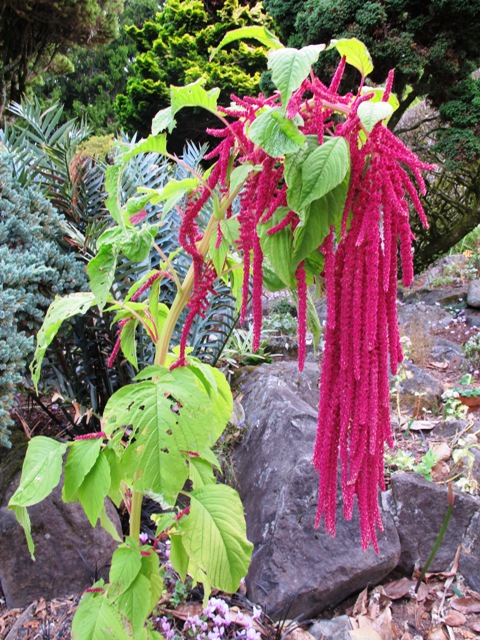
Amaranthus caudatus - Love Lies Bleeding

Amaranthus caudatus – Love Lies Bleeding

There is nothing fancy or special about this amaranthus which bears the unfortunate common name of Love Lies Bleeding. It is just an annual which has seeded down over many years in our rockery, but in early autumn we welcome its return. It grows at a remarkable speed. Throughout most of summer, the tiny seedlings are only a few centimetres tall, taking up next to no space at all. Look away for a couple of weeks and suddenly they have rocketed up to a metre or more and produced these eye-catching red tassels which will last right through autumn. The advantage in our garden situation is that the plants still take up very little ground space so the bulbs that are shooting away in the same pockets of the rockery are not crowded out.

There are many different amaranthus species – maybe 70 of them. Some species are eaten as fresh greens, some are predominantly grown as ornamentals while some provided grain in their native habitats of Mexico and South America. There is some resurgence of interest in amaranth grain, including from alternative lifestylers. It appears that A. cruentus is the main grain species but our A. caudatus also gives edible grain and so does the oddly named A. hypochondriacus. The problem we see in using our Love Lies Bleeding is that, while it sets prodigious amounts of seed, it does not all ripen at once, which would make harvesting difficult. However, should armageddon come, we do apparently have a potential source of grain in our front garden, as long as I leave one or two plants to seed down each year in the interim. In the meantime, they do a great job of feeding the birds.

First published in the Waikato Times and reprinted here with their permission.