Tag Archives: Abbie Jury

Plant Collector: Nerine pudica

Nerine pudica

Nerine pudica

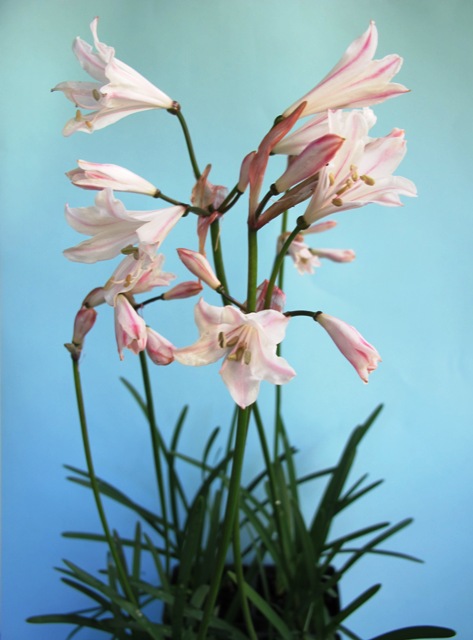
How pretty is little pudica? This is the first season I have seen it flower and it is a delight. The pointed bells are mainly white with a pink stripe down the centre of each petal and each stem has up to six flowers on it. It is a nerine which makes it a bulb, but it is a much smaller one than the more common sarniensis and bowdenii types. The foliage is also much finer and narrower. It looks more a mondo grass or liriope leaf.

N. pudica is a species, hailing from the western side of South Africa. The ever-useful reference “Bulbs for NZ Gardeners and Collectors” by Terry Hatch and Jack Hobbs tells me that it is one of the original parents of many of the modern hybrids. While showy hybrids have their place, there is often a simple charm in the original species. The ones in the photograph are still in pots. It will take several years before we can comment on how reliable they are as garden plants in the rockery but the requirements are the same as for other nerines – excellent drainage and full sun. I am hoping they will do well because it makes a pretty addition to the autumn bulb display.

First published in the Waikato Times and reprinted here with their permission.

An Easter legend – the Glastonbury thorn

I went looking for the Glastonbury thorn but it was not to be found at St Mary's cathedral after all

I went looking for the Glastonbury thorn but it was not to be found at St Mary’s cathedral after all

The legend of the Glastonbury thorn seems timely as an Easter story. I started by setting out to find the local specimen at St Mary’s Cathedral in New Plymouth that is reputed to be the Glastonbury thorn, only to find it isn’t. We have our own legends too.

Glastonbury is in the Somerset area of the United Kingdom. The abbey site has had a Christian church on it since the seventh century, but legend takes it back further. One version has Joseph of Arimathea bringing his young nephew, Jesus Christ to Glastonbury where they built the first Christian church at that location. But the Glastonbury thorn tree is attributed to the second visit by Joseph of Arimathea soon after the death of Christ. Reportedly landing in a state of exhaustion, he thrust his staff into the ground on the slope now known as Wearyall Hill. The staff took root overnight and grew into the Glastonbury thorn tree, revered as sacred through the ages since.

Interwoven through the Glastonbury thorn legend, is the more powerful myth of the Holy Grail that Joseph was believed to have brought and buried just beneath the Glastonbury Tor. The Holy Grail of course is the cup used by Christ at the Last Supper and subsequently used by Joseph to catch his blood at the crucifixion. And with the Holy Grail come the legends of King Arthur and the Knights of the Round Table. Glastonbury Abbey is reputedly the final resting place of both Arthur and Guinevere. Sadly, after about 1000 years, they got a bit careless with the remains and when the abbey was sacked and largely destroyed in the 1500s, Arthur and Guinevere’s remains were no more.

But the Glastonbury thorn endured. Not the original tree. It had a bit of a rough history and still has as replacement plants either die, are vandalised or maybe attacked in spiritual fervour. But as the plant does not strike from cutting or grow true from seed, it has to be grafted. And it does appear that the plant has remained true and been distributed for many hundreds of years.

It seems a little mean-spirited to disturb such a wonderful legend with botany. But whatever the truth is about the Holy Grail, it is a fact that that the Glastonbury thorn is simply a variation on Crataegus monogyna that is the common hawthorn of the UK – the fragrant Mayflower. It seems unlikely that Joseph of Arimathea’s wooden staff at the time of his alleged arrival in Britain was fashioned from a plant native to that country. What makes C. monogyna “Biflora” different is that it has two flowerings a year. Its main flowering is in spring but it also puts up a minor second blooming in winter. The tradition of sending a spray of Glastonbury thorn to the monarch at Christmas started back in the time of James 1 at the turn of the sixteenth century and apparently continues today.

These days Glastonbury is probably associated as much with the annual music festival which, despite being timed for the end of June, seems to be a particularly muddy affair. Despite its very early Christian history and even earlier pagan history, or maybe as a result of it, modern Glastonbury apparently now resembles something more akin to Diagon Alley from the Harry Potter stories.

I noticed the wry comments on a BBC New Magazine site from 2012. “The former mayor John Coles tends to the remnants of the thorn. In recent years, people have tied ribbons to it bearing messages, prayers and maybe even spells. Coles removes them. “It takes daylight away from the trunk,” he explains. He also prises out the coins that people have jammed into the bark.”This never used to happen even eight or nine years ago,” he says sadly.The apparent takeover of the town by new age believers disturbs him. “There’s nothing wrong with paganism but there is a certain taste of Satanism as well and I have always regarded Glastonbury as a Christian town.”

Many St Mary’s parishioners in New Plymouth were proud of their Glastonbury thorn until it was revealed that it is Crataegus crus-galli from the eastern states of North America. Apparently it was planted back around 1860 by Archdeacon Govett. This makes it one of the oldest known introduced trees in the province but the Glastonbury thorn it ain’t. This is a bit of a shame as the Cathedral of St Mary is the oldest stone church in New Zealand with its foundation stone having been laid in 1845. It would have been a charming connection back to the Glastonbury Abbey history and legend where the lady chapel is still referred to as ‘Our Lady St. Mary of Glastonbury’. Instead they just have a scrubby but venerable North American species.

First published in the Waikato Times and reprinted here with their permission.

Future New Zealand – the Simon Bridges and National Government vision

This is little Pouri A, up the road. The way things used to be

This is little Pouri A, up the road. The way things used to be

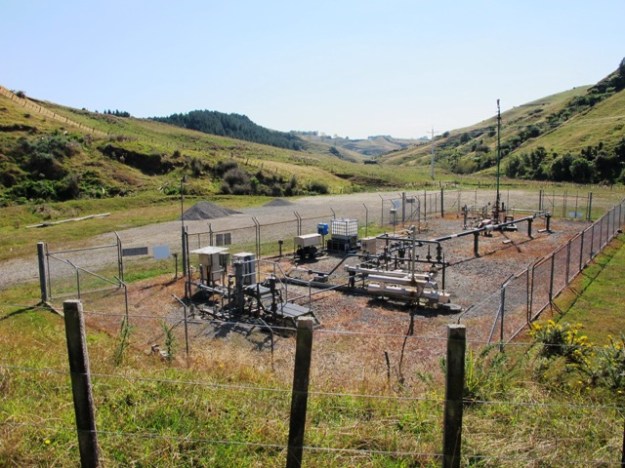
This is what a well site used to look like, in days past. Maybe this is what the Minister for Energy thinks a little bitty well site in a small corner of conservation land will look like. We will hardly notice it is there, will we?

Mangahewa D (photo: Fiona Clark)

Mangahewa D (photo: Fiona Clark)

In fact, a modern well site is much more likely to look like this. Difficult to ignore. But it is not just the well sites that people should worry about. It is what happens if the exploratory well is successful. I realized this week that while I have shown a multitude of well sites, heavy road transport, helicopters even, I have overlooked showing what successful well sites can mean.

Motunui (photo by Fiona Clark)

Motunui (photo by Fiona Clark)

This is Motunui. It is just over 5km down the road from us. It dates back to the Think Big era of the early ‘80s. Now it is back in full production (methanol) and…roaring. We get to hear it some days, particularly when we get the frequent cloud inversion layers. Some think it means jobs and wealth. Shame about the closest neighbours who get unrelenting noise.

Waitara Valley

The Waitara Valley Plant is just over 4.5 km from us, as the crow flies. It is another Think Big relic brought back into production with the current boom. It is also appallingly sited for noise dissemination and impacts on a large number of people. The low frequency noise resonates through the upstairs of our house. Since Christmas, we have gone to sleep listening to the droning hum every night and whenever we wake, the droning hum is still there. The quiet nights of our countryside appears to have gone. We fear this may be permanent noise which resonates through our house despite our double glazing. The prospect is unutterably depressing but how much worse must it be for the many neighbours who live closer?
McKee (photo by Fiona Clark)

McKee (photo by Fiona Clark)

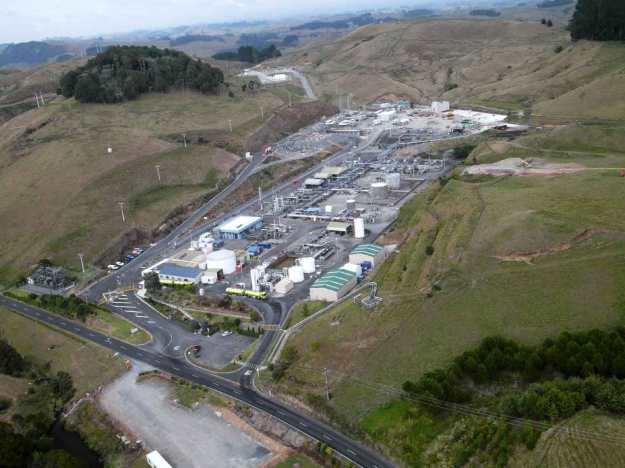
McKee is just over 5.5km up the road from us. We can’t hear it but ALL the heavy traffic passes us. It started life as just a production station but has grown and grown and then grown some more until the area was rezoned industrial. It probably seemed a good idea at the start to locate it out the back in the countryside but locals living nearby or on the sole transport route may beg to differ.

036

This is Turangi A, a few kilometers away heading towards the coast. It is early days yet but it looks to be on track to be another McKee. There is near continual flaring there now, belching black smoke. I keep hearing claims that we lead the way in Taranaki with best international practice. So how come we mandate ongoing flaring when other countries have banned it?

The mistake is to think that there is anyone tasked with planning, should the exploratory exercise be successful. No sirree. It is more a case of: “6 E. Can we place a tick in box 6E? Okay, yes. So 7A – what do they say for that?” And then we get: “Oh, they’ve found potentially commercial reserves. Well they are already there, so there is precedent to continue.”

Look to Tikorangi and North Taranaki for the future this government wants for the country. Our fresh-faced Minister of Energy, Simon Bridges, could be mistaken for the taxpayer-funded PR spokesman for the petrochemical industry – in my opinion at least. In a move of wonderful irony, young Simon is also the Associate Minister for Climate Change Issues and doesn’t that speak volumes for what this government thinks of climate change? There is a Tui billboard moment for you. This is the Minister who didn’t know there was a 200 000 hectare pristine forest park in an area he put up for petrochemical exploration This is the Minister that refers to ecological issues as “emotive claptrap”.

This is the New Zealand the National Government sees as the way of the future. Industrialising the countryside. Climate change? Let others worry about that.

Motunui (photo by Fiona Clark)

Motunui (photo by Fiona Clark)

Plant Collector: Hibiscus probably trionum

Hibiscus probably trionum

Hibiscus probably trionum

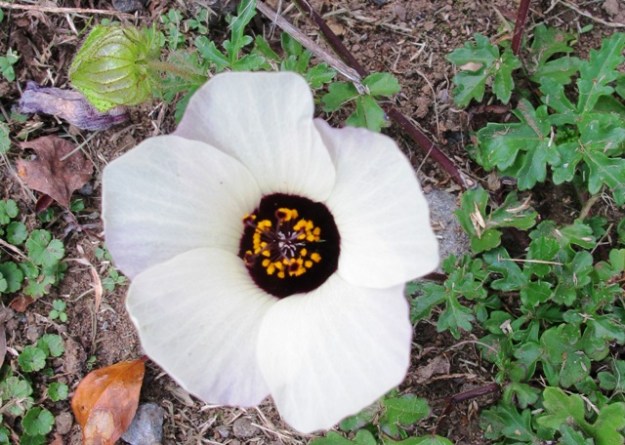
This plant took a little unravelling. It is a self sown seedling with large, short-lived flowers and serrated foliage which is lying almost flat to the ground. Mark thought it was a native but I think he is wrong. There is no shame in that. Most of the country thinks it is native and it is only recently that it has been separated from a very similar species, now called H. richardsonii, which is truly indigenous and indeed critically endangered in its natural habitat of northern east coast areas.

If I am right, this is actually H. trionum which originated in the Levant area of the Eastern Mediterranean, which more or less stretches from Cyprus to Palestine. It seems that the very dark eye to the flower is what makes it H. trionum rather than H. richardsonii. Well, that and chromosome counts. There are countless references on the internet to H. trionum being native in New Zealand as well as being widespread internationally. It has certainly naturalised here and by the time common usage catches up with the differences, it is likely that what we will have are hybrids between the two. It will fall to the botanists to try and keep a pure strain of the native H. richardsonii.

Both forms of hibiscus are usually short-lived perennials, often behaving as annuals, especially in frosty areas. They are in the mallow family (or malvaceae) and are showy, even if the individual flowers don’t last long. The common name is the unromantic bladder plant, though that is more correctly applied just to H. trionum. We do have one other native hibiscus and that is H. diversifolius.

First published in the Waikato Times and reprinted here with their permission.

Garden Lore

“I like trees because they seem more resigned to the way they have to live than other things do.”

Willa Cather (1876-1947)

002 - Copy

Autumn harvest and freezing tomatoes

The autumn harvest is being wheeled into house by the barrow load at the moment. They are melons in the photo – both water and rock varieties. The annual challenge for Mark is to get good crops of both through and to this end he takes some care and plants several different varieties of each. This year we have a bumper crop – too many to eat and give away so we have gone to juicing them for lunchtime smoothies. I did worry this week that the current fad of mixed fresh fruit and vegetable smoothies may in fact be the hipster take on Complan, that powdered product that used to be fed to fading elderly folk with no teeth. My anxiety is that we may be on the cusp of moving way past hipster age and approaching the elderly door.

But about the tomatoes. Experienced preservers will have their own tried and true techniques. For novices, faced by a surplus of tasty toms, I offer my method. In a fair division of labour, Mark grows them, harvests them, washes them, cuts out the tough stem end and any bad bits and lays them in a single layer in baking dishes. They are fan baked for a couple of hours around 130C. I then take over, strain off much of the clear liquid which is very flavourful and excellent for creamy winter soups. This I decant to plastic bottles and freeze. I then pull all the skins off the baked tomatoes. It takes a fraction of the time to do it after cooking rather than before. I then pack to meal-sized containers and freeze them. That is it. I add any extra flavourings at the time I cook with them, not at the time of freezing. I know tinned tomatoes are cheap to buy, but the only dollar cost in freezing our own is running the oven. The time required in preparation is minimal and, given the choice, we prefer to know where our food came from.

First published in the Waikato Times and reprinted here with their permission.