Tag Archives: Abbie Jury

Dudley and the new season’s avocado crop

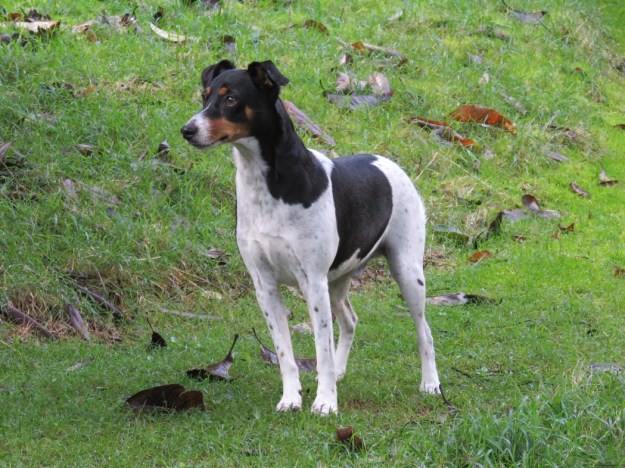
Behold our handsome Dudley. Or Dudders, to give him his cricketing name. I wrote about Dudley’s penchant for self-serve avocados two years ago in The Avocado Thief.

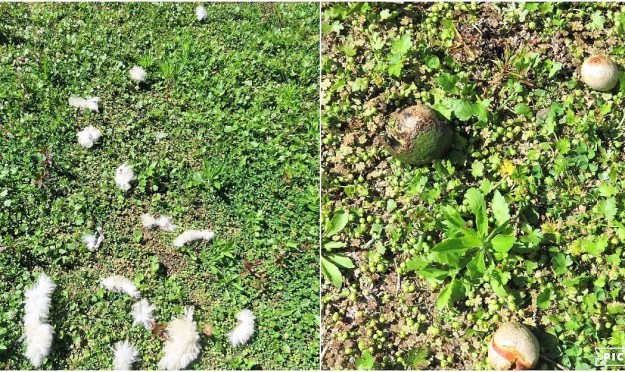
Last year the avocado pickings were very lean, bordering on non-existent, really. This year, we have a terrific crop of Fuerte avocados coming in right now and there is nothing wrong with Dudley’s memory. In the centre of a large area which we are developing into a new garden, I found his stash this morning. At this point the revolting lambs’ tails retrieved from the neighbours just across the fence outnumber the avocado stones but Dudley is working on that. Apparently he has designated this area as his outdoor dining space – not to be confused with his breakfast nook by the house where he receives his morning rations.

The evidence! Left: his stash of ageing lambs’ tails adjacent to his avocado stones on the right

Sometimes I read that one should not feed avocado to dogs as it is allegedly toxic. Dudley is a dog of many talents but he has failed to read these warnings and he has never shown any ill effects from an excess of avocado. The same cannot be said for an excess of lambs’ tails which can, at times, clog up in his gut though this does not appear to deter him for long. An excess of avocado flesh merely gives him a glossy coat. This was a townie dog that has adapted rather too well to life in the country.

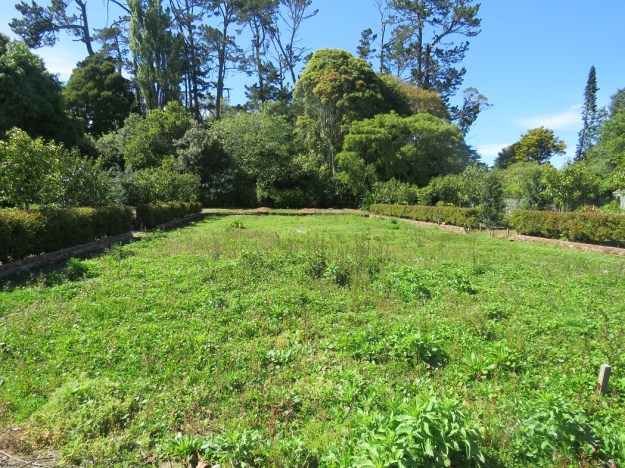
Dudley’s outdoor dining area is in the middle of an area under development – loosely referred to here as the court garden because it currently resembles a tennis court in dimensions. The two year plan is for a wildflower garden. 

Plant Collector: Malus ioensis ‘Plena’ – (Betchel Crabapple)

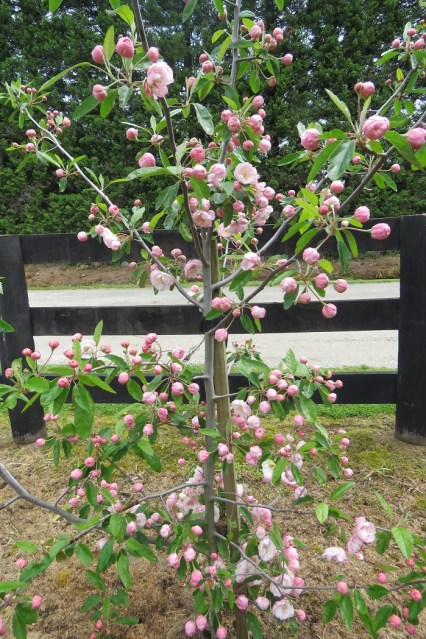
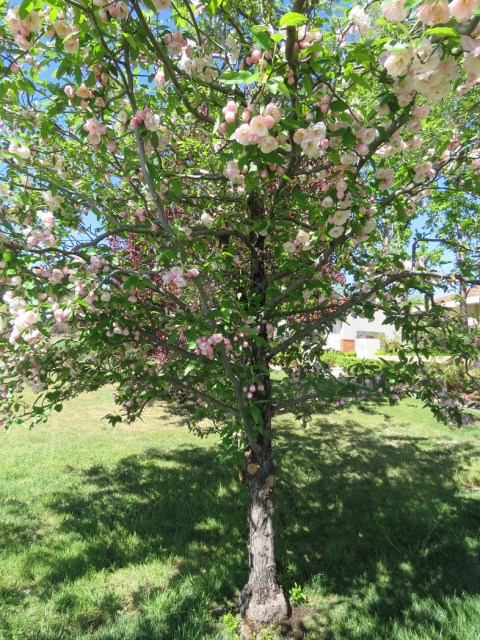
My first sighting of a juvenile plant in a Taranaki garden last spring

When I first spotted this pretty, young tree in a local garden last spring, I could not identify it but it sure was a charming sight. In Canberra a couple of weeks ago, there were SO MANY of these trees in bloom that I felt I had to track down a name. It is a flowering crabapple, a malus. The nurseries that supply Canberra are clearly making a killing on producing this cultivar (along with the pretty dogwoods). It is being used widely as a street tree on suburban road verges, it was strongly represented in the gardens at Parliament House that we visited and was featured in many, many (many) gardens.

It is a pretty blossom tree though it does flower as its fresh foliage has broken dormancy, so the display is not on bare branches. Crab apples fit a similar niche to flowering cherries (prunus), though many varieties will flower a little later. Unfortunately, with ‘Plena’, you don’t get the bonus of coloured crab apples later in the season, although it can be used as a pollinator for the fruiting varieties.

Malus ioensis ‘Plena’ , not a prunus as I initially assumed

I have not looked closely at the plants in New Zealand to see if they are cutting grown or grafted. The Canberra plants were grafted, usually onto a rootstock that had an attractive, smooth pale grey bark. The problem with the plants in the Parliament House gardens (no photos allowed so I can’t show you), is that the lower grey bark of the root stock for the first metre or so was not particularly compatible with the graft so the union – where the grafted variety meets the rootstock – was already a bit lumpy and not attractive. They were not as bad as the linden shown here, but neither were the plants mature so they may well get worse. If you like your trees to last the distance over many years, just be cautious about buying plants that have been grafted as standards well above ground level. The closer the graft is to the ground, the less obvious any incompatibility will be.

It is a very pretty tree and one I expect we will see become as popular in this country as in Canberra.

A very pretty and presumably well behaved street tree in Canberra


Plant Collector: the good and the bad of nandina

There are not many plants that I actively dislike but the dwarf, coloured nandina is one. You can tell I do not care for it because I gave no loving attention at all to taking this photograph of a plant on a random street frontage in town. Yet this plant is everywhere. One of those bullet-proof, easy-care plants which is alleged to have ‘year-round interest’ with its coloured foliage so a perfect fit for non gardeners who merely want plants to act as low or no-maintenance soft furnishings in the garden.

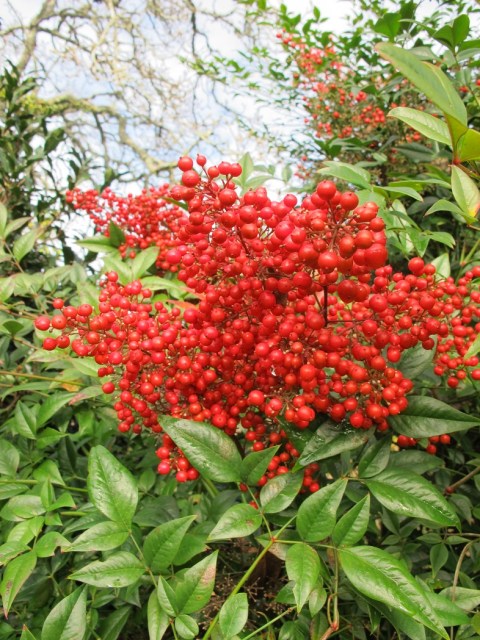
The taller version – Nandina domestica ‘Richmond’ seen here – has sufficient aesthetic merit to justify a place in the garden

Mark was as surprised as I was when I told him I had looked it up and there is only one species of nandina and that this boring little coloured mound which is rarely above knee height is the same species as the far more graceful and attractive Nandina domestica ‘Richmond’ that we grow. I can only assume that the common name of heavenly bamboo was initially applied to the more graceful, taller type of selections like ‘Richmond’. I guess, at a pinch, one could claim it has a bamboo look to it, though probably only to those who have never actually looked at the real thing. It is actually a member of the beriberidaceae family (think berberis). Apparently nandinas only berry in warmer climates and ‘Richmond’ is self-fertile so will berry without needing the pollinator that most others do. It is worth growing – easy, reliable and low maintenance yet with a grace and elegance to it, as well as seasonal interest with its berries.

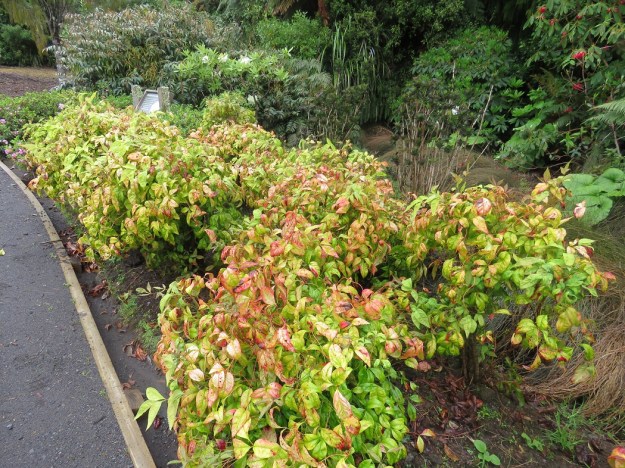
The institutional look of utilitarianism

The dwarf forms lack all of these more desirable attributes except utilitarianism. The more you have, the more utilitarian your garden will look. I have photos of a private garden which has planted a score or more of them but it is too easy to identify the place from my photos and I do not want to upset the owners.  I can, however, offer you this photo of it being used in a public garden. It will not look much different in your garden at home. But it will be easy-care.

The dwarf forms seem to be available under a whole bunch of different cultivar names with some variation in leaf tones and berrying capacity. You can tell it will be a dwarf form by the descriptions of it as clumping, compact or dwarf with projected heights of 60 to 75cm. The red berries, if you get a berrying variety, will never be as showy on a 60cm mound with coloured leaves as they are on their taller sibling with its green leaves and the panicles of berries displayed prominently at eye level or above.

In the interests of disclosure, I will admit that we have one of the dwarf nandina in our garden, though not in a prominent position. Its days are numbered. Probably in single digits since I worked out how much I actively dislike it.

Togs, togs, togs. Undies! A post that is not about gardening.

When I headed across the Tasman two weeks ago, I anticipated a couple of extra degrees of warmth – so late spring rather than our changeable mid-spring. I was wrong. Summer seemed to have arrived already in both Sydney and Canberra and I did not pack sufficient summer clothes. However, it was not yet summery enough to make me think of swimming.

Sydney daughter lives on the fringe of wealthy but staid Bellevue Hill, where it meets the uber-trendiness of turmeric latte Bondi. It could not be more different to Tikorangi and our local town of Waitara so I always find plenty to look at while out walking and I usually carry my camera. However, when confronted by three confident young men wearing only the briefest of swim attire and striding along some distance from the beach, whipping out my camera was truly the last thing I thought of. I was almost flustered by this brazen display of masculinity.

Australia continues to embrace the briefest of brief swim attire for men, usually referred to as budgie smugglers. For recreational wear, New Zealand men long ago moved to the more modest baggy attire of surf shorts. I am fairly sure that only competitive swimmers and the occasional embarrassing older dad wear such brief togs in NZ these days. But then I do not think we have ever had an onion-munching prime minister who took some pride in being photographed publicly in these budgie smuggler togs. If you google Tony Abbott, you will find plenty of evidence and if you are not Australian, it is near incomprehensible.

I was relaying my surprise to my daughter and she found me this You Tube clip. I laughed and laughed.

It is simple, if you can’t see the sea, you are wearing underpants. Or if you are more than 300m from the water’s edge, you have entered the underpants transformation zone. These young gentlemen were certainly wearing revealing undies, in that case.

And even being a buff, gym-fit, Bellevue Hill, private school educated, stockbroker type of young man does not make wearing undies in public acceptable attire

City trees. An asset, not a liability

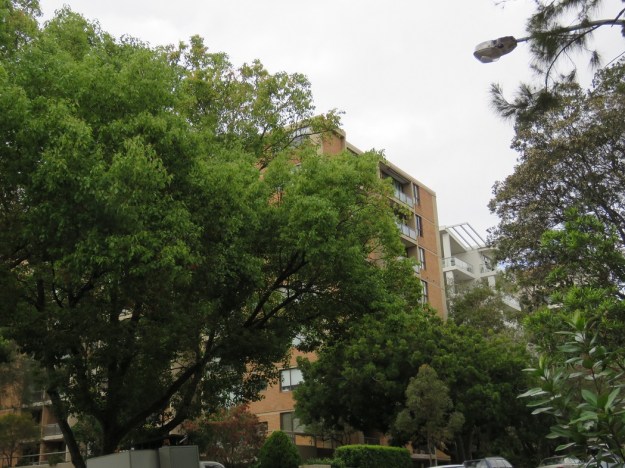
High density living amongst the trees in Sydney

In the week before I left for Australia, I had seen coverage about the loss of trees in Auckland. The loss of up to one third of all Auckland’s established trees, in fact. That is an astonishing number to have been removed  in the last five years. Too many New Zealanders hate trees.

It was interesting to hit Sydney and Canberrra where temperatures were rising rapidly for summer and to hold conversations with people who value trees a great deal more. I was told more than once that good tree cover in the city can lower the temperature in summer by as much as two or three degrees, making the leafy suburbs much more liveable. And the whole term “leafy suburbs” is used to describe the affluent areas. Sadly, the more down market the area, the more barren and treeless it tends to be.

I photographed this sign in Canberra but ringing in my ears were the cries I often hear in our local city of New Plymouth to fell trees where the roots are starting to lift the seal. It is a curious fact that as soon as this occurs, legions of people suddenly speak up for the welfare of the elderly who, in our local area at least, are allegedly incapable of coping with an uneven surface. Having travelled in Asia, Australia, Europe and the UK, I can assure you that a bit of lifting or cracking of seal is NOT seen as a reason for removing trees in those places.

Privacy on the third floor balcony
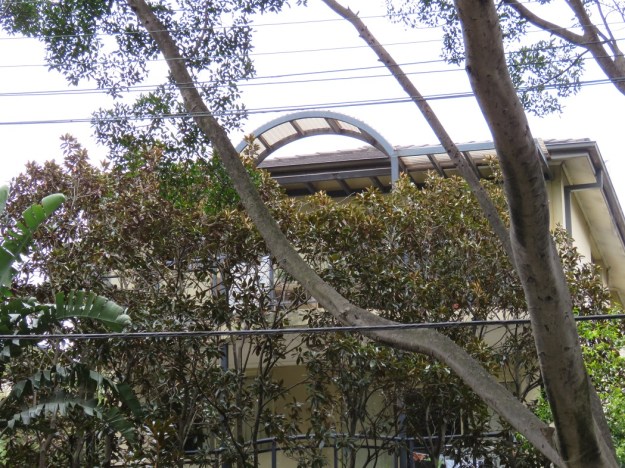
My second daughter gave me food for thought. She bought a third floor apartment with a good sized balcony overlooking a very busy road. In a densely populated area of Sydney, there are only about three apartments out of many (but I failed to count how many), that can see onto her balcony. It is amazingly private and that is due to the trees, both the street trees and the elongated Magnolia grandiflora ‘Little Gem’ that are on the apartment property.

The street trees are huge. It is a ficus outside her place. And yes, the roots do get into the drains. Just before she bought her apartment, there had been a major repair required on the building’s main sewer pipe. If this happened in New Zealand, the resulting cries for the removal of the offending tree would be deafening.

“Would I have bought this apartment if the trees weren’t here?” Daughter commented. “No. Not a chance. It is the trees that make the busy road and being overlooked bearable. Maybe repairing the underground pipes from time to time is a price I have to pay for living here.” That is NOT a New Zealand sentiment!

Yes trees can cause a lot of damage in storms and when the roots penetrate pipes and crack sealed areas. But never before has it been so important to keep our big trees in urban areas and cutting them down to replace them with shrubs or small, suburban trees which are never going to get much above three metres is not an adequate substitute. Trees generate the very oxygen we breathe as well as contributing to ecosystems and the environment.

Elder daughter drove me round new Canberra suburbs. With typical over-sized freestanding houses on small sections, there is no room for big trees to be planted on these private properties. That is where town planning to allow for plantings in public spaces becomes so very important. If big trees are not established on road verges and in neighbourhood parks, such subdivisions will forever be barren wastelands of concrete and brick. As well as up to three degrees hotter on scorching summer days.

The established – and higher priced – leafy suburbs of Canberra

The established, older areas of Sydney, Canberra and Melbourne all have B I G street trees and how lovely that is to see. It is time for Auckland to rise to the challenge of planting more trees rather than felling them in ever increasing numbers. Planning is critical to create sufficient space for trees to be able to reach maturity. And time for all New Zealanders to cast aside the pioneer mentality that trees merely exist for humans to fell them.

If you don’t have trees, then you don’t get to experience the opening of the first flowers on the jacaranda. In Sydney. In October. Ours at home won’t bloom until February.