Tag Archives: gardening

Plant Collector: Telopea (probably speciosissima) or Australian waratah

009
In days when we used to retail plants from here, we would have to keep a straight face when ingénues came in asking what the “lovely red rhododendron at the gate” was. Ahem – commonly known as a waratah, though not to be confused with the fencing waratah. It is the emblem of New South Wales and, like many Australian natives, is not too happy in the fertile, high rainfall conditions of much of this country. It evolved to grow in poorer, harder, drier environments though I see the gardening advice across the ditch is to give these plants semi shade and to water in summer. It has also evolved to survive regular bush fires.

Telopeas are members of the proteaceae family and we struggle growing most of those because of our regular rain all year. They do better in drier, coastal areas. Some years are much better than others for the telopea floral display and this year it may be the dry summer helped. The Australian advice is to cut the plant back very hard after flowering each year. We have never done this and ours tends to undergo a natural die-back process every few years. However, it has still reached the maximum height of 5 metres, owing to the fact that we don’t get bush fires to keep it down. The habit of growth is more shrubby than tree-like and foliage has that Aussie gum tree look. It is apparently a long-lived cut flower.
012
First published in the Waikato Times and reprinted here with their permission.

Garden lore

“Lady Cantal says that flowers can feel no pain. I asked if hers did, and she said yes, so I pointed to a hideous stone gnome overlooking a bed of very nice Stocks and told her the reason.”

H.L.V. Fletcher Purest Pleasure (1949)

022
Sowing seed

Most beginners think you can just scatter seed around the garden and it will grow but it does not take long to realise that the results can be very disappointing, non-existent even. It is worth learning how to grow seed. Some can be sown direct into the garden. There will be instructions on the back of commercial seed packs telling you how deeply to plant the seed. However, it is often more successful to sow into a seed tray or individual pots, germinating the seed in more controlled conditions.

Generally you need about 10cm of depth so egg cartons are only going to work for quick turnaround crops like peas or lettuces. It is best to buy a bag of seed raising mix which is sterile (so when a green shoot emerges you know it is your seed and not a weed) and also lower in fertiliser than a potting mix. Tamp the mix down to get rid of air bubbles. Individually sow large seeds or sprinkle fine seed carefully and then spread a thin layer of mix on top of the seeds. The smaller the seed, the lighter the covering but almost all seeds need a complete cover. Water carefully. A misting bottle (the well washed window or shower cleaner bottle with a pump spray) is ideal for fine seed. Don’t flood the seeds.

Until seeds germinate, place the pots or tray out of direct sun but in good light. It is usually wise to elevate the seed trays away from slugs and snails or cats who think it is a litter box.

First published in the Waikato Times and reprinted here with their permission.

The Yellow Magnolias and Honey Tulip

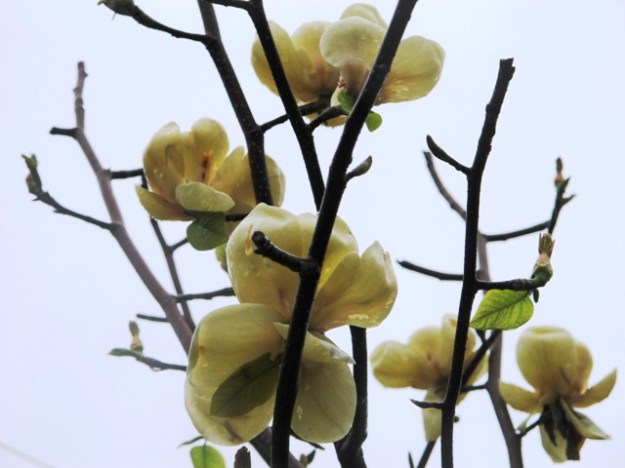
Honey Tulip - looking very good this week

Honey Tulip – looking very good this week

There is some relief here this week as our newest magnolia, Honey Tulip, is looking particularly good. It is always a bit nerve wracking releasing a new cultivar on the market and hoping we have it right.

We are still a little bemused by a communication from some random person when Honey Tulip was first shown in an overseas publication. I will have to paraphrase it because I must have deleted it in irritation at the time, but it said something along the lines of: “It is good that Mark Jury is discerning in the magnolias he names, but the world has enough yellow magnolias already….” It then proceeded to instruct my Mark on what he should be breeding for instead.

The international world of magnolias is pretty small, the number of international magnolia breeders even fewer. We know most of them by repute, if not personally. This email did not come from anyone we had heard of before. What was galling was that in the heady world of new magnolias, Honey Tulip represents a genuine step in flower form for the yellows.
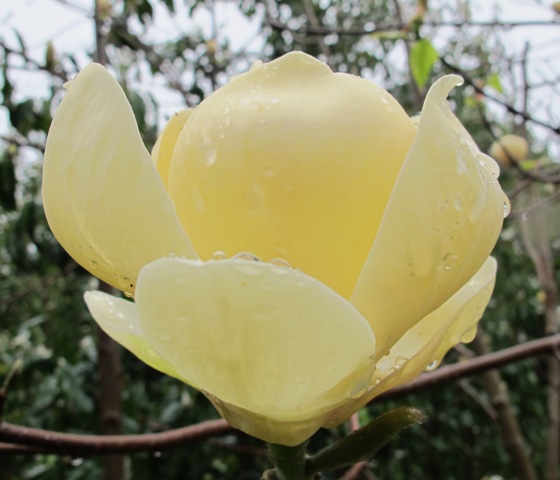
Honey Tulip - a lucky break in flower form and performance

Honey Tulip – a lucky break in flower form and performance

The yellow magnolias descend from a single species and while most magnolias originate from parts of Asia, the yellow deciduous M. acuminata and the evergreen grandiflora magnolias are from USA. M. acuminata is from eastern USA up into southern Ontario in Canada. We can remember when it first came into this country maybe 25 years ago, along with four of the earliest yellow hybrids – Yellow Bird, Yellow Fever, Elizabeth and Koban Dori. They were a collector’s novelty. Who knew that magnolia flowers could be yellow?

It did not take that long to realise that the yellow magnolias were not quite like the big pink, red, purple and white ones. There are a few problems yet to be solved. M. acuminata itself grows very rapidly and very large which takes it beyond the size most gardens can accommodate. The flowers are small, very small by magnolia standards, though they have good fragrance. Mind you, it has to be a very strong scent to mean anything when the blooms are 20 metres up above.

However, the biggest problem with acuminata and most of the hybrids is that the flowers come so late in the season that they coincide with the new foliage which then hides them. We are of the opinion that the whole point of a deciduous magnolia is to have all those fat, furry buds exploding into a mass of blooms on a bare tree in late winter and early spring. So little flowers, no matter what colour, obscured by masses of fresh foliage, are not going to set the world on fire.

Magnolia Yellow Fever planted on our road boundary

Magnolia Yellow Fever planted on our road boundary

We have not kept buying the many new yellow hybrids that have come on the market. There is a limit to how much space we have and too many of them show the same flaws. In a large garden, the best performer we have seen so far remains the early American hybrid with the unfortunate name of Yellow Fever. It is not the strongest yellow but it does flower on bare wood and is a pretty primrose, unlike Elizabeth which is more cream.

There is yellow form of the Asian M. denudata but we have not heard of it being imported to this country yet and have not seen it in person. It is difficult to judge colour from the range of hues shown on the internet. A form called ‘Yellow River’ is being sold overseas but the nature of its breeding and origin is unclear. Certainly it came out of China and it has denudata origins but whether it is a yellow sport of that species, a natural hybrid or a controlled cross seems unclear. Even less clear is when or if it will become available in this country. Only time will tell whether international breeders get the jump on different yellow magnolias using denudata yellow, with or without acuminata.

For all these reasons, our Honey Tulip represented a significant breeding step. It flowers on bare wood, before the foliage. It does not appear that it is going to be of timber tree stature. The colour is a pretty butterscotch but the big breakthrough is the form. While not huge flowers, the tulip shaped blooms are larger than most other yellows – very similar in fact to a soft yellow form of Magnolia Black Tulip. It was also a lucky break because it was the only one of the plants from that particular cross that flowered in that form and colour.

The ultimate challenge is to get a pretty yellow Iolanthe with big cup and saucer flowers. Mark has about 20 years left in him to work towards this goal. I wonder then if the overseas critic who saw himself as an expert on yellow magnolias will concede that there is always room for improvement.

The ultimate breeding challenge - is a yellow Iolanthe even possible?

The ultimate breeding challenge – is a yellow Iolanthe even possible?

First published in the Waikato Times and reprinted here with their permission.
Plant Collector: Camellia minutiflora

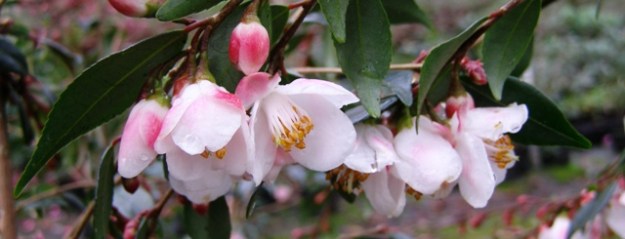
Camellia minutiflora

Camellia minutiflora

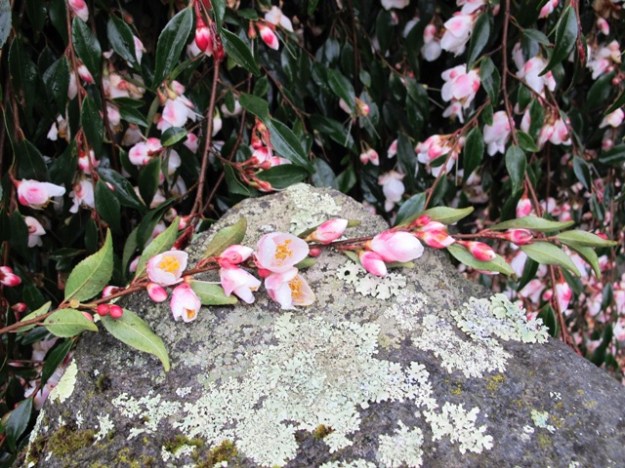
Before we finish camellia season for the year, I would like to introduce one of my absolute favourites. The foliage is small and dark and the branches are long and pendulous so it has a weeping habit. The tiny red buds open to masses of tiny white flowers with a deep pink flush. It is delicate in appearance and so pretty. The original plant came from Camellia Haven in Papakura (now closed) and has only ever reached a metre in height.

We are so taken by this cultivar that we have trained up about a dozen plants to a taller height, ready to plant out in our new garden. Imagine a miniature, evergreen weeping cherry and you may get a mental picture of the effect we are after with these plants.

It appears that the Chinese have reclassified this plant as a variant of another species so its correct name is Camellia lutchuensis var. minutiflora. As it is their plant and they have professional taxonomists, I am happy to accept their decision. C. lutchuensis has similar tiny foliage though much paler in colour and inclined to yellow in the sun, similar flowers though creamy white without the red and it is the most scented camellia of all. I cannot get any scent from C. minutiflora but it is superior as a garden plant.

This is a species. It can be raised from seed. If you can’t find it for sale but know of a plant somewhere, check around its base for seedlings.

After maybe 15 years, the plant is about a metre tall - C.minutiflora

After maybe 15 years, the plant is about a metre tall – C.minutiflora

First published in the Waikato Times and reprinted here with their permission.
Pruning and shaping

Ulmus Jacqueline Hillier after pruning. For the avoidance of confusion, this plant is only 3m by 3m, not a forest giant.

Ulmus Jacqueline Hillier after pruning. For the avoidance of confusion, this plant is only 3m by 3m, not a forest giant.

I am married to a master pruner. I recognise his skills are hugely greater than mine. This was reinforced when he pruned the Ulmus Jacqueline Hillier at the weekend. This plant is meant to be a dwarf but it is looking less and less dwarf-like in our rockery and needs attention most years to keep it to a suitable size for that location.

At the end of the better part of half a day, he asked me how I thought it looked. In fact it looked very similar to how it had looked when he started. It is a plant with a lovely characterful shape and fan like sprays which hold the tiny leaves. There was close to as much lying cut off on the lawn as there was left on the shrub but you would not pick that. It had been reduced considerably in size and scale but had lost none of its form or shape. That is good pruning, dear Readers, as opposed to the butchery carried out by lesser mortals.

There was almost as much on the ground as left on the plant but you could not tell that by looking.

There was almost as much on the ground as left on the plant but you could not tell that by looking.

Such dedicated and meticulous pruning takes time, skill and sharp hand tools.

We joined a garden tour in the north of Italy some years ago and anyone who has visited those grand Italian gardens will know that most are clipped and shaped to within an inch of their lives. In fact they are so heavily clipped and groomed that plant health is often not that great. It is all about form and shape and very labour intensive.

Similarly, we have looked at the meticulous bonsai specimens in the Chinese gardens in Singapore. These are tended constantly by people with nail scissors, I kid you not. It may not be nail scissors exactly, but they were definitely nipping and snipping with scissors of some description. Surgical precision and detail. Again, labour intensive.

We lack the personpower here to carry out that sort of heavy clipping and shaping. Oh, to have a small army of serfs that we could upskill and then reward with a hovel in which to live and the occasional sack of spuds. But even then, we would not want a heavily contrived and clipped garden, preferring instead to go with some degree of natural harmony. It is all about degrees, however. Gardening involves a whole lot of management and manipulation to get desired effects.

Once the initial shaping and training is done, it does not take huge skill to maintain it. These are just camellias used as shapes in the garden.

Once the initial shaping and training is done, it does not take huge skill to maintain it. These are just camellias used as shapes in the garden.

Getting the initial shaping on plants is the skill, or bringing an over-sized specimen back to a more manageable size and shape. Once it is done, it only takes a moderate level of skill and care to maintain it.

I have watched Mark bring a wayward plant into line and that is why I am happy to concede his skills are so much greater than mine. He takes his time and he concentrates. He is up and down the ladder repeatedly (despite this playing havoc with a dodgy knee joint), viewing the plant from all angles at all stages. Major cuts are very carefully considered because you can’t glue a branch back on if you make a mistake. It is all about finding the natural shapes within the plant and highlighting those.

Frankly, it would often be faster to cut a plant out, even if it then involves major work removing stumps and roots. But if one forever removes plants when they get some size and maturity, then there is never a chance for them to develop character and the garden will remain perpetually juvenile.

All this comes back to the fact that we use plants as features and focal points in our garden, not ornaments. We prefer to clip a strategic plant here and there than to paint the outdoor furniture a different colour or place an urn.

First published in the Waikato Times and reprinted here with their permission.