Tag Archives: Jury magnolias

Magnolia Diary 11, 9 September 2009

Click to see all Magnolia diary entries

Click on the Magnolia diary logo above to see all diary entries

Magnolia Serene, the last of Felix's selections to flower each season

Magnolia Serene, the last of Felix's selections to flower each season

Our magic spring has continued with no wind. A magnolia flowering season with a bad weather factor of only two short lived storms is a good season here. Though I am told that in the south of the province, a series of severe frosts have taken out most of the season’s display. In the deciduous magnolias, Burgundy Star flowers on and is still looking good whereas Felix’s series (Iolanthe et al) are now past their peak. Iolanthe will continue on for weeks yet, but not in her full glory. Serene is still opening. This is one variety that we have been surprised has not had more recognition overseas. Good pink colour, flower form and size, flowers later but still on bare wood and a tidy, well behaved tree. Being liliiflora x Mark Jury, it has reasonable hardiness.
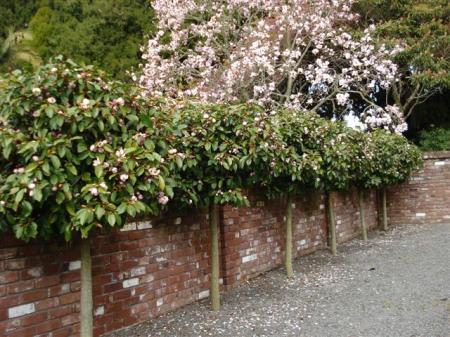
Lollipopped Fairy Magnolia Blush with Magnolia Iolanthe behind

Lollipopped Fairy Magnolia Blush with Magnolia Iolanthe behind

It is full on michelia season. Fairy Magnolia Blush continues in flower and the lollipop row on our frontage is looking good. They were planted in quite harsh conditions (compacted old driveway, in some cases) about five years ago but haven’t minded a bit. I give them a light clip twice a year to retain the shape but otherwise they are left entirely to their own devices.

Mark’s Honey Velvet is in full flower. This is a Magnolia dianica (syn: Michelia yunnanensis) selection and every nurseryman, woman and dog has their own selection made now, so easy is it to raise seed. All we can say about Honey Velvet is that it has a honey cream coloured flower (rather than white) of good size, wonderful bud set, longer flowering season than some and good dark foliage. And it does not appear to defoliate in a cold, wet spring as some of the dianicas do. Other than that, we can’t get too excited about what is just a species selection.
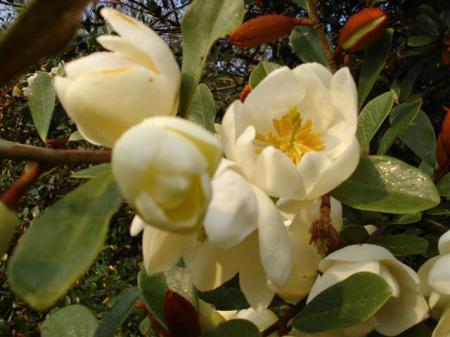
Honey Velvet, Mark's dianica selection

Honey Velvet, Mark's dianica selection

We can and do get excited about the michelia breeding programme and the increasing range of deeper flower colour and size we are starting to see as Mark continues down the track of ever more complex downstream crosses. We can see real progress here but that, alas, is all we can say publicly. It was a bit of a red letter day here yesterday as Mark decided that he was happy to give the go ahead on another deciduous magnolia. Mark has only ever named three magnolias in a breeding programme which has built on his father’s work and thus spans close to five decades now with many hundreds of magnolia plants raised. So to make the decision on a fourth one is no light matter. It is still a long haul from here through final trialling and production before it ever gets anywhere near the marketplace but all we will say officially is that this one is not red.

Magnolia diary 10, 7 September 2009

Click to see all Magnolia diary entries

Click on the Magnolia diary logo above to see all diary entries

We are trying to decide whether the magnolia flowering this year has been a little earlier or whether we have been wrong in the past when we talk about peaking in the first week of September. It is an open verdict but certainly our early reds peak in July and August. While we still have plenty in flower, the best has now passed for 2009. Leonard Messel and our white stellata flower on. While they lack any substance in flower form, they certainly make up for it in prolonged flowering and there is charm in their spidery simplicity.

Lotus, the unsung hero in the big white class

Lotus, the unsung hero in the big white class

Even the nursery plants of Lotus have flowered this year

Even the nursery plants of Lotus have flowered this year

Burgundy Star continues to look fantastic in our carpark area. On the tree, it certainly looks the purest red of any of our red varieties so far. But it is the whites we have been looking at in recent days. Manchu Fan flowers on and, for our money, is unsurpassed as the best performing white goblet type for small gardens. Mark went through the Esplanade Gardens in Palmerston North (about three hours drive south from us) last week and Manchu Fan looked equally good there. Manchu Fan is an American hybrid from Todd Gresham. But for larger gardens, it is Lotus that we have been having a second look at in the whites. It looked particularly good in the Esplanade too and it has been superb in our park. We have even had nursery plants setting good flowers this year. Lotus is rather the unsung sister of Felix’s series of lennei alba x Mark Jury hybrids, coming in behind Milky Way and Athene. We didn’t promote it as enthusiastically because while it has a perfect flower form, we thought it took longer to settle in to flowering and considered Milky Way to be a better commercial plant. Now we are thinking that we have underestimated Lotus and it is a quiet achiever that can hold its own in the big white class.

Mark calls it the Fab Ab series in our North Garden

Mark calls it the Fab Ab series in our North Garden

The current overall winner in the big white class are the seedlings in our North Garden that Mark has started referring to as the Fab Ab series. I am not sure that I wish to be immortalised as Fab Ab but we are certainly having another look at these big bold whites which are performing well year in and year out.

Flowering this week – Magnolia Iolanthe

Iolanthe - unsurpassed this week

Iolanthe – unsurpassed this week

Yes, I admit it we are rather dominated by magnolias at the moment but at this time of the year we live and breathe them and the current all-round-simply-astounding plant has to be the original Magnolia Iolanthe. It is a tree of grand proportions after nearly fifty years and in full flower, it really can take your breath away. We describe it as the original Iolanthe because it really-o truly-o is the first plant, grown from a seed of a controlled cross by Felix Jury. A controlled cross is a deliberately managed hybrid, as opposed to a chance seedling. He heeled a number of the resulting seedlings into his vegetable garden, intending to plant them out to beautify Waitara but Iolanthe popped open a flower. And even that first flower indicated it was pretty special. So special in fact that the plant remained where it was heeled in and these days Mark is moving the vegetable garden rather than attacking the tree. All other Iolanthes around New Zealand and the world have been propagated in the first instance from the tree that graces our driveway.

We still rate Iolanthe as a top variety in the soft lilac-pink and cream colour range. It has a very large flower and because it sets flower buds down the stem, the flowering season is long. If one set of blooms is damaged (the hail storm on Tuesday last week wasn’t great and nor was the follow up last Sunday), within a week a fresh set of buds opens. And there is a second flowering in summer. We did once see Iolanthe plants being sold in a garden centre with labels describing it as a small tree to two metres. I don’t think so, but if you have sufficient space, Iolanthe is unlikely to disappoint..

The inspiration for the name came from the late Iolanthe Small, the dedicated plantswoman who spent the better part of her lifetime working in the Fernery at Pukekura Park.

Magnolia Diary 9, 1 September 2009

Click to see all Magnolia diary entries

Click on the Magnolia diary logo above to see all diary entries

Iolanthe yesterday morning after the storm - the petal drop was prodigious

Iolanthe yesterday morning after the storm - the petal drop was prodigious

Another fierce storm here two nights ago sorted out the durable magnolias from the fly by nighters. Poor old Mark Jury has gone for the year. He only looked sensational for a week. But his progeny are faring better. It is pretty remarkable how much petal drop we can get from Iolanthe and still have a tree full of flowers. The winds blew the petals over 40 metres away. These are short, sharp incidents of storms which last a few hours only but the strong winds and torrential rain certainly causes damage to magnolia blooms. Viewed from a distance, Felix Jury looks great but seen close up, there is quite a bit of damage and bruising and it is the same story on Iolanthe, Milky Way, Lotus and Athene. Cultivars which flower down the stems (as opposed to the short lived stars which set flower buds only on the tips so there is one mass flowering and then it is over) extend the season and there is a second chance to open undamaged blooms. Our white stellata is bravely flowering on through all conditions. Suishoren can blow apart rather easily whereas Manchu Fan takes pretty well all the bad weather in its stride.

Burgundy Star opening its flowers

Burgundy Star opening its flowers

Burgundy Star is the last of our reds to open and the original plant in our carpark is nowhere near to peaking yet. It is a very dark red and on the tree appears to have lost much of the magenta tone which can dominate the other reds. Mark is still hoping that he will get a good plant which is pure red (and we have some hopeful candidates on the track) but in the meantime Burgundy Star makes a very deep red pillar. It being three quarter liliiflora nigra, we are hopeful it may have more hardiness than some of our other selections.

The Snow Flurry series flower on

The Snow Flurry series flower on

Serene is the last flagship magnolia to flower here and is just opening the first flowers. None of the American yellows are open yet, but these mostly flower too late for us and are breaking into leaf at the same time. The doltsopa hybrid Snow Flurry series of michelias flower on and are wonderfully rewarding. The season on the michelias lasts considerably longer and we have many to follow. Alas we have to be very circumspect about what we show of new breeding lest it cut across the chance to patent later so this diary will not be showing the flowerings which make us most excited here.

Magnolia Diary number 8, 29 August 2009

Click to see all Magnolia diary entries

Click on the Magnolia diary logo above to see all diary entries

Mark Jury in full flower

Mark Jury in full flower

Back in the 1950s when Felix Jury was establishing the garden here, one of the plants he coveted was Magnolia Lanarth. He ordered it from Hilliers in the UK. History is a little vague as to what number and form the plant material took (scions or plants) but it included a seedling which, when it flowered after a number of years, was clearly not the solid purple flower of the chosen cultivar. No, instead it was very large and pale lavender pink and white. Enquiries from Hilliers established that it was most likely a cross between Lanarth and sargentiana robusta. Felix did manage to establish true Lanarth (Magnolia diary entries 1 and 4 have photos of the splendid specimen after fifty years), but the chance seedling proved to be the jump start for a breeding programme. Felix subsequently named it Mark Jury, for his youngest son and it has been distributed in the trade both in New Zealand and overseas. We have never promoted it widely ourselves. Although it makes a splendid large tree for a park, we think the next generation are superior garden plants.

Athene

Athene

From Magnolia Mark Jury came Iolanthe (ref Diary 7), Milky Way, Lotus, Athene and Atlas (all involving forms of lennei) which are all flowering now. Apollo too is flowering (this one does not have Mark in its lineage, being thought instead to be a liliiflora nigra hybrid crossed with Lanarth). Picking favourites is all about taste. Iolanthe has an exceptionally long flowering season and a large flower with good colour here (though we were disappointed at how it looked in Switzerland at Eisenhuts and it does not appear to be the stand out performer in the UK and Europe that it is here). Lotus has a perfect form in pure cream but can take 5 or 6 years to settle into good flowering. Athene has blooms which in our eyes are simply beautiful. Atlas had the largest flowers imaginable until rivaled by Felix. Apollo is our best purple so far. Milky Way is just an all round top performer. What more can we say? Felix’s legacy is still remarkable.

Magnolia Apollo, Felix's best purple

Magnolia Apollo, Felix's best purple