

In the absence of a photo of the Isola Madre steps, I give you Villa d’Este steps even though they are not the same. And they are missing the elegant white peacocks.
In all the gardens I have seen, two sets of steps are etched in my memory. The first is the graceful flight leading down to the original boat landing on Isola Madre in the northern Italian Lago Maggiore. I do not think I even have a photo of it and I failed to find one on a cursory look on the internet, so you will just have to imagine a long and sweeping set of stone steps, populated these days by oh-so-exquisite pure white peacocks rather than ladies in long gowns.
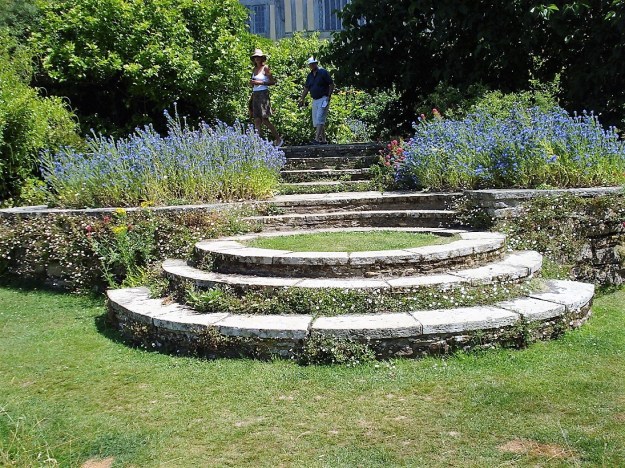
Lutyens steps at Great Dixter
The second enduring memory is of a style, not a particular set of steps. The circular Lutyens steps from the early twentieth century, seen in many gardens but perhaps best known from Hestercomb and Great Dixter. We wanted some of our own as soon as we saw them. It has taken a decade, but we are into slow gardening here. Finally, we had a location where we needed steps and where we had enough space to consider steps that would be a design feature, rather than utility access. And let me tell you, executing such steps is not as simple as it looks, even when you have had a good close look at them.
One of the lessons I took away from looking at a garden that I wrote about at the time as being the closest to perfection that we have ever seen, was the importance of quality construction. I am not big on what I call ‘veneer gardening’ – somewhat like theatre set design but in a garden context. It may hit with the wow factor but soon becomes tacky and doesn’t last the distance. The same goes for poorly executed constructions and installations. Good design and construction underpin a good garden over time. We wanted to get our steps right.
Fortunately we have Our Lloyd who is a perfectionist with a good eye, backed up with his theodolite, string lines, tape measures and various other accoutrements. Even so, it took three goes and three sets of eyes to get it right. The site does not have a large fall and the two levels are defined by small brick retaining wall. We figured the steps needed to be two metres wide so that is the distance between the two small pillars. Firstly, Lloyd mocked it up for us to look at. I was slightly disappointed that the mock up did not have the generous look I was hoping for but Mark picked the problem at first glance. Lloyd had laid it out so the widest point was two metres, not starting with the inner circle being that diameter.
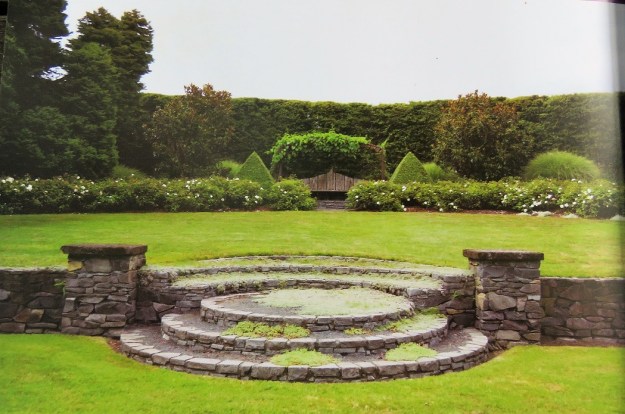
From a book – the circle of steps is fully contained in the gap of the small retaining wall.
It is the same mistake, I think, that is found in this set of steps photographed in a book we had. To be fair, that may have been how they wanted their steps, but it wasn’t how we wanted ours. We only have sufficient fall to get three wide, shallow steps – one set back into the top level and two opening out to the area that is destined to be planted as the Court Garden this autumn. The second glitch came when we realised after the initial construction, that the outward facing bricks to the central circle needed to be set lower than the bricks on the top half circle. On the top, those bricks are the riser, on the lower side, they are the retaining edging and the riser to the next step down so they are set at a lower level. It is surprisingly complicated.
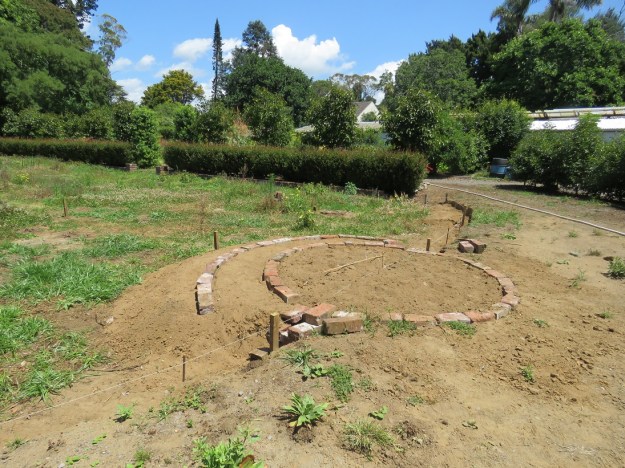
Mock up number two (I did not photograph the first one) – the inner circle is now the width of the opening but the top step set into the terrace has yet to evolve so it is a flat circle

The next mistake was not to drop the half circle on the left during construction
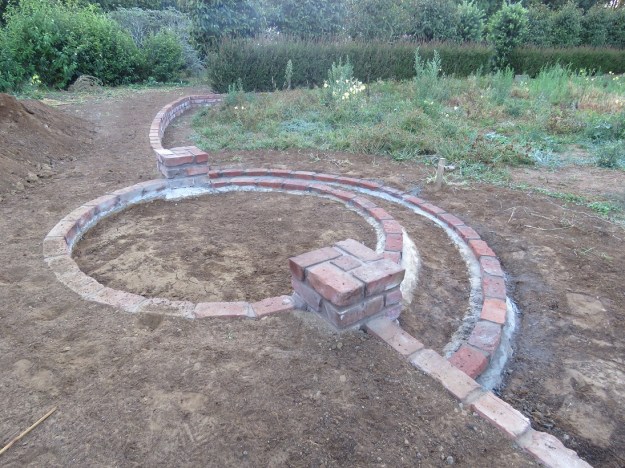
Getting there.
The thing about circles is that when you expand the diameter, the circumference increases hugely. The final width at the lowest point is about three metres. I think I am going to really like these when they are completed. At this stage, the plan is to fill the centres with compacted hoggin (golden, crushed limestone). We don’t do fully bricked steps in our climate. With our high humidity and rainfall, they get mossy and dangerously slippery very quickly. I like the colour of the hoggin, it is said to compact down to a very hard layer, is durable and cheap and cheerful. I am hoping to use it for the paths through this area although Mark has flagged a concern that, being limestone, it will leach into our acid soils and alter the pH so we are still pondering this matter.
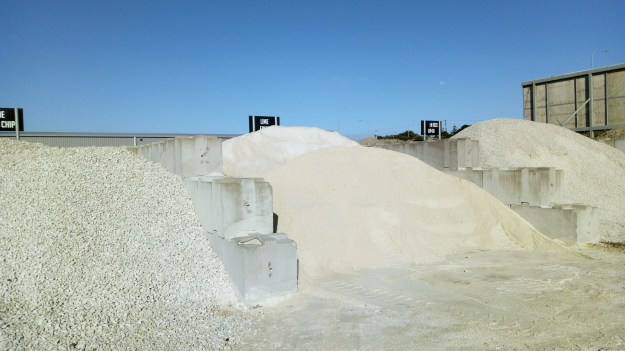
Lime chip to the left, lime fines, more soft golden yellow than white, in the middle.
At the other end of this large space, we need another set of steps but in this case, the low brick retaining wall is straight, not curved so we will do straight steps.
But, here is food for thought. My landscaper friend, Tony, looked and said, “You will set the steps back into the top terrace and not build them outwards into the lower space, won’t you?” And I admit it had never even occurred to me that this was a decision that needed to be made. I had just assumed we would build them outwards into the open space. But the visual effect is going to be very different, depending on the design decision made. Because the top terrace is not so wide, we may go half and half – perhaps the top step set back, the middle step set between the small end pillars that will define the space and the lower step set leading into the large, open area.
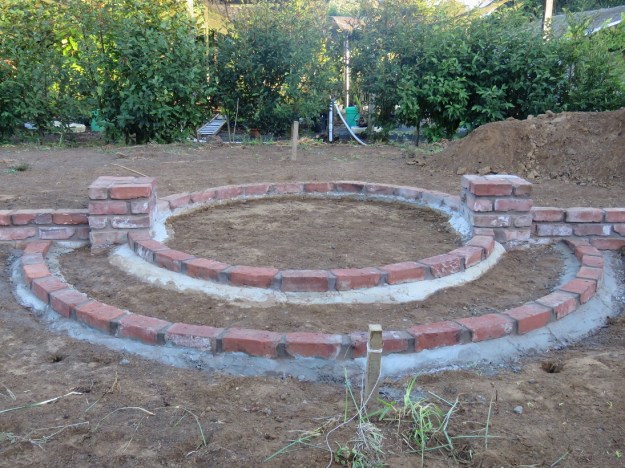
It took a while, but I think we are right now and they will be graceful, wide, shallow steps
No-one will ever look at these steps as closely again, bar the occasional professional, perhaps. But that is as it should be. The hard landscaping plays a key support role to a garden but it is not the star, at least not in our style of gardening. If it is right from the start, it will define the area and play a key role in how the garden is seen and experienced. If it is wrong or badly executed, it becomes an ongoing irritant, maybe just a nagging regret or sometimes an ongoing issue.
An earlier photo sequence I did of different styles of steps – from back in the days when I wrote for the Waikato Times – can be found here.

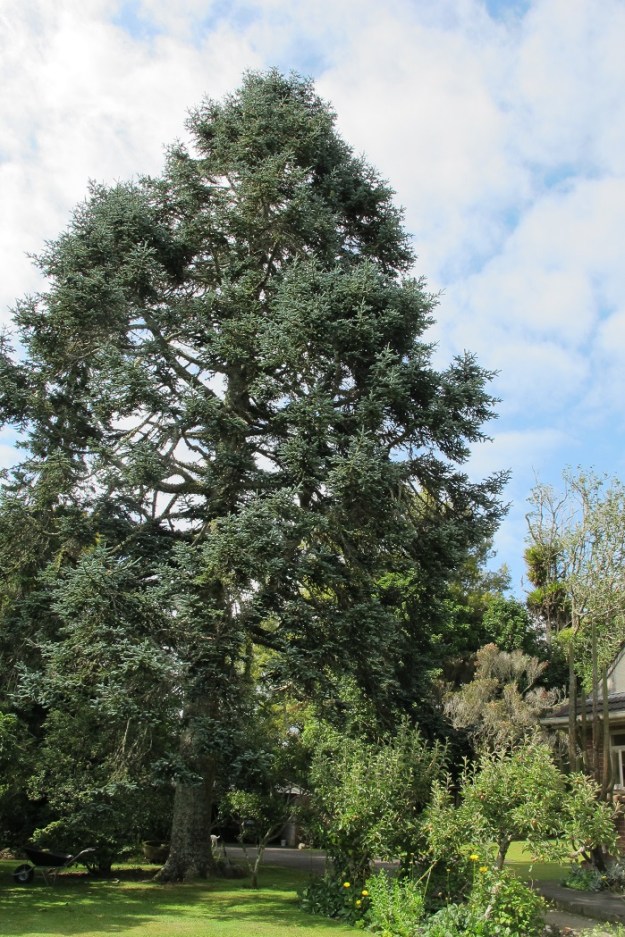
 Oh look, here is a little photo taken earlier. Best guess is that it is early 1960s, when Felix planted it in the rockery. I am reassured that he, too, could plant without doing adequate research on ultimate size. Or maybe he thought it was a dwarf conifer at the time. At least he moved it out of the rockery while he could but it would have been helpful had he moved it more than 8 metres from the house. It is now over 20 metres tall, though not very wide, and we are psyching ourselves up for its removal. Should it fall (and it did have an issue with rot at its base, though that appears to have healed over time), it is likely to take out a good part of the house, starting with our bedroom. It is one of those major and expensive jobs that we know is coming up sooner, rather than later. Beautiful tree. Wrong location.
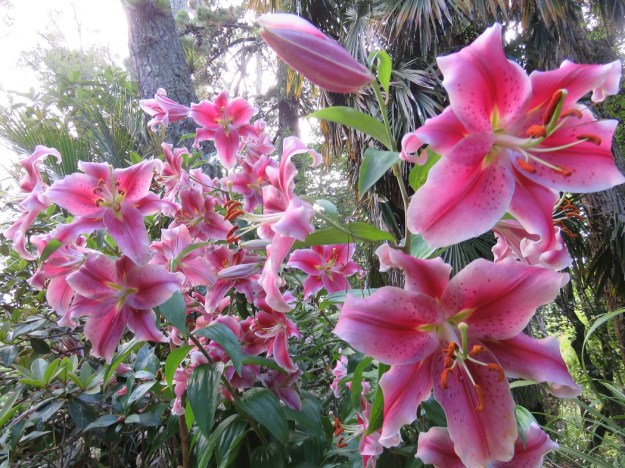 Auratum lily time is a delight, a joy even. Showy, over the top, flamboyant but glorious. And we are just entering these weeks of glory.
 We grow lilies in the better lit areas of woodland. They can get somewhat stretched reaching for the light so need more staking when not in full sun. I am rounding them up to limit the areas where we have them growing in order to make that seasonal staking task easier. But they certainly light up the woodland margins.
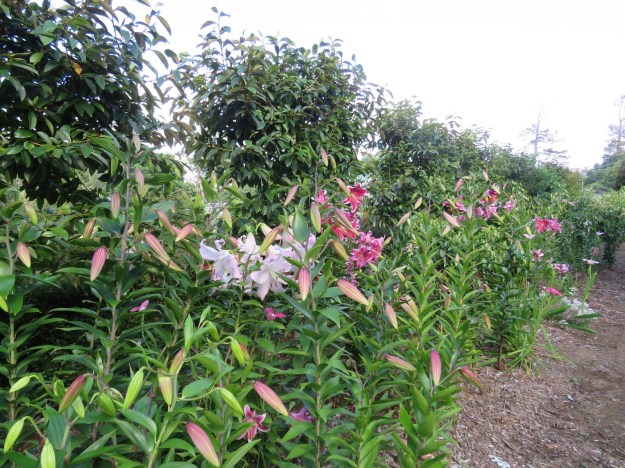 The new lily border has just opened its earliest flowers. These are the result of a determined and sustained effort to
  Almost all of ours are unnamed hybrids raised by father and son – first Felix and now Mark. Felix named a few that we used to sell but they are pretty mixed in the garden now. All are outward facing, not upward facing. That was one of the breeding aims. Upward facing lilies act as leaf and debris catchers and weather-mark badly.
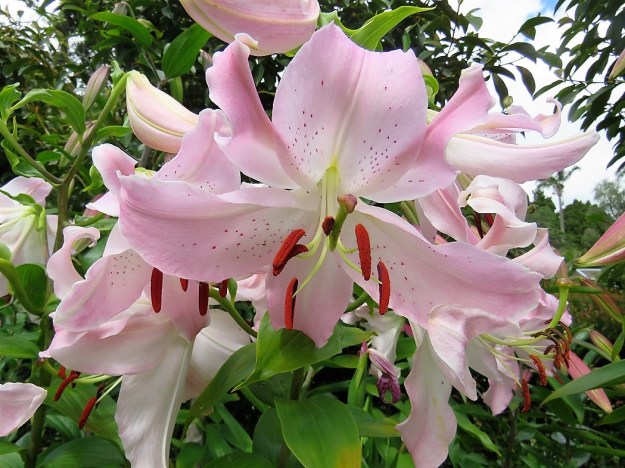 Of them all, I think these soft, marshmallow pink ones of Mark’s raising may be my favourite. Or it could be another one in a few days’ time.
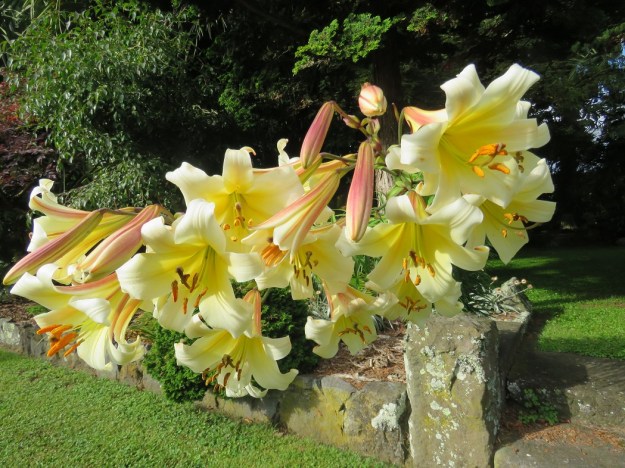 Finally, just in case there are any lily experts reading this: I assumed these trumpet lilies elsewhere in the garden are an unusual, honey-coloured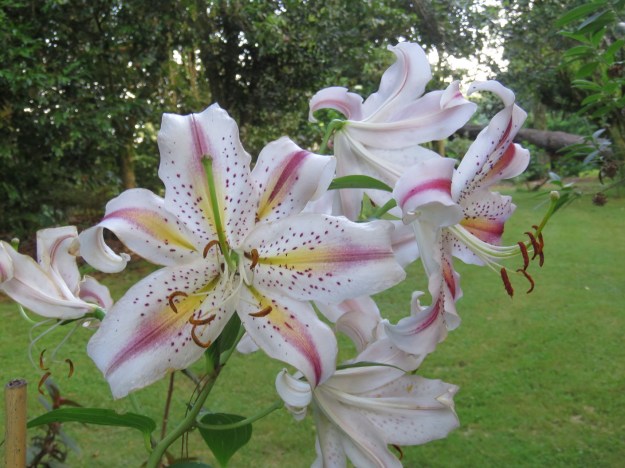

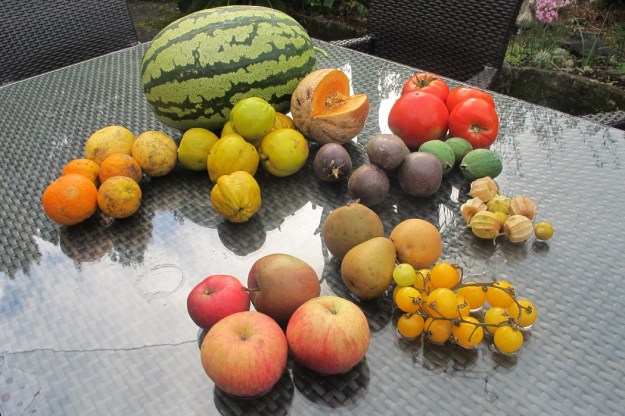
 That got me thinking. Do we eat twenty-five different fruit and veg week in and week out? The recommended daily intake of five plus is no issue, but that is servings of fruit and veg, not different types. We are large consumers of fresh fruit and vegetables but do we reach twenty-five different ones? When I say we eat a lot, we are maybe 90% vegetarian these days. Mark starts his day with avocado on toast, I have fresh fruit and muesli. Lunch is always a fresh fruit salad with five or six different fruits and Greek yoghurt. Dinner includes a fresh salad, a cooked green vegetable and a vegetable and carbs-based dish that contains protein. We can eat like this because we produce most of our own food, though I use the word ‘we’ in the royal sense. Mark grows the food crops. Were we buying all our food, I can’t imagine that the range of fruit and veg we eat would be anything near its current level. I blench at the thought of traversing the supermarket fresh produce section for the weekly shop and trying to select twenty-five different options. I mean, how many more of those resusable mesh produce bags would I need? (Answer: another nineteen).

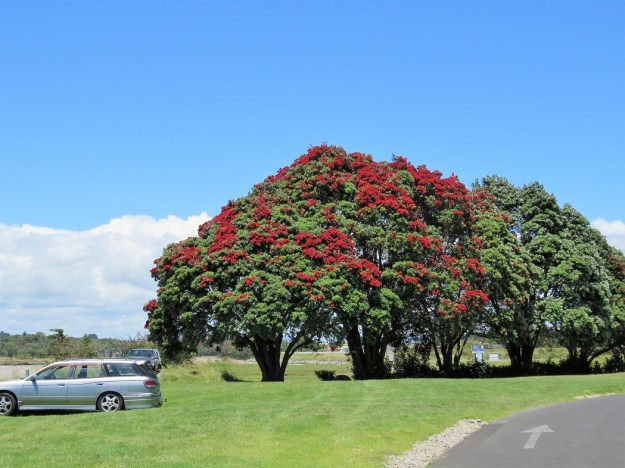
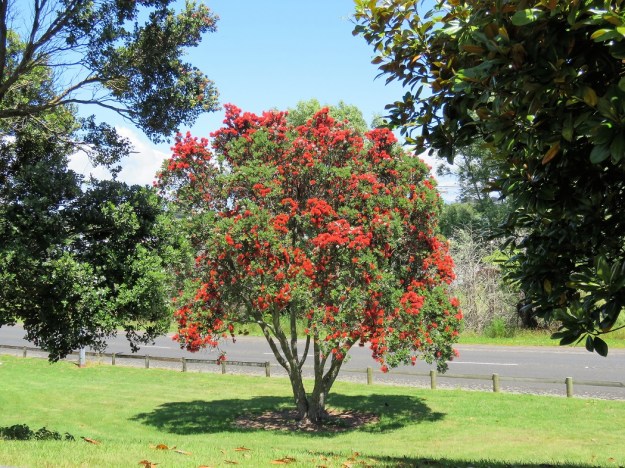
 The story of a New Zealand Christmas is inextricably bound up with the annual blooming of our native pohutukawa trees – Metrosideros excelsa. Truth be told, they only occur naturally as far south as northern Taranaki where we live and Gisborne across the island, (but not in the middle where it is too cold for them). Fortunately, most of the country is happy to go with descriptor of the New Zealand Christmas tree.

 Tikorangi The Jury Garden