
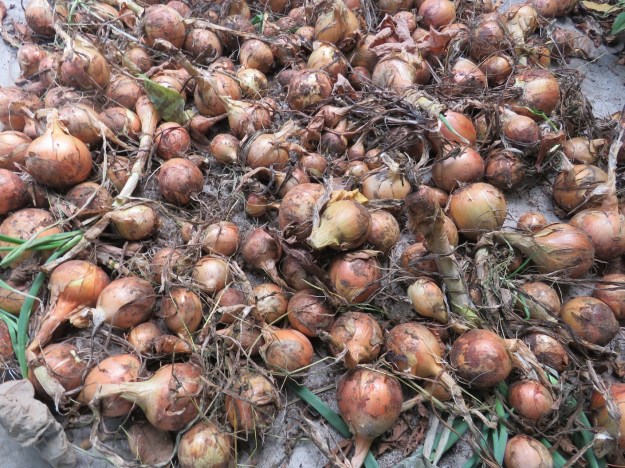
 The onions are not the main purpose of this story – more on those a little later. They are just more visually appealing than the sight of rubbish sorting at its most basic level.
I mentioned in last week’s post the heartening sight of how little landfill waste was generated by the 50 members of the IDS when they lunched here. This week it was a coachload of Massey University environmental ecology students who visited. I put out my labelled pots for the waste, curious to see how they would respond. They passed with flying colours. Of course they did. What else would one expect from these young people on whom rests so much hope for the future?
 I now realise what I have failed to do is to photograph the lunch food laid out for these large groups. Therein lies the key to minimising inorganic waste. With the IDS, the menu included quiches cut in squares, small filled rolls, green salad and fresh watermelon for dessert. And coffee, tea and chilled water served from large jugs. All the food came out on china or wooden serving dishes. The only disposable items used were the cardboard ‘plates’ and bamboo forks.
The students had an expansive range of options from which to assemble their own filled rolls and sandwiches with fresh fruit to follow. Plus the option of yoghurt and treats like muesli bars which admittedly generated individual waste. But the bulk of the food was in multi-use plastic containers and even the butter came cut in individual cubes from a large block so there was no packaging needed and no wastage. The students had been told to bring their own water bottles which they refilled from a nearby tap.
I have learned two things. If you set up a situation where individuals are expected to sort their waste, they do it but most waste is reduced by the steps taken in the catering. We have become so used to individually packaged portions – marketed as being both convenient and hygienic – that many people have forgotten that it used to be done differently and sometimes that is better. A sandwich or filled roll prepared on the spot to one’s own tastes is hugely preferable to getting one somebody else prepared four hours earlier and then left to sweat in its own plastic cling-film wrapping.

Soy beans! Part of the Tikorangi soy bean crop
Waste is much on our mind here. Hence the onions seen above. And the delight at a successful soy bean harvest. Why onions and soy beans when they are extremely cheap to buy, you may wonder. Why not grow the higher value crops? We grow those too, or at least Mark does. Space is not a problem for us. But commercial onions are reputed to be one of the most heavily sprayed crops and we know ours are spray-free. And soy beans may be cheap as chips but they also come with very high food miles. The food miles are on our soy beans are zero. Besides, when it comes to taste treats, freshly picked edamame beans steamed and sprinkled with a little rock salt is right up there as gourmet food.
Not all crops are worth growing. The peanuts gave a really good yield last year but were so tedious to de-husk by hand that even Mark decided they weren’t worth the effort. He is quite happy to prepare the beans, seeing his attempts to produce as much food as he can from our own property as a worthy challenge. Not only does it hugely reduce the amount of waste we personally produce but we also know the origin of our food, the conditions in which it has been grown and the age of the produce.
This all feels like a return to where we were at back in the 1970s, though we are more lined and more experienced now. If more of us had stuck with that rejection of consumerism back then, maybe the world would not be in such a parlous state.
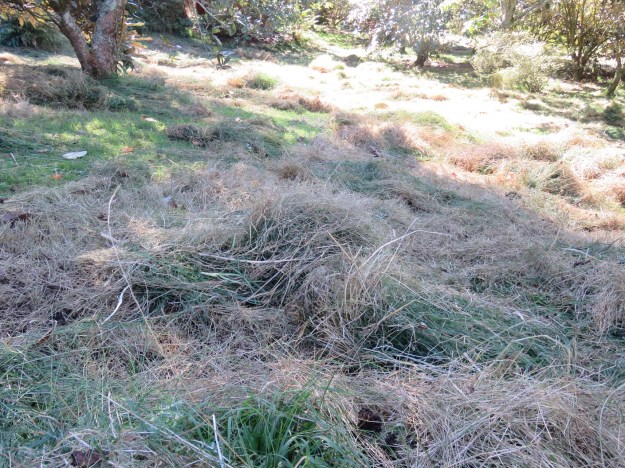
One man has indeed made a good start on the annual a-mowing of the meadow
Applying related principles of lightening our footprints on the land to the ornamental garden is an entirely different topic because there is the added factor of aesthetics. We are spending a lot of time discussing and experimenting here but in the meantime, I can tell you that one man went to mow, went to mow the meadow. With our smart new sickle-bar mower because that is all that could handle the mountains of meadow grass. So much grass, in fact, that Mark was wondering if we should be teaching ourselves the old skills of building haystacks. This current and most major mowing is just the latest instalment of an ongoing experiment. How far can we change our gardening habits and tread more lightly on the land yet still be happy with the high aesthetic values we strive for in the garden? Time will tell.
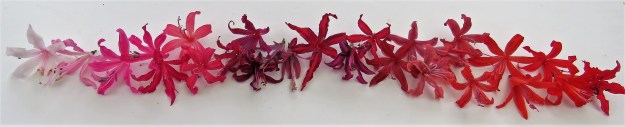


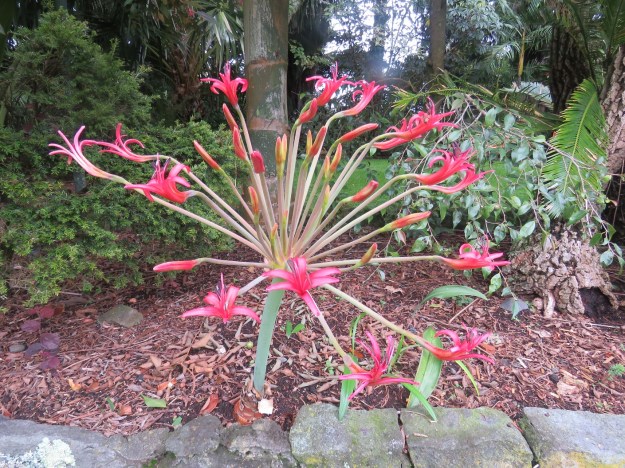
 Autumn is also
  With our garden closed to the public these days, we don’t accept many tours or groups but the New Zealand chapter of the IDS (International Dendrology Society) was an exception a few weeks ago. Of all the horticultural societies we have encountered over time, the IDS remains our favourite. It attracts the most interesting and knowledgeable people and we really enjoyed their visit. There were 50 in the group and they ate lunch here.

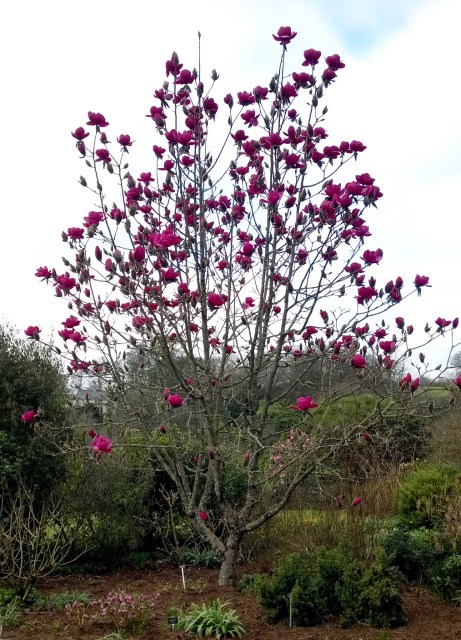 We are generally accustomed to seeing Jury plants growing in different parts of the world, though sometimes it generates a special thrill. A UK friend sent this photo of Magnolia Felix Jury in bloom at The Garden House in Devon last week. We had seen this particular tree growing strongly several years ago but it was summer, so in leaf, not bloom.
 Even I found it touching to see Mark’s delight at the specimen of Magnolia Felix Jury growing a few doors up from where our daughter lives in Canberra. He felt it was like having a touch of Tikorangi in her street. Canberra is not exactly Magnolia Central so if ‘Felix Jury’ blooms as well there as at The Garden House, it will be a showstopper. The house owners were a tad surprised when I knocked on their door to ask if I could take photos and explained why. They also had Mark’s Fairy Magnolia Blush growing to the immediate left of the umbrella. Nothing illustrates the stark difference in climate to here more than an astroturf lawn.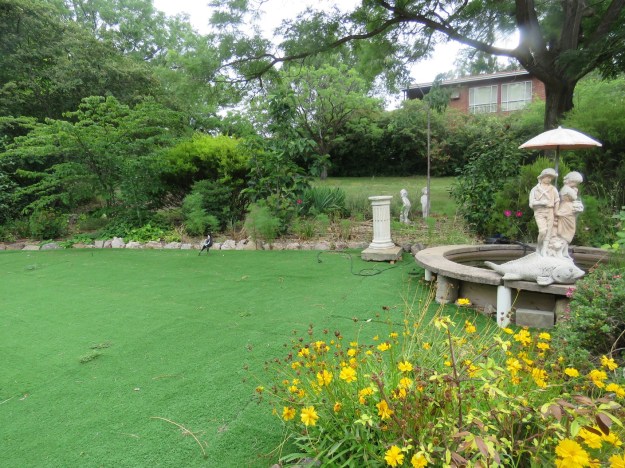
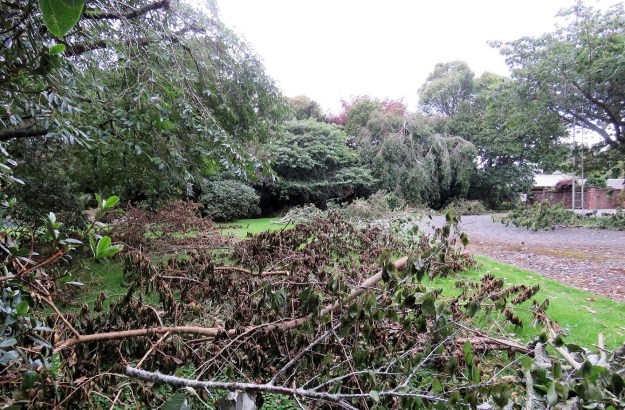
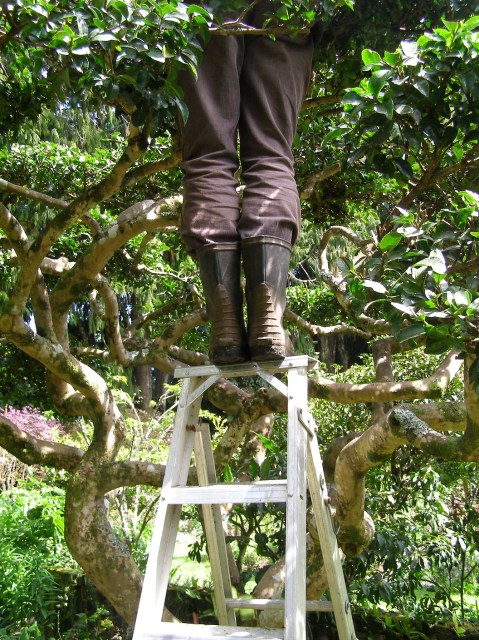
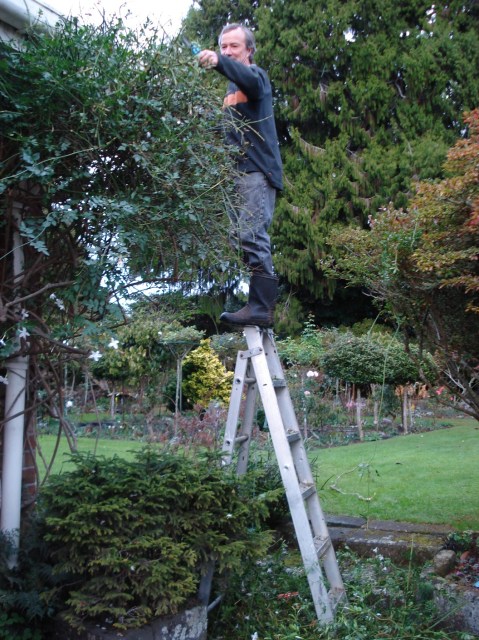 Mark, being an agile and wiry man with very good balance, has given me the most alarming photos of how not to use ladders. Do not try this at home. He would like a disclaimer added that he is not stupid. He only does this with the ladder in a stable position and with something firm to hand that he can grab should anything go awry. Never with the chainsaw. He is extremely mindful of safety and caution with the chainsaw when mistakes can be fatal.
 Because ladders play such a role in our lives, we were pretty interested in this permanent ladder structure seen attached to a tree in a tourist park in Jinghong, near China’s southern border. Presumably this tree is climbed regularly to warrant the construction of a ladder, although the reason why was not clear to us at the time. It can’t be that good for the long term health of the tree to have the wooden pegs bored into its trunk but at least they are not nails.
 We spent Christmas in Canberra. Why Canberra, you may wonder. Or you may not. We are one of those New Zealand families where all three of our children have headed off into the merry blue yonder and the daughter with our first and only grandchild lives there.
 It was protection from the abundant and intrusive birdlife that saw the next door garden shrouded in white netting. The owners, Croatian migrants who escaped then-Yugoslavia in the 1960s for a better life in free Australia, were keen food producers growing many fruits and vegetables. It was an interesting visual effect, the shrouding of the garden, though you wouldn’t be able to expect a fruit crop in our humid conditions with the tree foliage compressed into tight domes.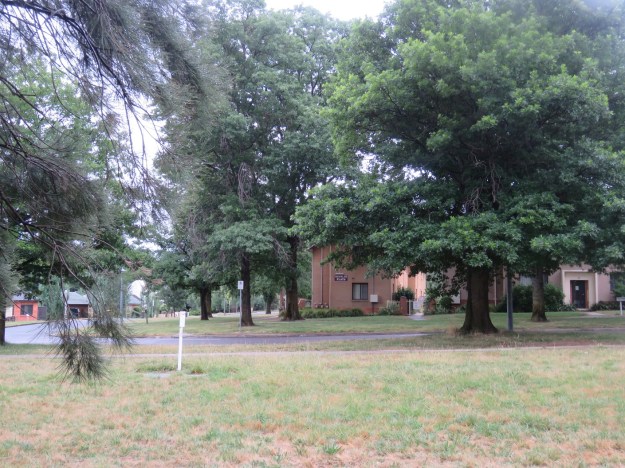

 Tikorangi The Jury Garden