Tag Archives: Mark and Abbie Jury

Romantic gardening

“He leaped the fence, and saw that all nature was a garden.”

                Horace Walpole from ‘On Modern Gardening’ (1780)

In New Zealand, we tend to place a very high value on tidy gardens. Edges, hedges and lawns, as I once heard a prominent gardener espouse. Attend to those and the rest of the garden will look fine – although, if it is a garden open to the public, it must also be weed-free.

I call this garden grooming, the outside equivalent of housework. It is a never-ending task to keep a garden manicured, but it is a matter of pride for many. You will likely be judged by your neighbours, relatives and visitors on how tidy your place is.

All those sharp lines and tidy edges give a high level of definition to a garden that makes for good photographs but they do not make my heart swell with joy.
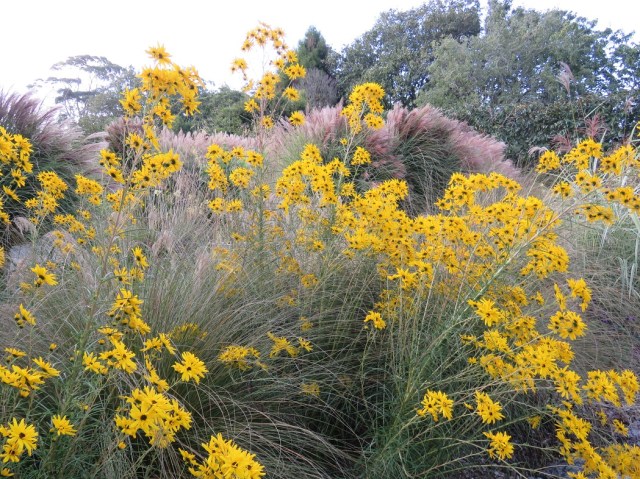
Helianthus and large grasses swaying in the autumn breeze here at Tikorangi

When I set out in 2009 to get to grips with contemporary summer gardens, primarily in the UK and parts of Europe, I was jolted out of that preoccupation with orderly, tidy gardens. There is a whole lot happening there and not much of it has to do with tidiness. I saw a generous profusion in the modern plantings, a fresh energy and vitality in the scale, the colour and the size of the plants that were never going to straitjacketed into obedience in a nice, orderly manner.

Current trends overseas are referred to as the Dutch New Wave, New Perennials, the new naturalism, naturalistic gardening, Piet Oudolf-inspired, prairie planting, the meadow revival, the Sheffield School movement and more. They all share certain features which come down to a principle of gardening with Nature, not gardening by controlling Nature. Many gardens sit on the landscape; these gardens sit within the landscape.

My gardening and life partner, Mark, and I landed on the term of ‘romantic gardening’ – a softer-edged, more naturalistic style that blurs the lines between the garden and the wider landscape. It is a different way of looking and it takes a different approach to managing the garden.
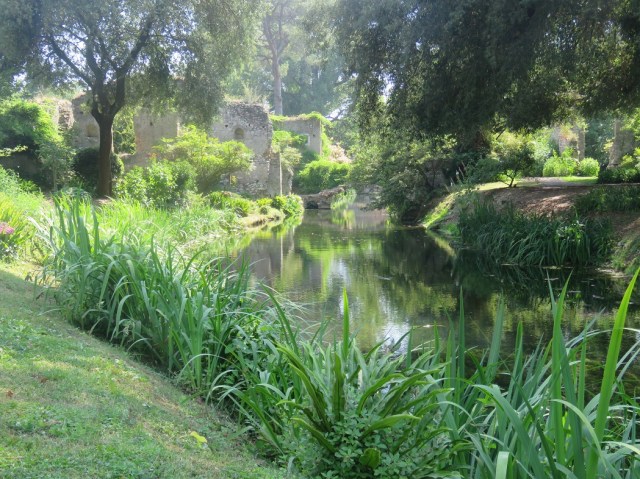
Ninfa Giardino di Ninfa, south of Rome, is sometimes described as the world’s most romantic garden.

“You must go to Ninfa,” English friends and colleagues said to us when we first started talking about romantic gardening. The English love Ninfa, which is in southern Italy near the charmless city of Latina. Sometimes it is even described as “the world’s most romantic garden”. Essentially, it is a looser, voluptuous style of gardening set within the ruins of an entire small town that was sacked in 1370 after being occupied since Roman times. How can the result not be romantic? It was very different to all the classic, grand Italian gardens where formality and structure gives the framework and the planting is largely an afterthought.
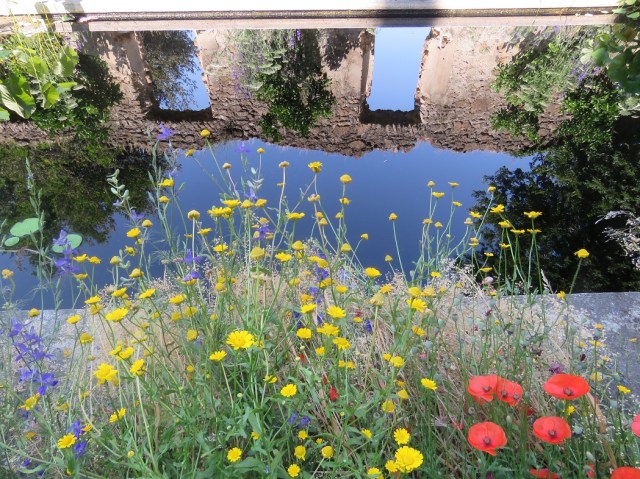
Torrecchia Vecchia is a modern example of what the Italians call the romantic, English style.

We also visited Torrecchia Vecchia nearby: a smaller, private garden which emulated some of the Ninfa style. It, too, was created around ruins, this time of a small village. On the day, I admit I was not blown away by its beauty, although it had some lovely areas. In retrospect, it has given me more to think about because it was a modern interpretation of what the Italians call the ‘romantic English style’. This is not surprising when you know it was created in the mid 1990s by leading English designer, Dan Pearson.

Given New Zealand’s distinct lack of abandoned villages, small towns or anything in ancient stone, we need to strip away the underpinning physical structures of these gardens to see what could work here. Trying to re-create the magic of historic Italy in tanalised timber or ponga logs is really not going to cut the mustard.
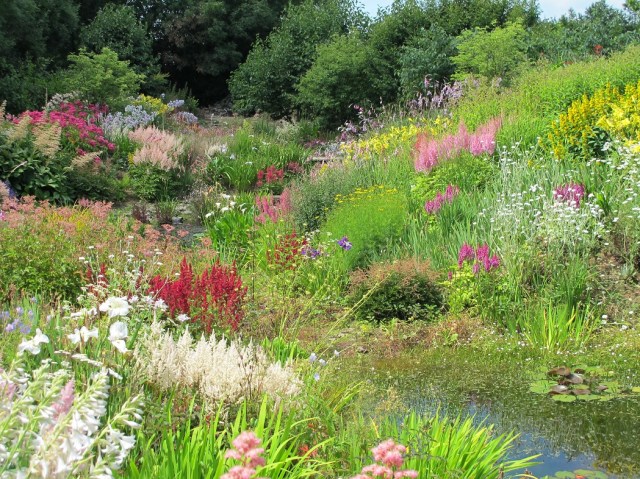
Wildside in Devon, UK, shows how a romantic garden can be created without hard landscaping

Without the human-made structures, the layers of history and romantic back stories that typically characterise ‘romantic gardens’ elsewhere, we looked to the natural landforms, plants and management strategies instead. “Enhancing Nature”, Mark likes to call it.
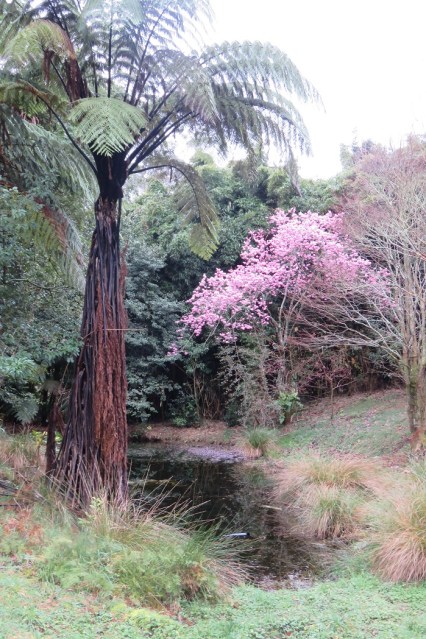
The simplicity of an early spring scene in the Wild North Garden is more romantic than stylish.   

For us, a romantic garden is one where the overriding sense is of being in the garden, rather than looking at the garden. English garden writer, Tim Richardson, talks about the difference between pictorial gardens and immersive gardens. Pictorial gardens are those where your eyes take in a pleasing view, where design and structure are usually the key elements. That is why they photograph well. Immersive gardens are more about the wrap-around experience, enveloping you in the movement, texture and colour of the close-up view.

This softer-edged approach of working in cooperation with Nature is underpinned by increasingly important principles – sustainability, support for natural eco-systems, better environmental practices, harmony and respect – while placing a high value on both prettiness and beauty. It is sometimes a celebration of the simplicity, rather than grandeur.
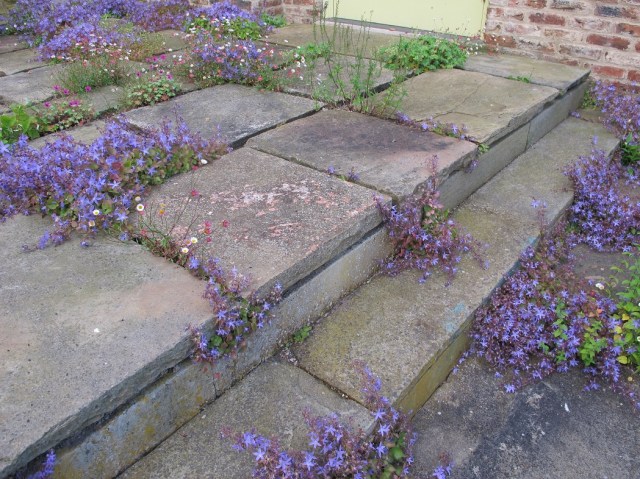
Softening hard surfaces by allowing plants to colonise the cracks and gaps

Romantic gardening is not tied to a particular garden design style: it can work with cottage-style, woodland, meadow, sunny perennials, or even just a suburban section. The exception is a formal garden which requires strict maintenance and precision for its impact.

It is a way of looking with different eyes and a different mind-set translating into gentler ways to maintain the garden. Moving away from sharp definition and excessive tidiness means a softer-edged garden, a blurring of hard lines so paths and garden are more seamless, where plants are not corseted into submission but allowed to festoon – but within reason.  Instead of focal points, we limb up taller plants to create views through and to highlight the play of light and shade. In some areas, we let the grass grow long and just mow  paths.

We still have parts of our garden that are maintained to a high level, but not too many and generally closer to the house. I may look at the tidy areas with satisfaction when they are looking spruce but it is the looser areas that can make my heart sing.
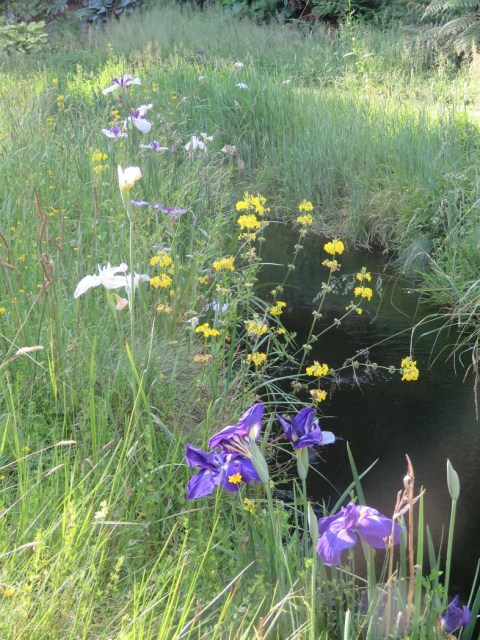
Japanese Higo iris flowering in the meadow in Tikorangi The Jury Garden

The Higo iris in the meadow down in the park, the flowering cherries in the Wild North Garden dropping their petals on the water, the voluptuous helianthus with the tall grasses flowering in autumn, the disorderly jumble of colours and blooms in the bee and butterfly garden – all these make me happy in ways that tidy formality does not.

First published in Woman Magazine March 2022 and reprinted here with their permission

Part two of our very recent trip to Australia with festoons of curtains, bushfire regeneration, she-oaks and a side of snake wisdom

Every single room was similarly festooned and all but one in lilac ombre – even the bathrooms. Acres of festooned fabric

From Ulladulla, we headed down to Catalina in Bateman’s Bay where our Air BnB was Something Else. With hundreds of metres of sheer curtains in lilac ombre festooned in every room and acres of large white tiles on the floor, it had its own style. Sydney daughter described it as having a Greek wedding vibe.

It is just over two years ago that the Black Summer fires swept through parts of Australia. Just -pre-pandemic in fact. I wrote this piece in January 2020. We had entered bushfire territory.

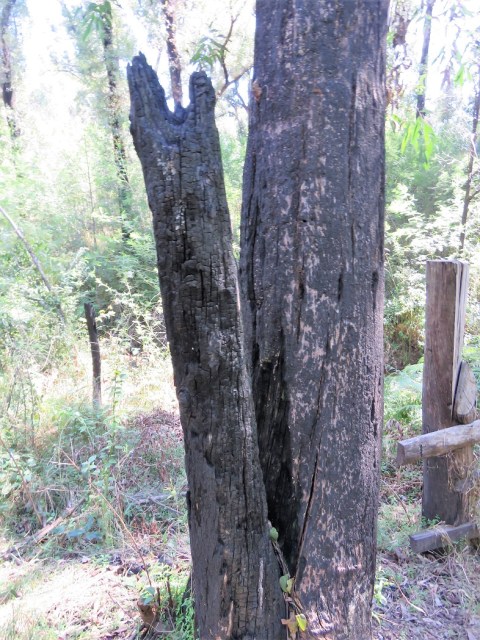
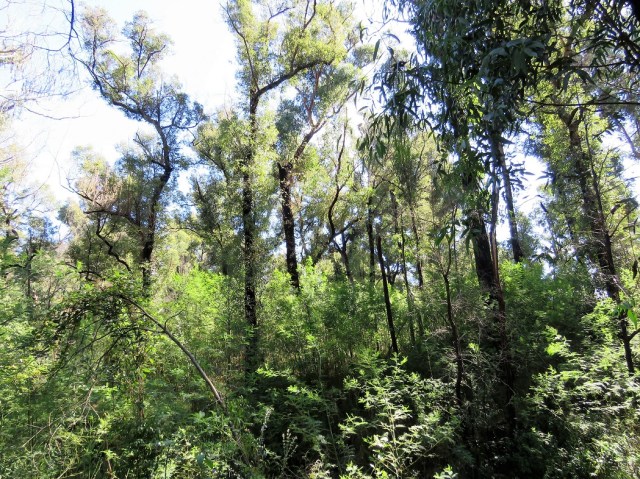
It is astonishing how quickly the Australian bush can regenerate – helped, daughters told me, by the fact that rains arrived not long after. That is by no means always the case but the area we were in was looking lush and green by Australian standards. “You can tell where the fires came through,” Canberra daughter said, “by the trees with black trunks with dense tufts of fresh foliage on short growths.” Those trees are mainly their native eucalyptus. We soon had our eye in for spotting fire damage and that was haunting.

Regeneration after the fires at Eurobadalla Botanic Gardens

The fires swept through Eurobadalla Botanic Gardens near Mogo on New Year’s Eve of 2019. Looking at the fire photos on line, there wasn’t much left and all the infrastructure was destroyed. These gardens are more what we call ‘nature reserve’ than ‘botanic garden’ but I don’t know how much of that is post-fire. Sydney and Melbourne both have botanic gardens that are more international in their plant collections; Canberra’s botanic gardens are based on Australian native plants and have a totally different feel. I would guess Eurobadalla has always been more focused on native plants but with the main efforts going into rebuilding infrastructure, the flora is more about regeneration at this time than showcasing a broad range of native plants.
Drifts of symbolic yellow wattle blooms
It must have taken a lot of community involvement to knit 37 000 of these

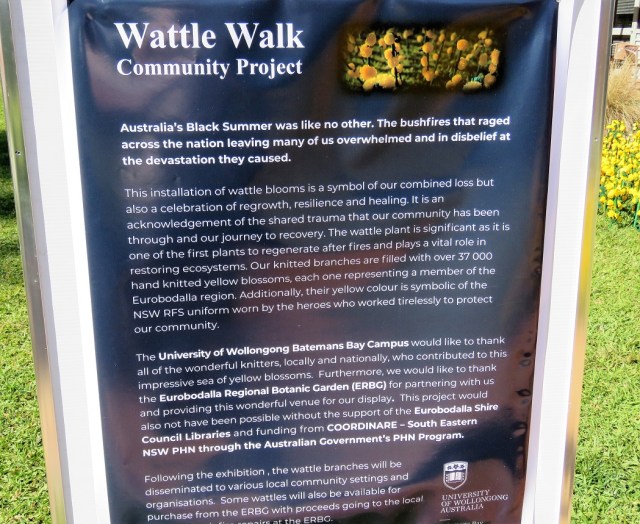
The more than 37 000 knitted wattles on the entrance lawn were both eyecatching (“Well, that is one way to get colour in the garden,” was Mark’s initial observation) but poignant in the extreme when we read the information board. Wattles, from the acacia family, are one of the first nurse plants to appear after fire. So these hand-crafted sticks of flowers were both an acknowledgement of the devastation experienced and a symbol of regeneration.  

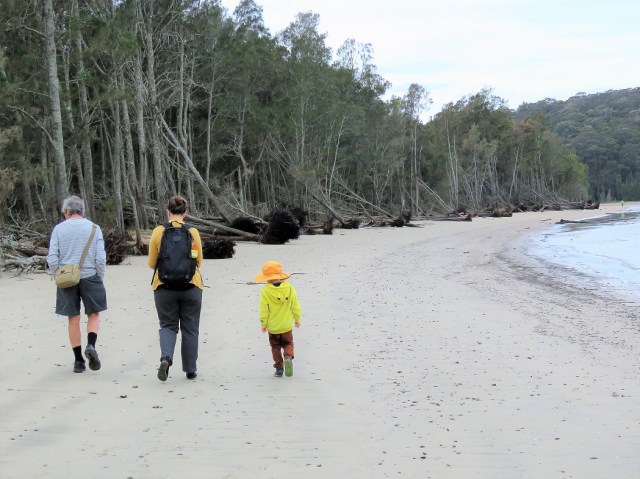
We went for a walk one grey, calm morning along a beach which seems to be part of a nature reserve by the Clyde River that reaches the sea in Bateman’s Bay.  

Three generations

Elder daughter has a been a great picker-upper of unconsidered trifles all her life. It is only recently that I have dispersed most of her rock and shell collections from the back shed here. To my amusement, she has passed on this trait of gathering beach treasure to her small son. And I can tell you that the shells on this Australian beach were a great deal more varied and colourful than anything I have seen on a New Zealand beach. Small, but so pretty. I wanted to gather them myself. Daughter and son pocketed these small treasures to take home and that brought a smile to my face.

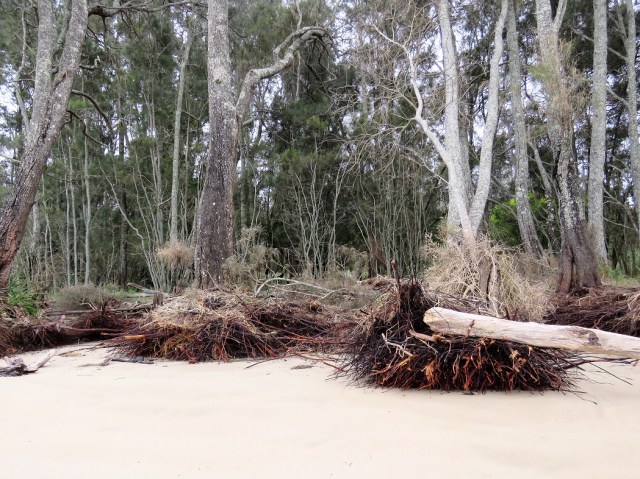
The beach was lined in what we call she-okes in this country. Excellent firewood, Mark says, despite being fast growing, brittle trees that can fall apart in our winds.  She-okes are Casuarina equisetifolia, native to Australia and up through the Pacific into Asia. They are not a tree of great beauty in form or foliage, being typical of that somewhat scrawny, scruffy, rangy look of much of Australia’s tough native vegetation. What was interesting about these plants was the role they were playing in breaking the force of the sea and their ability to grow in areas where they must get inundated by salt water on a regular basis. That said, the front row of trees had fullly exposed roots and were falling backwards on a frequent basis.

After a rewarding week of family bonding, we were jolly relieved to test negative at Sydney airport, on our arrival home and again five days later. Travelling in Covid times is a whole new ballgame but we are big fans of N95 masks.

Postscript: It gave me quite a jolt when I heard my daughter cautioning her five year old that we were moving through snake territory at Eurobadalla Gardens. This is not what a NZ grandmother expects to hear. For overseas readers, NZ has no snakes at all – not even in zoos. Australia, on the other hand, has a fair representation of the world’s most venomous snakes. NZ children are taught about personal safety measures in earthquakes and tsunamis. I assume many Australian children are raised being aware of safety around snakes and bushfires.

Given my ingrained fear of them, I snorted when I saw this tweet come down my Twitter line. In a world where many people pay lip-service only to the threats posed by climate change, I thought yes. Very much yes.

Autumn nerines

The autumn rockery this week

Look at the nerines. Autumn stars, these are.

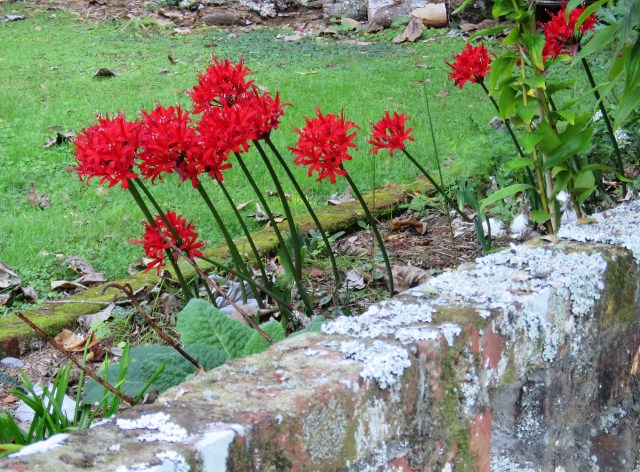
We grow a few different species but what is coming into bloom now are what we refer to as the N. sarniensis hybrids. I will admit that I do not know what they were hybridised with. As they appear to have been popular in both Europe and Japan by the 1600s, I am guessing the genes are pretty mixed by now but dominated by the species, N. sarniensis.

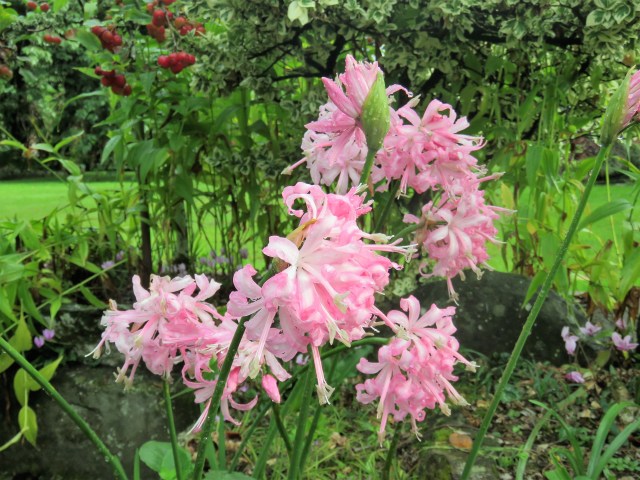
It really is shocking pink or highlighter pink, brighter even than in this photo

All nerines hail from areas of southern Africa and there are currently 24 species recognised. Notwithstanding that origin, the common name internationally is the ‘Guernsey lily’ owing to that island in the English Channel adopting the flower early on as its own and establishing a cut flower trade with it. I have no idea if it is fact or legend that a ship carrying a load of nerine bulbs to the Netherlands was wrecked nearby and the bulbs floated to the shores of Guernsey Island and naturalised themselves on the coastline. It is a good story and bulbs had to get there somehow.

The history of nerines in cultivation seems to be pretty murky, maybe because it goes back over 400 years. I had always assumed – based on the photos of the Guernsey lily that appeared to be predominantly red – that sarniensis in the wild was red. Mark thought it was orange, based on Nerine fothergilla major (which has now been reclassified as sarniensis, just to confuse us further) but it appears that the colour may be variable in the wild.

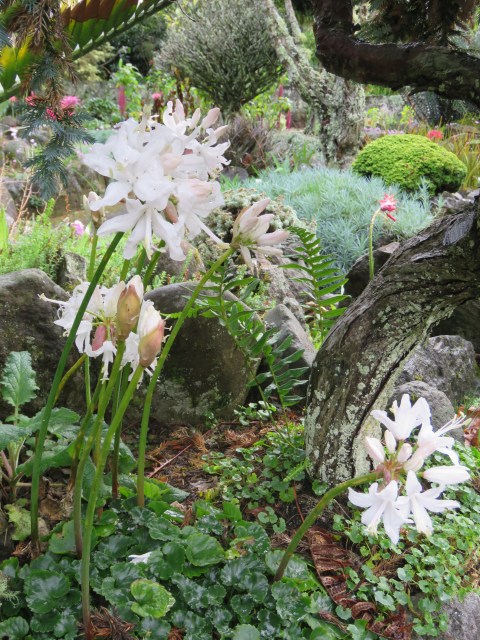
Our nerines range from pure white through pale pink, pink and white bi colours, mid pinks, coral shades, shocking pink, cerise, crimson, shades of orange and scarlet.

Ageing to blue purple tones

“Oh lord,” said Mark, looking at the purple ones on my flower lay, “the phone will ring next week with people wanting a purple nerine. Reader, they don’t open purple. Mark spent a bit of time crossing and selecting to get the blue and purple lines in the flowers and those ones age to purple. We never named any of them and we don’t know if other breeders have similar shades which they have put on the market, which would seem likely. Whether any are available in New Zealand is another matter.

Very few of our nerines have ever been sold commercially. We have a few named cultivars originally from the Exbury collection in the UK (where they have to grow them under glass), Felix Jury named a few but not many and I think Mark named one that we once sold. It is all a bit academic now because we just enjoy them in the garden and it doesn’t matter to us whether they are named cultivars or unnamed hybrids.

These nerines are deciduous and they put up their flower spikes before putting out the fresh foliage. I don’t love the foliage in spring when it is getting tatty and tired and we have some quite big clumps of them, but they make up for it in autumn. Because they have foliage through the winter, sarniensis nerines are frost tender and they struggle in cold, wet conditions. They need to be in full sun with sharp drainage and the large bulbs nestled into the soil but with their top half and necks exposed to bake in the sun. They are quite particular about conditions and won’t flower if they don’t like them. Nerine bowdenii which flowers later is much easier, hardier and less particular but only comes in pink, I think.

In partnership with Nature

Mark counted more than sixty rings in the cut trunk so the abies must have been planted around 1960

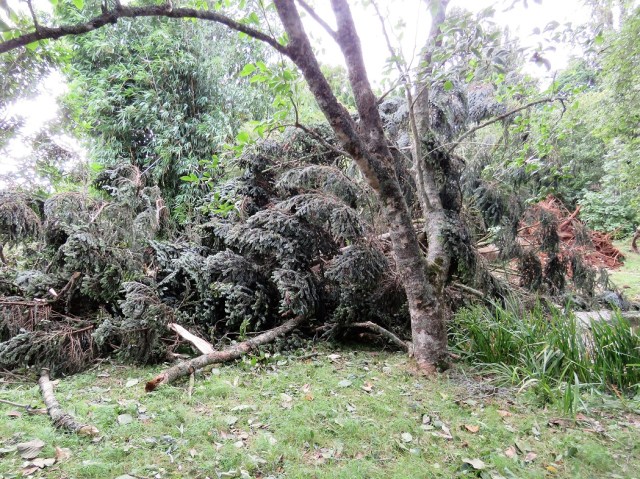
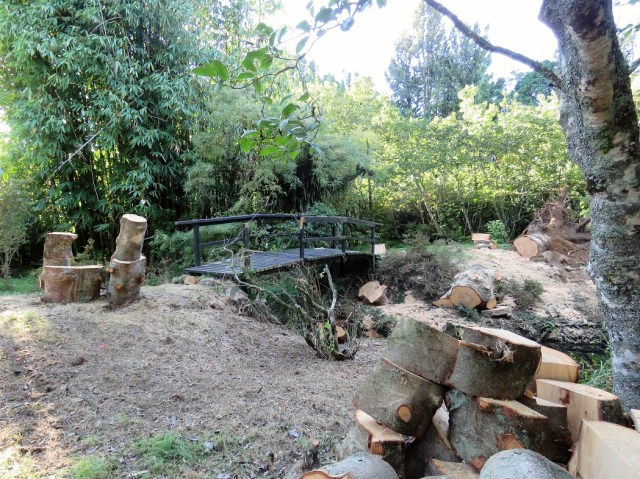
The clean-up from Cyclone Dovi is continuing here at a cracking pace. Zach started on the large, fallen abies in the park and has almost finished it. We were relieved to find that damage to the bridge beneath is minimal. A few more centimetres to one side and it could have wiped out most of the bridge. This would have been a problem for us, had it twisted the metal chassis beneath the bridge timbers.

Wisteria Blue Sapphire on the bridge has been hammered but will recover, the azalea has been extensively damaged but should also recover and Magnolia Lotus on the right lost some branches as the abies fell but the bridge just had railings broken.

Because it is right at the bottom of the park, dealing with the debris is an issue. Mark was not interested in the timber for firewood. We burned the Abies procera we dropped a few years ago but it proved to be a very light timber and we have better options. Access issues mean it isn’t practical to offer the wood to people who are less picky about their firewood and we don’t want to haul the whole lot out with our baby tractor, so creativity is required.

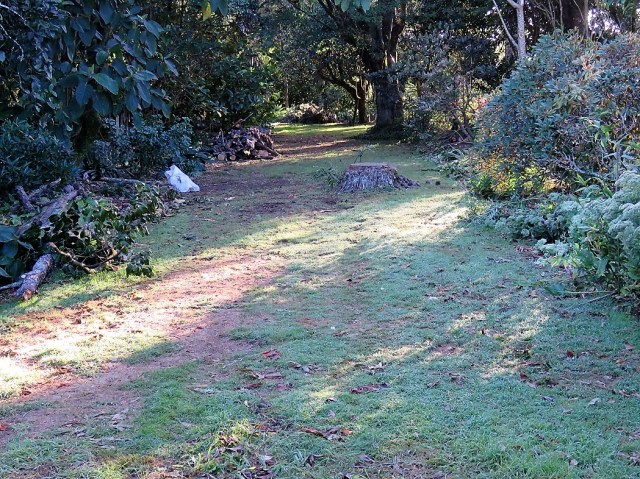
We debated about hiring an industrial-grade mulcher to deal with all the branches and foliage but decided in the end to burn it nearby. It leaves a dead patch in the grass but that can be resown and will disappear in a year or so. It is less work than having to disperse a mountain of wood chip in an area where we don’t need mulch.

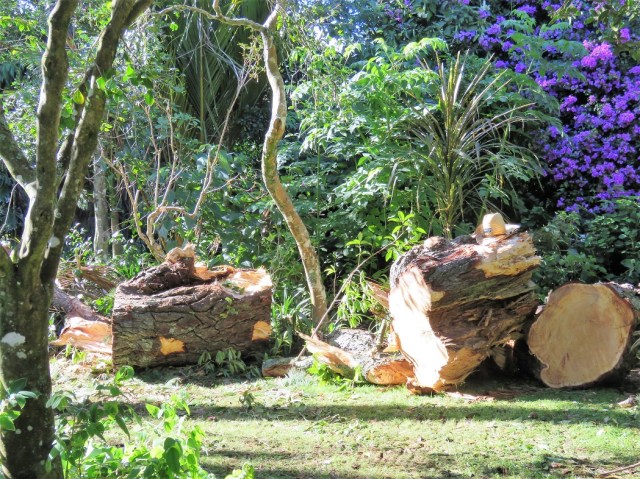
But what to do with the lengths of trunk that can’t be left where the tree fell across the stream?

I like the shape of this fallen pine tree that perched itself up on its side branches like some freeform crocodile or giant lizard. It is decaying so it will drop at some point but that is fine.

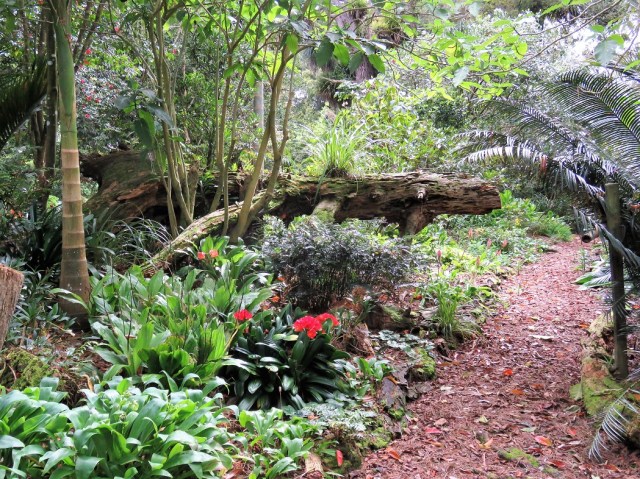
We re-use a lot of fallen material here. Suitable thinner lengths of branches are sometimes used to edge garden beds and borders where appropriate. Where we can, we clean up fallen trees, reducing them just to the main trunk and then garden around them. Over time, they rot down and start to disintegrate but that is part of the long-term cycle.

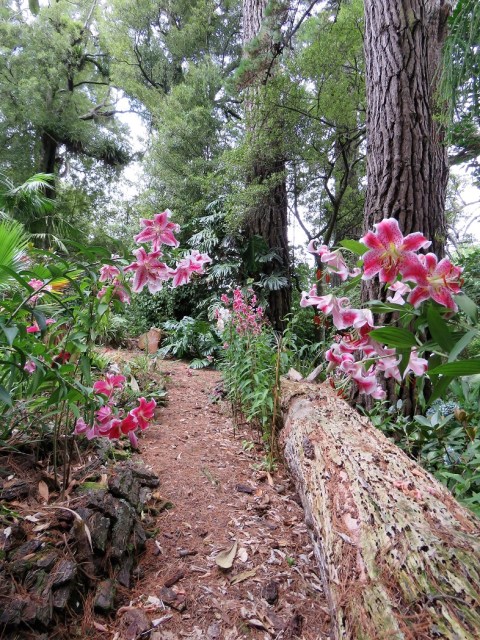
This was a substantial length of pine tree that fell and then rolled into a most convenient position on the edge of a path.

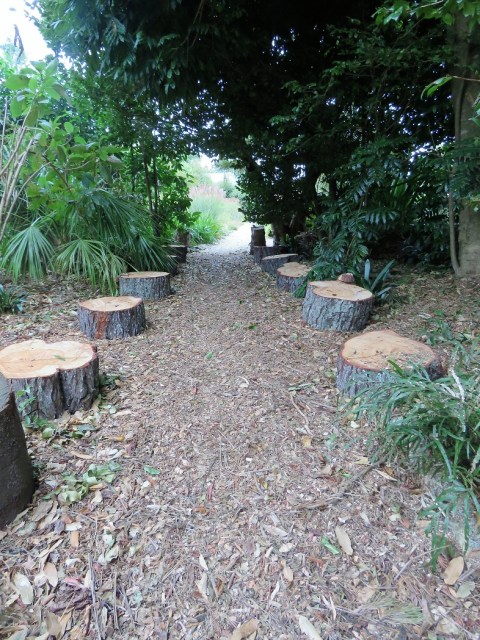
Where this is not an option, we will cut the trunks to manageable lengths, take out what we want for firewood and place the rest. Other gardens may have sculptures and installations that are clearly made by human hands; we have casual installations of wood, sometimes as stumperies and sometimes just as low-key placements.

Defining the path with pine tree sections

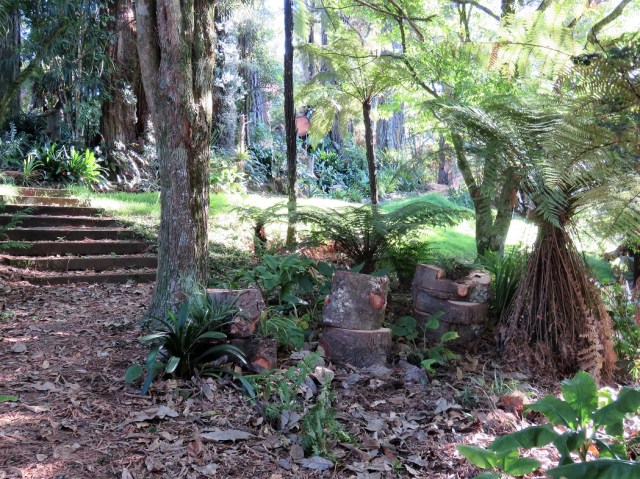
We have already placed the pine lengths from the Avenue Gardens that were surplus to firewood replacements. At least some of the abies is destined for another use – giving height and structure to a rather casual area of planting. This is an area that has no name yet, where the Avenue Gardens transition down the hill to the park – I wrote about it once on blurring the transition from well-tended gardens to more laissez-faire outer reaches. We may have to come up with some shorthand name rather than referring to it as ‘the bit beside the steps coming down from the Avenue Gardens to the Mangletia insignis”.

Stacking lengths of abies to use in a different area

This is Mark’s vision. Neither Zach nor I can grasp yet what he has in mind, although Zach has carted abies lengths to this area in preparation. Zach and I are pretty good on placing individual bits as punctuation marks in the garden but not on creating entire structures. We will both watch and learn as it happens. I have every confidence in Mark’s skills in this endeavour

Felix used ponga logs and stumps to create his section of what we now call the Rimu Avenue

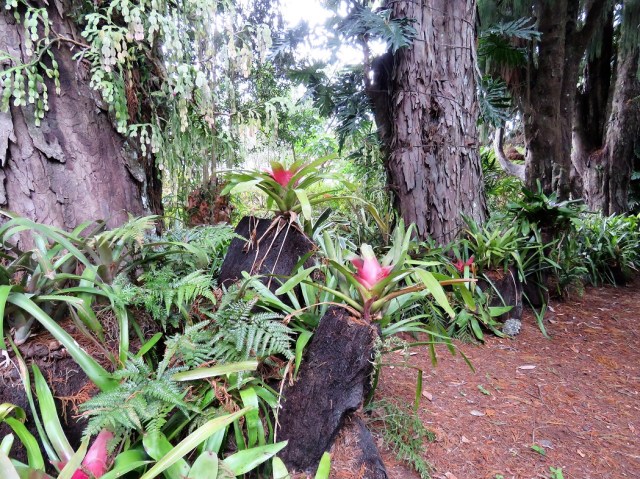
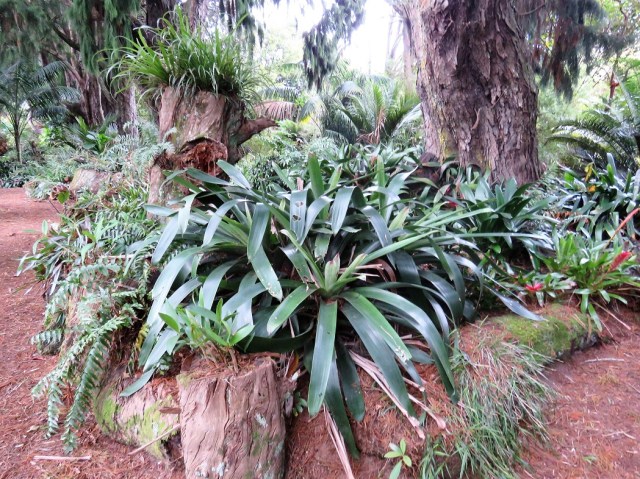
Our feature Rimu Avenue is essentially a stumpery, created as a pragmatic solution to enable plants to grow in dry shade where the enormous trees above are sucking all the goodness and moisture from the ground beneath. They are a naturalistic, raised bed solution. The oldest section was created in the 1950s by Mark’s dad, Felix and he used ponga logs and stumps (NZ tree ferns, for overseas readers). These are remarkably durable – still serving their purpose after 70 years.

Mark used whatever timber he had to hand when he doubled the length of the Rimu Avenue to give both structure and raised beds

When Mark doubled the length of the Rimu Avenue 20 years ago, he was disinclined to go out to the bush to harvest ponga so he used what we had to hand – a bit of ponga but mostly lengths of trees that have fallen here.

A simple feature. It will only last a few years because it is just a section of banglow palm trunk but it will decay gracefully

Somewhat unintentionally, our labour saving strategies are creating a theme throughout the entire garden – the re-use of fallen timber to create focal points, casual structure and different environments for plants as well as stowing lengths of fallen or felled trees in a way we find aesthetically and environmentally pleasing. It has been happening here for years. Cyclone Dovi has just accelerated it.

It all decays over time but don’t we all?

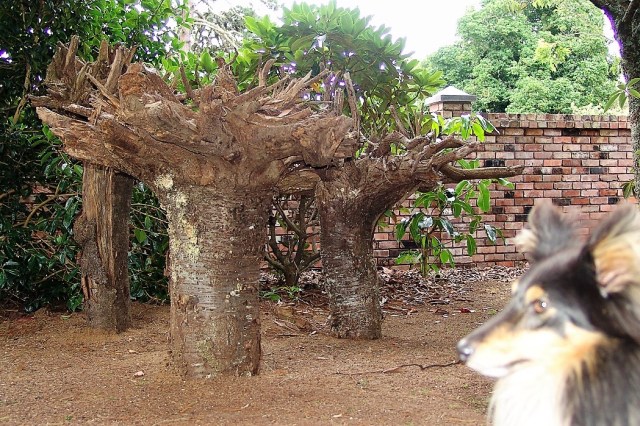
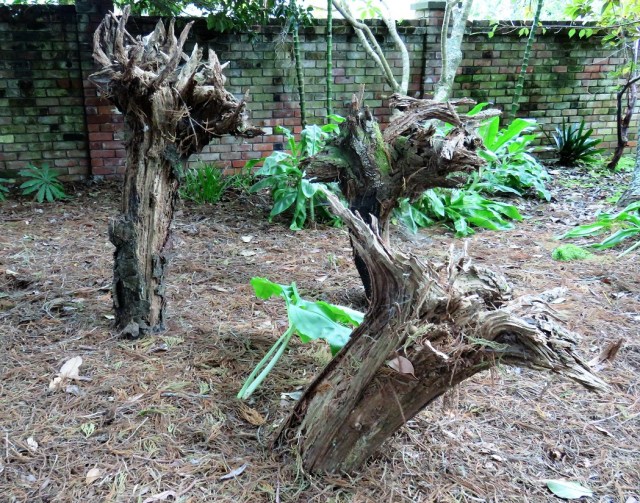
I see the date on this photo is 2004, probably very soon after Mark asked Lloyd to bury the upturned plum tree stumps to make a natural feature
In 2022 – today in fact – those stumps are getting ever smaller and less of a feature but that is part of Nature doing what Nature does.

Hit by Cyclone Dovi

One of the wide grass paths in the Avenue Gardens

We weren’t worried when the warnings came through that Cyclone Dovi might hit land in New Zealand. We are in the middle of vast ocean and mostly these storm events end up passing by. Besides, we are well sheltered here and it can be howling a gale elsewhere and we are relatively calm.

We were wrong last Sunday.

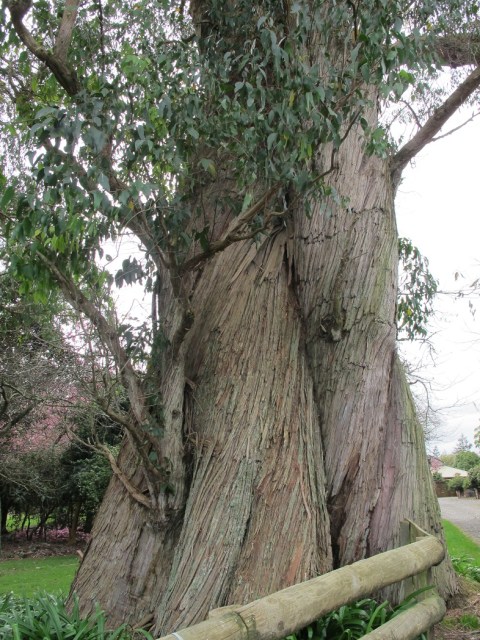
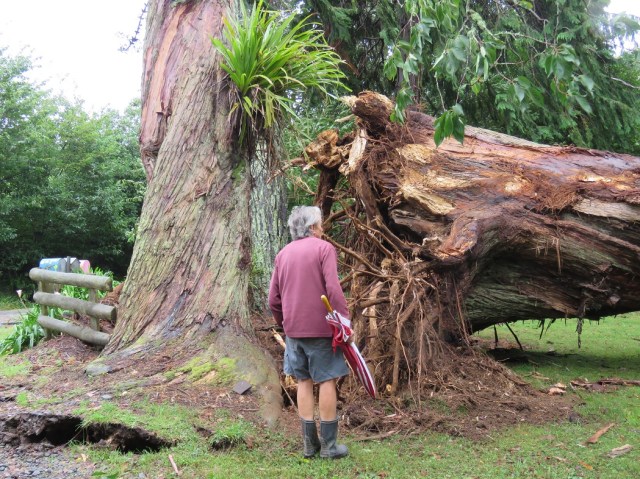
This was the base of the giant gum tree at our roadside before

Cyclone Dovi hit us with the worst winds we have ever experienced. The peak lasted for hours and was frankly terrifying and sounded as though we were surrounded by roaring trucks. Believe me, we were grateful that two years ago we dropped the one tree that would threaten our house if it fell. Our house came through Dovi unscathed.

and after with half of it split off and the other half lifting the ground around and needing to be felled

The first big tree I was aware of falling was the massive gum tree (eucalyptus) at our gate. It was around 170 years old, planted by Thomas Jury in the 1870s. We were lucky it fell inwards and not across the road. There is still a dead half of it left, leaning against the next tree and it will have to be felled with some urgency. The specialist arborist is currently thinking his way into how best to do that safely.

The sheer size of many of these trunks is daunting

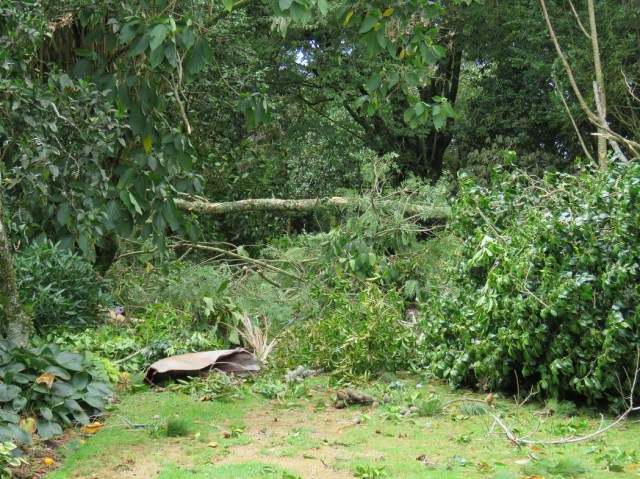
We didn’t dare walk around the property but I was standing on the doorstep when one of our largest pines broke off in two pieces causing massive damage as it came down in the Avenue Gardens. Because it came down in two pieces, it effectively did the same amount of damage as two trees falling. The jacaranda which had a splendid flowering this summer is now a broken stump and pretty much all the mid layer of trees and shrubs in the area have been taken out.

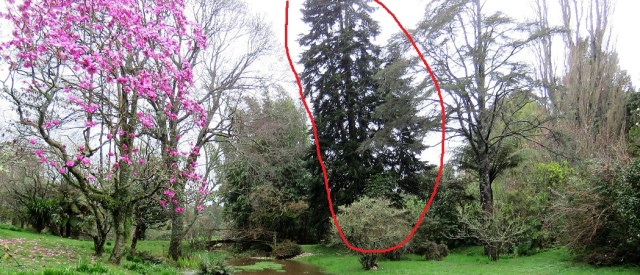
That was the pine that did the most damage. There are another two massive pine trees uprooted, also in the Avenue Gardens. Even though much larger with all the trunk and roots – up to 45 metres of tree each – their damage is more localised and they have fallen in places where we can leave the bulk of the trunks.  Mark just about wept the next day when he found the handsome abies in the park had also fallen.  

This abies, outlined in red
The high bridge in the park is beneath the abies

That was just the big trees. There are branches and smaller trees down but they seem minor in comparison.

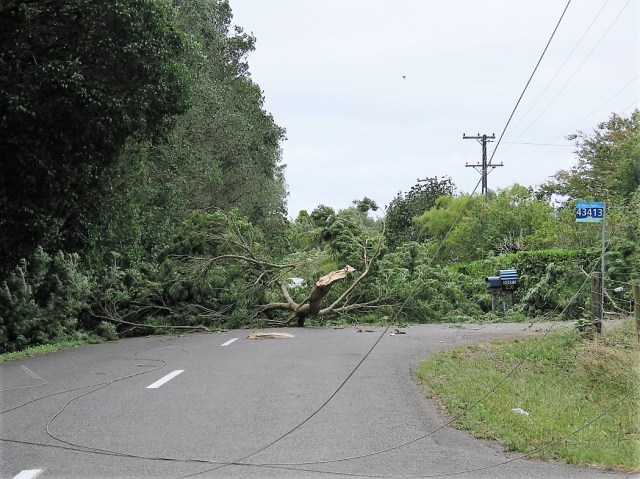
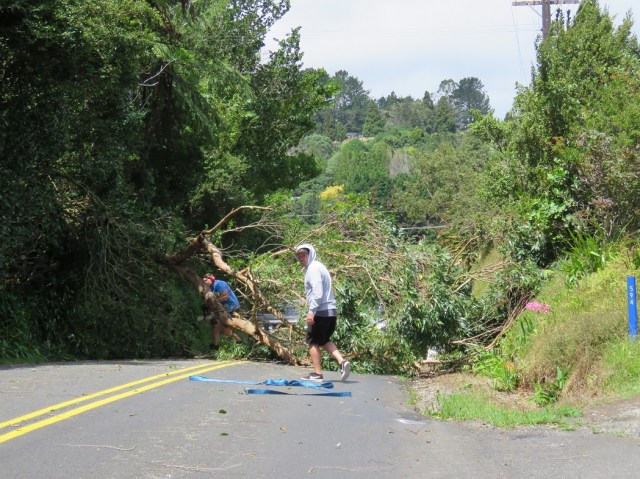
There are three roads that give access to our place. As the initial fury abated, I drove around to make sure none of our boundary trees had fallen to block the road. I had walked out earlier to the road and found passers-by efficiently dealing to one of our branches without even coming in to tell us. How handy to live rurally where people just happen to have chainsaws. It was the last road open and to drive it meant driving under power lines further down the road which had a tree resting on them.

The road to the left at the bottom of our place – not our tree or power lines, thank goodness.
And the road to the right down the bottom of the hill. Again, not our trees or power lines but this repair was a major that took several days
The only road left open with a minor tree suspended on the power lines. This was the one that took our power out for 36 hours.
Practical passers-by dealing to an immediate problem. This was the only major branch of ours that fell onto the road.

Mark and I were completely numbed for the first two days by the sheer enormity of the damage. It wasn’t helped by having no electricity and when the power goes out, we lose running water. Like most rural people these days, we depend on electric pumps to get water to the taps. 36 hours without water and electricity is difficult but everything looked more manageable when they were restored.  

Starting the clean up in the Avenue Gardens. That was a complex woodland, herbaceous planting beneath. Note the use of ‘was’.

Our arborist and his apprentice gave us priority and were here by 8am on Monday. Lloyd and Zach have thrown themselves into the task of cleaning up and we are making progress. There is a long way to go but at least we are not in as bad a situation as we were last Sunday.

The Avenue Gardens on Sunday
Same view by Wednesday, we had it to this stage but that is only the paths cleared, not the gardens

Three things I have learned this week: firstly that it is harder to have no running water than no electricity.  Never have I been so grateful that we are a five loo establishment…

Secondly, when people are in in immediate shock at what has happened, well-intentioned comments from Pollyannas are not helpful. Comments like, ‘look at this as a new opportunity’ or ‘at least nobody died and your house is not damaged so it could have been worse’ carry a high irritation factor. We do not need to be told that. The time comes soon enough to look forward but it takes time to process what has happened first.

Thirdly, in a crisis and its aftermath, people are very kind. I can get Pollyannaish over that. More than once, the kindness of others, including strangers, has brought tears to my eyes.

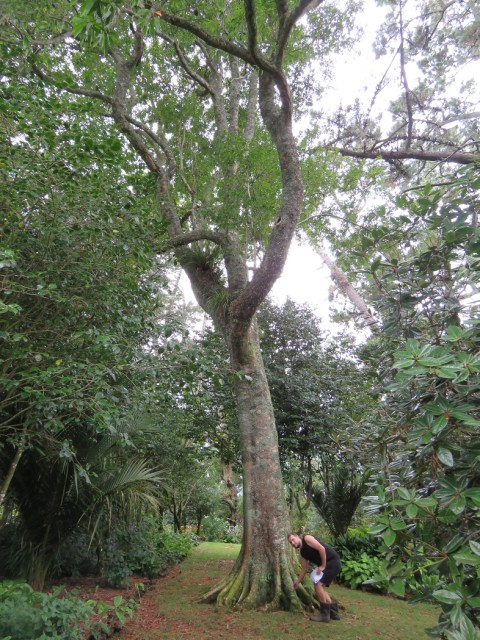
I took this photo of the beautiful elaeocarpus tree with its buttressed roots last week
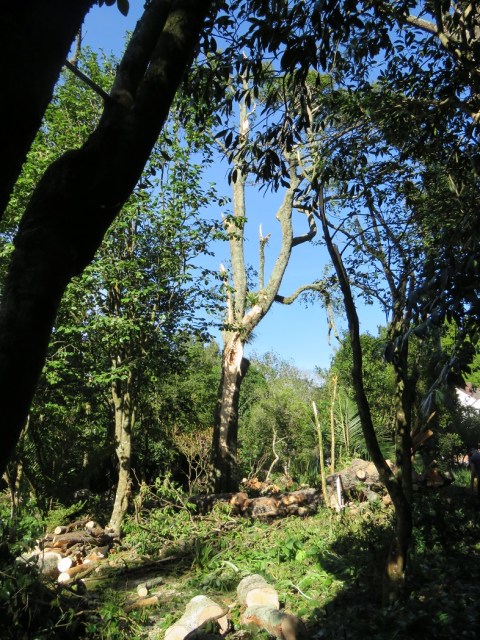
That skeleton in the centre of the photo is what remains of it this week

It has been a tough week but the final word probably rests with the neighbour who had walked over and was talking to me at the back doorstep when the largest pine snapped and fell before our eyes. “This is a taste of what is to come in the next 20 to 25 years,” she said. Climate change. I fear she is right.

Wednesday, three days on, and progress is being made

Postscript: Technically, Cyclone Dovi is usually described in NZ as either ‘ex-tropical cyclone Dovi’ or ‘the remnants of Cyclone Dovi’ which means it is way more intense when cyclones hits full force on Pacific islands. I have to keep reminding myself of this. I looked up the difference between a cyclone, a hurricane and a tornado and it is geographic. South of the equator we call them cyclones, north of there they are called hurricanes except north west where they are often called typhoons. So now you know.

Post postscript: I saw screen shots of extreme right conspiracist chat pages who worked out that Cyclone Dovi = C Dovi and – OMG – C Dovi is an anagram for Covid. To them, this is proof of a conspiracy by our government to create a cyclone event to try and dislodge the ‘convoy occupiers’ blocking roads in Central Wellington and taking over Parliament grounds.  So now you know that too.                                                                                                                                                                                                                           

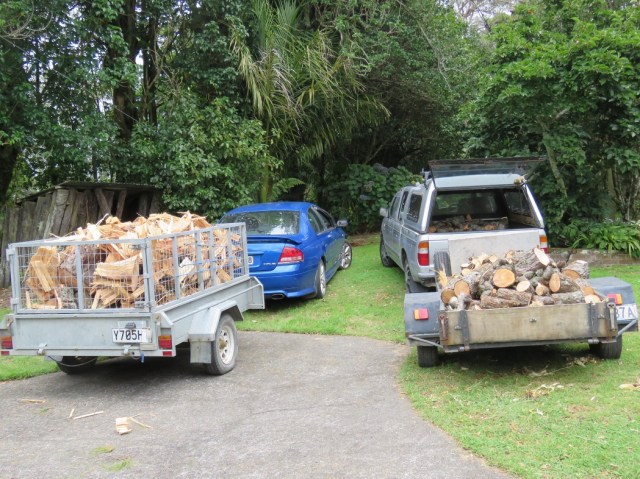
I offered free firewood and pinecones on a local Facebook page and the firewood disappeared very quickly. Mark and I are amused at just how many older men there are in our local area who still have chainsaws and time on their hands.