Tag Archives: Rhododendron Noyo Chief

Big, red rhododendrons

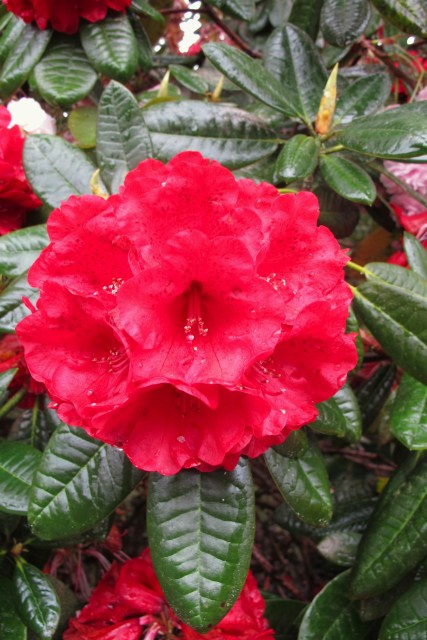
Rhododendron ‘Kaponga’ in Pat’s garden. We have a specimen planted somewhere in the garden but not in a prominent position because I would have to go looking for it.

I do not miss our days of retailing plants. Nursery work was simply a means to earn a living and now that we are retired from all but gardening and final selections from Mark’s plant breeding programme, we are reaping the benefits of those long hours and quite a bit of hard work. Nothing reminds me more of that than red rhododendrons.

“You should take a photograph of ‘Kaponga’, my friend Pat said last week. And indeed it did look as splendid as a full truss, red rhododendron can, when viewed from her window. I didn’t have my camera with me at the time. I am old school – I prefer to use a camera rather than my phone. So I called back in this morning and it is already just past its peak.
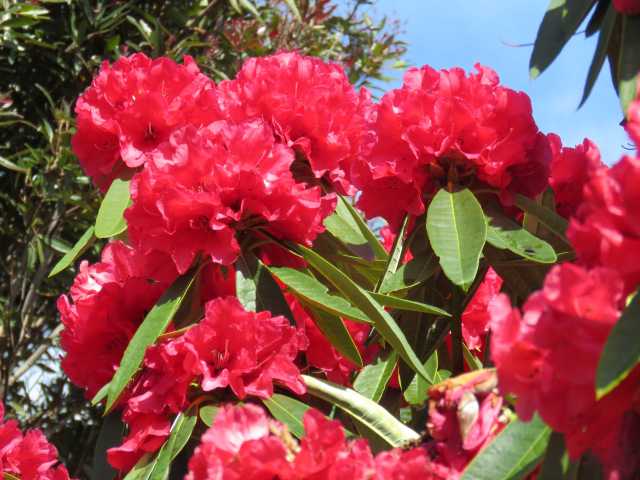
Rhododendron ‘Kaponga’

‘Kaponga’ is a local selection of a red R. arboreum hybrid, bred and named by the late Bernie Hollard of Hollard Gardens fame. We like arboreums in our conditions because they don’t get hammered by thrips (turning the foliage silver) or die-back so the plant stays looking well furnished and healthy without needing spraying and special attention. ‘Kaponga’ was never my favourite; I do not love the big ball trusses on rhododendrons so favoured and admired by others. The looser trusses and flower forms of the maddenii group are more to my taste. ‘Kaponga’ is not a pure red like ‘Rubicon’,  having a slight pink cast to its tone but it is an exceptional performer.
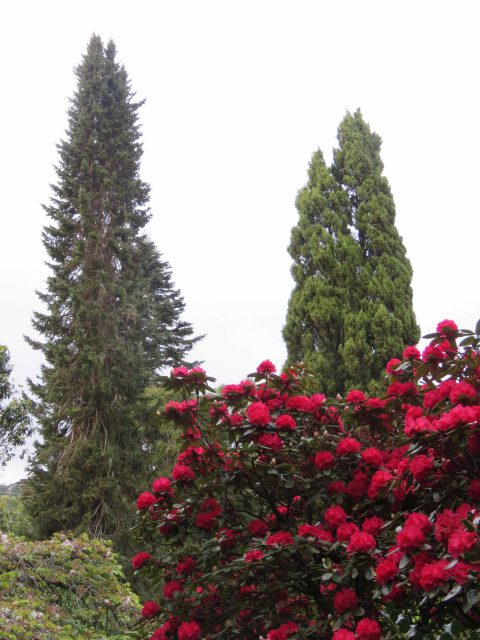
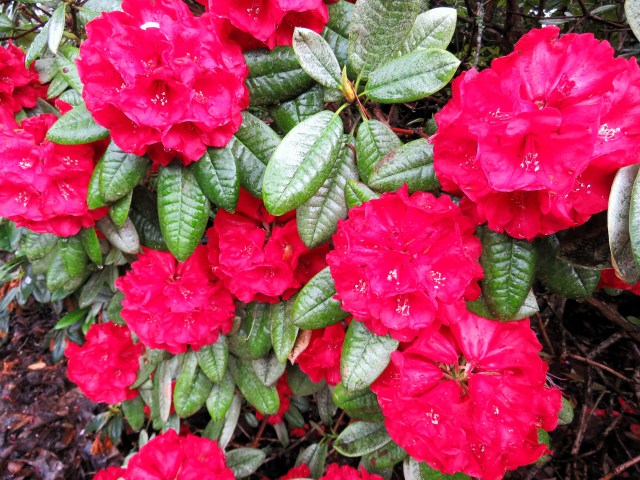
Rhododendron ‘Noyo Chief’ in our park, clearly planted in a more prominent position than ‘Kaponga’ because I know exactly where it is.
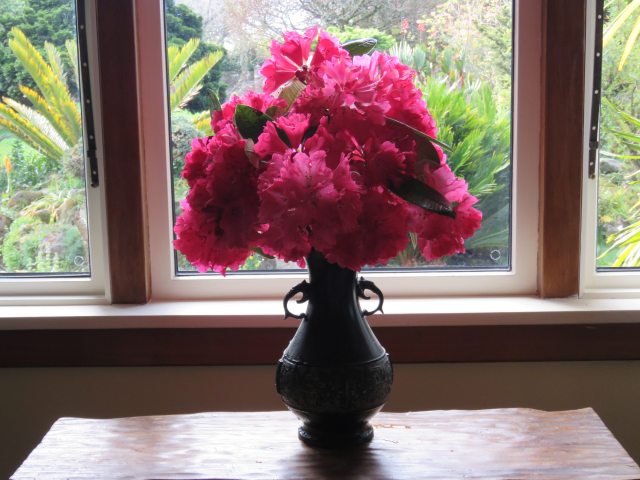
It is hard to capture reds accurately. The photo of ‘Noyo Chief’ in our park looks redder than it actually is. This photo of it in a vase is somewhat pinker than it is. The actual shade lies somewhere between the two photos.

Overseas readers will know ‘Noyo Chief’ better than our local selections and, while an excellent plant which performs well every year, it too has that slight pink cast to its full red trusses.

Coming back to selling plants, every person who sells plants will know that any plant in bloom sells on sight. Never more so than red rhododendrons with full, ball trusses. Over the  years, I realised that men bought red rhodos. Almost every time. When women bought them, it was often as a gift for their husbands. I should not have been as surprised by this gender-based colour preference – there are still men today who won’t have anything to do with pink, pastel apricot or paler lilac colours, regarding them as too ‘girly’ or feminine for real men. Maybe gardening men have broadened their tastes in the time since we dropped retail about 15 years ago? I hope so.
‘Rubicon’ was my favourite – pure red and handsome foliage but prone to thrips. It needed spraying to keep it healthy and we are not willing to use sprays in the garden just to keep plants looking good. In the end the thrip infestation got so bad that they pretty much marched away with the plant. Brilliant red rhodo but best grown in a climate with a colder winter than we get.

I am sure I must have told the story before (but not, I hope, recently) of the Tauranga landscaper who came in to buy plants for a new retirement village. He would only buy red, yellow or orange flowered plants, maybe blue – no whites, creams, pastels and certainly no pretty pinks because he, personally, didn’t like them. At the time, selling plants was more important than my view, but I really, really wanted to point out to him that his retirement village occupants were going to have a majority of women owing to the fact that women have a longer life expectancy. Besides, some men do like pretty flowers and rise above the constraints of old fashioned, masculine expectations when it comes to colour choices.

It must have scarred me because, to this day, I find it hard to rise above my disinterest in big red rhododendrons. I can still admire a good plant that performs well but they never make my heart sing or lift my spirits. Each to their own.
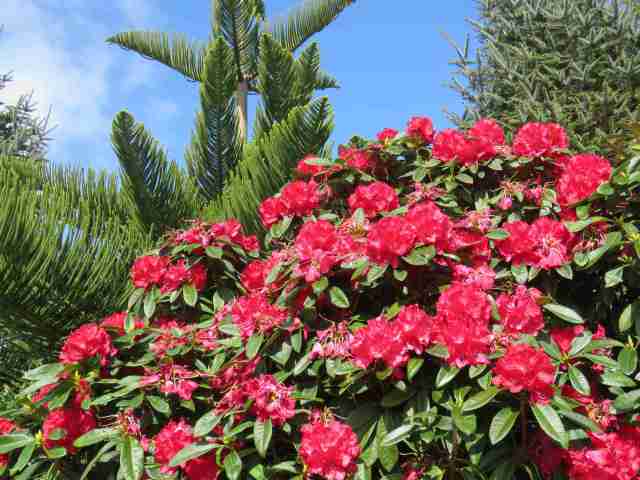
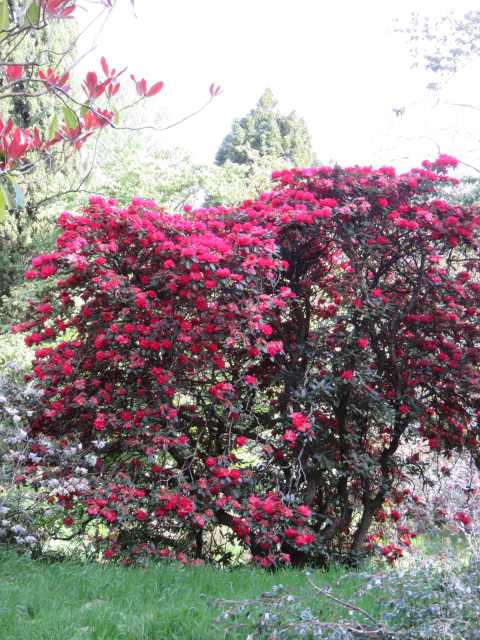
Pat, she of the ‘Kaponga’ plant, had a neighbour who planted a row of reds on their road boundary. I had assumed it was ‘Kaponga’ until I looked at the foliage today and it is not. It will be one of the common varieties in commercial production here these days but, since we stopped selling plants, my memory has filtered out information that no longer seems necessary to remember and confidently identifying many rhododendrons has gone with it.

My lukewarm attitude to big red rhododendrons

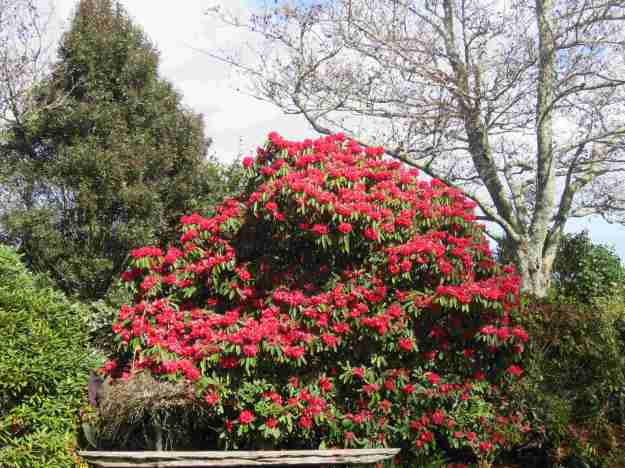
Noyo Chief, big, bold and red.

Back in the days when we used to retail plants, I would quip that nine out of every ten big, red rhododendrons were bought by men; the tenth was usually bought by a woman for her husband. This may well be an exaggeration but it made me view big, red, rhodos as very… well… masculine.

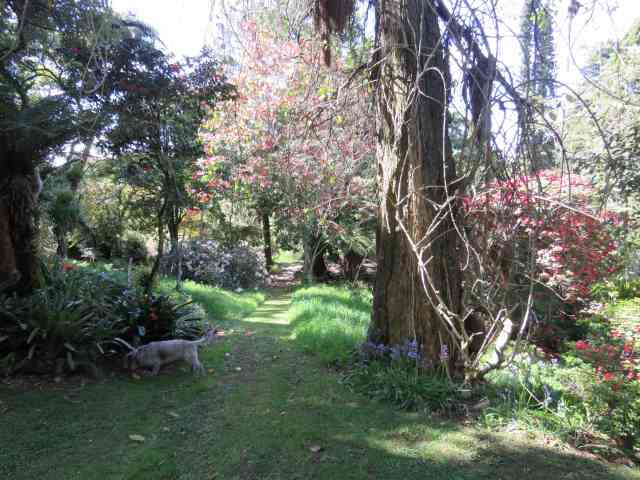
Looking down to the park. Noyo Chief on the right, polyandrum on the left of the mown path. And photobombing Ralph in the foreground.

It may be that, in the intervening years, men have matured beyond that manly cliché and refined their tastes. I couldn’t possibly comment. This train of thought came back to me as I stood looking down one of the tracks to our park. On one side is a large, handsome plant of ‘Noyo Chief’ in full bloom and on the other side of the track is R. polyandrum in flower. My brain registered that ‘Noyo Chief’ was putting on its usual showy display but my heart drew me down to look more closely at polyandrum. It is all a matter of taste and preference. I can see  the merit of the big red but it was the gentler charm of the very fragrant, loose-flowered cream that stirred my emotions.

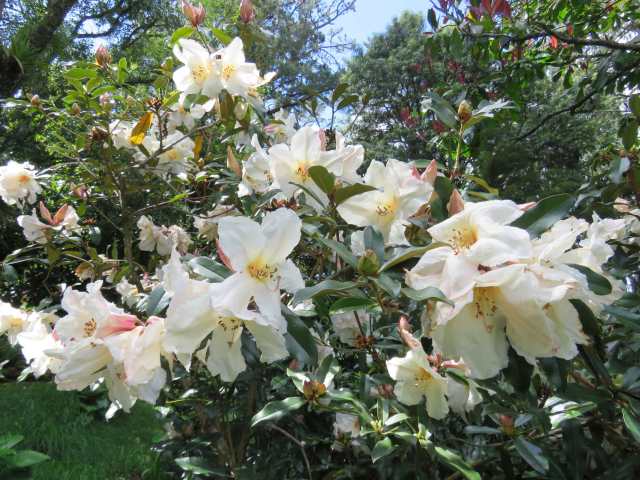
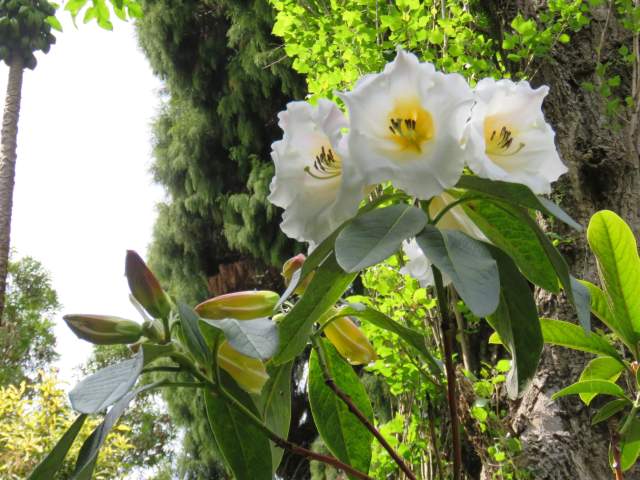
Polyandrum with its heavily scented, large flowers that measure up to 17cm across but not your classic ball truss of a rhododendron.

Back in the early 1980s, Mark started the nursery here. We will give his father, Felix, credit for many things but contrary to what some people still think, he did not start the nursery. That was all Mark’s effort, from one wheelbarrow up. He started with rhododendrons as the main line and, as one in four New Zealanders lived in the Auckland area at the time (now more or less, one in three), he always had the goal to produce rhododendrons more suited to their climate. This meant varieties that would keep good foliage and not need regular spraying in a mild, high humidity climate that lacked winter chill.

The NZ hybrid Rubicon is one of the best reds – my camera has turned it pinker than it is to the naked eye. But you can see the silvering on the leaves which is a sign of thrips which we get badly in mild climates. This plant flowered brilliantly for years and then simply… died.

There are a few big ball truss types that perform well in Auckland and this includes the arboreums, many of which are big reds. ‘Kaponga’ is a good example. But it was the maddenii group that Mark targeted. Felix had already found that they performed way better here in our mild, humid climate, keeping healthy foliage without spraying, flowering abundantly every year and many, if not most, had fragrance. Most of Felix’s successful hybrids are from within the maddenii group – ‘Bernice’, ‘Moon Orchid’, ‘Floral Dance’ and ‘Barbara Jury’, amongst others.

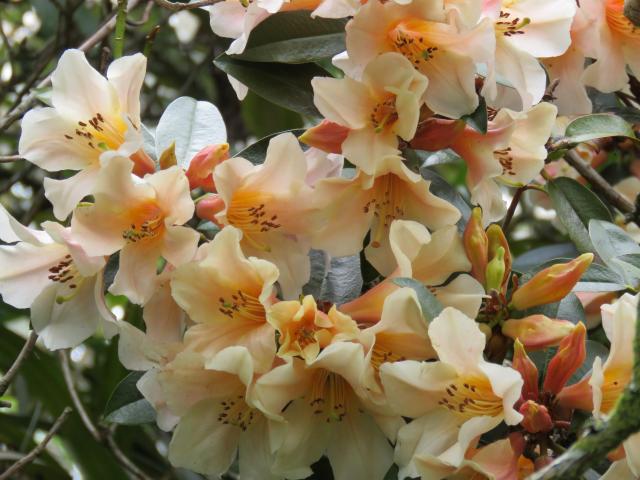
This is an unnamed maddenii from Felix’s breeding – the same cross that gave Moon Orchid and Felicity Fair.
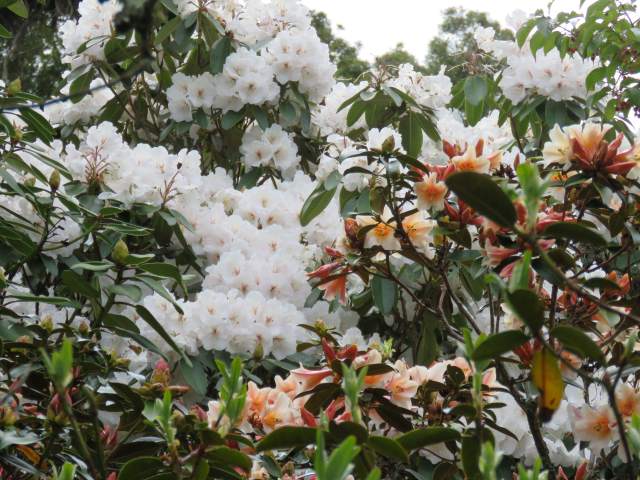
The same maddenii beside white Mount Everest. I like that contrast of the looser maddenii with the chunky sturdiness of the ball truss on Everest.

Alas, none of the maddeniis have big, ball trusses that are generally associated with rhododendrons. Nor do they come in red, be it bright red or dark red or pure red. And the maddeniis don’t have that chunky, solid, rounded form of growth seen in many rhododendrons, instead being much looser in form. We spent years working hard to convince the buying public of their merits. It often felt like pushing the proverbial excrement uphill and I don’t miss those days at all. These days, I am happy to enjoy them in our own garden. The maddeniis make my heart sing more than any other group of rhododendrons. Personal taste and all that.

Rhododendron nuttallii x lindleyi ‘Stead’s Best’ delights me far more than any big, bold red.

As a postscript to big red rhododendrons, let me tell the story of ‘Fireman Jeff’. Back in the early days of the nursery, our country’s borders were much looser and there was a lot of new material coming into the country. Mark bought all the new hybrids he could find locally, mostly originating from the USA. It was the era of plants like ‘Lems Monarch’, ‘Lems Cameo’, ‘Puget Sound’, ‘Trude Webster’ and so many more. I see our 1990 mailorder catalogue ran to a full 127 different rhododendron options, which seems a huge number for what was still a small nursery. ‘Fireman Jeff’ was amongst those recent imports. Mark and I must have been a bit tired in 1989 when we wrote its description for our catalogue:

Fireman Jeff (Jean Marie de Montague x Grosclaude) 2m Mid season.

This over-rated hybrid is best suited to a cooler climate where its bright red, almost hose in hose flowers could make a splendid feature in your neighbour’s garden. Large plants $10.00.

I see a year later, in 1990, we changed our tune a bit and wrote: “To prove our comments last year wrong, it flowered beautifully for us this season. Better suited to cooler climates where it may justify its good reputation.” And we had put the price up to $15.50. We dropped if from our range, though, because it wasn’t suitable for our target market.

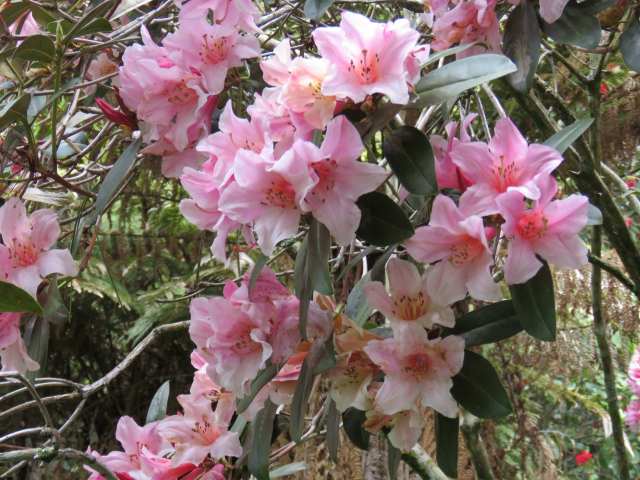
I lack any photos of Fireman Jeff. This instead is another maddenii seedling.

‘Fireman Jeff’ is still being sold extensively but the advice remains sound – best in cooler climates (south or inland) with winter chill and lower humidity. Keeping to the arboreums and maddeniis is a safer move if, like us, you are high humidity and lacking winter chill. With a garden dating back to the early 1950s here, we can speak with some authority on the rhododendrons that have lasted the distance in these conditions.

These are both unnamed seedlings but again, that combination of the tight ball truss and the loose maddenii bells pleases me.