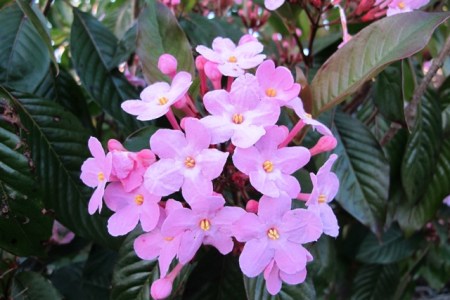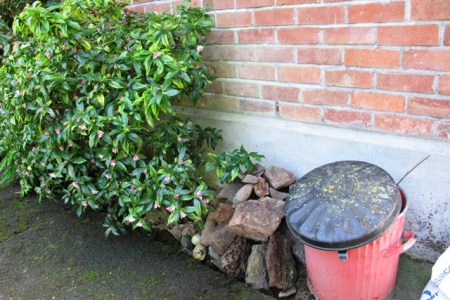
Daphne odora – happy around the back by the rubbish tin.
We have never forgotten the nursery colleagues who told us that their range included lemon trees and daphnes “because you can sell a lemon tree to pretty much every household and everybody has to replace their daphne every five years or so”. I had never thought about it before, but they were right. Most New Zealand gardens have at least one of each and daphnes do not rank up there as long lived plants. But we wouldn’t be without them in the winter garden.
While there are upwards of 60 different species in the wild, in terms of garden plants in this country, generally you have a choice of odora, odora or odora with occasional breaks for D. bholua and if you are really lucky, you might spot the little ground hugging D. cneorum (with its silent c), the dainty D. x burkwoodii, or the remarkable blue D. genkwa. You may buy your odora by many other names, but if it has typical daphne foliage and flowers, it is just an odora selection. The flowers are generally small and a mix of lilac pink and white with a range of subtle variations. Some are darker, pinker or even pure white. I bought one that was reputedly apricot but that was wishful thinking with the description.
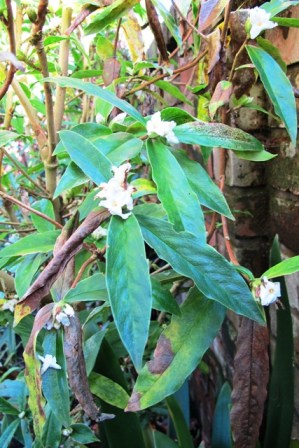
The good and the bad of the Himalayan Daphne bholua
We have a bit of a love-hate relationship with the Himalayan Daphne bholua. In our opinion it has the best and strongest fragrance of all and it has a long flowering season. Its upright habit of growth means it fits into borders and beside paths well. That is the good side. On the down side it suckers (spreads underground), seeds much too freely and is dispersed by birds so has weed potential. It also becomes very scruffy with time. It is semi deciduous which means it is neither one thing nor the other – it drops some leaves and those that hang on often look messy. The form is ugly and it can get quite large after a few years if you don’t stay on top of the pruning. So it is not a plant of great beauty at all, but its scent is superb. Hide it at the back of the border in behind more attractive plants so that it can wow you with its fragrance.
The blue flowered Daphne genkwa from China is remarkable. For most of the year it is just an anonymous willowy shrub. It is fully deciduous, so drops all its leaves in autumn. Then in late August, all those whippy growths burst into lilac blue flowers down their length. It is a wondrous sight. Some claim a light perfume, but I think that is imagination. It is just one of the loveliest shrubs you will ever see in flower. Alas, it is difficult to propagate (it is generally done from root cuttings) and can be difficult to get established so it is not common. However, it is still produced commercially and a good garden centre may be able to order it in for you. Plant it where it has good light, good drainage and plenty of space so it won’t need trimming. I killed a well established plant by cutting it back and I wasn’t that brutal. I loved it so much I bought three replacements and these will be planted with plenty of space so they should never need pruning.
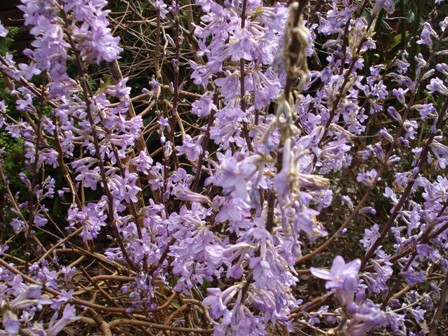
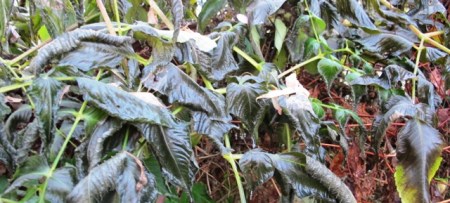
Deciduous, lacking scent and blue lilac but it is probably the most spectacular – Daphne genkwa
Growing tips: daphnes are not suitable plants to grow in containers. Mostly they look unhealthy and straggly because it is hard to get the potting mix right. It is much easier to keep them lush and healthy planted in the garden, even more so if you pick a position out of full sun. The odoras and bholua are often a good choice for the more shaded house borders. While they need good light levels, they are quite happy with little or no direct sun.
Daphnes prefer rich loamy conditions, neither acid nor alkaline. They won’t love you if you put them in waterlogged conditions either so look for spots with good drainage which never get bone dry either. Keep them mulched with compost or leaf litter.
While Daphne bholua will accept hard pruning, most other types won’t. You are better to take a bit more care and think more about pinching out new growth to encourage bushiness and shaping with secateurs, rather than hacking bark hard all over.
Because they are winter flowering, finding locations near to where you walk in winter means you will get more benefit. This is one of the few plants with such strong scent that you will pause and look for the source so plant it where that can happen. Only D. genkwa is spectacular in flower, so they are wasted in more removed locations. Round the back of house near the rubbish bin is a handy location for us though we have quite a few other plants all over the place.
First published in the Waikato Times and reprinted here with their permission.
-39.042098
174.300314