Tag Archives: Tikorangi: The Jury garden

Tikorangi notes: July 30, 2010

Latest posts:
1) July 30, 2010: Agapetes serpens – aptly described by somebody else as a vegetable octopus, we love the fact it feeds our native birds despite its origin in the Himalayas.
2) July 30, 2010: All Gardeners Dream – Abbie’s newspaper column.
3) July 30, 2010: In the garden this week – tasks and hints from pruning to making little slug bait stations to lichen.
4) July 30, 2010: Around the province, gardeners are counting down to our annual garden festival at the end of October – the latest update.
5) July 27, 2010: Camellia Diary 4. The sad story about camellia petal blight in NZ.

Towering 20 metres up in the air - our queen palms

Tikorangi Notes:
We enjoy our queen palms (Syagrus romanzoffiana), now of rather towering stature at about 20 metres high and half a century old. But their falling fronds can be a bit of a menace and there is certainly no way of getting up to groom those hanging about waiting to fall. You would not want to be underneath one because they weigh a surprising amount at the base and crash down with considerable force – taking out a large wodge of a camellia below recently. Mark has been moved to comment that there are rather a lot of vegetable time bombs planted very close to houses and apartments in Auckland, often by landscapers who all too frequently lack the
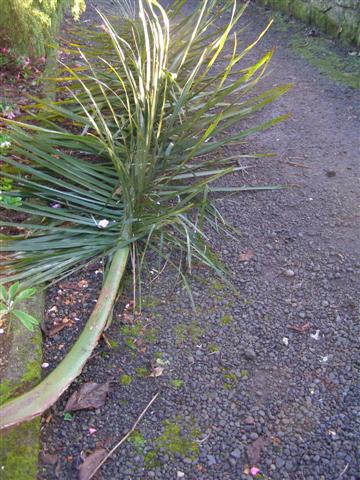
Falling from 20 metres, the fronds can be somewhat alarming.

plant experience to know what their selections are capable of when mature. Palms, you see, take up little space, are easy-care and wonderfully evocative of the warmer temperatures of the tropics so have been all the rage in urban gardens for some time now. As they keep reaching for the sky and growing in stature, the potential for falling fronds to cause damage increases – you certainly wouldn’t want your house spouting to be caught by a falling frond, let alone your car. But the average life expectancy of a garden plant in this country is, I have been told, a mere 10 years (before being chopped out and replaced by the latest fashion) so the chances of many palms reaching sufficient maturity to cause problems are not great.
Tikorangi Notes

Latest Posts:

1) July 23, 2010: The yellow Lachenalia reflexa midst English snowdrops – the delight of the early bulbs.

2) July 23, 2010: Recommended tasks for this week in the garden – our winters do not last long here.

3) July 23, 2010: Heucheras are a tried and true plant, readily available from every garden centre in an ever increasing colour range but they do need a little attention if the clumps are to grow larger, rather than smaller.

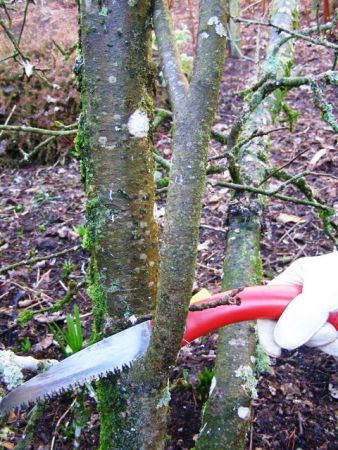
4) July 23, 2010: Outdoor Classroom – the hows and wherefores of long overdue pruning of elderly apple trees. Our step by step guide.

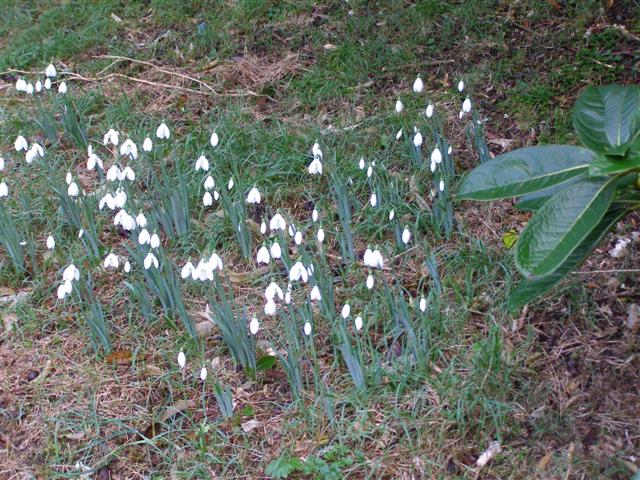
Naturalising the snowdrops takes some special efforts here. The rhododendron leaf belongs to a sino nuttallii

Tikorangi Notes: July 23, 2010

While there is considerable anticipation looking at the early magnolias laden with big, fat furry buds (sleeping bags for mice, our children used to describe the furry casings in years gone by), it is the tiny vision of the English snowdrops with which we are currently delighted. We can understand why these pretty, dainty little flowers give rise to such passion in dedicated collectors (are they called galanthophiles?) We are hardly good snowdrop territory here so we confine ourselves to the few varieties which will keep performing happily in our mild conditions. Managing to get some drifts established in a meadow situation is no mean feat. Meadows are not easy here. Our grass growth is so rampant we mow the lawns all year – weekly for most of it and fortnightly in the depths of winter when the growth slows. It is a bit much to expect bulbs or wildflowers to compete with such vigorous growth. In order to get this bank of bulbs started, Mark has had to discourage the stronger grasses and encourage a much slower growing, less competitive native microlina grass which won’t swamp the little treasures.

The galanthus only flower for a few weeks, but for that short time they are one of the most charming of all seasonal bulbs.

Winter pruning apple trees: step-by-step guide Abbie Jury and Colin Spicer

Apple trees benefit from a little attention in winter and in summer – easy care summer strategies for apples.

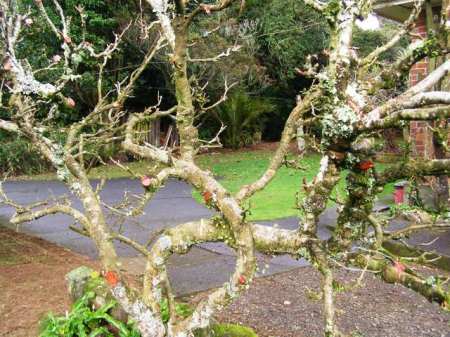
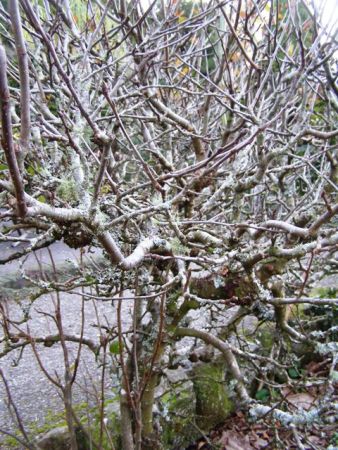
1) This dwarf apple tree has not has not had any attention other than a light haircut in winter and again in summer for many years. It is congested and overgrown and while it still fruits, the quality of the crop will improve in better conditions.

2) Select the branches which will give the tree its framework. Keep the main leader in the centre of the plant and choose branches which are well spaced to allow for air movement and maximum light. Remove all surplus growth not needed for this framework, including branches which cross each other. We are pruning for a tree which is more or less an espalier shape – two dimensional with height and width but little depth because it grows in a narrow border beside our driveway.

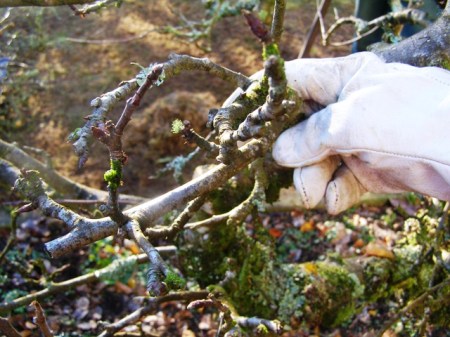
3) Now that the basic shape of the tree has been restored, thin out the clusters of fruiting spurs. Apples will continue to set fruit on old spurs for several years, but best results will be on growths from one to three years old. Where a spur is cut off, the plant will usually push out a fresh growth in spring.

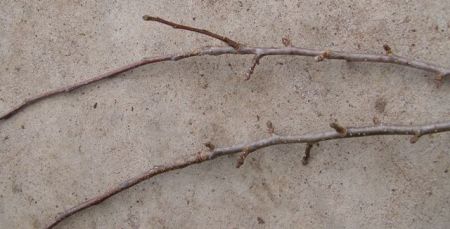
4) This shoot shows two years of growth. The lower half was new growth made in spring two years ago and the upper half is growth from last spring. You can see the fruiting spurs forming on the 2008 growth. These will flower and set fruit this year. If you make the mistake of always pruning by trimming off the long whippy new growths, you are cutting off all the fresh fruiting spurs. Try to get a mix of fresh spurs and already established spurs so that you are encouraging gradual replacement.

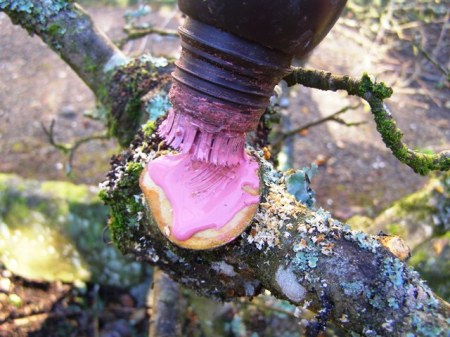
5) Sealing the cuts is optional but strongly recommended by our visiting pruning expert. He applies Bacseal which is an antibacterial sealant. Avoid getting this on your hands and always wait until you have finished all the pruning to avoid brushing wet surfaces with your skin or clothing.

6) A spray of lime sulphur will clean up the heavy lichen infestation. Follow up with a copper spray at winter strength in three weeks time to get the tree into a much healthier state. Follow the instructions on the containers for dilution rates for both sprays.

Tikorangi Notes: July 20, 2010

The first flowers of the season are opening on Magnolia campbellii

The first bud on Vulcan to show colour

Tikorangi Notes

Magnolia season is just starting. Of all the plant families we love, the ten weeks or so of deciduous magnolia flowering is the highlight each year. Magnolia campbellii in our park has opened its first few flowers. These flowers are quite some distance up from the ground. Vulcan is just opening the first red bud in the nursery but has yet to show colour on the trees in the garden. A few of Mark’s early season seedlings are opening and he is waging daily war on possums and rats which can attack the flower buds of plants, particularly those planted near our bush. Not to be left out, the earliest michelias are also opening the first flowers. This signals the time we re-open the garden to visitors at the start of August when the magnolias are really coming on stream.

Tikorangi notes: Friday 16 July

Latest posts
1) Early, frilly and fragrant – one of the first rhododendrons for this season is R. cubittii.
2) Exotic trees versus native plants – Abbie’s column (spare me from politically correct ignorance).
3) Cranberry update
4) In the garden – tasks for this week.

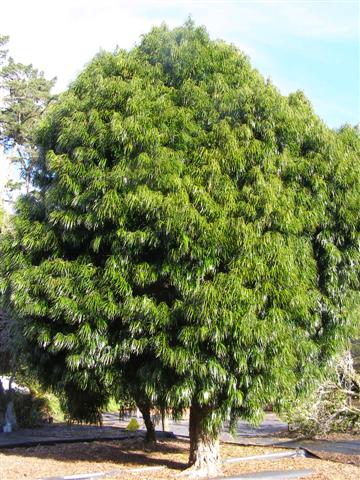
Our magnificent Podocarpus henkelii will see the nursery capillary beds surrounding it both come and go in its lifetime

Tikorangi update:
I was listening to a radio interview last weekend with Peter Arthur, a keen dendrologist and NZ’s foremost retailer of garden and plant books. In a country where it is currently quite difficult to sell any plant which is not a vegetable or a fruit tree, he was asked to predict what the next big gardening craze will be. He didn’t hesitate: trees. A return to trees.

I thought of Peter’s comment as I looked at a beautiful specimen of Podocarpus henkelii. When Mark established the nursery here, he worked around existing trees on site so we have tended to have obstacles – a citrus tree amongst the vireya rhododendrons with the overhead shade cloth cut around to fit, an eriobotrya in the hosta block – and this magnificent African podocarpus set amongst the capillary beds. Now the day has come, as we wind up the nursery, that the capillary beds will go and the P. henkelii will be accorded the status it deserves as part of a planned new garden. It will have to share the limelight with the planned Palm Walk but it has at least four decades on the palms and will no doubt retain its status as the senior plant in this new area for our lifetime. I hope Peter Arthur is right and we will see a wider appreciation of the magnificence of trees. A utility apple tree is not, I think, a match for our P. Henkelii.