Tag Archives: Tikorangi: The Jury garden

Countdown to Festival, July 9, 2010

At Paradiso in town, creative veg gardener, Denise Wood, thinks this may be her last year opening for Festival so is determined to make the most of it. She is preparing the ground now for sowing and planting as early as possible and her baskets in varied colours are coming along well. The new theme in her garden this year is pink flamingos but I don’t think we are talking real ones here. Denise donates all proceeds from her open garden to animal rescue.

I recall crowning Havenview’s Maree Rowe as the compost queen last year. She reports this week that she feels her life is compost, compost, compost, moving endless barrow loads of it around her fruit and vegetable plants. I think you can be pretty confident that she makes her own compost and it does not come in a heavy duty plastic bag from any garden retailer. She has just moved her chooks out of the second hot house where they had been happily scratching around, ridding it of bugs and pests while enriching it with their own contributions – she prides herself on good natural controls. Maree has now put in a layer of silage and compost and the house is ready for planting. She is also busy planting riparian plants along the areas of waterway on the farm and wishing the rain would stop for longer.

Around the coast, Vandys’ Maria van der Poel is highly motivated and out with her spade moving plants around. In fact, some have several rides in the wheelbarrow before she feels she has it right but the many clivias her sister in law gave her found a home immediately and filled a shaded area. They are such a convenient shade plant, are clivias, as long as you don’t have severe frosts. Maria is delighted at her new garden and storage shed, which freed her instantly from competition for space in the woodshed, and she is revelling in her new-found orderly storage. Next she is hoping that her new hot house is going to eventuate and make wintering over cuttings and germinating seed much easier. However, she is sad to see her favourite garden centre, The Girlz, closing down and says she will miss being able to pop in there on her way home down the coast.

At La Rosaleda, Coleen Peri is one of the first gardeners who are serious about their roses to report that she has completed the annual prune. In her own words: “… a fine day!!! Was out there and finished the rose pruning, such relief. This is always the time of year I question my sanity with having over 300 roses – I am battered, scratched and bruised, but satisfied! I tend to clear the bases of the roses and get rid of weeds in the immediate vicinity at the same time as pruning…. The larger roses are always the hardest – Sally Holmes is my nemesis this time of year, with 23 of them all along the pool fence, right at the back of the borders – I have to fight my way through the roses in front just to get to them, then manoeuvre myself amongst the very closely planted thugs – definitely not a task for the faint hearted. I used to really give them a good hard prune, but they have won the battle and now I prune fairly lightly just to keep them in check (size wise and to a nice shape), and to get rid of any significant dead wood. Oh well, come summer all will be forgiven!”

In Central Taranaki, Merleswood’s Erica Jago is feeling cheerful at the sight of spring bulbs appearing (her daffodil lawns are a feature) and with the shortest day now past, spring seems to be waiting in the wings. She spent a goodly part of June tackling her seventy metre hedge of the rugosa rose “Scabrosa”, pruning it and taking out all the dead wood. This was a much heavier prune and clean up than usual and she is delighted with the effect of freshening up the front garden and allowing views through to the mature rhododendrons behind. She comments that her snake bark maple, Acer Esk Flamingo is only now dropping the last of its autumn leaves and it has provided a spectacular autumn finale. This is a good example of how much better autumn colour is inland where the change in temperature is sharper. The Acer Esk Flamingo I can see out of my window is very pretty in spring but its autumn colour is non-existent in our milder, coastal conditions.

Here at Tikorangi, we have been enjoying a superior class of morning tea. Our neighbours, Chris and Lloyd, are doing food for our garden visitors during Festival weekends and Chris has been refining her recipe choices and trying them out on us. She is accomplished at baking and we think quite capable of holding her own in those ghastly TV competitions. The pumpkin and prune cake was particularly delicious though I also nurse fond memories of her Greek lemon cake which was a tour de force. I, alas, am not a good baker but at least we are an appreciative tasting panel.

Outdoor Classroom – Winter pruning Hydrangea macrophylla

The common hydrangeas grown here belong to the macrophylla family. These give us most of the traditional mop-tops along with the flat heads of many lace-cap varieties. Less common hydrangea species (the ones with oak leaves, cone flower heads, evergreens and the like) often have different pruning requirements.

1) It is not essential to prune hydrangeas. They will still flower if not pruned but you will usually get many small flowers on a bush which grows ever larger. Pruning takes place to keep the bush smaller and tidier and to encourage bigger blooms.

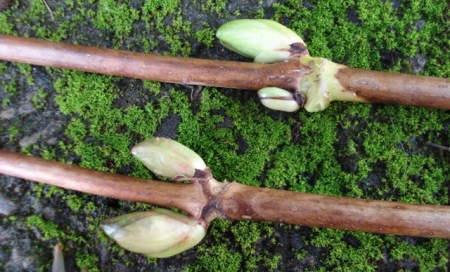
2) Most hydrangea stems will have a series of buds in pairs visible down their length. The fat buds are flower buds. The thin, small buds are leaf buds. Ideally you want pairs of fat buds, because that will be two flower heads but sometimes you find one fat bud paired with a small leaf bud. You will only get one flower from that spike.

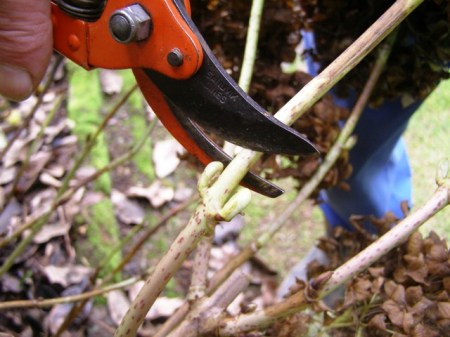
3) Using secateurs, prune back to the lowest pair of fat buds. If that is still much taller than you want, trim back to the lowest single fat bud.

4) After you have reduced the height of each stem, look at the clump and take out any really old, thick, woody stems and any spindly weak ones. You can also take out stems which are headed sideways and those with no flower buds if you want to keep your bush more compact.

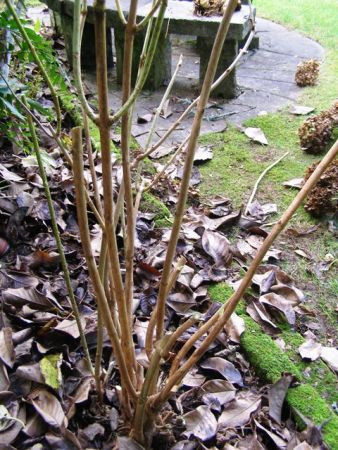
5) Because most hydrangeas flower on last year’s growth, if you cut too low down and without taking any account of the difference between leaf buds and flower buds, you will have cut all this summer’s flowers off. You can cut off near to ground level if you want to rejuvenate an old plant and it will shoot again but you will have to wait 18 months for flowers. We have pruned for flowers on this plant.

There are no shortcuts when it comes to notable trees in the landscape

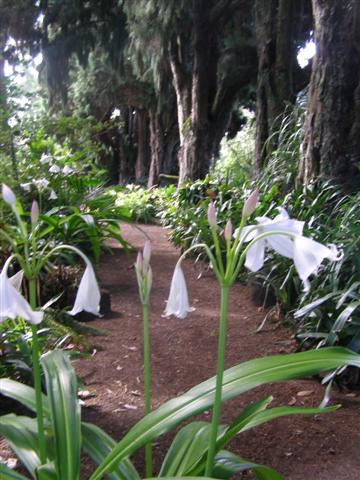
A great grandfather's legacy - the canopy of rimu trees planted in 1880 as a shelter belt.

A great grandfather's legacy - the canopy of rimu trees planted in 1880 as a shelter belt.

New Zealand is a windy country. It seems self evident but it wasn’t until I started travelling overseas that I realised that the wind we have learned to live with here is not the experience of many. But you just have to look at a map and see our long thin islands surrounded by vast bodies of ocean and it is hardly a surprise that we have on shore winds, off shore winds, winds from the south, the north, the east and the west. It is the norm and consequently shelter belts in rural areas are also part of our landscape. Australians have commented to me about the predominance of clipped hedging in our garden landscape too and a lot of that has to do with minimising wind.

Many readers will be aware that hedges and plants are better at dissipating the blast of wind than a solid barrier. Walls and fences can funnel the wind up and over, protecting only the area in the immediate lea of the barrier because the air then flows down again. Even then, you are only protecting for the height of the wall so any time a plant gets its head above, it catches the full blast.

But it is not hedging for urban gardens that I have been thinking about, rather the benefits of a bit of creative thinking and plantsmanship when it comes to utility shelter belts. Here we benefit greatly from the vision of Mark’s great grandfather when he settled here 130 years ago. Presumably Tikorangi had already been cleared of most of its native tawa forest cover because the first thing Thomas Jury did was to get in and plant some shelter from the prevailing winds. Those trees give us our stately garden avenues today and we have learned much from looking at them. The more spectacular is the rimu avenue, often likened by visitors to the effect of a vaulted cathedral ceiling. Now those trees give us an environment which is one of the most special areas of our garden – and as it has taken well over a century to reach this stature, it is not easily replicated.

Our other avenue comprises mere pine trees, but pines of huge grandaddy stature – towering over 40 metres high and a mixed blessing. At ground level they give us wonderful gnarled old trunks, again in rows because of course they started life as a shelter belt. Above is a little more problematic with falling pine cones and a few swinging branches but nobody has been injured so far. Both avenues continue to perform their initial function – they break the wind and shelter the garden.

How many of today’s shelter belts will still be around in another century? And how many are planted in trees with the potential to add significant impact to the landscape? Leightons Green, phebalium, nasty yellow conifers or pittosporumns … I don’t think so.

After 130 years, our Pinus muricata are somewhat more compact than the P. radiata windbreak trees of the same vintage.

After 130 years, our Pinus muricata are somewhat more compact than the P. radiata windbreak trees of the same vintage.

It is of course Arbor Day tomorrow and that is a good time to make some shelter belt resolutions. These wind breaks do not have to be 100% cheap, utility and uniform. Dropping it to 90% cheap, utility and uniform is fine and there is the opportunity to use these shorter term plants of little or no aesthetic value to act as nurse trees for the long term landscape trees. For who will plant the rimu, totara, araucaria (Norfolk Island pines, monkey puzzle and the like, along with our own kauri), picea, abies, tawa, beech, oaks and other splendid trees with the potential for stature and longevity? As the size of town sections grows ever smaller, the need to continue planting potentially large trees in positions where they have the opportunity to reach maturity becomes correspondingly more important. Owners of lifestyle blocks have a chance to make a significant long term contribution and leave a worthwhile legacy if they just plant some decent trees. It is all very well thinking farmers should do it. Some do, but you can’t just plant trees in paddocks which are grazed. Trees have to be fenced off and that is very expensive and fiddly on a large scale. By their very nature, shelter belts are double fenced and planting is the easy part.

When it came to our own roadside shelter belts some fifteen years ago, Mark went for the mixed and layered approach. Quick, cheap cover came from expendable alders. Long term landscape trees are mostly kauri, rimu and totara, planted perhaps for our grandchildren and great grandchildren. Then, because we don’t have to buy the plants, seasonal impact has been added with magnolias – both showy deciduous types and larger growing evergreen michelias. The final layer is the roadside camellias – larger growing varieties surplus to garden requirements. They are a bit of a seasonal statement, some of our shelter belts, but also practical and planted with an eye to the long term future.

Many years ago, I wrote a column advocating that every person should plant at least one good, long term, landscape tree in a position where it has the chance to reach maturity. I recall two responses. The first was: “What, only one?” Fortunately a few will plant many but that only compensates for some of those people who will never, ever plant a decent tree in their entire lifetime. The second person castigated me for being too honest about how large a large tree will eventually grow. “We will never sell any if people know how big they can get,” she said.

In my books, landscape trees are large, handsome and long lived. These are not to be confused with pretty but low-grade, short term, quick impact trees favoured in most home gardens – the Albizia julibrissin, flowering cherries, robinias and their ilk. As a general rule, fruit trees will never make a landscape tree either. By definition, any plant with the telltale words compact or dwarf in the description will lack stature.

Our country is still somewhat raw and utility in our approach to trees. To many farmers, they are a waste of valuable grazing space and they get in the way of machinery in this heady world of high production but green desert farming. To many town dwellers, they block views and are messy. In a country with a tendency to cold houses, the shadow they cast is another black mark. Any tree of stature is measured in terms of timber potential, not landscape value. Compare that to the pride taken in the UK with their champion trees – those specimens judged to be the largest of their type in the country and awarded accordingly and in Europe where trees of ancient pedigree are venerated. I have seen the plane tree, now some 2500 years and definitely ailing, beneath which Hippocrates apparently sat to write the Hippocratic Oath. We have a long way to go yet here. Arbor Day would be a good place to start.

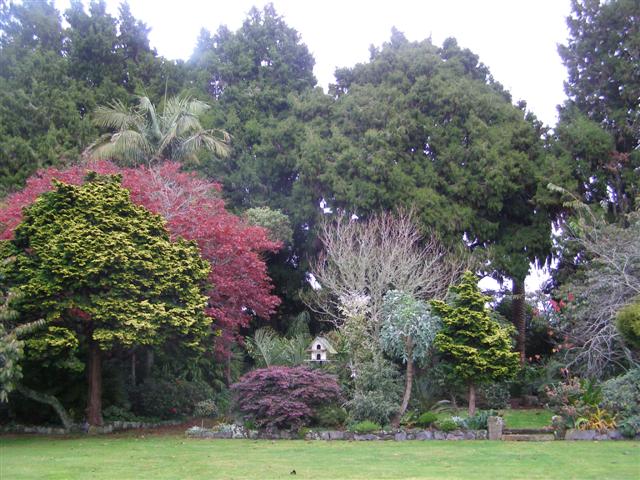
Rimu trees from 1880 in the background, mixed plantings from 1950 to now in the middle ground

Rimu trees from 1880 in the background, mixed plantings from 1950 to now in the middle ground

Tikorangi Notes: 28 May, 2010

Latest posts:
1) 28 May, 2010: The banana crop of 2010 revealed but really about our recommended tasks in the garden this week.
2) 28 May, 2010: The wonderful lemon fragrance of Backhousia citriodora.
3) 28 May, 2010: More about bananas – our Outdoor Classroom on thinning to get better crops.
4) 28 May 2010: The burgundy coloured loropetalums, China Pink in our case, are a splendid additon to our gardens here.
5) 26 May, 2010: The story of Cordyline Red Fountain.

The persimmon in autumn is more about looks than taste, for us at least

The persimmon in autumn is more about looks than taste, for us at least

As autumn morphs into winter here (to paraphrase our inimitable television weather presenter), we seem to be doing the Squirrel Nutkin impersonation and following a food theme. We aim to be self sufficient in vegetables and most fruit – I say aim, some years we get closer than others. But with only two of us left at home these days, I don’t have to resort to buying much fresh produce at all.

One of the edible crops we grow which we rarely eat ourselves is the highly ornamental persimmon which looks fantastically decorative in the autumn. This is an elderly astringent variety which means one needs to wait until it so ripe it is nearly rotting before it becomes palatable. Even at that stage, I only like the jelly-like segments at the very centre and find the outer flesh rather clarty and sticky. I am sure it would make an excellent gelato, icecream or granita but none of these appeal in the chill of late autumn. It is possible to buy non-astringent fruit and plants which can apparently be eaten crisp, like an apple, but I have yet to bring myself to buy one when we have all these going to waste at home. Except that they are not really going to waste because they bring us a great deal of pleasure over many weeks just adorning the bare branches of the tree.

Pruning a rampant climber: step-by-step with Abbie and Mark Jury

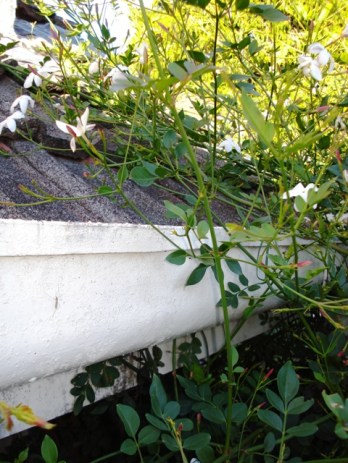
1) This climber has gone well past the point where a light trim will suffice and allow more light in the window behind. However, we don’t want to dig it out and cutting it off at the ground is likely to kill it. This is an ornamental jasmine (not the dangerously rampant variety) and we like the fragrance.

2)The tendrils going over and under the spouting, and even worse, under the roof tiles are a warning that action needs to be taken now. Looking into the mass of vines, you can see that the downpipe is under threat and also that the plant is putting out new growth from the middle and not just on top.

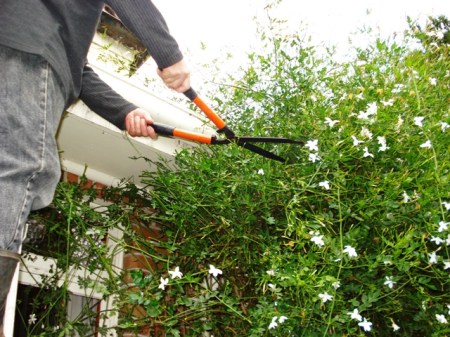
3) Cut back the foliage hard. We are aiming for a curved shape around the corner of the house. It is easier to work out which vines to keep when you can see where each one is headed. You can use a chainsaw for the initial shaping and follow up with clippers and secateurs to tidy up the rough cuts.

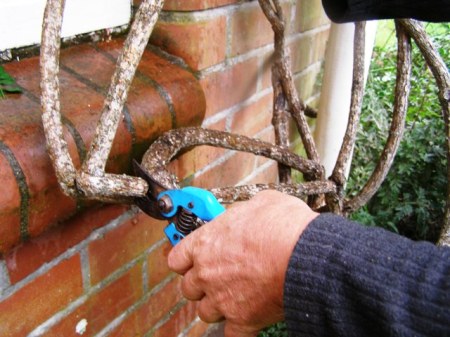
4) Trace the path taken by the vines and remove unwanted stems in sections. If you try and pull it out in long lengths, you run the risk of damaging the growths you want to keep. We are trying to protect the house and to allow the window to be opened so we are thinning extensively. More frequent pruning would have avoided this.

5) Thin out clutter and remove all dead wood.

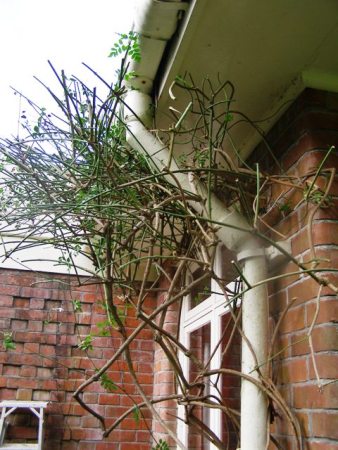
6) The finished product looks shorn and a shadow of its former self but should grow away strongly. In our mild and soft climate, we can do this type of cutting any time of the year but gardeners in cold, inland areas may wish to wait until late winter or early spring, timed for just before the plant will put on its first flush of new season’s growth.

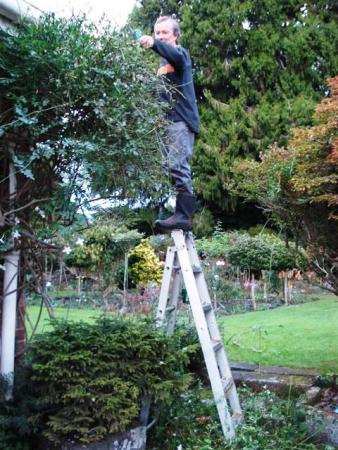
7) This is the photo that we did not use in the newspaper when this feature first ran – not perhaps the best advertisement for safe practice (though Mark asserts that he was holding on tightly with the hand which is out of sight…).