Tag Archives: Tikorangi: The Jury garden

Tikorangi notes: April 16, 2010

Latest posts:
1) April 16, 2010 There are times we have regretted letting our purple bougainvillea reach its natural massive proportions but it is a splendid sight in flower.
2) April 16, 2010 There are no like for like replacements for the ever handy (if a little dull and clichéd) buxus hedge.3) April 16, 2010 Making the most of mild autumn conditions in the garden – what to do in the Taranaki garden this week.
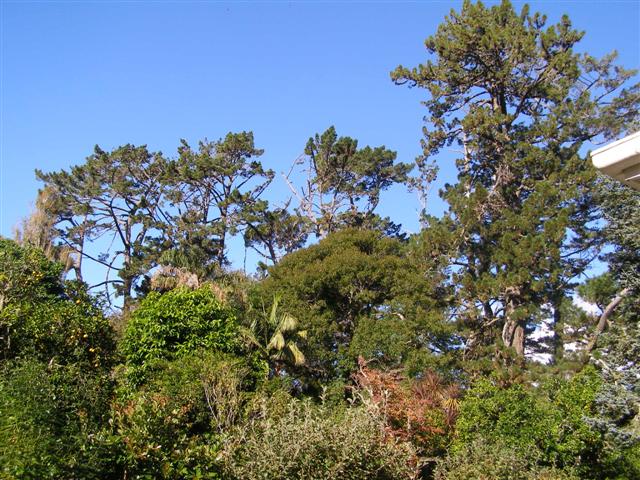
Our venerable old man pines against the blue sky of autumn

The common reaction from New Zealanders to our massive, but elderly pine trees is that we should be taking them out immediately because they are dangerous but we are fond of their scruffy majesty on our south eastern skyline. Planted in a double row around 1880 by Mark’s great grandfather, they were originally a shelter belt and will rank amongst the oldest specimens in the country. Californians are often impressed because these Monterey pines tower around 50 metres or over 150 feet high which we are told is unusual for their homeland on the Monterey Peninsula.
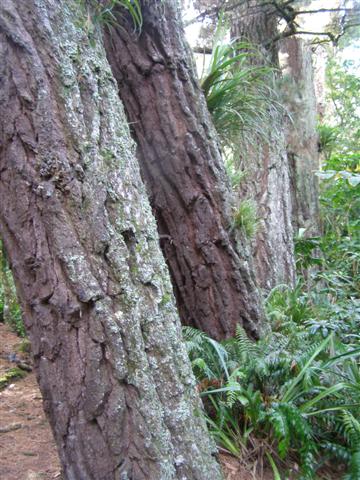
Our Monterey pines - not all are exactly at right angles to the ground

But to New Zealanders, they are just crusty old Pinus radiata, a cultivar the timber industry has made our own as a very quick turn around, low grade timber crop covering vast acreages.

Occasionally we lose a pine tree – running about once every fifteen years at the moment – and the last one dropped itself in the one clear space that we would have chosen had we deliberately felled it, doing minimal damage as it crashed down but gouging out a 30cm deep indentation on the ground. Because they started life as a shelter belt and are planted in more or less straight rows, they now give us a woodland avenue below to grow frost tender material such as vireya rhododendrons, cymbidium orchids, monstera delicosa and a range of woodland bulbs. Such is their location, they would have to removed by logging helicopter but we are happy to live with them as a characterful backdrop.
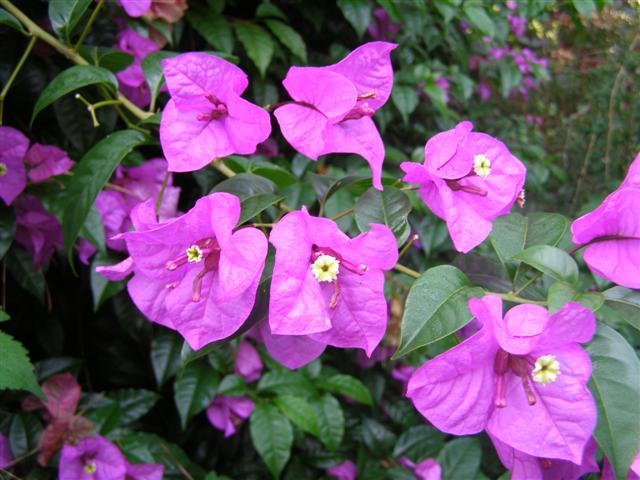
Flowering this week – our rather rampant bougainvillea

Decidedly rampant, extremely spiny but quite spectacular - the bougainvillea

Decidedly rampant, extremely spiny but quite spectacular - the bougainvillea

Not, as we assumed, originating in the Bougainville Islands, but named for the French explorer, Louis Antoine de Bougainville and hailing from South America. We think this form is glabra, from Brazil. There is nothing rare about these scrambling climbers and they are appreciated throughout the temperate and tropical world for their display which can be all year round in latitudes close to the Equator. Here they peak in summer to autumn. It is not the insignificant flowers that make the show but the coloured bracts which surround the flowers and hang on for a long time. The colours range from the royal purple of this variety through cerise, red, pink, lilac, orange, gold and white. Left to their own devices , these can be formidable plants. Ours smothered a dead tree to around ten or fifteen metres high, and a little shy of that figure in both width and depth until the host tree rotted and fell over bringing down most of the bougainvillea with it. It then became a major mission because one of the other characteristics of this genus is its many sharp thorns.

Most of what are sold now are hybrids and they are not left to their own wayward habits as we have done. They are easy enough to trim and shape when small, sometimes trained as standards. We saw some really interested topiary specimens in Bali where three different colours had been grafted onto one stem and then trained to shape as a curious container plant. They are also recommended for hedging and with their thorny ways, they may be just the ticket to deter burglars in crime-prone areas with a mild climate.

Tikorangi notes: April 6, 2010

Latest posts:

1) April 1, 2010 Garden tasks for the week, from buying bargain woody trees and shrubs from last season to autumn harvests.

2) April 1, 2010 Trimming and clipping formal hedges, our latest Outdoor Classroom. There is no doubt if you are going to have the sharp definition of a formal hedge, it might as well be done properly. We can’t do the traditional English yew in our climate – we have too high a rainfall and they get phytophthora and tend to die young.

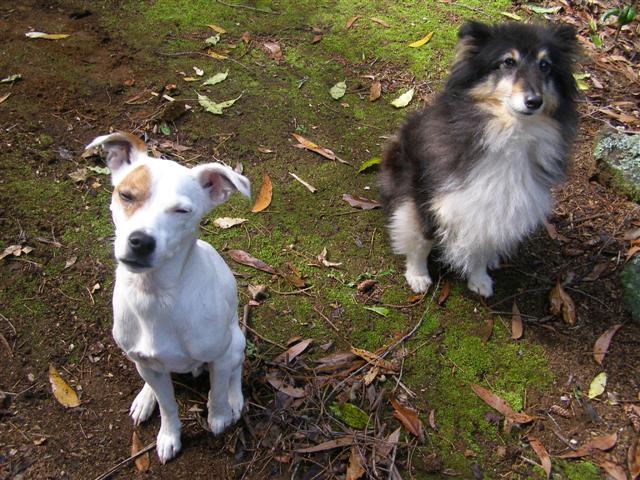
Spike, to the left, ate the Easter bunny. Zephyr would have but he is no match for the speedy Spike

Easter has been and gone. Alas, few Easter eggs here as Spike ate the Easter bunny. Buffa the cat has probably eaten a fair number of the Easter bunny’s brothers and sisters too. We are dealing with a rabbit explosion and would have preferred the early settlers from Britain to have left the rabbits back in their homeland rather than introducing them to this country back in the 1800s. We would have been better off had they also left the possum in Australia. While on the subject, one wishes they had spent the long voyage at sea ridding the plants of the slugs and snails that hitched a ride.

Our autumns tend to be long and mild here, drifting slowly from summer to winter, which makes for brilliant gardening conditions.

Awaiting the mulcher machine, nikau palm to the fore.

The latest project is redeveloping an area of woodland. Most large gardens have messy patches – the areas one walks through quickly with eyes averted but I could no longer ignore this particular area. Lots of lifting and limbing and the removal of surplus plants have allowed more light in, the rediscovery of lines long blurred by too much growth and a feeling of open space again. The piles for the mulcher (chipper) have been prodigious and even the occasional nikau palm (Rhopalostylis sapida) has been sacrificed. This may seem too much for those who treasure the world’s southernmost palm, but they self seed freely here and while very beautiful, there is a limit to how many we need in the garden. Similarly the tree ferns, known here as pongas, seed all round the place and are often removed with the chainsaw. Having seen these greatly prized in Italian and English gardens, we are always a little amused that they are taken completely for granted in this country.

Tikorangi Notes: March 19, 2010

Latest posts:
1) March 19, 2010: The simple purity of Lapageria alba and praise for the Chilean climbers which are almost never without a flower for us.
2) March 19, 2010: Outdoor Classroom on lifting and limbing – aka: a little bit of judicious pruning can make a significant difference.
3) March 19, 2010: In the Taranaki garden this week : With autumn approaching rapidly, we offer advice on garden tasks for the week ahead, including our usual plug for green crops and compost, along with advice on using animal manures.

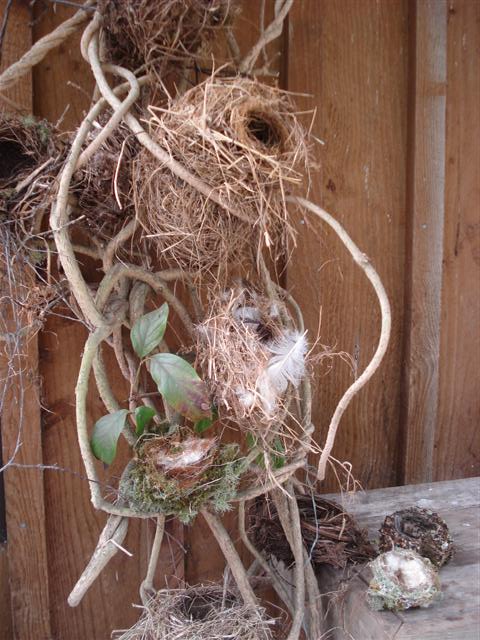
The growing collection of birds's nests

The growing collection of birds's nests

We have recently started a little collection of birds’ nests here and Mark is regretting that he did not start recording his observations years ago so he could chart the changing materials our feathered garden inhabitants have used over the years. While we try and minimise litter here, it is frankly alarming to see the number of Tuflok labels, plastic ties and budding strips that the birds find to line their nests. They are also stripping the threads of fibreglass from a clear roof here. I was particularly taken by the little chaffinch nest constructed from dried grass and lichen and lined in what looks like dog fur (I did trim our long haired sheltie for summer) but which Mark disappointed me by telling me was in fact the fibrous thread from our tree ferns (pongas). We have been bringing in the abandoned nests we find in good condition and arraying them under cover up the vinous stems of Tecomanthe venusta.

Lifting & limbing – the before and after of careful pruning

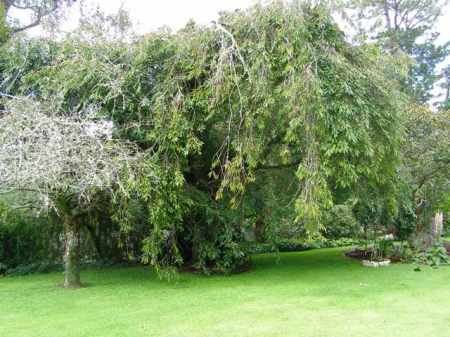
1) This garden aspect is generally all right but you would not look twice at it. The large tree is a weeping cherry, Prunus subhirtella pendula. The fact that the left hand tree, a malus or flowering crabapple, has no leaves on it in high summer is a bit of a giveaway. It is dead.

2) The malus is showing fresh growth at its base but as we knew it was a grafted plant, this is just the root stock growing away.

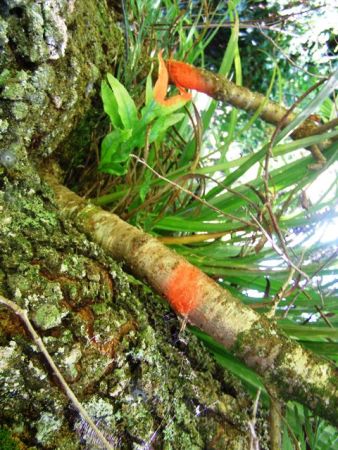
3) Spend some time working out which branches need to be removed. You can’t glue branches back on and it is surprisingly easy to make a mistake. We are taking off the lower branches and a few higher ones which extend too far over the adjacent gardens. We used a squirt of paint to mark the branches destined for the chop.

4) Make an initial cut underneath the branch. This prevents the branch from ripping off and damaging the bark when you cut from above.

5) Cut close to the trunk or main stems. Don’t leave ugly stumps which resemble protruding coat hooks. There are different schools of thought about whether wounds need to be painted with an antibacterial paint. In this case we have coated the wounds but we don’t usually bother.

6) The dead malus has been removed entirely, even the main stump. If you can get most of the root ball out, it reduces the chance of honey fungus or armillaria getting established on the rotting roots and potentially spreading to surrounding trees. The cherry tree now has a more pleasing shape and it is possible to see beyond the tree and to notice other garden features in the same view. Successful pruning is often discreet – quite a bit of material is removed without it being obvious where it has come from.